2011 MERCEDES-BENZ C-Class auto hold
[x] Cancel search: auto holdPage 8 of 320

Child-proof locksRear doors ....................................... 60
Children
In the vehicle ................................... 55
Restraint systems ............................ 56
Child seat
Automatic recognition .....................46
Automatic recognition/air bag
deactivation, self-test ......................48
Display message ............................ 185
LATCH-type (ISOFIX ) child seat
anchors ............................................ 58
Special seat belt retractor ...............58
Top Tether ....................................... 59
Troubleshooting ............................... 49
Cigarette lighter ................................ 224
Classification system for
occupants (OCS) Faults ............................................... 45
Operation ......................................... 41
System self-test ............................... 44
Climate control
Activating/deactivating .................122
Activating/deactivating air-
recirculation mode .........................125
Controlling automatically ...............123
Cooling with air dehumidification ..122
Defrosting the windshield ..............124
Demisting the windows .................. 125
Dual-zone automatic climate
control ........................................... 121
Important safety information .........120
Indicator lamp ................................ 123
Maximum cooling .......................... 124
Problems with "cooling with air
dehumidification" ........................... 123
Problems with the rear window
heating .......................................... 125
Refrigerant ..................................... 309
Setting the air distribution .............123
Setting the airflow .........................124
Setting the air vents ......................126
Setting the temperature ................123
Switching the MONO function on/
off .................................................. 124
Switching the rear window
heating on/off ............................... 125
Clock (on-board computer) ............... 179Cockpit ................................................. 25
Combination switch .......................... 108
Compass ............................................ 235
Consumption statistics (on-board
computer) .......................................... 170
Convenience closing feature .............. 84
Convenience opening feature ............ 84
Coolant (engine) Checking the level .........................240
Display message ............................ 194
Notes ............................................. 310
Temperature (on-board computer) . 171
Temperature gauge ........................ 166
Warning lamp ................................. 210
Cooling
see Climate control
Cornering light (display message) ... 191
Crash-responsive emergency
lighting ............................................... 111
Cruise control Cruise control lever .......................156
Display message ............................ 197
Function/notes ............................. 156
Cup holder ......................................... 220
Center console .............................. 221
Rear compartment .........................221
Current fuel consumption (on-
board computer) ............................... 170
Customer Assistance Center (CAC) ............................................... 21
Customer Relations Department ....... 21
D
Dashboard see Cockpit
Date (on-board computer) ................ 179
Daytime running lamps Display message ............................ 194
Switching on/off (on-board
computer) ...................................... 180
Delayed switch-off
Exterior lighting (on-board
computer) ...................................... 180
Interior lighting (on-board
computer) ...................................... 180
Digital speedometer ......................... 171
Display (cleaning instructions) ........ 247
6IndexBA 204 USA, CA Edition A 2011; 1; 5, en-UShereepeVersion: 3.0.3.62010-05-20T09:17:30+02:00 - Seite 6
Page 9 of 320

Display messagesBrakes ........................................... 189
Calling up (on-board computer) .....183
Clearing (on-board computer) ........183
Driving systems ............................. 197
Engine ............................................ 194
KEYLESS-GO .................................. 202
Lamps ............................................ 191
Safety systems .............................. 184
Service interval display ..................242
SmartKey ....................................... 201
Tires ............................................... 197
Vehicle ........................................... 200
Distance recorder ............................. 170
Door Automatic locking ............................ 78
Automatic locking (on-board
computer) ...................................... 181
Display message ............................ 201
Emergency locking ........................... 79
Emergency unlocking .......................79
Opening (from inside) ......................78
Door control panel
Overview .......................................... 31
Doors
Important safety notes ....................77
Drinking and driving ......................... 151
Drinks holder see Cup holder
Drive program
Automatic ...................................... 141
Manual ........................................... 142
SETUP (on-board computer) ..........171
Drive program display ...................... 139
Driving abroad ................................... 155
Driving on flooded roads .................. 154
Driving safety system EBD (Electronic Brake force
Distribution) ..................................... 66
ESP ®
(Electronic Stability
Program) .......................................... 63
ETS/4ETS (Electronic Traction
System) ........................................... 63
Important safety information ...........61
Driving safety systems
ABS (Anti-lock Braking System) .......62
ADAPTIVE BRAKE ............................. 66BAS (Brake Assist System) ..............62
Overview .......................................... 61
Driving systems
Cruise control ................................ 156
Dynamic handling package with
sports mode .................................. 158
PARKTRONIC ................................. 159
Rear view camera .......................... 162
Driving tips ........................................ 139
Braking .......................................... 153
Downhill gradients .........................152
Driving on flooded roads ................154
Wet road surface ........................... 152
Winter ............................................ 155
DVD audio (on-board computer) ...... 175
Dynamic handling package with
sports mode ....................................... 158
E
EASY-ENTRY feature ............................ 99
Activating/deactivating (on-
board computer) ............................ 181
EASY-EXIT feature ............................... 99
Activating/deactivating (on-
board computer) ............................ 181
Crash-responsive ............................. 99
EBD (Electronic Brake force
Distribution) Display message ............................ 190
Function/notes ................................ 66
Electrical fuses
see Fuses
Electronic Brake force
see EBD
Electronic Stability Program
see ESP ®
Electronic Traction System
see ETS/4ETS
Emergency call
see mbrace
Emergency release
Fuel filler flap ................................. 146
Trunk ............................................... 82
Vehicle ............................................. 79
Emergency running mode
Automatic transmission .................144
Index7BA 204 USA, CA Edition A 2011; 1; 5, en-UShereepeVersion: 3.0.3.62010-05-20T09:17:30+02:00 - Seite 7
Page 39 of 320

impact air bag inflates. This could result in
serious injuries or death should the side
impact air bag be deployed. Always sit as
upright as possible, wear the seat belt
properly and use an appropriately sized
child restraint, infant restraint or booster
seat recommended for the size and weight
of the child.
R Canada only: children under 12 years may
only sit in the front-passenger seat if they
are seated in a child restraint system which
is compatible with BabySmart™ and
approved by Mercedes-Benz. If the child
restraint system is installed properly, the
front-passenger front air bag is deactivated
in conjunction with the BabySmart™
system installed in the vehicle. Otherwise,
the child could be struck by the air bag
when it inflates in a crash. This could lead
to serious or fatal injuries.
Failure to follow these instructions can result
in severe injuries to you or other occupants.
If you sell your vehicle, it is important that you
make the buyer aware of this safety
information. Be sure to give the buyer this
Operator's Manual.GWarning
Accident research shows that the safest place
for children in an automobile is in a rear seat.
A side impact air bag related injury may occur
if occupants, especially children, are not
properly seated or restrained when next to a
side impact air bag which needs to deploy
rapidly in a side impact in order to do its job.
To help avoid the possibility of injury, please
follow these guidelines:
(1)Always sit as upright as possible
and use the seat belts properly.
Make sure that children 12 years
old and under use an appropriately
sized child restraint, infant
restraint, or booster seat
recommended for the size and
weight of the child.(2)Always wear seat belts properly.The air bags are only deployed if the airbag
control unit detects the need for deployment.
Only in the event of such a situation will they
provide their supplemental protection.
The driver and passenger should always wear
their seat belts. Otherwise, it is not possible
for the air bags to provide their supplemental
protection.
In the event of other types of impacts and
impacts below air bag deployment
thresholds, air bags will not deploy. The driver
and passengers will then be protected to the
extent possible by a properly fastened seat
belt. A properly fastened seat belt is also
needed to provide the best possible
protection in a rollover.
Air bags offer supplemental protection but
are not a substitute for seat belts. All vehicle
occupants must fasten their seat belts
regardless of whether your vehicle is
equipped with airbags or not.
It is important for your safety and that of your
passenger to have deployed air bags replaced
and to have any malfunctioning air bags
repaired. This will help to make sure the air
bags continue to perform their protective
function for the vehicle occupants in the
event of a crash.
Front air bagsGWarning
Observe "Important safety notes"
( Y page 36).
The front air bags increase protection for the
driver's and front-passenger's head and
chest.
Occupant safety37SafetyBA 204 USA, CA Edition A 2011; 1; 5, en-UShereepeVersion: 3.0.3.62010-05-20T09:17:30+02:00 - Seite 37Z
Page 43 of 320

Window curtain air bags : are deployed:
Ron the side on which an impact occurs
Rat the start of an accident with a high rate
of lateral vehicle deceleration or
acceleration, e.g. in a side impact
Rregardless of whether the front-passenger
seat is occupied
Rindependently of seat belt use
Rindependently of the front air bags
Window curtain air bags : will not deploy in
impacts with deceleration rates which do not
exceed the system’s preset deployment
thresholds for vehicle deceleration or
acceleration. You will then be protected by
the seat belt.
Occupant classification system (OCS)
How the Occupant Classification
System works
The Occupant Classification System (OCS) is
standard equipment in the USA.
OCS categorizes the occupant on the front-
passenger seat by means of a weight sensor.
The front-passenger front air bag is
automatically deactivated for certain weight
categories. The respective status can be
recognized by the 45 indicator lamp.
With the 45 indicator lamp
illuminated, the front-passenger front air bag
is deactivated.
The system does not deactivate:
Rthe side impact air bag
Rthe pelvis air bag
Rthe window curtain air bag
Rthe Emergency Tensioning Devices
To be classified correctly, the front passenger
must sit:
Rwith the seat belt properly fastened
Rin a position that is as upright as possible
with the back against the seat backrest
Rwith their feet on the floor
If the front-passenger's weight is transferred
to another object in the vehicle (e.g. by
leaning on armrests), OCS may not be able to
approximate the occupant's weight category.
If the front passenger seat, the seat cover, or
the seat cushion are damaged, have the
necessary repair work carried out at an
authorized Mercedes-Benz Center.
For reasons of safety, Mercedes-Benz
recommends that you only use seat
accessories that have been approved by
Mercedes-Benz.
Both the driver and the front passenger
should observe the 45 indicator lamp
to determine whether or not the front
passenger is positioned correctly.
GWarning
If the 45 indicator lamp illuminates
when an adult or someone larger than a small
individual is in the front passenger seat, have
the front passenger reposition himself or
herself in the seat until the 45
indicator lamp goes out.
In the event of a collision, the air bag control
unit will not allow front passenger front air bag
deployment when the OCS has classified the
front passenger seat occupant as weighing as
much as or less than a typical 12-month-old
child in a standard child restraint or if the front
passenger seat is classified as being empty.
When the OCS senses that the front
passenger seat occupant is classified as
being up to or less than the weight of a typical
Occupant safety41SafetyBA 204 USA, CA Edition A 2011; 1; 5, en-UShereepeVersion: 3.0.3.62010-05-20T09:17:30+02:00 - Seite 41Z
Page 74 of 320

This may impair the functioning of KEYLESS-
GO.
RTo open or close the vehicle, the KEYLESS-
GO key should be no more than 3 ft (1 m)
from the door or trunk.
RWhen the vehicle is parked for more than
72 hours, the KEYLESS-GO function is
deactivated. Pull one of the outer door
handles and turn on the ignition to
reactivate the KEYLESS-GO function.
RIf the KEYLESS-GO key is not near the
vehicle, it is possible that the system may
not recognize it. In this case, the vehicle
cannot be locked or started with KEYLESS-
GO.
RIf the KEYLESS-GO key has been removed
from the vehicle (e.g. if a passenger leaves
the vehicle with the KEYLESS-GO key):
-while someone is holding the Start/Stop
button or attempting to lock the vehicle
with the outer door handle, the message
Key not detected appears in the
multifunction display
-while the engine is running, the red
message Key not detected appears in
the multifunction display as you pull
away. Find the KEYLESS-GO key or
change its current position immediately
(e.g. place it on the front-passenger seat
or carry it in your shirt pocket.)
RIf you have started the engine using the
Start/Stop button, you can turn if off again
by:
-pressing the Start/Stop button again
-inserting the KEYLESS-GO key in the
ignition lock when the vehicle is
stationary and the automatic
transmission is in parking position P.
RYou may accidentally unlock the vehicle if
the KEYLESS-GO key is within 3 ft (1 m) of
the vehicle and:
-an outer door handle comes into contact
with water
or
-you are cleaning an outer door handle.
RNote that the engine can be started by any
vehicle occupant if a KEYLESS-GO key is in
the vehicle.
Option 1: there is a KEYLESS-GO key in the
vehicle and a KEYLESS-GO key outside the
vehicle. If you leave the KEYLESS-GO key
behind when you get out and lock the
vehicle, a message does not appear in the
multifunction display.
Option 2: there is a KEYLESS-GO key in the
vehicle but no KEYLESS-GO key outside the
vehicle. When you get out and try to lock
the vehicle, the message Key still in
vehicle appears in the multifunction
display. The vehicle is not locked in this
case.
When starting the engine and while driving,
KEYLESS-GO also checks whether a valid key
is in the vehicle by periodically establishing
radio contact.
X To unlock the vehicle: touch the inner
surface of the door handle.
XTo lock the vehicle: touch sensor
surface :.
XConvenience closing feature: touch
sensor surface ; for an extended period
(Y page 84).
If you pull on the handle of the trunk lid, only
the trunk/cargo area of the vehicle is
unlocked.
72SmartKeyOpening and closing
BA 204 USA, CA Edition A 2011; 1; 5, en-UShereepeVersion: 3.0.3.62010-05-20T09:17:30+02:00 - Seite 72
Page 81 of 320
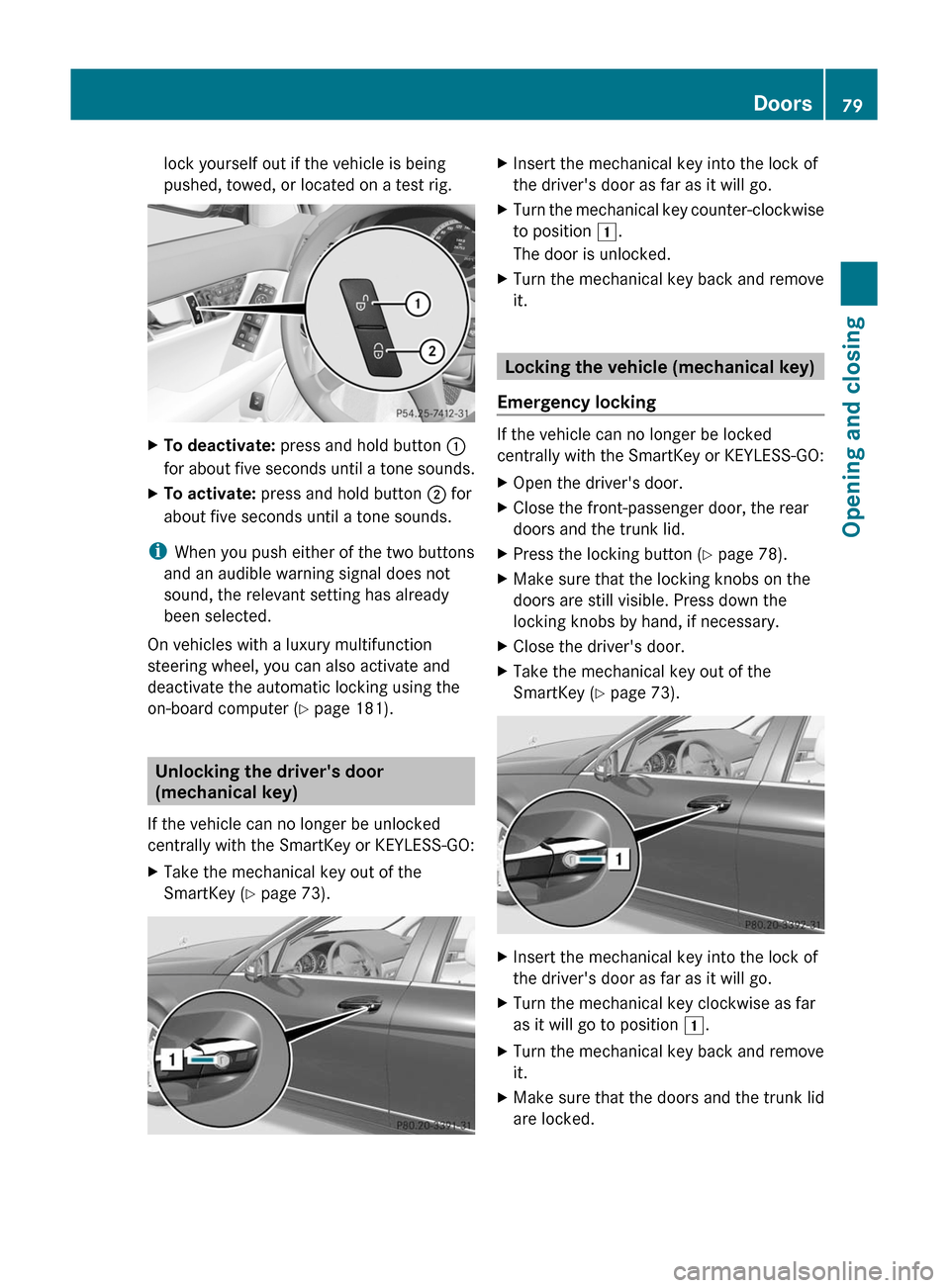
lock yourself out if the vehicle is being
pushed, towed, or located on a test rig.
XTo deactivate: press and hold button :
for about five seconds until a tone sounds.
XTo activate: press and hold button ; for
about five seconds until a tone sounds.
iWhen you push either of the two buttons
and an audible warning signal does not
sound, the relevant setting has already
been selected.
On vehicles with a luxury multifunction
steering wheel, you can also activate and
deactivate the automatic locking using the
on-board computer (Y page 181).
Unlocking the driver's door
(mechanical key)
If the vehicle can no longer be unlocked
centrally with the SmartKey or KEYLESS-GO:
XTake the mechanical key out of the
SmartKey (Y page 73).
XInsert the mechanical key into the lock of
the driver's door as far as it will go.
XTurn the mechanical key counter-clockwise
to position 1.
The door is unlocked.
XTurn the mechanical key back and remove
it.
Locking the vehicle (mechanical key)
Emergency locking
If the vehicle can no longer be locked
centrally with the SmartKey or KEYLESS-GO:
XOpen the driver's door.XClose the front-passenger door, the rear
doors and the trunk lid.
XPress the locking button (Y page 78).XMake sure that the locking knobs on the
doors are still visible. Press down the
locking knobs by hand, if necessary.
XClose the driver's door.XTake the mechanical key out of the
SmartKey (Y page 73).
XInsert the mechanical key into the lock of
the driver's door as far as it will go.
XTurn the mechanical key clockwise as far
as it will go to position 1.
XTurn the mechanical key back and remove
it.
XMake sure that the doors and the trunk lid
are locked.
Doors79Opening and closingBA 204 USA, CA Edition A 2011; 1; 5, en-UShereepeVersion: 3.0.3.62010-05-20T09:17:30+02:00 - Seite 79Z
Page 83 of 320

XPull handle :.XRaise the trunk lid.
Closing
GWarning
To prevent possible personal injury, always
keep hands and fingers away from the trunk
opening when closing the trunk lid. Be
especially careful when small children are
around.
XPull the trunk lid down using recess :.XLock the vehicle if necessary with
the & button on the SmartKey or with
KEYLESS-GO ( Y page 71).
Automatic opening and closing from
the outside
Important safety guidelines
GWarning
Make sure the trunk lid is closed when the
engine is running and while driving. Among
other dangers, deadly carbon monoxide (CO)
gases may enter the vehicle interior resulting
in unconsciousness and death.
! The trunk lid swings upwards when
opened. Therefore, make sure that there is
sufficient clearance above the trunk lid.
For the trunk lid to be opened fully, there must
be a minimum clearance from floor to ceiling
of 5.90 ft (1.80 m).
Opening
You can open the trunk lid automatically
using the SmartKey or the handle in the trunk
lid.
XPress and hold the F button on the
SmartKey until the trunk lid opens.
or
XWhen the trunk is unlocked, pull on the
trunk lid handle and let it go again
immediately.
Closing
i If you leave a KEYLESS-GO key in the
trunk, the trunk lid will not lock.
Opening automatically from the
inside
GWarning
Make sure the trunk lid is closed when the
engine is running and while driving. Among
other dangers, deadly carbon monoxide (CO)
gases may enter the vehicle interior resulting
in unconsciousness and death.
You can open the tailgate from the driver's
seat when the vehicle is stationary.
XTo open: press the upper section of remote
operating switch : for the trunk lid until
the trunk lid opens.Trunk81Opening and closingBA 204 USA, CA Edition A 2011; 1; 5, en-UShereepeVersion: 3.0.3.62010-05-20T09:17:30+02:00 - Seite 81Z
Page 85 of 320

Side windows
Important safety notes
GWarning!
When leaving the vehicle, always remove the
SmartKey from the starter switch. Always
take the SmartKey with you and lock the
vehicle. Do not leave children unattended in
the vehicle, even if they are secured in a child
restraint system, or with access to an
unlocked vehicle. A child's unsupervised
access to a vehicle could result in an accident
and/or serious personal injury. The children
could
R injure themselves on parts of the vehicle
R be seriously or fatally injured through
excessive exposure to extreme heat or cold
R injure themselves or cause an accident with
vehicle equipment that can be operated
even if the SmartKey is removed from the
starter switch or removed from the vehicle,
such as seat adjustment, steering wheel
adjustment, or the memory function
If children open a door, they could injure other
persons or get out of the vehicle and injure
themselves or be injured by following traffic.
Do not expose the child restraint system to
direct sunlight. The child restraint system's
metal parts, for example, could become very
hot, and the child could be burned by these
parts.
GWarning!
Do not carry heavy or hard objects in the
passenger compartment or trunk unless they
are firmly secured in place.
Unsecured or improperly positioned cargo
increases a child's risk of injury in the event
of
R strong braking maneuvers
R sudden changes of direction
R an accident
GWarning!
When opening or closing the door windows,
make sure there is no danger of anyone being
harmed by the opening/closing procedure.
The door windows are equipped with the
automatic operation and anti-entrapment
features. If during automatic operation a door
window encounters an obstruction that
blocks its path, the anti-entrapment feature
will stop the door window and open it slightly.
The door windows operate differently when
the switch is pulled and held. See the section
about the side windows for details.
The closing of the door windows can be
immediately halted by releasing the switch or,
if the switch was pulled past the resistance
point and released, by either pressing or
pulling the respective switch.
If a door window encounters an obstruction
that blocks its path in a circumstance where
you are closing the door windows by pressing
and holding button & on the SmartKey or
by pressing and holding the sensor surface
(vehicles with KEYLESS-GO) on an outside
door handle, the anti-entrapment feature will
not operate.
Activate the override switch when children
are riding in the back seats of the vehicle. The
children may otherwise injure themselves,
e.g. by becoming trapped in the door window
opening.
GWarning!
Do not keep any part of your body up against
the window pane when opening a window. The
downward motion of the pane may pull that
part of your body down between the window
pane and the door frame and trap it there. If
there is a risk of entrapment, release the
switch and pull it to close the window.
Side windows83Opening and closingBA 204 USA, CA Edition A 2011; 1; 5, en-UShereepeVersion: 3.0.3.62010-05-20T09:17:30+02:00 - Seite 83Z