Page 156 of 340

Black plate (156,1)
qSeat Belt Warning Beep
If the driver's seat belt is not fastened
when the ignition is switched ON, a beep
sound will be heard for about 6 seconds.
If the driver or the front passenger's seat
belt is not fastened and the vehicle is
driven at a speed faster than about 20
km/h (12 mph), a beep sound will be
heard again for a specified period of time.
Refer to Seat Belt Warning Light/Beep on
page 5-42.
qIgnition Key Reminder
If the ignition is switched off or the
ignition is switched to ACC with the key
inserted, a continuous beep sound will be
heard when the driver's door is opened.
qLights-On Reminder
If lights are on and the key is removed
from the ignition switch, a continuous
beep sound will be heard when the
driver's door is opened.
qTire Inflation Pressure Warning
Beepí
The warning beep sound will be heard for
about 3 seconds when there is any
abnormality in tire inflation pressures
(page 5-23).
5-50
Driving Your Mazda
íSome models.
Warning/Indicator Lights and Beep Sounds
Mazda2_8BX2-EA-10K_Edition2 Page156
Thursday, December 23 2010 4:48 PM
Form No.8BX2-EA-10K
Page 211 of 340
Black plate (211,1)
Spare Tire and Tool Storage
Spare tire and tools are stored in the locations illustrated in the diagram.
Jack lever
Lug wrench
Jack
Tool bag
Spare tire Flat tire belt
Towing eyelet
In Case of an Emergency
Flat Tire
7-3
Mazda2_8BX2-EA-10K_Edition2 Page211
Thursday, December 23 2010 4:48 PM
Form No.8BX2-EA-10K
Page 220 of 340

Black plate (220,1)
If you are unsure of how tight the nuts
should be, have them inspected at an
Authorized Mazda Dealer.
Nut tightening torque
N·m (kgf·m, ft·lbf) 88 ―118 (9 ―12, 65 ―87)
WARNING
Always securely and correctly tighten
the lug nuts:
Improperly or loosely tightened lug
nuts are dangerous. The wheel could
wobble or come off. This could result
in loss of vehicle control and cause a
serious accident.
Be sure to reinstall the same nuts you
removed or replace them with metric
nuts of the same configuration: Because the wheel studs and lug nuts
on your Mazda have metric threads,
using a non-metric nut is dangerous.
On a metric stud, it would not secure
the wheel and would damage the
stud, which could cause the wheel to
slip off and cause an accident.
5. Remove the luggage compartment cover. Refer to Luggage Compartment
on page 3-14.
6. Remove the belt for securing the flat
tire.
7. Return the rear seatback to its original position. Refer to Split-Folding Rear
Seatback on page 2-5.
8. Remove the tire blocks and store the tools and jack.
9. Remove the center cap by tapping it with the lug wrench.
10. Thread the belt through the rear seat as shown in the figure.
7-12
In Case of an Emergency
Flat Tire
Mazda2_8BX2-EA-10K_Edition2 Page220
Thursday, December 23 2010 4:48 PM
Form No.8BX2-EA-10K
Page 221 of 340
Black plate (221,1)
11. Place the flat tire in the luggagecompartment.
12. Thread the buckle through the wheelas shown in the figure.
13. Thread the belt through the bucklewhile pressing the tire to the seatback.
14. Pull the belt end to secure the flat tire.
In Case of an Emergency
Flat Tire
7-13
Mazda2_8BX2-EA-10K_Edition2 Page221
Thursday, December 23 2010 4:48 PM
Form No.8BX2-EA-10K
Page 227 of 340

Black plate (227,1)
Keep all flames, including cigarettes, and sparks away from open battery cells:
Flames and sparks near open battery cells are dangerous. Hydrogen gas, produced
during normal battery operation, could ignite and cause the battery to explode. An
exploding battery can cause serious burns and injuries.
Do not jump-start a frozen battery or one with a low fluid level: Jump-starting a frozen battery or one with a low fluid level is dangerous. It may
rupture or explode, causing serious injury.
Connect the negative cable to a good ground point away from the battery: Connecting the end of the second jumper cable to the negative (
) terminal of the
discharged battery is dangerous.
A spark could cause the gas around the battery to explode and injure someone.
Route the jumper cables away from parts that will be moving: Connecting a jumper cable near or to moving parts (cooling fans, belts) is dangerous.
The cable could get caught when the engine starts and cause serious injury.
CAUTION
Use only a 12 V booster system. You can damage a 12 V starter, ignition system, and
other electrical parts beyond repair with a 24 V power supply (two 12 V batteries in
series or a 24 V motor generator set).
Discharged battery
Jumper cables
Connect cables in numerical order and disconnect in reverse order.
Booster battery
In Case of an Emergency
Emergency Starting
7-19
Mazda2_8BX2-EA-10K_Edition2 Page227
Thursday, December 23 2010 4:48 PM
Form No.8BX2-EA-10K
Page 236 of 340

Black plate (236,1)
qSchedule 1
Maintenance Interval Number of months or kilometers (miles), whichever comes first
Months 6 12 18 24 30 36 42 48
×1000 km 12 24 36 48 60 72 84 96
×1000 miles 7.5 15 22.5 30 37.5 45 52.5 60
ENGINE
Engine valve clearance Audibly inspect every 120,000 km (75,000 miles), if noisy,
adjust
Drive belts I
Engine oil RRRRRRRR
Engine oil filter RRRRRRRR
COOLING SYSTEM
Engine coolant FL22 type
*1Replace at first 192,000 km (120,000 miles) or 10 years; after
that, every 96,000 km (60,000 miles) or 5 years
Others Replace at first 96,000 km (60,000 miles) or 4 years; after that,
every 2 years
FUEL SYSTEM
Air filter CC R C
Fuel lines and hoses
*2II
Hoses and tubes for emission*2I
IGNITION SYSTEM
Spark plugs Replace every 120,000 km (75,000 miles)
CHASSIS and BODY
Brake lines, hoses and connections I I
Disc brakes IIII
Drum brakes I I
Tire (Rotation) Rotate every 12,000 km (7,500 miles)
Steering operation and linkages I I
Front and rear suspension, ball joints and wheel
bearing axial play II
Driveshaft dust boots I I
Bolts and nuts on chassis and body T T
Exhaust system and heat shields Inspect every 72,000 km (45,000 miles) or 5 years
All locks and hinges LLLLLLLL
8-4
Maintenance and Care
Scheduled Maintenance
Mazda2_8BX2-EA-10K_Edition2 Page236
Thursday, December 23 2010 4:48 PM
Form No.8BX2-EA-10K
Page 238 of 340
Black plate (238,1)
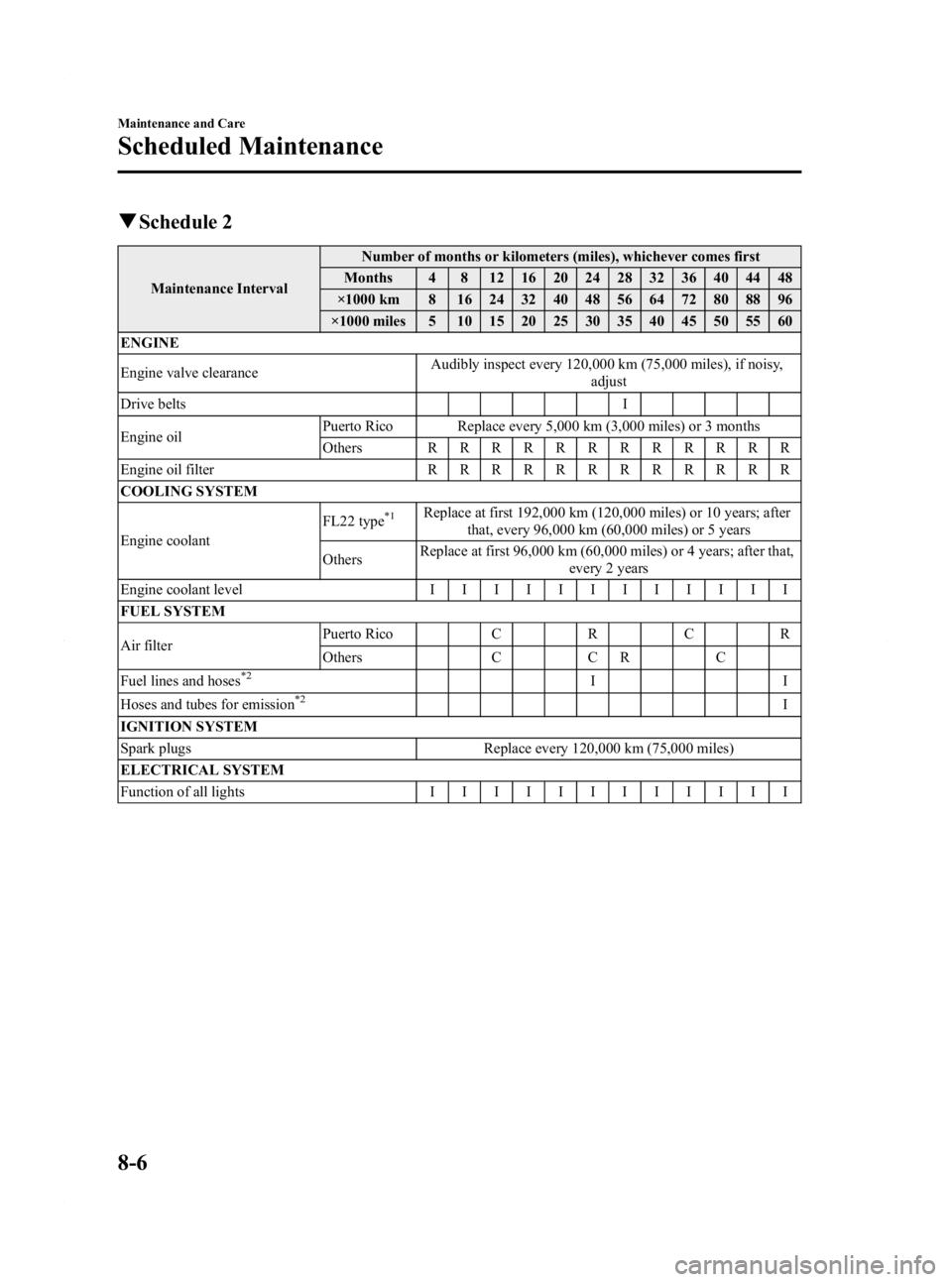
qSchedule 2
Maintenance Interval Number of months or kilometers (miles), whichever comes first
Months 4 8 12 16 20 24 28 32 36 40 44 48
×1000 km 8 16 24 32 40 48 56 64 72 80 88 96
×1000 miles 5 10 15 20 25 30 35 40 45 50 55 60
ENGINE
Engine valve clearance Audibly inspect every 120,000 km (75,000 miles), if noisy,
adjust
Drive belts I
Engine oil Puerto Rico Replace every 5,000 km (3,000 miles) or 3 months
Others
RRRRRRRRRRRR
Engine oil filter RRRRRRRRRRRR
COOLING SYSTEM
Engine coolant FL22 type
*1Replace at first 192,000 km (120,000 miles) or 10 years; after
that, every 96,000 km (60,000 miles) or 5 years
Others Replace at first 96,000 km (60,000 miles) or 4 years; after that,
every 2 years
Engine coolant level IIIIIIIIIIII
FUEL SYSTEM
Air filter Puerto Rico
CRCR
Others C C R C
Fuel lines and hoses
*2II
Hoses and tubes for emission*2I
IGNITION SYSTEM
Spark plugs Replace every 120,000 km (75,000 miles)
ELECTRICAL SYSTEM
Function of all lights IIIIIIIIIIII
8-6
Maintenance and Care
Scheduled Maintenance
Mazda2_8BX2-EA-10K_Edition2 Page238
Thursday, December 23 2010 4:48 PM
Form No.8BX2-EA-10K
Page 258 of 340

Black plate (258,1)
Tires
For reasons of proper performance, safety,
and better fuel economy, always maintain
recommended tire inflation pressures and
stay within the recommended load limits
and weight distribution.
WARNING
Using Different Tire Types:Driving your vehicle with different
types of tires is dangerous. It could
cause poor handling and poor
braking; leading to loss of control.
Except for the limited use of the
temporary spare tire, use only the
same type tires (radial, bias-belted,
bias-type) on all four wheels.
Using Wrong-Sized Tires: Using any other tire size than what is
specified for your Mazda (page 10-6)
is dangerous. It could seriously affect
ride, handling, ground clearance, tire
clearance, and speedometer
calibration. This could cause you to
have an accident. Use only tires that
are the correct size specified for your
Mazda.
qTire Inflation Pressure
WARNING
Always inflate the tires to the correct
pressure:
Overinflation or underinflation of
tires is dangerous. Adverse handling
or unexpected tire failure could result
in a serious accident.
Refer to Tires on page 10-6.
Use only a Mazda-genuine tire valve
cap: Use of a non-genuine part is
dangerous as the correct tire air
pressure cannot be maintained if the
tire valve becomes damaged. If the
vehicle is driven under this condition,
the tire air pressure will decrease
which could result in a serious
accident. Do not use any part for the
tire valve cap that is not a Mazda-
genuine part.
8-26
Maintenance and Care
Owner Maintenance
Mazda2_8BX2-EA-10K_Edition2 Page258
Thursday, December 23 2010 4:48 PM
Form No.8BX2-EA-10K

