Page 296 of 578
295
3-4. Using the hands-free phone system (for mobile phones)
3
Interior features
IS350/250_U
■Automatic volume adjustment
When vehicle speed reaches 50 mph (80 km/h) or more, the volume automati-
cally increases. The volume returns to the previous volume setting when vehicle
speed drops to 43 mph (70 km/h) or less.
■When using a voice command
For numbers, say a combination of single digits from zero to nine, # (pound),
∗ (star), and + (plus).
Say the command correctly and clearly.
■Situations in which the system may not recognize your voice
●When driving on rough roads
●When driving at high speeds
●When air is blowing out of the vents onto the microphone
●When the air conditioning fan emits a loud noise
■Operations that cannot be performed while driving
●Operating the system with , and
●Registering a mobile phone to the system
■Changing the passkey
→ P. 3 0 3
Page 368 of 578
Maintenance and care4
367
IS350/250_U
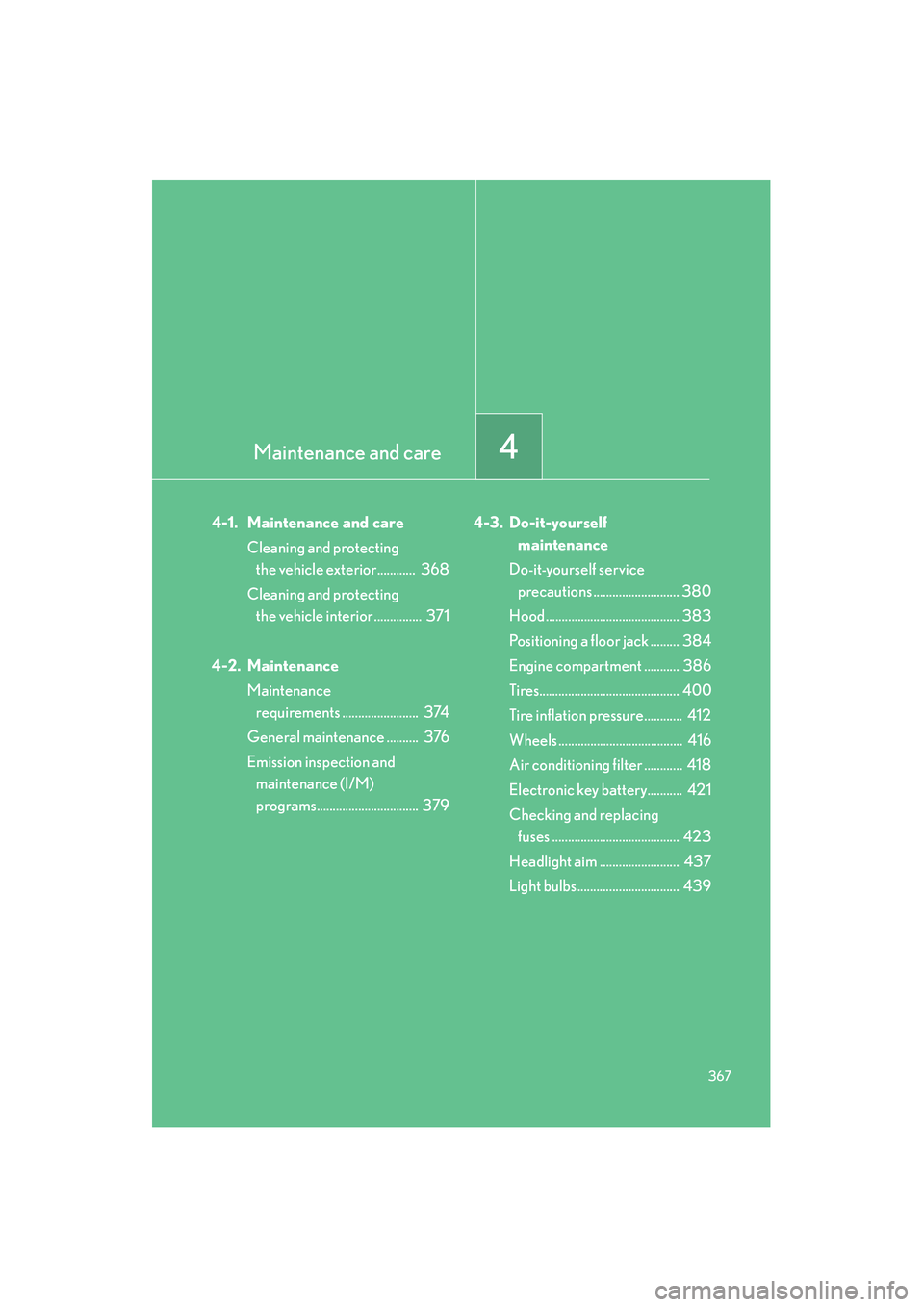
4-1. Maintenance and careCleaning and protecting the vehicle exterior............ 368
Cleaning and protecting the vehicle interior ............... 371
4-2. Maintenance Maintenance requirements ........................ 374
General maintenance .......... 376
Emission inspection and maintenance (I/M)
programs................................ 379 4-3. Do-it-yourself
maintenance
Do-it-yourself service precautions ........................... 380
Hood .......................................... 383
Positioning a floor jack ......... 384
Engine compartment ........... 386
Tires............................................ 400
Tire inflation pressure............ 412
Wheels ....................................... 416
Air conditioning filter ............ 418
Electronic key battery........... 421
Checking and replacing fuses ........................................ 423
Headlight aim ......................... 437
Light bulbs................................ 439
Page 383 of 578

382
4-3. Do-it-yourself maintenance
IS350/250_U
CAUTION
The engine compartment contains many mechanisms and fluids that may move sud-
denly, become hot, or become electrically energized. To avoid death or serious injury,
observe the following precautions.
■When working on the engine compartment
●Keep hands, clothing, and tools away from the moving fan and engine drive belt.
●Be careful not to touch the engine, radiator, exhaust manifold, etc. right after driv-
ing as they may be hot. Oil and other fluids may also be hot.
●Do not leave anything that may burn easily, such as paper or rags, in the engine
compartment.
●Do not smoke, cause sparks or expose an open flame to fuel or the battery. Fuel
and battery fumes are flammable.
●Be extremely cautious when working on the battery. It contains poisonous and
corrosive sulfuric acid.
■When working near the electric cooling fan or radiator grille
Be sure the “ENGINE START STOP” switch is OFF.
With the “ENGINE START STOP” switch in IGNITION ON mode, the electric
cooling fan may automatically start to run if the air conditioning is on and/or the
coolant temperature is high. (→P. 3 9 4 )
■Safety glasses
Wear safety glasses to prevent flying or falling material, fluid spray, etc. from getting
in the eyes.
NOTICE
■If you remove the air cleaner filter
Driving with the air cleaner filter removed may cause excessive engine wear due to
dirt in the air. Also, a backfire could cause a fire in the engine compartment.
Page 395 of 578
394
4-3. Do-it-yourself maintenance
IS350/250_U
Radiator and condenserCheck the radiator and condenser and clear any foreign objects.
If either of the above parts are extremely dirty or you are not sure of their
condition, have your vehicle checked by your Lexus dealer.
Brake fluid■ Checking fluid level
The brake fluid level should be
between the “MAX” and “MIN”
lines on the tank.
Make sure to check the fluid type and prepare the necessary items.
■ Adding fluid
CAUTION
■When the engine is hot
Do not touch the radiator or condenser, as they may be hot and you may be burned.
Fluid typeFMVSS No.116 DOT 3 or SAE J1703 brake fluid
ItemsClean funnel
■Brake fluid can absorb moisture from the air
Excess moisture in the fluid can cause a dangerous loss of braking efficiency. Use
only newly opened brake fluid.
Page 407 of 578

406
4-3. Do-it-yourself maintenance
IS350/250_U
■When to replace your vehicle’s tires
Tires should be replaced if:
●You have tire damage such as cuts, splits, cracks deep enough to expose the
fabric or bulges indicating internal damage
●A tire goes flat repeatedly or cannot be properly repaired due to the size or
location of a cut or other damage
If you are not sure, consult with your Lexus dealer.
■Replacing tires and wheels
If the ID code of the tire pressure warning valve and transmitter is not registered,
the tire pressure warning system will not work properly. After driving for about 20
minutes, the tire pressure warning light blinks for 1 minute and stays on to indicate a
system malfunction.
■Tire lif e
Any tire over 6 years old must be checked by a qualified technician even if it has sel-
dom or never been used or damage is not obvious.
■If the tread wears down below 0.16 in. (4 mm) on snow tires
The effectiveness of snow tires is lost.
■Low profile tires (models not equipped with 16-inch tires)
Generally, low profile tires will wear more rapidly and tire grip performance will be
reduced on snowy and/or icy roads when compared to standard tires. Be sure to
use snow tires or tire chains
* on snowy and/or icy roads and drive carefully at a
speed appropriate for road and weather conditions.
*: Tire chains cannot be mounted on 18-inch tires.
Page 412 of 578

411
4-3. Do-it-yourself maintenance
4
Maintenance and care
IS350/250_U
NOTICE
■To avoid damage to the tire pressure warning valves and transmitters
When a tire is repaired with liquid sealants, the tire pressure warning valve and
transmitter may not operate properly. If a liquid sealant is used, contact your Lexus
dealer or other qualified service shop as soon as possible. Make sure to replace the
tire pressure warning valve and transmitter when replacing the tire. (→P. 4 0 2 )
■Driving on rough roads
Take particular care when driving on roads with loose surfaces or pot holes.
These conditions may cause losses in tire inflation pressure, reducing the cushion-
ing ability of the tires. In addition driving on rough roads may cause damage to the
tires themselves, as well as the vehicle’s wheels and body.
■Low profile tires and wheels
Wheels with profile tires like 17- and 18-inch tires may cause greater damage than
usual to the tire wheel when receiving impact from the road surface. Therefore pay
attention to the following:
●Be sure to use proper tire inflation pressure. If tires are under-inflated, they may
be damaged more severely.
●Avoid pot holes, uneven pavement, curbs and other road hazards.
Failure to do so can lead to severe tire and wheel damage.
■If tire inflation pressure become low while driving
Do not continue driving, or your tires and/or wheels may be ruined.
Page 416 of 578
415
4-3. Do-it-yourself maintenance
4
Maintenance and care
IS350/250_U
CAUTION
■Proper inflation is critical to save tire performance
Keep your tires properly inflated. Otherwise, the following conditions may occur
and result in an accident causing death or serious injury.
●Excessive wear
●Uneven wear
●Poor handling
●Possibility of blowouts resulting from overheated tires
●Poor sealing of the tire bead
●Wheel deformation and/or tire separation
●A greater possibility of tire damage from road hazards
NOTICE
■When inspecting and adjusting tire inflation pressure
Be sure to reinstall the tire valve caps.
Without the valve caps, dirt or moisture could get into the valve and cause air leak-
age, which could result in an accident. If the caps have been lost, replace them as
soon as possible.
Page 419 of 578
418
4-3. Do-it-yourself maintenance
IS350/250_U
Air conditioning filter
The air conditioning filter must be cleaned or changed regularly to main-
tain air conditioning efficiency.
■ Removal method
Set the air conditioning system to recirculated mode.
The air conditioning filter case cannot be removed with the system in
the outside air mode.
Turn the “ENGINE START STOP” switch OFF.
Open the glove box. Lift and
remove the partition.
Remove the filter cover.
Remove the filter case.
STEP1
STEP2
STEP3
STEP4
STEP5


