Page 7 of 563
1
2
3
4
5
6
7
ES350_U
5
4-1. Maintenance and careCleaning and protecting the vehicle exterior................... 362
Cleaning and protecting the vehicle interior .................... 365
4-2. Maintenance Maintenance requirements .... 368
General maintenance ................ 370
Emission inspection and maintenance (I/M)
programs ...................................... 373
4-3. Do-it-yourself maintenance Do-it-yourself service precautions .................................. 374
Hood.................................................. 378
Positioning a floor jack............... 379
Engine compartment................... 381
Tires ................................................... 394
Tire inflation pressure................ 403
Wheels.............................................. 407
Air conditioning filter................. 409
Electronic key battery ................... 411
Checking and replacing fuses ................................................. 413
Headlight aim (vehicles with discharge headlights) .............. 422
Light bulbs ....................................... 424 5-1. Essential information
Emergency flashers .................... 434
If your vehicle needs to be towed ............................................. 435
If you think something is wrong .............................................. 441
Fuel pump shut off system ........ 442
Event data recorder.................... 443
5-2. Steps to take in an emergency If a warning light turns on or a warning buzzer
sounds... ........................................ 445
If a warning message is displayed....................................... 455
If you have a flat tire..................... 467
If the engine will not start .......... 476
If the shift lever cannot be shifted from P .............................. 478
If you lose your keys .................... 479
If the electronic key does not operate properly .............. 480
If the vehicle battery is discharged .................................. 483
If your vehicle overheats ........... 486
If the vehicle becomes stuck............................................... 489
If your vehicle has to be stopped in an emergency ...... 490
4Maintenance and care5When trouble arises
Page 11 of 563
ES350_U
9
Tires
●Rotation
● Replacement
● Inflation pressure
P. 394
P. 467
P. 499
Tail lights P. 147
Side marker lights P. 147
Trunk P. 44
Rear window defogger P. 215
Doors P. 40
Fuel filler door P. 76
Turn signal lights P. 133
Page 193 of 563
191
2-5. Driving information
2
When driving
ES350_U
Winter driving tips
Carry out the necessary preparations and inspections before driving the
vehicle in winter. Always drive the vehicle in a manner appropriate to the
prevailing weather conditions.
■Pre-winter preparations
●Use fluids that are appropriate to the prevailing outside tempera-
tures.
• Engine oil
• Engine coolant
• Washer fluid
● Have a service technician inspect the level and specific gravity of
battery electrolyte.
● Have the vehicle fitted with four snow tires or purchase a set of
tire chains for the front tires.
Ensure that all tires are the same size and brand, and that chains match
the size of the tires.
●Tire inflation pressure falls in winter as the outside temperature
falls. Add 2.9 to 4.3 psi (20 to 30 kPa, 0.2 to 0.3 kgf/cm2 or bar)
to the standard tire inflation pressure.
Page 363 of 563

Maintenance and care4
361
ES350_U
4-1. Maintenance and careCleaning and protecting the vehicle exterior............. 362
Cleaning and protecting the vehicle interior .............. 365
4-2. Maintenance Maintenance requirements ....................... 368
General maintenance .......... 370
Emission inspection and maintenance (I/M)
programs................................ 373 4-3. Do-it-yourself
maintenance
Do-it-yourself service precautions ............................ 374
Hood .......................................... 378
Positioning a floor jack ......... 379
Engine compartment ............ 381
Tires............................................ 394
Tire inflation pressure........... 403
Wheels ...................................... 407
Air conditioning filter ........... 409
Electronic key battery............ 411
Checking and replacing fuses ......................................... 413
Headlight aim (vehicles with discharge
headlights) ............................ 422
Light bulbs................................ 424
Page 374 of 563
372
4-2. Maintenance
ES350_U
Vehicle exterior
ItemsCheck points
Steering wheel
• Moves smoothly?
• Has correct free play?
• No strange noises?
ItemsCheck points
Door/trunk• Operate smoothly?
Engine hood• The lock system works properly?
Fluid leaks• Is there any leakage after parking?
Ti r e
• Inflation pressure is correct?
• Tire surfaces not worn or dam-aged?
• Tires rotated according to the maintenance schedule?
• Wheel nuts are not loose?
CAUTION
■If the engine is running
Turn the engine off and ensure that there is adequate ventilation before performing
maintenance checks.
Page 377 of 563
375
4-3. Do-it-yourself maintenance
4
Maintenance and care
ES350_U
ItemsParts and tools
Engine oil level (→P. 383)
• “Toyota Genuine Motor Oil” or
equivalent
• Rag or paper towel, funnel (used
only for adding engine oil)
Fuses (→ P. 4 1 3 )• Fuse with same amperage rating as
original
Tire inflation pressure ( →P. 4 0 3 )• Tire pressure gauge
• Compressed air source
Headlight aim ( →P. 422)• Phillips-head screwdriver
Power steering fluid
level (→ P. 3 8 9 )
• Automatic transmission fluid
DEXRON II or III
• Rag or paper towel
• Funnel (used only for adding power steering fluid)
Radiator and condenser ( →P. 388)
Washer fluid ( →P. 393)
• Water washer fluid containing anti-
freeze (for winter use)
• Funnel
Page 398 of 563

396
4-3. Do-it-yourself maintenance
ES350_U
Initializing the tire pressure warning system■ The tire pressure warning system must be initialized in the following
circumstances:
● When changing the tire inflation pressure by changing traveling
speed or load weight, etc.
When the tire pressure warning system is initialized, the current tire
inflation pressure is set as the pressure benchmark.
■ How to initialize the tire pressure warning system
Park the vehicle in safe place and turn the “ENGINE START
STOP” switch OFF.
While the vehicle is moving, initialization is not performed.
Adjust the tire inflation pressure to the specified cold tire inflation
pressure level. ( →P. 4 9 9 )
Make sure to adjust the tire pressure to the specified cold tire inflation
pressure level. The tire pressure warning system will operate based on
this pressure level.
Turn the “ENGINE START STOP” switch to IGNITION ON
mode.
Push and hold the tire pressure
warning reset switch until the tire
pressure warning light blinks
slowly 3 times.
Wait for a few minutes with the IGNITION ON mode, and then
turn the “ENGINE START STOP” switch OFF.
STEP1
STEP2
STEP3
STEP4
STEP5
Page 400 of 563
398
4-3. Do-it-yourself maintenance
ES350_U
■When to replace your vehicle’s tires
Tires should be replaced if:
●You have tire damage such as cuts, splits, cracks deep enough to expose the
fabric or bulges indicating internal damage
●A tire goes flat repeatedly or cannot be properly repaired due to the size or
location of a cut or other damage
If you are not sure, consult with your Lexus dealer.
■Replacing tires and wheels
If the ID code of the tire pressure warning valve and transmitter is not registered,
the tire pressure warning system will not work properly. After driving for about 20
minutes, the tire pressure warning light come s on after blinking for 1 minute to indi-
cate a system malfunction.
■Tire life
Any tire over 6 years old must be checked by a qualified technician even if they
have seldom or never been used or damage is not obvious.
■If the tread wears down below 0.16 in. (4 mm) on snow tires
The effectiveness of snow tires is lost.
■Maximum load of tire
Check that the maximum load of the replacement tire is greater than 1 /2 of the
Gross Axle Weight Ratings (GAWR) of either the front axle or the rear axle, which-
ever is greater.
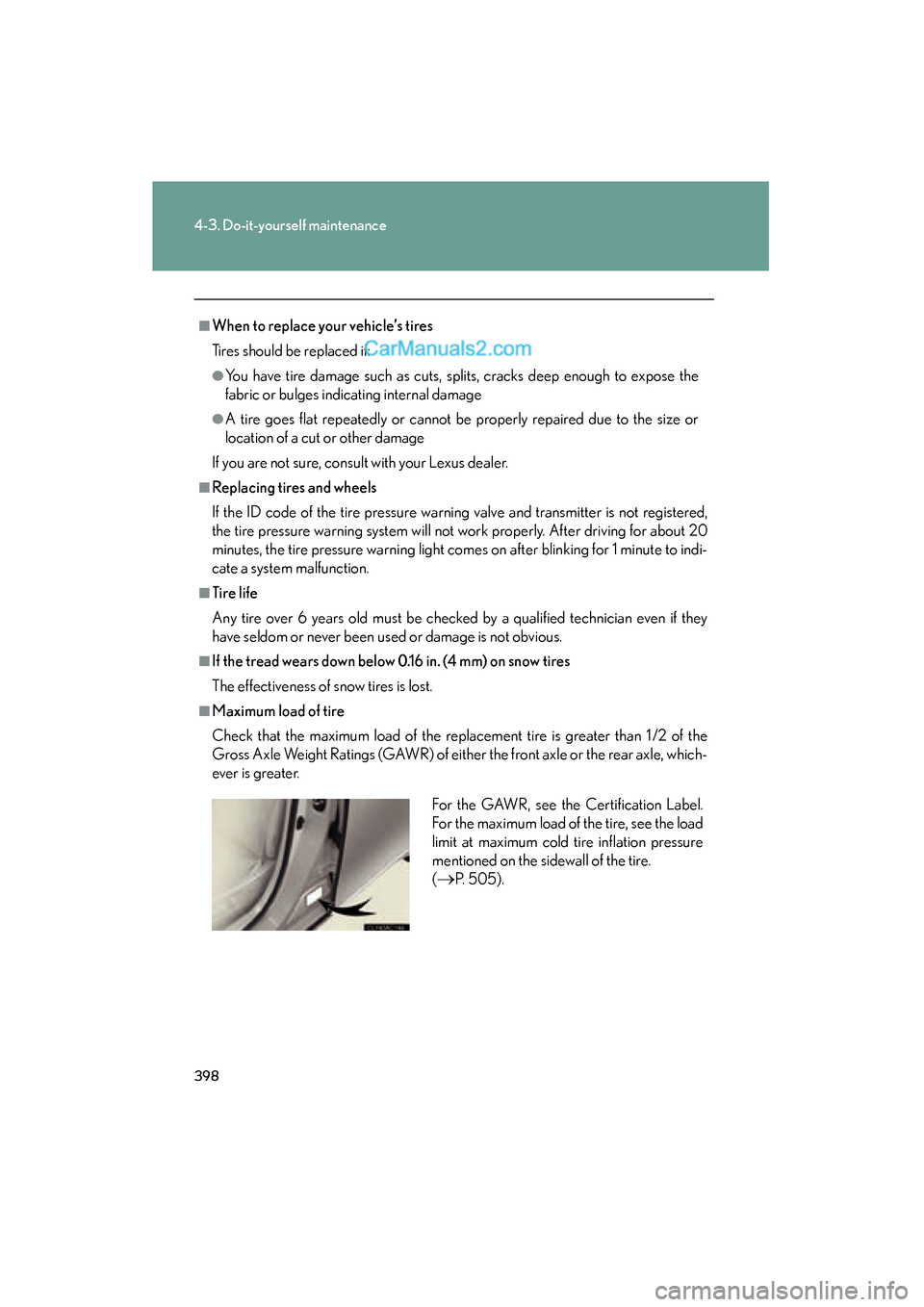
For the GAWR, see the Certification Label.
For the maximum load of the tire, see the load
limit at maximum cold tire inflation pressure
mentioned on the sidewall of the tire.
(
→P. 505).


