Page 392 of 563
390
4-3. Do-it-yourself maintenance
ES350_U■
Checking the fluid level
Make sure to check the fluid type and prepare the necessary items.
Clean all dirt off the reservoir.
Remove the reservoir cap by turning it counterclockwise and
wipe the dipstick clean.
Reinstall the reservoir cap.
Remove the reservoir cap again and look at the fluid level.
Fluid typeAutomatic transmission fluid DEXRON II or III
ItemsRag or paper towel and funnel (only for adding fluid)
CAUTION
■Checking the fluid level
Take care, as the reservoir may be hot.
NOTICE
■When adding fluid
Avoid overfilling, or the power steering may be damaged.
■After replacing the reservoir cap
Check the steering box case, vane pump and hose connections for leaks or dam-
age.
STEP1
STEP2
STEP3
STEP4
Page 403 of 563
401
4-3. Do-it-yourself maintenance
4
Maintenance and care
ES350_U
CAUTION
■When inspecting or replacing tires
Observe the following precautions to prevent accidents.
Failure to do so may cause damage to parts of the drive train, as well as dangerous
handling characteristics, which may lead to an accident resulting in death or serious
injury.
●Do not mix tires of different makes, models or tread patterns. Also, do not mix
tires of remarkably different treadwear.
●Do not use tire sizes other than those recommended by Lexus.
●Do not mix differently constructed tires (radial, bias-belted or bias-ply tires).
●Do not mix summer, all season and winter tires.
●Do not tow the vehicle with the compact spare tire installed.
■When initializing the tire pressure warning system
Do not push the tire pressure warning reset switch without first adjusting the tire
inflation pressure to the specified level. Otherwise, the tire pressure warning light
may not come on even if the tire inflation pressure is low, or it may come on when
the tire inflation pressure is actually normal.
Page 435 of 563

When trouble arises5
433
ES350_U
5-1. Essential informationEmergency flashers............... 434
If your vehicle needs to be towed ...................................... 435
If you think something is wrong ....................................... 441
Fuel pump shut off system.... 442
Event data recorder .............. 443 5-2. Steps to take in an
emergency
If a warning light turns on or a warning buzzer
sounds... ................................. 445
If a warning message is displayed................................ 455
If you have a flat tire................ 467
If the engine will not start ..... 476
If the shift lever cannot be shifted from P ....................... 478
If you lose your keys ............... 479
If the electronic key does not operate properly.......... 480
If the vehicle battery is discharged ............................ 483
If your vehicle overheats ..... 486
If the vehicle becomes stuck........................................ 489
If your vehicle has to be stopped in an
emergency ............................ 490
Page 437 of 563
5
When trouble arises
435
5-1. Essential information
ES350_U
If your vehicle needs to be towed
Before towingThe following may indicate a problem with your transmission. Contact
your Lexus dealer before towing.
● The engine is running, but the vehicle will not move.
● The vehicle makes an abnormal sound.
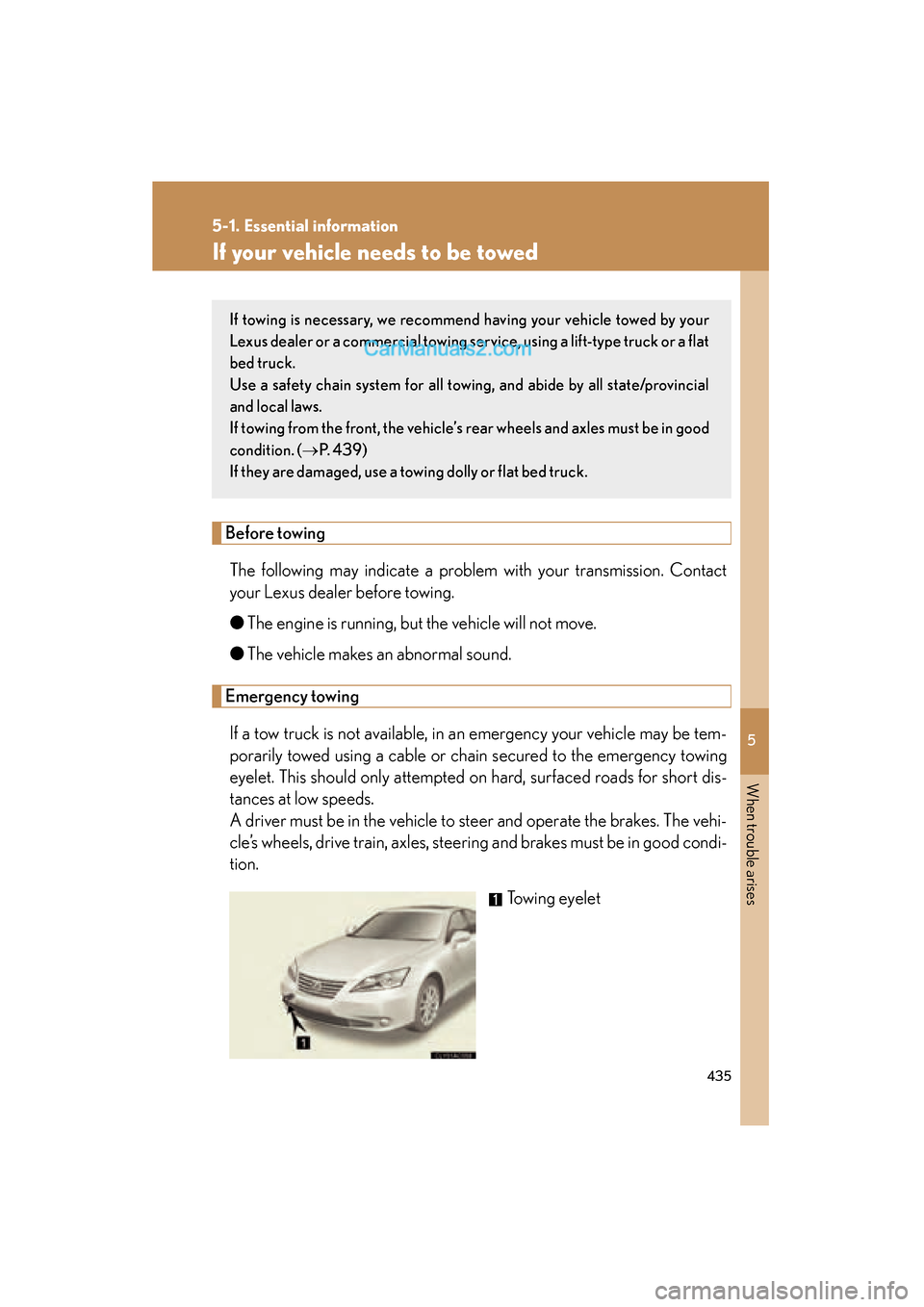
Emergency towing
If a tow truck is not available, in an emergency your vehicle may be tem-
porarily towed using a cable or chain secured to the emergency towing
eyelet. This should only attempted on hard, surfaced roads for short dis-
tances at low speeds.
A driver must be in the vehicle to steer and operate the brakes. The vehi-
cle’s wheels, drive train, axles, steering and brakes must be in good condi-
tion. Towing eyelet
If towing is necessary, we recommend having your vehicle towed by your
Lexus dealer or a commercial towing se rvice, using a lift-type truck or a flat
bed truck.
Use a safety chain system for all towing, and abide by all state/provincial
and local laws.
If towing from the front, the vehicle’s rear wheels and axles must be in good
condition. ( →P. 439)
If they are damaged, use a towing dolly or flat bed truck.
Page 438 of 563

436
5-1. Essential information
ES350_U
Installing towing eyeletRemove the eyelet cover using a
flathead screwdriver.
To protect the bodywork, place a
rag between the screwdriver and
the vehicle body, as shown in the
illustration.
■Emergency towing procedureRelease the parking brake.
Shift the shift lever to N.
Turn the “ENGINE START STOP” switch to ACCESSORY (engine off)
or IGNITION ON mode (engine running).
CAUTION
■Caution while towing
●Use extreme caution when towing the vehicle.
Avoid sudden starts or erratic driving maneuvers which place excessive stress on
the emergency towing eyelets and the cables or chains. Always be cautious of the
surroundings and other vehicles while towing.
●If the engine is not running, the power assist for the brakes and steering will not
function, making steering and braking more difficult.
NOTICE
■To prevent causing serious da mage to the transmission
Never tow this vehicle from the rear with front wheels on the ground.
This may cause serious damage to the transmission.
STEP1
STEP2
STEP3
STEP1
Page 439 of 563
5
When trouble arises
437
5-1. Essential information
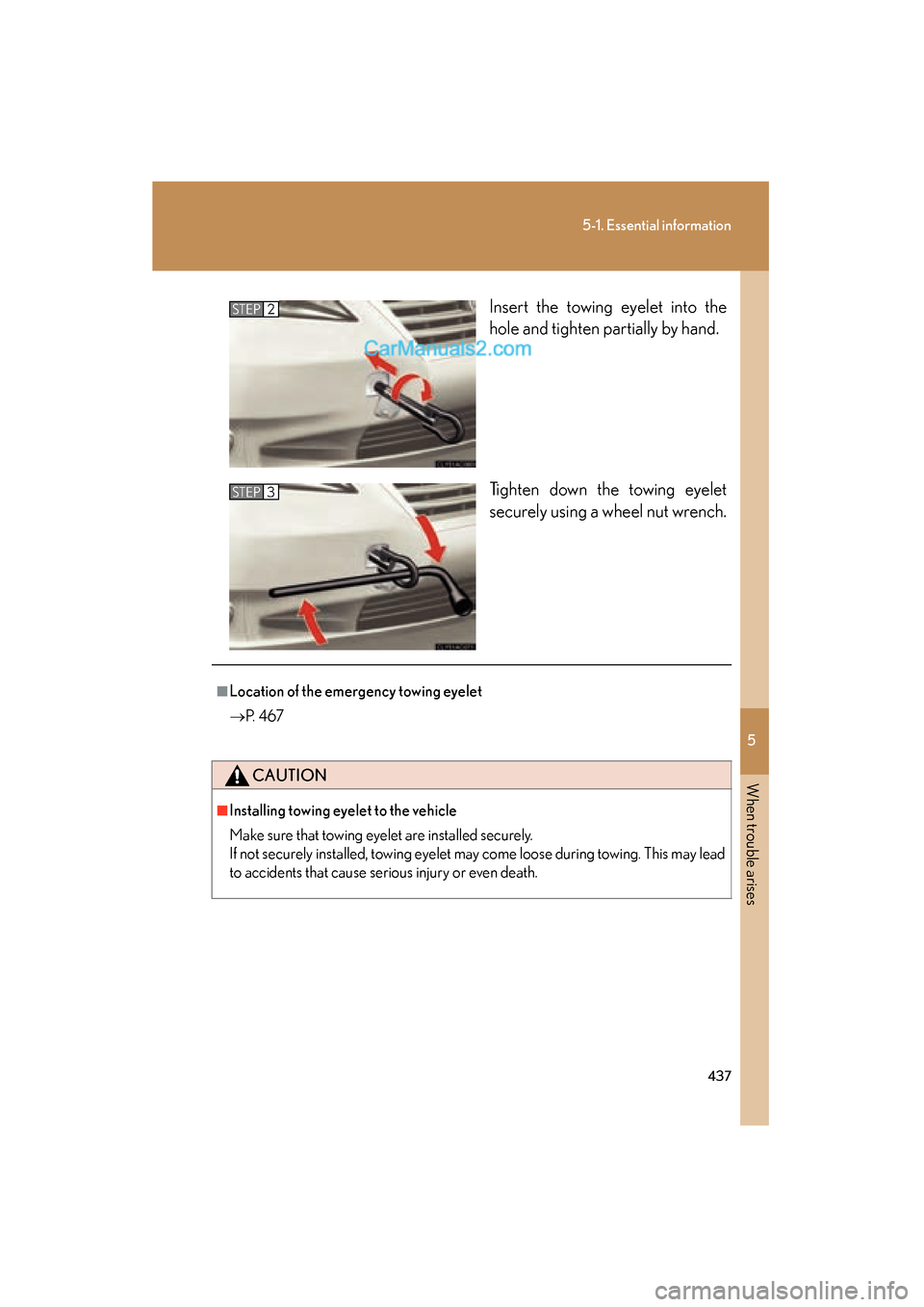
ES350_UInsert the towing eyelet into the
hole and tighten partially by hand.
Tighten down the towing eyelet
securely using a wheel nut wrench.
STEP2
STEP3
■Location of the emergency towing eyelet
→
P. 4 6 7
CAUTION
■Installing towing eyelet to the vehicle
Make sure that towing eyelet are installed securely.
If not securely installed, towing eyelet may come loose during towing. This may lead
to accidents that cause serious injury or even death.
Page 440 of 563
438
5-1. Essential information
ES350_U
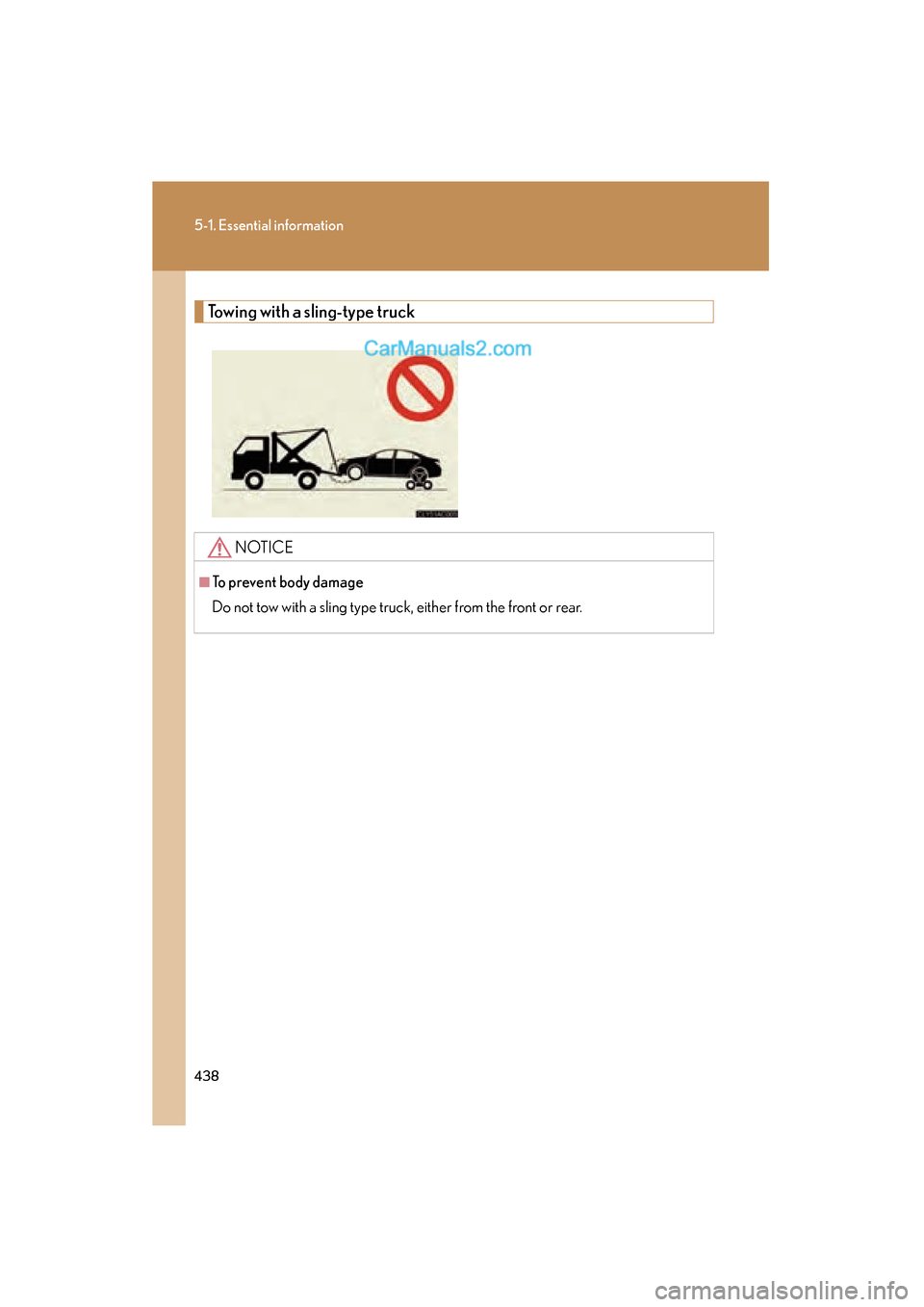
Towing with a sling-type truck
NOTICE
■To prevent body damage
Do not tow with a sling type truck, either from the front or rear.
Page 441 of 563
5
When trouble arises
439
5-1. Essential information
ES350_U
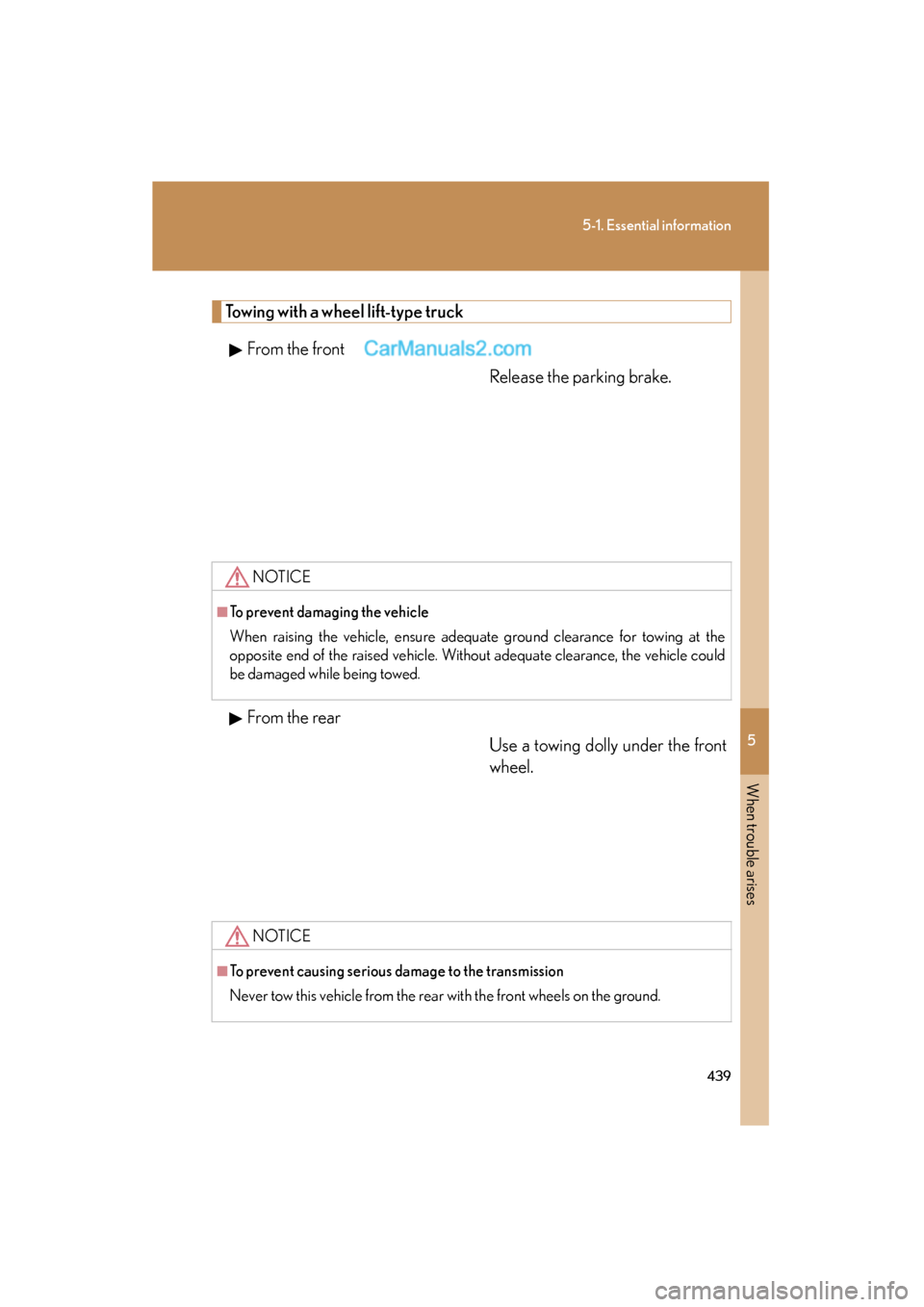
Towing with a wheel lift-type truckFrom the front Release the parking brake.
From the rear Use a towing dolly under the front
wheel.
NOTICE
■To prevent damaging the vehicle
When raising the vehicle, ensure adequate ground clearance for towing at the
opposite end of the raised vehicle. Without adequate clearance, the vehicle could
be damaged while being towed.
NOTICE
■To prevent causing serious damage to the transmission
Never tow this vehicle from the rear with the front wheels on the ground.