Page 449 of 563
5
When trouble arises
447
5-2. Steps to take in an emergency
ES350_U
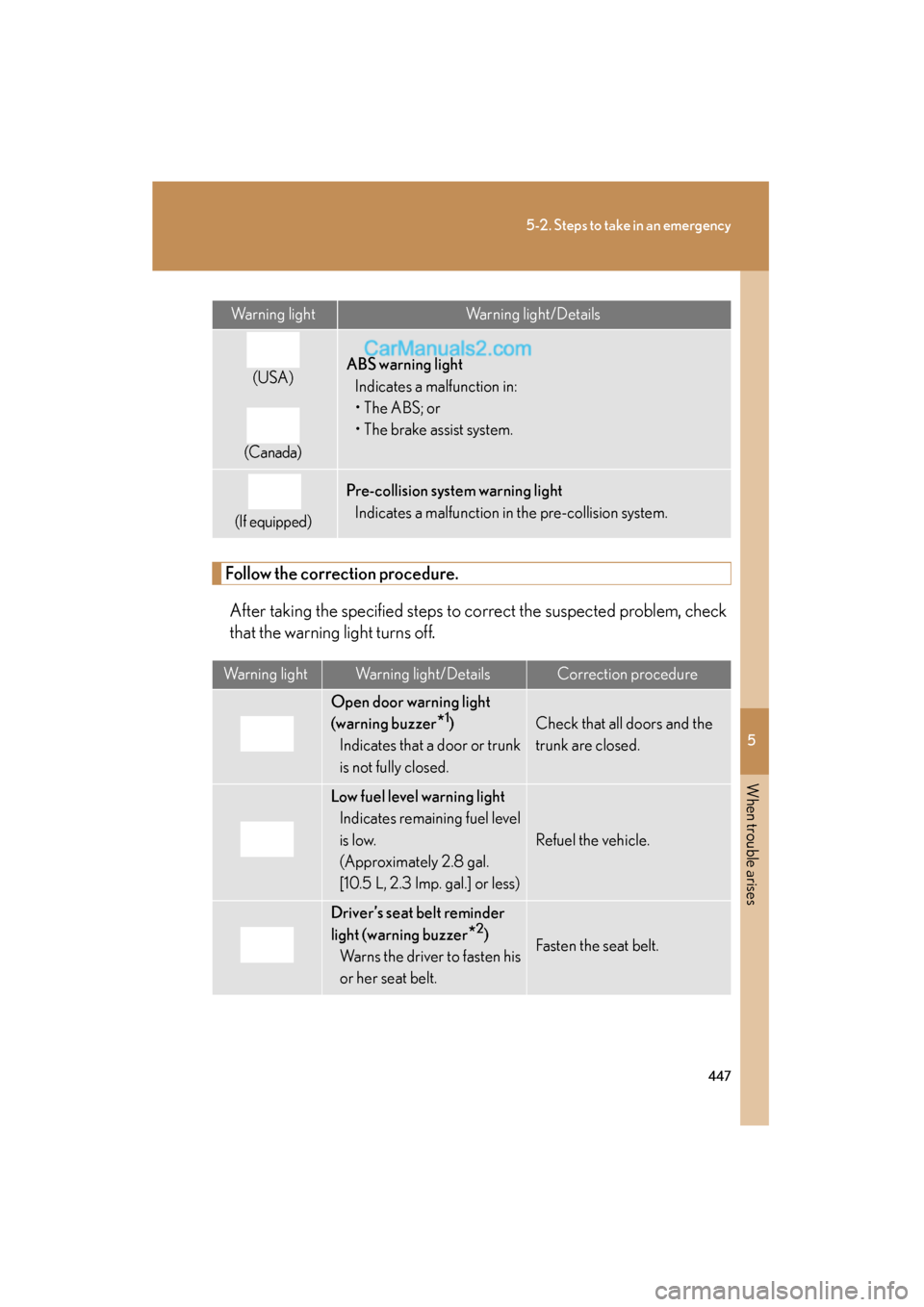
Follow the correction procedure.After taking the specified steps to correct the suspected problem, check
that the warning light turns off.
Warning lightWarning light/Details
(USA)
(Canada)
ABS warning light Indicates a malfunction in:
• The ABS; or
• The brake assist system.
(If equipped)
Pre-collision system warning lightIndicates a malfunction in the pre-collision system.
Warning lightWarning light/DetailsCorrection procedure
Open door warning light
(warning buzzer
*1)
Indicates that a door or trunk
is not fully closed.Check that all doors and the
trunk are closed.
Low fuel level warning light
Indicates remaining fuel level
is low.
(Approximately 2.8 gal.
[10.5 L, 2.3 Imp. gal.] or less)
Refuel the vehicle.
Driver’s seat belt reminder
light (warning buzzer
*2)
Warns the driver to fasten his
or her seat belt.Fasten the seat belt.
Page 451 of 563

5
When trouble arises
449
5-2. Steps to take in an emergency
ES350_U
*1: Open door warning buzzer:
→P. 4 5 8
*2: Driver's and front passenger’s seat belt reminders:
The driver’s and front passenger’s seat belt reminder sounds to alert the
driver and front passenger that his or her sear belt is not fastened. The buzzer
sounds intermittently for 10 seconds after the vehicle has reached a speed of
at least 12 mph (20 km/h). Then, if the seat belt is still unfastened, the buzzer
will sound in a different tone for 20 more seconds.
■First check when the malfunction in dicator lamp comes on while driving
Check the following:
●Is the fuel tank empty?
If it is, fill the fuel tank immediately.
●Is the fuel tank cap loose?
If it is, tighten it securely.
The lamp will go off after taking several driving trips.
If the lamp does not go off even after several trips, contact your Lexus dealer as
soon as possible.
■SRS warning light
This warning light system monitors the following:
• The airbag sensor assembly
• The front airbag sensors
• The side and curtain shield airbag sensor assemblies
• The curtain shield airbag sensor assemblies
• The driver’s seat position sensor
• The driver’s seat belt buckle switch
• Occupant detection system (ECU and sensors)
• “AIR BAG ON” and “AIR BAG OFF” indicator lights
• Front passenger’s seat belt buckle switch
• The seat belt pretensioner assemblies
• The inflators
• The interconnecting wiring and power sources
Page 455 of 563

5
When trouble arises
453
5-2. Steps to take in an emergency
ES350_U
CAUTION
■Maintenance of the tires
Each tire, including the spare (if provided), should be checked monthly when cold
and inflated to the inflation pressure recommended by the vehicle manufacturer on
the vehicle placard or tire inflation pressure label (tire and load information label).
(If your vehicle has tires of a different size than the size indicated on the vehicle
placard or tire inflation pressure label [tire and load information label], you should
determine the proper tire inflation pressure for those tires.)
As an added safety feature, your vehicle has been equipped with a tire pressure
monitoring system (TPMS-tire pressure warning system) that illuminates a low tire
pressure telltale (tire pressure warning light) when one or more of your tires is sig-
nificantly under-inflated. Accordingly, when the low tire pressure telltale (tire pres-
sure warning light) illuminates, you should stop and check your tires as soon as
possible, and inflate them to the proper pressure. Driving on a significantly under-
inflated tire causes the tire to overheat and can lead to tire failure. Under-inflation
also reduces fuel efficiency and tire tread life, and may affect the vehicle's handling
and stopping ability.
Please note that the TPMS (tire pressure warning system) is not a substitute for
proper tire maintenance, and it is the driver's responsibility to maintain correct tire
pressure, even if under-inflation has not reached the level to trigger illumination of
the TPMS low tire pressure telltale (tire pressure warning light).
Your vehicle has also been equipped with a TPMS (tire pressure warning system)
malfunction indicator to indicate when the system is not operating properly. The
TPMS (tire pressure warning system) malfunction indicator is combined with the
low tire pressure telltale (tire pressure warning light). When the system detects a
malfunction, the telltale will flash for approximately one minute and then remain
continuously illuminated. This sequence will continue upon subsequent vehicle
start-ups as long as the malfunction exists. When the malfunction indicator is illumi-
nated, the system may not be able to detect or signal low tire pressure as intended.
TPMS (tire pressure warning system) malfunctions may occur for a variety of rea-
sons, including the installation of replacement or alternate tires or wheels on the
vehicle that prevent the TPMS (tire pressure warning system) from functioning
properly. Always check the TPMS (tire pressure warning system) malfunction tell-
tale after replacing one or more tires or wheels on your vehicle to ensure that the
replacement or alternate tires and wheels allow the TPMS (tire pressure warning
system) to continue to function properly.
Page 478 of 563
476
5-2. Steps to take in an emergency
ES350_U
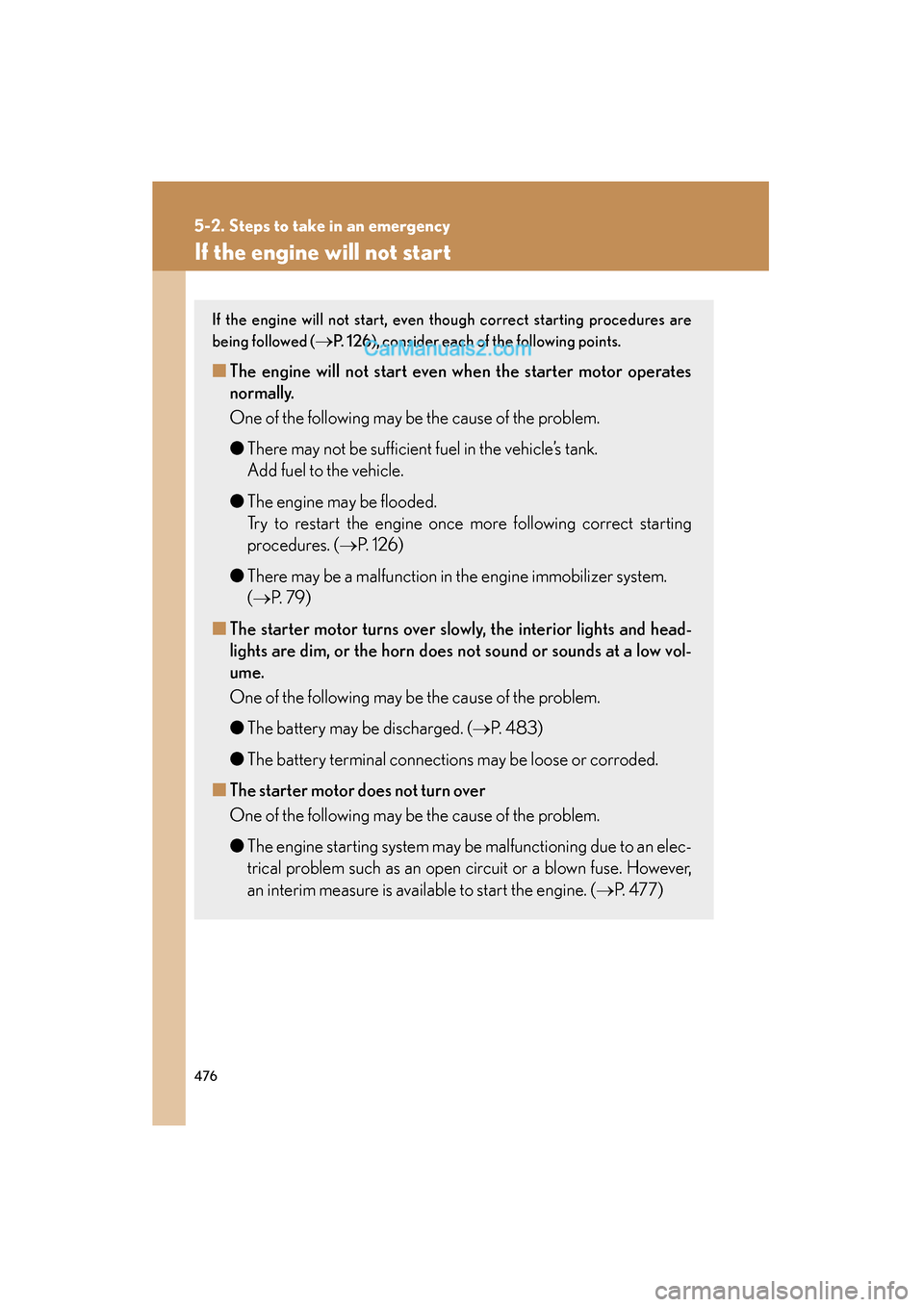
If the engine will not start
If the engine will not start, even though correct starting procedures are
being followed (
→P. 126), consider each of the following points.
■The engine will not start even when the starter motor operates
normally.
One of the following may be the cause of the problem.
● There may not be sufficient fuel in the vehicle’s tank.
Add fuel to the vehicle.
● The engine may be flooded.
Try to restart the engine once more following correct starting
procedures. ( →P. 1 2 6 )
● There may be a malfunction in the engine immobilizer system.
(→ P. 7 9 )
■ The starter motor turns over slowly, the interior lights and head-
lights are dim, or the horn does not sound or sounds at a low vol-
ume.
One of the following may be the cause of the problem.
● The battery may be discharged. ( →P. 4 8 3 )
● The battery terminal connections may be loose or corroded.
■ The starter motor does not turn over
One of the following may be the cause of the problem.
● The engine starting system may be malfunctioning due to an elec-
trical problem such as an open circuit or a blown fuse. However,
an interim measure is available to start the engine. ( →P. 4 7 7 )
Page 493 of 563
Vehicle specifications6
491
ES350_U
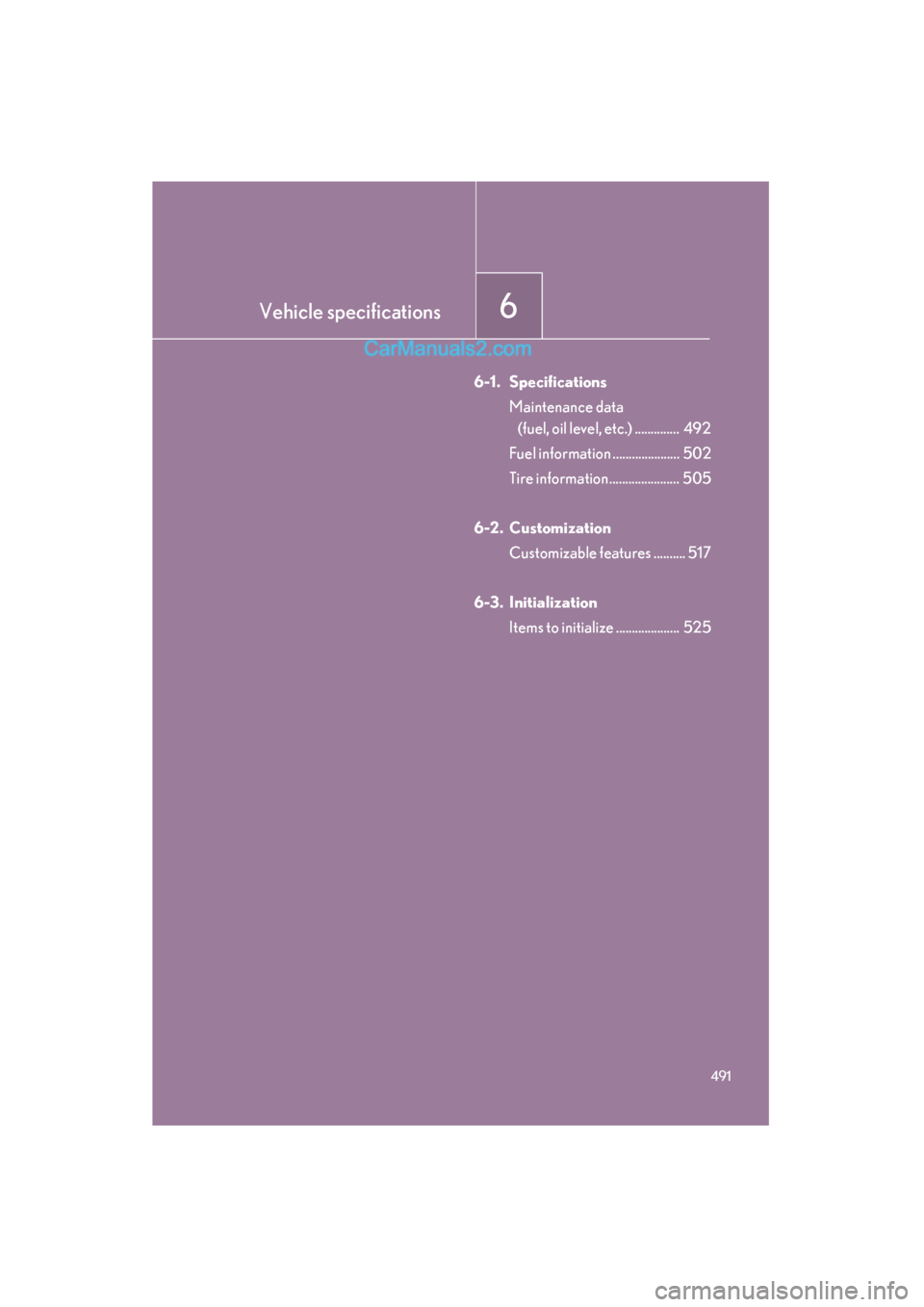
6-1. SpecificationsMaintenance data (fuel, oil level, etc.) .............. 492
Fuel information ..................... 502
Tire information...................... 505
6-2. Customization Customizable features .......... 517
6-3. Initialization Items to initialize .................... 525
Page 494 of 563
492
ES350_U
6-1. Specifications
Maintenance data (fuel, oil level, etc.)
Dimensions and weight
*: Unladen vehicle
Overall length191.7 in. (4870 mm)
Overall width71.7 in. (1820 mm)
Overall height *57.1 in. (1450 mm)
Wheelbase109.3 in. (2775 mm)
Tr e a dFront62.0 in. (1575 mm)
Rear61.6 in. (1565 mm)
Vehicle capacity weight
(Occupants + luggage)900 lb. (410 kg)
Towing capacity
(trailer weight + cargo weight)1000 lb. (450 kg)
Page 496 of 563
494
6-1. Specifications
ES350_U
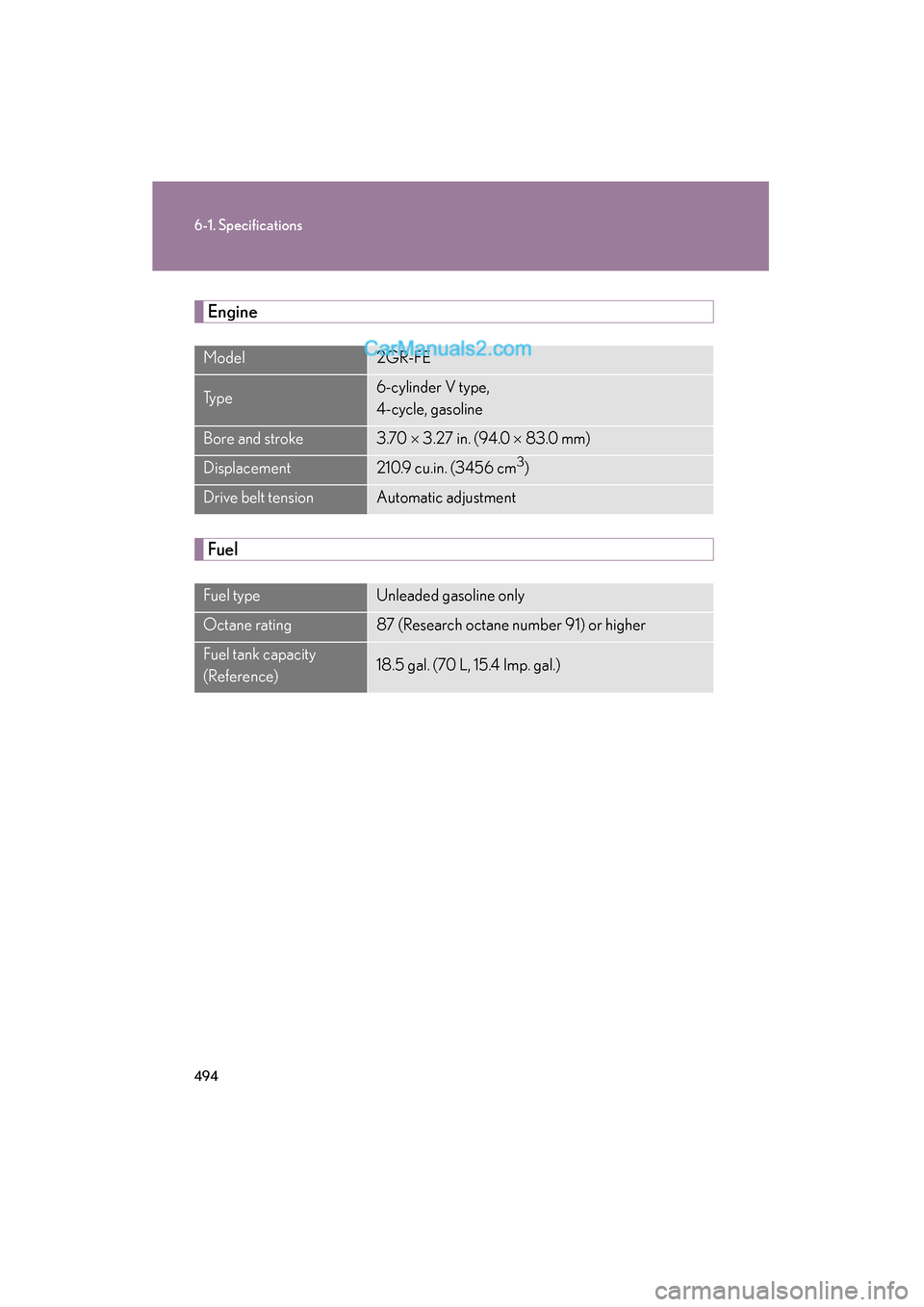
Engine
Fuel
Model2GR-FE
Ty p e6-cylinder V type,
4-cycle, gasoline
Bore and stroke3.70 × 3.27 in. (94.0 × 83.0 mm)
Displacement210.9 cu.in. (3456 cm3)
Drive belt tensionAutomatic adjustment
Fuel typeUnleaded gasoline only
Octane rating87 (Research octane number 91) or higher
Fuel tank capacity
(Reference)18.5 gal. (70 L, 15.4 Imp. gal.)
Page 497 of 563
495
6-1. Specifications
6
Vehicle specifications
ES350_U
Lubrication system■ Engine oil selection
“Toyota Genuine Motor Oil” is used in your Lexus vehicle. Use Lexus
approved “Toyota Genuine Motor Oil” or equivalent to satisfy the follow-
ing grade and viscosity.
Oil grade: ILSAC multigrade engine oil
Recommended viscosity: SAE 5W-30
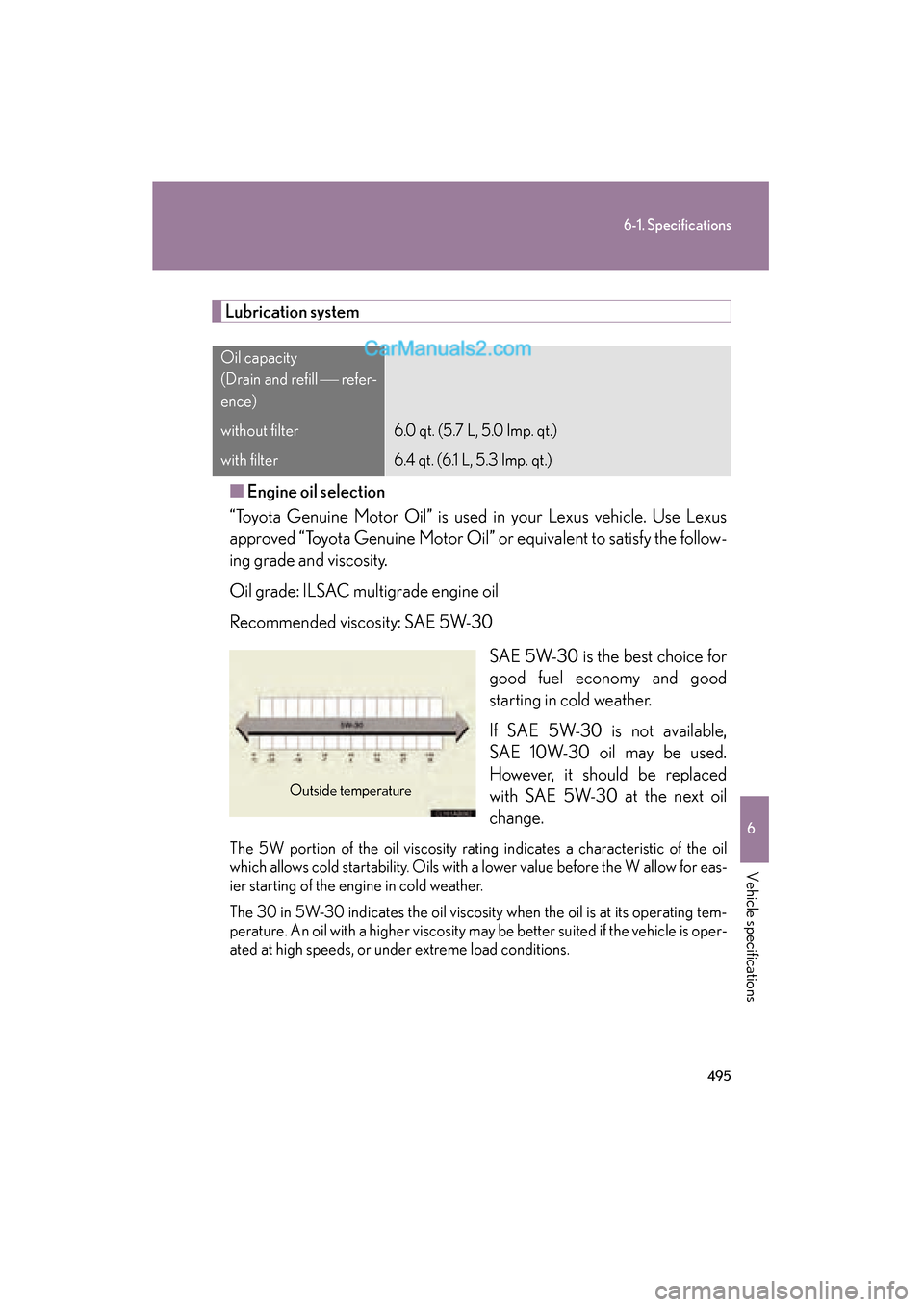
SAE 5W-30 is the best choice for
good fuel economy and good
starting in cold weather.
If SAE 5W-30 is not available,
SAE 10W-30 oil may be used.
However, it should be replaced
with SAE 5W-30 at the next oil
change.
The 5W portion of the oil viscosity rating indicates a characteristic of the oil
which allows cold startability. Oils with a lower value before the W allow for eas-
ier starting of the engine in cold weather.
The 30 in 5W-30 indicates the oil viscosity when the oil is at its operating tem-
perature. An oil with a higher viscosity may be better suited if the vehicle is oper-
ated at high speeds, or under extreme load conditions.
Oil capacity
(Drain and refill refer-
ence)
without filter 6.0 qt. (5.7 L, 5.0 Imp. qt.)
with filter6.4 qt. (6.1 L, 5.3 Imp. qt.)
Outside temperature