2011 KIA Sportage child seat
[x] Cancel search: child seatPage 14 of 385
3
Seats / 3-2
Seat belts / 3-18
Child restraint system / 3-33
Air bag - advanced supplemental restraint system / 3-42
Safety features of your vehicle
Page 18 of 385
35
Safety features of your vehicle
C010102AHM
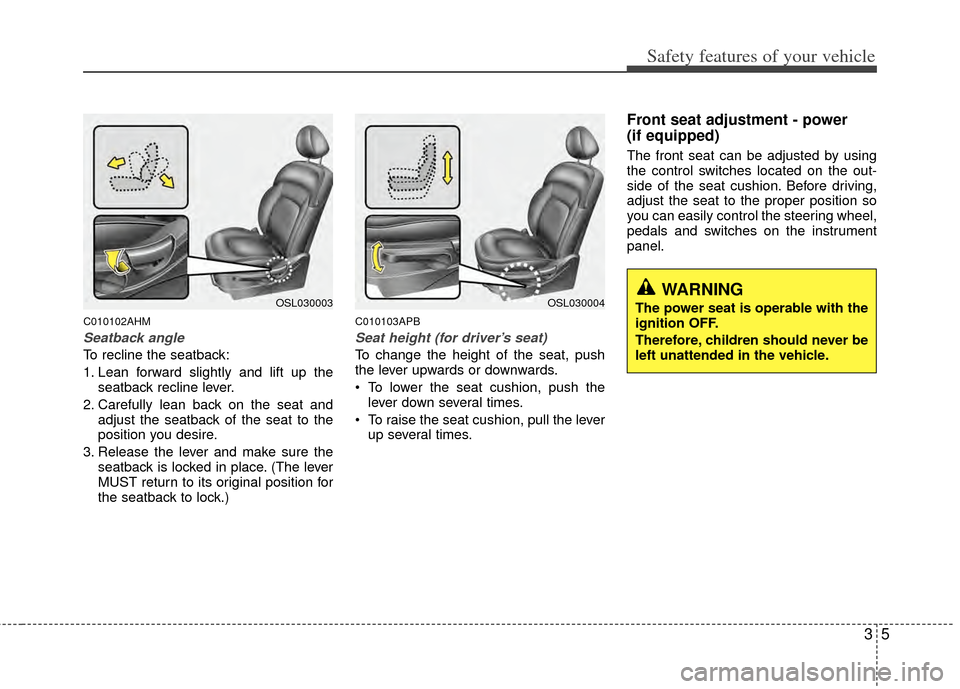
Seatback angle
To recline the seatback:
1. Lean forward slightly and lift up theseatback recline lever.
2. Carefully lean back on the seat and adjust the seatback of the seat to the
position you desire.
3. Release the lever and make sure the seatback is locked in place. (The lever
MUST return to its original position for
the seatback to lock.)
C010103APB
Seat height (for driver’s seat)
To change the height of the seat, push
the lever upwards or downwards.
To lower the seat cushion, push thelever down several times.
To raise the seat cushion, pull the lever up several times.
Front seat adjustment - power
(if equipped)
The front seat can be adjusted by using
the control switches located on the out-
side of the seat cushion. Before driving,
adjust the seat to the proper position so
you can easily control the steering wheel,
pedals and switches on the instrument
panel.
WARNING
The power seat is operable with the
ignition OFF.
Therefore, children should never be
left unattended in the vehicle.OSL030004OSL030003
Page 24 of 385
311
Safety features of your vehicle
C010108AAM
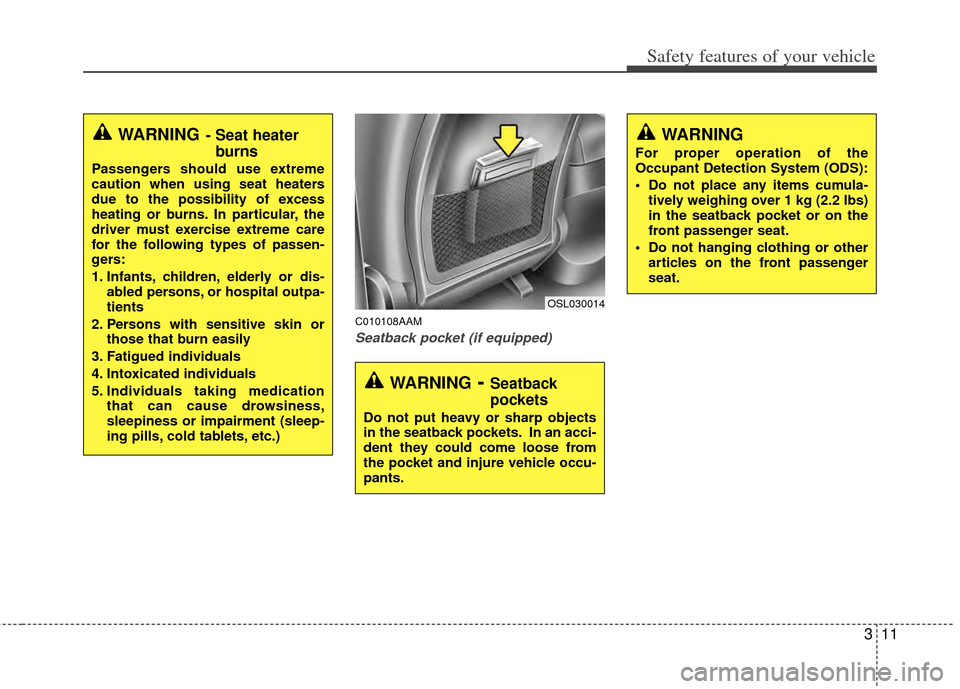
Seatback pocket (if equipped)
WARNING- Seat heaterburns
Passengers should use extreme
caution when using seat heaters
due to the possibility of excess
heating or burns. In particular, the
driver must exercise extreme care
for the following types of passen-
gers:
1. Infants, children, elderly or dis-
abled persons, or hospital outpa-
tients
2. Persons with sensitive skin or those that burn easily
3. Fatigued individuals
4. Intoxicated individuals
5. Individuals taking medication that can cause drowsiness,
sleepiness or impairment (sleep-
ing pills, cold tablets, etc.)
OSL030014
WARNING- Seatback
pockets
Do not put heavy or sharp objects
in the seatback pockets. In an acci-
dent they could come loose from
the pocket and injure vehicle occu-
pants.
WARNING
For proper operation of the
Occupant Detection System (ODS):
Do not place any items cumula-tively weighing over 1 kg (2.2 lbs)
in the seatback pocket or on the
front passenger seat.
Do not hanging clothing or other articles on the front passenger
seat.
Page 30 of 385
317
Safety features of your vehicle
CAUTION
When cleaning the seats, do notuse an organic solvent such asthinner, benzene, alcohol andgasoline. Doing so may damagethe surface of the heater or seats.
To prevent overheating the seat heater, do not place blankets,cushions or seat covers on theseats while the seat heater is inoperation.
Do not place heavy or sharp objects on seats equipped withseat heaters. Damage to the seatwarming components could occur.WARNING- Seat heater burns
Passengers should use extreme
caution when using seat heaters
due to the possibility of excess
heating or burns. In particular, the
driver must exercise extreme care
for the following types of passen-
gers:
1. Infants, children, elderly or hand-
icapped persons, or hospital out-
patients
2. Persons with sensitive skin or those that burn easily
3. Fatigued individuals
4. Intoxicated individuals
5. Individuals taking medication that can cause drowsiness or
sleepiness (sleeping pills, cold
tablets, etc.)
Page 31 of 385
Safety features of your vehicle
18
3
SEAT BELTS
C020100AHM
Seat belt restraint system
WARNING
For maximum restraint system
protection, the seat belts must
always be used whenever the
vehicle is moving.
Seat belts are most effective when seatbacks are in the
upright position.
Children age 12 and under must always be properly restrained in
the rear seat. Never allow chil-
dren to ride in the front passen-
ger seat. If a child over 12 must
be seated in the front seat, he/she
must be properly belted and the
seat should be moved as far back
as possible.
Never wear the shoulder belt under your arm or behind your
back. An improperly positioned
shoulder belt can cause serious
injuries in a crash. The shoulder
belt should be positioned midway
over your shoulder across your
collarbone.
(Continued)
(Continued)
Avoid wearing twisted seat belts.A twisted belt can't do its job
well. In a collision, it could even
cut into you. Be sure the belt
webbing is straight and not twist-
ed.
Be careful not to damage the belt webbing or hardware. If the belt
webbing or hardware is dam-
aged, replace it.WARNING
Seat belts are designed to bear
upon the bony structure of the
body, and should be worn low
across the front of the pelvis or the
pelvis, chest and shoulders, as
applicable; wearing the lap section
of the belt across the abdominal
area must be avoided.
Seat belts should be adjusted as
firmly as possible, consistent with
comfort, to provide the protection
for which they have been designed.
A slack belt will greatly reduce the
protection afforded to the wearer.
Care should be taken to avoid con-
tamination of the webbing with pol-
ishes, oils and chemicals, and par-
ticularly battery acid. Cleaning may
safely be carried out using mild
soap and water. The belt should be
replaced if webbing becomes
frayed, contaminated or damaged.
(Continued)
Page 32 of 385
319
Safety features of your vehicle
C020101AAM-EU
Seat belt warning (for driver’s seat)
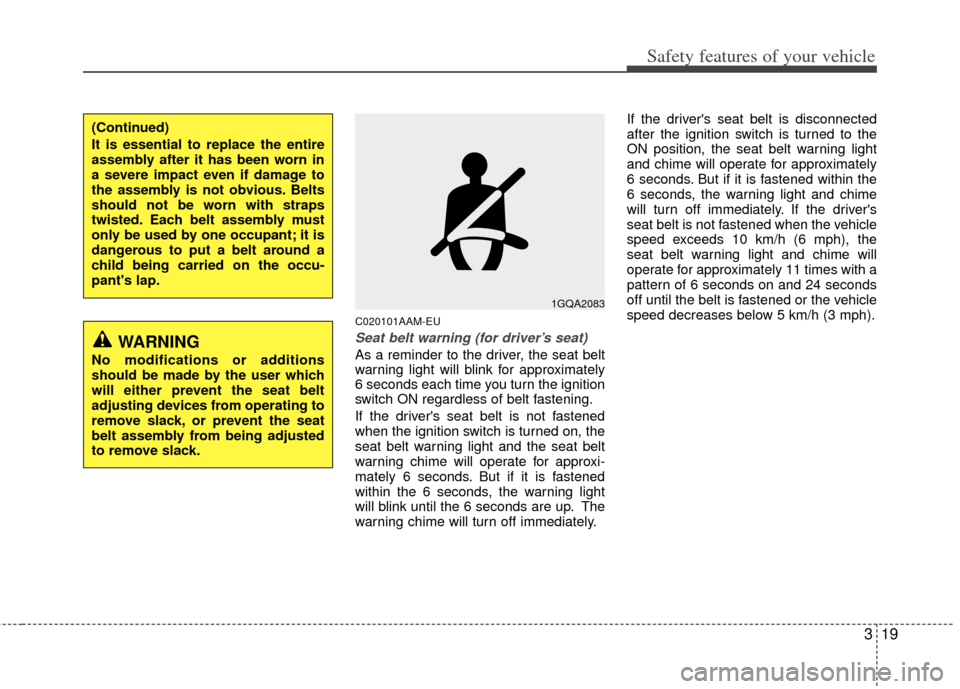
As a reminder to the driver, the seat belt
warning light will blink for approximately
6 seconds each time you turn the ignition
switch ON regardless of belt fastening.
If the driver's seat belt is not fastened
when the ignition switch is turned on, the
seat belt warning light and the seat belt
warning chime will operate for approxi-
mately 6 seconds. But if it is fastened
within the 6 seconds, the warning light
will blink until the 6 seconds are up. The
warning chime will turn off immediately.If the driver's seat belt is disconnected
after the ignition switch is turned to the
ON position, the seat belt warning light
and chime will operate for approximately
6 seconds. But if it is fastened within the
6 seconds, the warning light and chime
will turn off immediately. If the driver's
seat belt is not fastened when the vehicle
speed exceeds 10 km/h (6 mph), the
seat belt warning light and chime will
operate for approximately 11 times with a
pattern of 6 seconds on and 24 seconds
off until the belt is fastened or the vehicle
speed decreases below 5 km/h (3 mph).
1GQA2083
(Continued)
It is essential to replace the entire
assembly after it has been worn in
a severe impact even if damage to
the assembly is not obvious. Belts
should not be worn with straps
twisted. Each belt assembly must
only be used by one occupant; it is
dangerous to put a belt around a
child being carried on the occu-
pant's lap.
WARNING
No modifications or additions
should be made by the user which
will either prevent the seat belt
adjusting devices from operating to
remove slack, or prevent the seat
belt assembly from being adjusted
to remove slack.
Page 35 of 385
Safety features of your vehicle
22
3
C020106AUN
Seat belts - Front passenger and rear
seat 3-point system with combinationlocking retractor
To fasten your seat belt:
Combination retractor type seat belts are
installed in the rear seat positions to help
accommodate the installation of child
restraint systems. Although a combina-
tion retractor is also installed in the front
passenger seat position, it is strongly
recommended that children always be
seated in the rear seat. NEVER place
any infant restraint system in the front
seat of the vehicle.
This type of seat belt combines the fea-
tures of both an emergency locking
retractor seat belt and an automatic lock-
ing retractor seat belt. To fasten your seat
belt, pull it out of the retractor and insert
the metal tab into the buckle. There will
be an audible "click" when the tab locks
into the buckle. When not securing a
child restraint, the seat belt operates in
the same way as the driver's seat belt
(Emergency Locking Retractor Type). It
automatically adjusts to the proper length
only after the lap belt portion of the seat
belt is adjusted manually so that it fits
snugly around your hips. When the seat belt is fully extended from
the retractor to allow the installation of a
child restraint system, the seat belt oper-
ation changes to allow the belt to retract,
but not to extend (Automatic Locking
Retractor Type). Refer to “Using a child
restraint system” in this section.
✽ ✽
NOTICE
Although the combination retractor
provides the same level of protection for
seated passengers in either emergency
or automatic locking modes, have the
seated passengers use the emergency
locking feature for improved conven-
ience. The automatic locking function is
intended to facilitate child restraint
installation. To convert from the auto-
matic locking feature to the emergency
locking operation mode, allow the
unbuckled seat belt to fully retract.
CAUTION
Do NOT fold down the left portion of
the rear seat back when the rearcenter seat belt is buckled. ALWAYS UNBUCKLE the rear center seatbelt before folding down the leftportion of the rear seat back. If the rear center seat belt is buckledwhen the left portion of the rear seat back is folded down, distortionand damage to the top portion of the seat back and seat belt garnishmay result, causing the seat back tolock into the folded down position.
Page 42 of 385
329
Safety features of your vehicle
C020300AUN-EU
Seat belt precautions
C020306AUN-EU
Infant or small child
You should be aware of the specific
requirements in your country. Child
and/or infant seats must be properly
placed and installed in the rear seat. For
more information about the use of these
restraints, refer to “Child restraint sys-
tem” in this section.
✽ ✽NOTICE
Small children are best protected from
injury in an accident when properly
restrained in the rear seat by a child
restraint system that meets the require-
ments of the Safety Standards of your
country. Before buying any child
restraint system, make sure that it has a
label certifying that it meets the Safety
Standard of your country. The restraint
must be appropriate for your child's
height and weight. Check the label on
the child restraint for this information.
Refer to “Child restraint system” in this
section.
WARNING
All occupants of the vehicle must
wear their seat belts at all times.
Seat belts and child restraints
reduce the risk of serious or fatal
injuries for all occupants in the
event of a collision or sudden stop.
Without a seat belt, occupants
could be shifted too close to a
deploying air bag, strike the interior
structure or be thrown from the
vehicle. Properly worn seat belts
greatly reduce these hazards.
Even with advanced air bags,
unbelted occupants can be severe-
ly injured by a deploying air bag.
Always follow the precautions
about seat belts, air bags and occu-
pant seating contained in this man-
ual.
WARNING
Every person in your vehicle needs
to be properly restrained at all
times, including infants and chil-
dren. Never hold a child in your
arms or lap when riding in a vehi-
cle. The violent forces created dur-
ing a crash will tear the child from
your arms and throw the child
against the interior. Always use a
child restraint appropriate for your
child's height and weight.