2011 KIA Sportage 4WD
[x] Cancel search: 4WDPage 247 of 385
525
Driving your vehicle
✽
✽NOTICE
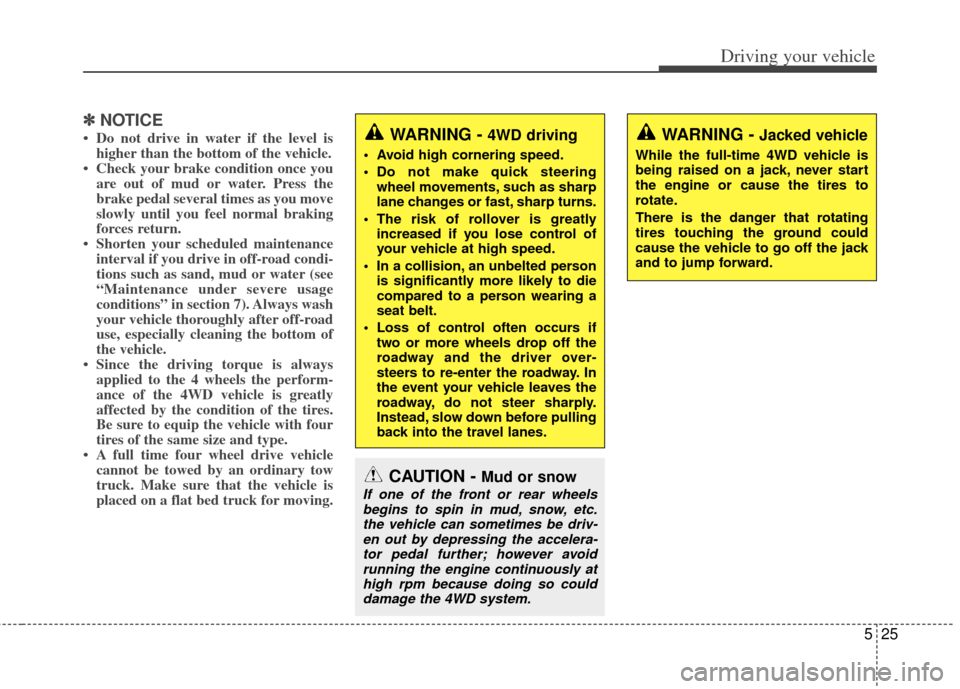
• Do not drive in water if the level is
higher than the bottom of the vehicle.
• Check your brake condition once you are out of mud or water. Press the
brake pedal several times as you move
slowly until you feel normal braking
forces return.
• Shorten your scheduled maintenance interval if you drive in off-road condi-
tions such as sand, mud or water (see
“Maintenance under severe usage
conditions” in section 7). Always wash
your vehicle thoroughly after off-road
use, especially cleaning the bottom of
the vehicle.
• Since the driving torque is always applied to the 4 wheels the perform-
ance of the 4WD vehicle is greatly
affected by the condition of the tires.
Be sure to equip the vehicle with four
tires of the same size and type.
• A full time four wheel drive vehicle cannot be towed by an ordinary tow
truck. Make sure that the vehicle is
placed on a flat bed truck for moving.
CAUTION - Mud or snow
If one of the front or rear wheels
begins to spin in mud, snow, etc.the vehicle can sometimes be driv-en out by depressing the accelera-tor pedal further; however avoidrunning the engine continuously athigh rpm because doing so coulddamage the 4WD system.
WARNING - 4WD driving
Avoid high cornering speed.
Do not make quick steering wheel movements, such as sharp
lane changes or fast, sharp turns.
The risk of rollover is greatly increased if you lose control of
your vehicle at high speed.
In a collision, an unbelted person is significantly more likely to die
compared to a person wearing a
seat belt.
Loss of control often occurs if two or more wheels drop off the
roadway and the driver over-
steers to re-enter the roadway. In
the event your vehicle leaves the
roadway, do not steer sharply.
Instead, slow down before pulling
back into the travel lanes.
WARNING - Jacked vehicle
While the full-time 4WD vehicle is
being raised on a jack, never start
the engine or cause the tires to
rotate.
There is the danger that rotating
tires touching the ground could
cause the vehicle to go off the jack
and to jump forward.
Page 248 of 385
Driving your vehicle
26
5
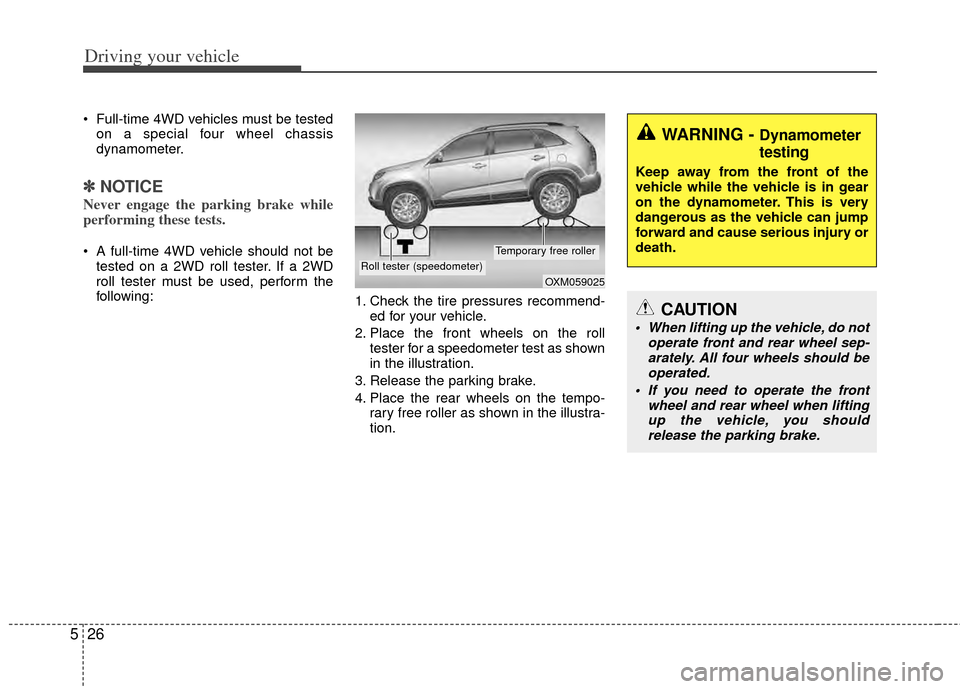
Full-time 4WD vehicles must be tested
on a special four wheel chassis
dynamometer.
✽ ✽ NOTICE
Never engage the parking brake while
performing these tests.
A full-time 4WD vehicle should not be
tested on a 2WD roll tester. If a 2WD
roll tester must be used, perform the
following: 1. Check the tire pressures recommend-
ed for your vehicle.
2. Place the front wheels on the roll tester for a speedometer test as shown
in the illustration.
3. Release the parking brake.
4. Place the rear wheels on the tempo- rary free roller as shown in the illustra-
tion.
WARNING - Dynamometer
testing
Keep away from the front of the
vehicle while the vehicle is in gear
on the dynamometer. This is very
dangerous as the vehicle can jump
forward and cause serious injury or
death.
OXM059025
Roll tester (speedometer)
Temporary free roller
CAUTION
When lifting up the vehicle, do not operate front and rear wheel sep-arately. All four wheels should be operated.
If you need to operate the front wheel and rear wheel when liftingup the vehicle, you shouldrelease the parking brake.
Page 282 of 385
Driving your vehicle
60
5
E140600BFD
If you do decide to pull a trailer
Here are some important points if you
decide to pull a trailer:
Consider using a sway control. You can
ask a hitch dealer about sway control.
Do not do any towing with your car dur- ing its first 2,000 km (1,200 miles) in
order to allow the engine to properly
break in. Failure to heed this caution
may result in serious engine or
transaxle damage.
When towing a trailer, be sure to con- sult an authorized KIA dealer for fur-
ther information on additional require-
ments such as a towing kit, etc.
Always drive your vehicle at a moder- ate speed (less than 100 km/h (60
mph)).
On a long uphill grade, do not exceed 70 km/h (45 mph) or the posted towing
speed limit, whichever is lower.
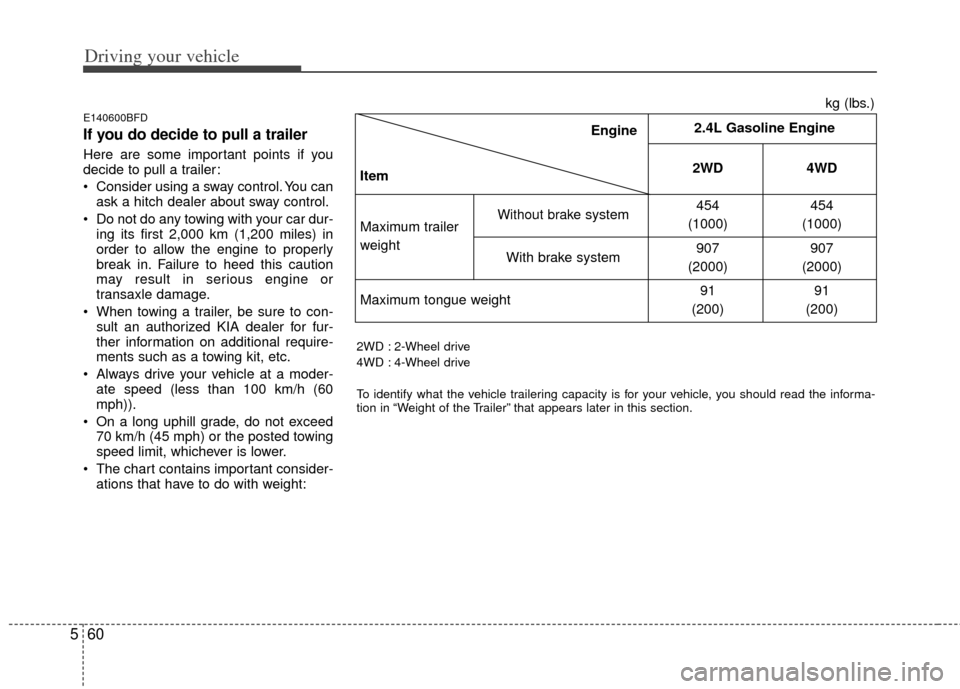
The chart contains important consider- ations that have to do with weight: Engine
Item 2.4L Gasoline Engine
2WD 4WD
Maximum trailer
weight
Without brake system 454
(1000) 454
(1000)
With brake system 907
(2000) 907
(2000)
Maximum tongue weight 91
(200) 91
(200)
kg (lbs.)
2WD : 2-Wheel drive
4WD : 4-Wheel drive
To identify what the vehicle trailering capacity is for your vehicle, you should read the informa-
tion in “Weight of the Trailer” that appears later in this section.
Page 305 of 385
615
What to do in an emergency
TOWING
F080100AAM-EU
Towing service
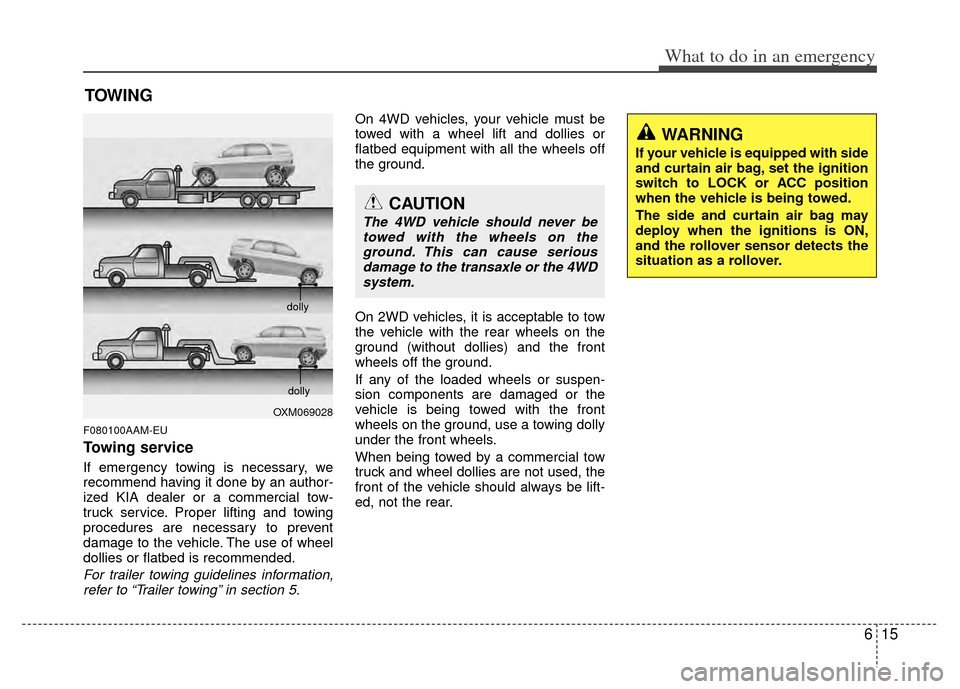
If emergency towing is necessary, we
recommend having it done by an author-
ized KIA dealer or a commercial tow-
truck service. Proper lifting and towing
procedures are necessary to prevent
damage to the vehicle. The use of wheel
dollies or flatbed is recommended.
For trailer towing guidelines information,refer to “Trailer towing” in section 5.
On 4WD vehicles, your vehicle must be
towed with a wheel lift and dollies or
flatbed equipment with all the wheels off
the ground.
On 2WD vehicles, it is acceptable to tow
the vehicle with the rear wheels on the
ground (without dollies) and the front
wheels off the ground.
If any of the loaded wheels or suspen-
sion components are damaged or the
vehicle is being towed with the front
wheels on the ground, use a towing dolly
under the front wheels.
When being towed by a commercial tow
truck and wheel dollies are not used, the
front of the vehicle should always be lift-
ed, not the rear.
OXM069028 dolly
dolly
CAUTION
The 4WD vehicle should never be
towed with the wheels on theground. This can cause seriousdamage to the transaxle or the 4WDsystem.
WARNING
If your vehicle is equipped with side
and curtain air bag, set the ignition
switch to LOCK or ACC position
when the vehicle is being towed.
The side and curtain air bag may
deploy when the ignitions is ON,
and the rollover sensor detects the
situation as a rollover.
Page 316 of 385
77
Maintenance
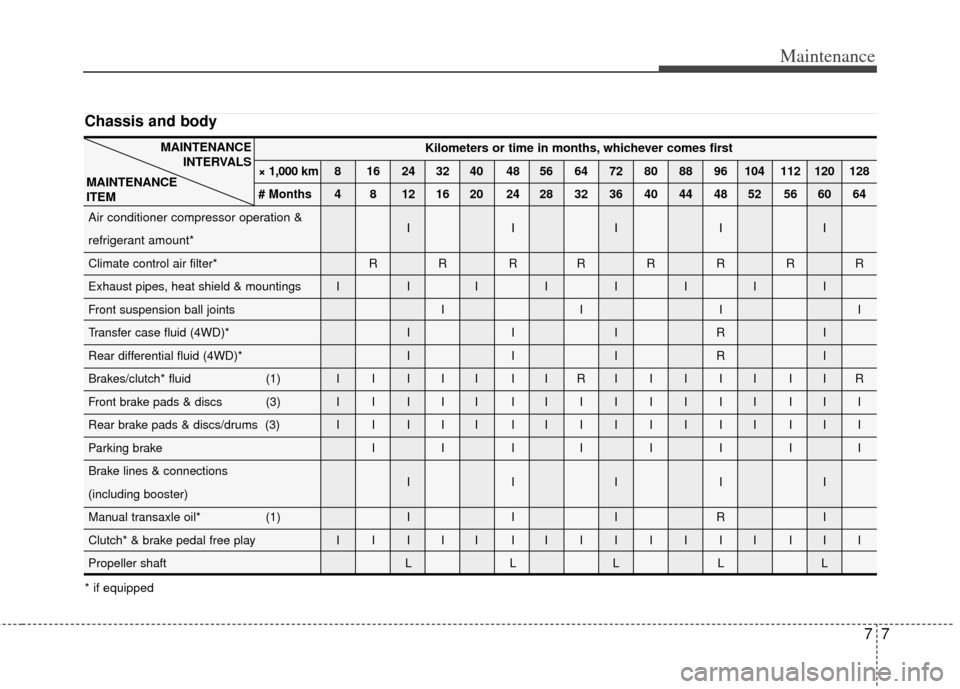
Chassis and body
Kilometers or time in months, whichever comes first
× 1,000 km 8 16 24 32 40 48 56 64 72 80 88 96 104 112 120 128
# Months 4 8 12 16 20 24 28 32 36 40 44 48 52 56 60 64
Air conditioner compressor operation & IIIII
refrigerant amount
*
Climate control air filter* R R R RRRRR
Exhaust pipes, heat shield & mountings I I IIIIII
Front suspension ball joints I I I I
Transfer case fluid (4WD)* I I I R I
Rear differential fluid (4WD)* I I I R I
Brakes/clutch* fluid (1) I I I I I I I R IIIII IIR
Front brake pads & discs (3) I I I I I I IIIIIII III
Rear brake pads & discs/drums (3) I I I I I I IIIIIII III
Parking brake I I I IIIII
Brake lines & connections IIIII
(including booster)
Manual transaxle oil* (1) I I I R I
Clutch* & brake pedal free play I I I I I I IIIIIII III
Propeller shaft L L L L L
MAINTENANCE INTERVALS
MAINTENANCE
ITEM
* if equipped
Page 356 of 385
747
Maintenance
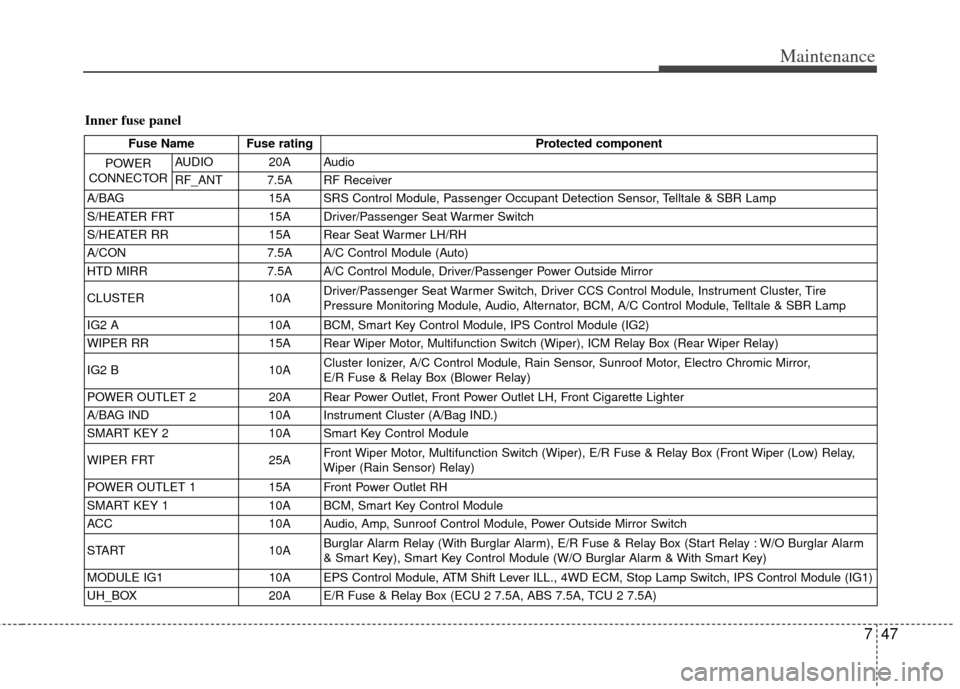
Inner fuse panel
Fuse Name Fuse ratingProtected component
POWER
CONNECTOR
AUDIO 20A Audio
RF_ANT 7.5A RF Receiver
A/BAG 15A SRS Control Module, Passenger Occupant Detection Sensor, Telltale & SBR Lamp
S/HEATER FRT 15A Driver/Passenger Seat Warmer Switch
S/HEATER RR 15A Rear Seat Warmer LH/RH
A/CON 7.5A A/C Control Module (Auto)
HTD MIRR 7.5A A/C Control Module, Driver/Passenger Power Outside Mirror
CLUSTER 10A Driver/Passenger Seat Warmer Switch, Driver CCS Control Module, Instrument Cluster, Tire
Pressure Monitoring Module, Audio, Alternator, BCM, A/C Control Module, Telltale & SBR Lamp
IG2 A 10A BCM, Smart Key Control Module, IPS Control Module (IG2)
WIPER RR 15A Rear Wiper Motor, Multifunction Switch (Wiper), ICM Relay Box (Rear Wiper Relay)
IG2 B 10A Cluster Ionizer, A/C Control Module, Rain Sensor, Sunroof Motor, Electro Chromic Mirror,
E/R Fuse & Relay Box (Blower Relay)
POWER OUTLET 2 20A Rear Power Outlet, Front Power Outlet LH, Front Cigarette Lighter
A/BAG IND 10A Instrument Cluster (A/Bag IND.)
SMART KEY 2 10A Smart Key Control Module
WIPER FRT 25A Front Wiper Motor, Multifunction Switch (Wiper), E/R Fuse & Relay Box (Front Wiper (Low) Relay,
Wiper (Rain Sensor) Relay)
POWER OUTLET 1 15A Front Power Outlet RH
SMART KEY 1 10A BCM, Smart Key Control Module
ACC 10A Audio, Amp, Sunroof Control Module, Power Outside Mirror Switch
START 10A Burglar Alarm Relay (With Burglar Alarm), E/R Fuse & Relay Box (Start Relay : W/O Burglar Alarm
& Smart Key), Smart Key Control Module (W/O Burglar Alarm & With Smart Key)
MODULE IG1 10A EPS Control Module, ATM Shift Lever ILL., 4WD ECM, Stop Lamp Switch, IPS Control Module (IG1)
UH_BOX 20A E/R Fuse & Relay Box (ECU 2 7.5A, ABS 7.5A, TCU 2 7.5A)
Page 358 of 385
749
Maintenance
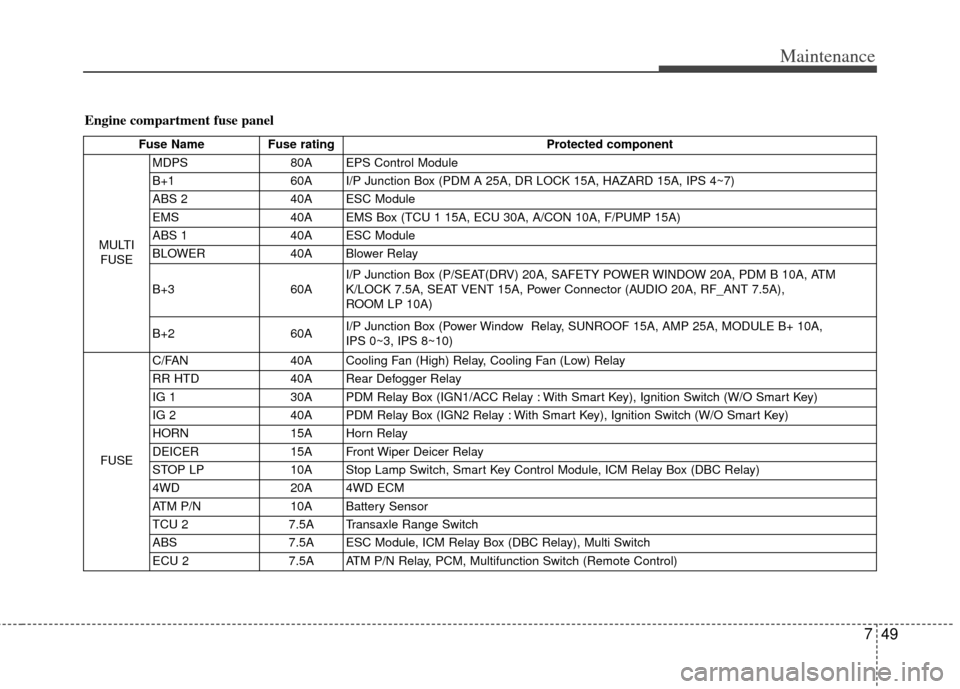
Engine compartment fuse panel
Fuse NameFuse rating Protected component
MULTI FUSE MDPS
80A EPS Control Module
B+1 60A I/P Junction Box (PDM A 25A, DR LOCK 15A, HAZARD 15A, IPS 4~7)
ABS 2 40A ESC Module
EMS 40A EMS Box (TCU 1 15A, ECU 30A, A/CON 10A, F/PUMP 15A)
ABS 1 40A ESC Module
BLOWER 40A Blower Relay
B+3 60AI/P Junction Box (P/SEAT(DRV) 20A, SAFETY POWER WINDOW 20A, PDM B 10A, ATM
K/LOCK 7.5A, SEAT VENT 15A, Power Connector (AUDIO 20A, RF_ANT 7.5A),
ROOM LP 10A)
B+2 60AI/P Junction Box (Power Window Relay, SUNROOF 15A, AMP 25A, MODULE B+ 10A,
IPS 0~3, IPS 8~10)
FUSE C/FAN
40A Cooling Fan (High) Relay, Cooling Fan (Low) Relay
RR HTD 40A Rear Defogger Relay
IG 1 30A PDM Relay Box (IGN1/ACC Relay : With Smart Key), Ignition Switch (W/O Smart Key)
IG 2 40A PDM Relay Box (IGN2 Relay : With Smart Key), Ignition Switch (W/O Smart Key)
HORN 15A Horn Relay
DEICER 15A Front Wiper Deicer Relay
STOP LP 10A Stop Lamp Switch, Smart Key Control Module, ICM Relay Box (DBC Relay)
4WD 20A 4WD ECM
ATM P/N 10A Battery Sensor
TCU 2 7.5A Transaxle Range Switch
ABS 7.5A ESC Module, ICM Relay Box (DBC Relay), Multi Switch
ECU 2 7.5A ATM P/N Relay, PCM, Multifunction Switch (Remote Control)
Page 372 of 385
8
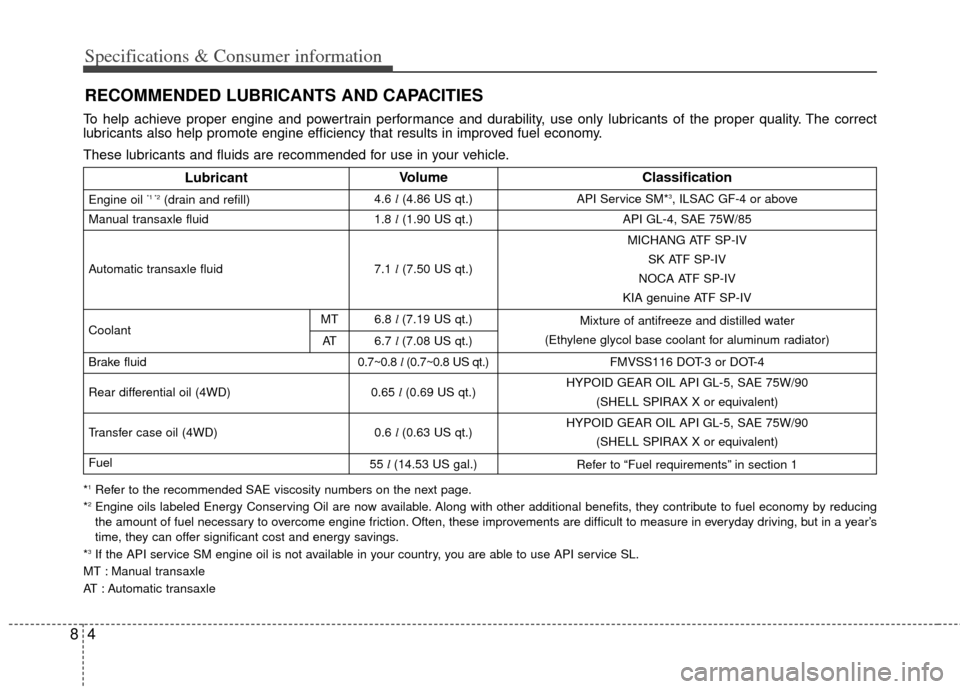
RECOMMENDED LUBRICANTS AND CAPACITIES
These lubricants and fluids are recommended for use in your vehicle.
To help achieve proper engine and powertrain performance and durability, use only lubricants of the proper quality. The correct
lubricants also help promote engine efficiency that results in improved fuel economy.
*1Refer to the recommended SAE viscosity numbers on the next page.
*2Engine oils labeled Energy Conserving Oil are now available. Along with other additional benefits, they contribute to fuel economy by reducing
the amount of fuel necessary to overcome engine friction. Often, these improvements are difficult to measure in everyday driving, but in a year’s
time, they can offer significant cost and energy savings.
*
3If the API service SM engine oil is not available in your country, you are able to use API service SL.
MT : Manual transaxle
AT : Automatic transaxle
4
Specifications & Consumer information
LubricantVolumeClassification
Engine oil *1 *2 (drain and refill)4.6 l(4.86 US qt.)API Service SM*3, ILSAC GF-4 or above
Manual transaxle fluid1.8 l(1.90 US qt.)API GL-4, SAE 75W/85
Automatic transaxle fluid7.1 l(7.50 US qt.)
MICHANG ATF SP-IV
SK ATF SP-IV
NOCA ATF SP-IV
KIA genuine ATF SP-IV
Coolant MT6.8 l (7.19 US qt.)Mixture of antifreeze and distilled water
(Ethylene glycol base coolant for aluminum radiator)
AT6.7 l (7.08 US qt.)
Brake fluid0.7~0.8 l (0.7~0.8 US qt.)FMVSS116 DOT-3 or DOT-4
Rear differential oil (4WD)0.65 l(0.69 US qt.)HYPOID GEAR OIL API GL-5, SAE 75W/90
(SHELL SPIRAX X or equivalent)
Transfer case oil (4WD)0.6 l(0.63 US qt.)HYPOID GEAR OIL API GL-5, SAE 75W/90
(SHELL SPIRAX X or equivalent)
Fuel55 l (14.53 US gal.)Refer to “Fuel requirements” in section 1