2011 KIA Soul TPMS
[x] Cancel search: TPMSPage 262 of 356
611
What to do in an emergency
This device complies with
Industry Canada Standard RSS-
210.
Operation is subject to the following
two conditions:
1.This device may not cause harmfulinterference, and
2.This device must accept any inter- ference received, including inter-
ference that may cause undesired
operation.
WARNING -
Tampering with, modifying, or
disabling the Tire Pressure
Monitoring System (TPMS)
components may interfere with
the system's ability to warn the
driver of low tire pressure con-
ditions and/or TPMS malfunc-
tions. Tampering with, modify-
ing, or disabling the Tire
Pressure Monitoring System
(TPMS) components may void
the warranty for that portion of
the vehicle.
WARNING- TPMS
The TPMS cannot alert you to severe and sudden tire dam-
age caused by external fac-
tors such as nails or road
debris.
If you feel any vehicle instabil- ity, immediately take your foot
off the accelerator, apply the
brakes gradually and with
light force, and slowly move to
a safe position off the road.
WARNING
Changes or modifications not
expressly approved by the party
responsible for compliance
could void the user’s authority
to operate the equipment.
Page 263 of 356
What to do in an emergency
12
6
TIRE PRESSURE MONITORING SYSTEM (TPMS) (IF EQUIPPED) - TYPE B
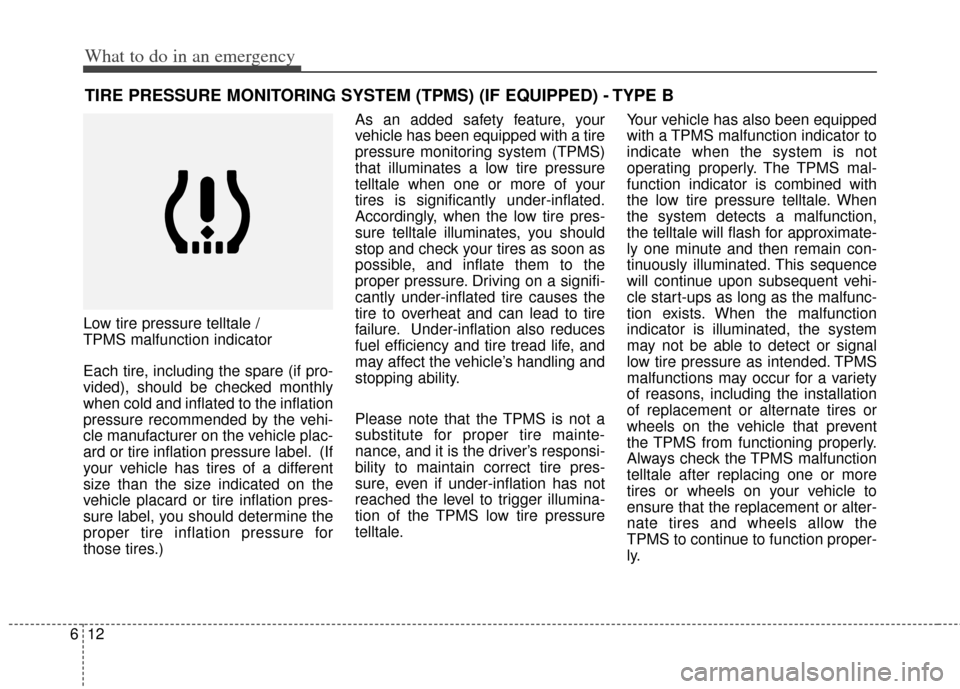
Low tire pressure telltale /
TPMS malfunction indicator
Each tire, including the spare (if pro-
vided), should be checked monthly
when cold and inflated to the inflation
pressure recommended by the vehi-
cle manufacturer on the vehicle plac-
ard or tire inflation pressure label. (If
your vehicle has tires of a different
size than the size indicated on the
vehicle placard or tire inflation pres-
sure label, you should determine the
proper tire inflation pressure for
those tires.) As an added safety feature, your
vehicle has been equipped with a tire
pressure monitoring system (TPMS)
that illuminates a low tire pressure
telltale when one or more of your
tires is significantly under-inflated.
Accordingly, when the low tire pres-
sure telltale illuminates, you should
stop and check your tires as soon as
possible, and inflate them to the
proper pressure. Driving on a signifi-
cantly under-inflated tire causes the
tire to overheat and can lead to tire
failure. Under-inflation also reduces
fuel efficiency and tire tread life, and
may affect the vehicle’s handling and
stopping ability.
Please note that the TPMS is not a
substitute for proper tire mainte-
nance, and it is the driver’s responsi-
bility to maintain correct tire pres-
sure, even if under-inflation has not
reached the level to trigger illumina-
tion of the TPMS low tire pressure
telltale.
Your vehicle has also been equipped
with a TPMS malfunction indicator to
indicate when the system is not
operating properly. The TPMS mal-
function indicator is combined with
the low tire pressure telltale. When
the system detects a malfunction,
the telltale will flash for approximate-
ly one minute and then remain con-
tinuously illuminated. This sequence
will continue upon subsequent vehi-
cle start-ups as long as the malfunc-
tion exists. When the malfunction
indicator is illuminated, the system
may not be able to detect or signal
low tire pressure as intended. TPMS
malfunctions may occur for a variety
of reasons, including the installation
of replacement or alternate tires or
wheels on the vehicle that prevent
the TPMS from functioning properly.
Always check the TPMS malfunction
telltale after replacing one or more
tires or wheels on your vehicle to
ensure that the replacement or alter-
nate tires and wheels allow the
TPMS to continue to function proper-
ly.
Page 264 of 356

613
What to do in an emergency
✽
✽NOTICE
If the TPMS, Low Tire Pressure
indicator do not illuminate for 3 sec-
onds when the ignition switch is
turned to the ON position or engine
is running, or if they remain illumi-
nated after coming on for approxi-
mately 3 seconds, take your car to
your nearest authorized KIA dealer
and have the system checked.
Low tire pressure telltale
When the tire pressure monitoring
system warning indicators are illumi-
nated, one or more of your tires is
significantly under-inflated.
If the telltale illuminates, immediately
reduce your speed, avoid hard cor-
nering and anticipate increased stop-
ping distances. You should stop and
check your tires as soon as possible.
Inflate the tires to the proper pres-
sure as indicated on the vehicle’s
placard or tire inflation pressure label
located on the driver’s side center pil-
lar outer panel. If you cannot reach a
service station or if the tire cannot
hold the newly added air, replace the
low pressure tire with the spare tire. Then the TPMS malfunction indicator
and the Low Tire Pressure telltale
may turn on and illuminate after
restarting and about 20 minutes of
continuous driving before you have
the low pressure tire repaired and
replaced on the vehicle.
CAUTION
In winter or cold weather, the
low tire pressure telltale may beilluminated if the tire pressurewas adjusted to the recom-mended tire inflation pressurein warm weather. It does notmean your TPMS is malfunction-ing because the decreased tem-perature leads to a proportionallowering of tire pressure.
When you drive your vehiclefrom a warm area to a cold areaor from a cold area to a warmarea, or the outside temperatureis greatly higher or lower, youshould check the tire inflationpressure and adjust the tires tothe recommended tire inflationpressure.
Page 265 of 356

What to do in an emergency
14
6
TPMS (Tire Pressure
Monitoring System)
malfunction indicator
The low tire pressure telltale will illu-
minate after it blinks for approximate-
ly one minute when there is a prob-
lem with the Tire Pressure Monitoring
System. If the system is able to cor-
rectly detect an underinflation warn-
ing at the same time as system fail-
ure then it will illuminate both the
TPMS malfunction and low tire pres-
sure telltales e.g. if Front Left sensor
fails, the TPMS malfunction indicator
illuminates, but if the Front Right,
Rear Left, or Rear Right tire is under-
inflated, the low tire pressure telltales
may illuminate toget her with the
TPMS malfunction indicator.
Have the system checked by an
authorized KIA dealer as soon as
possible to determine the cause of
the problem.
WARNING - Low pressure damage
Significantly low tire pressure
makes the vehicle unstable and
can contribute to loss of vehicle
control and increased braking
distances.
Continued driving on low pres-
sure tires can cause the tires to
overheat and fail.CAUTION
The TPMS malfunction indica- tor may be illuminated if thevehicle is moving around elec-tric power supply cables orradios transmitter such as atpolice stations, governmentand public offices, broadcast-ing stations, military installa-tions, airports, or transmittingtowers, etc. This can interferewith normal operation of theTire Pressure MonitoringSystem (TPMS).
The TPMS malfunction indica- tor may be illuminated if snowchains are used or some sep-arate electronic devices suchas notebook computer, mobilecharger, remote starter ornavigation etc., are used in thevehicle. This can interfere withnormal operation of the TirePressure Monitoring System(TPMS).
Page 266 of 356

615
What to do in an emergency
Changing a tire with TPMS
If you have a flat tire, the Low Tire
Pressure telltale will come on. Have
the flat tire repaired by an authorized
KIA dealer as soon as possible or
replace the flat tire with the spare
tire.
Each wheel is equipped with a tire
pressure sensor mounted inside the
tire behind the valve stem. You must
use TPMS specific wheels. It is rec-
ommended that you always have
your tires serviced by an authorized
KIA dealer.Even if you replace the low pressure
tire with the spare tire, the Low Tire
Pressure telltale will remain on until
the low pressure tire is repaired and
placed on the vehicle.
After you replace the low pressure
tire with the spare tire, the TPMS
malfunction indicator may illuminate
after a few minutes because the
TPMS sensor mounted on the spare
wheel is not initiated.
Once the low pressure tire is reinflat-
ed to the recommended pressure
and installed on the vehicle or the
TPMS sensor mounted on the
replaced spare wheel is initiated by
an authorized KIA dealer, the TPMS
malfunction indicator and the low tire
pressure telltale will extinguish within
a few minutes of driving.
If the indicator is not extinguished
after a few minutes of driving, please
visit an authorized KIA dealer.CAUTION
If a original mounted tire is
replaced with the spare tire, theTPMS sensor on the replacedspare wheel should be initiatedand the TPMS sensor on theoriginal mounted wheel shouldbe deactivated. If the TPMS sen-sor on the original mountedwheel located in the spare tirecarrier still activates, the tirepressure monitoring systemmay not operate properly. Havethe tire with TPMS serviced orreplaced by an authorized KIAdealer.
CAUTION
NEVER use a puncture-repair-ing agent to repair and/or inflatea low pressure tire. The tiresealant can damage the tirepressure sensor. If used, youwill have to replace the tire pres-sure sensor.
Page 267 of 356
What to do in an emergency
16
6
You may not be able identify a low
tire by simply looking at it. Always
use a good quality tire pressure
gauge to measure the tire's inflation
pressure. Please note that a tire that
is hot (from being driven) will have a
higher pressure measurement than a
tire that is cold (from sitting station-
ary for at least 3 hours and driven
less than 1 mile (1.6 km) during that
3 hour period).
Allow the tire to cool before measur-
ing the inflation pressure. Always be
sure the tire is cold before inflating to
the recommended pressure.
A cold tire means the vehicle has
been sitting for 3 hours and driven for
less than 1 mile (1.6 km) in that 3
hour period.
CAUTION
Do not use any tire sealant if
your vehicle is equipped with aTire Pressure MonitoringSystem. The liquid sealant candamage the tire pressure sen-sors.
WARNING - Protecting TPMS
Tampering with, modifying, or
disabling the Tire Pressure
Monitoring System (TPMS)
components may interfere with
the system's ability to warn the
driver of low tire pressure con-
ditions and/or TPMS malfunc-
tions. Tampering with, modify-
ing, or disabling the Tire
Pressure Monitoring System
(TPMS) components may void
the warranty for that portion of
the vehicle.WARNING- TPMS
The TPMS cannot alert you to severe and sudden tire dam-
age caused by external fac-
tors such as nails or road
debris.
If you feel any vehicle instabil- ity, immediately take your foot
off the accelerator, apply the
brakes gradually and with
light force, and slowly move to
a safe position off the road.
Page 349 of 356

Index
2I
Air bags··················\
··················\
··················\
··················\
··3-33Air bag warning label··················\
··················\
············3-59
Air bag warning light ··················\
··················\
············3-36
Curtain air bag··················\
··················\
··················\
·····3-51
Driver's and passenger's front air bag ··················\
·····3-45
Occupant detection system··················\
··················\
····3-39
Side impact air bag··················\
··················\
················3-49
Air cleaner ··················\
··················\
··················\
···············7-23
Antenna ··················\
··················\
··················\
··················\
··4-94
Anti-lock brake system (ABS) ··················\
··················\
··5-25
Appearance care··················\
··················\
··················\
·······7-52 Exterior care ··················\
··················\
··················\
········7-52
Interior care ··················\
··················\
··················\
·········7-57
Armrest ··················\
··················\
··················\
··················\
····3-8
Audio remote control ··················\
··················\
·················4-95\
Audio system ··················\
··················\
··················\
···········4-94 Antenna ··················\
··················\
··················\
···············4-94
Audio remote control ··················\
··················\
············4-95
Auto lock mode (Passenger seat belt) ··················\
·········3-28
Automatic climate control system ··················\
···············4-77 Air conditioning ··················\
··················\
··················\
··4-83
Automatic heating and air conditioning··················\
··4-78
Manual heating and air conditioning ··················\
······4-79
Automatic transaxle ··················\
··················\
··················\
·5-15 Ignition key interlock system ··················\
··················\
5-19
Shift lock system ··················\
··················\
··················\
·5-19
Sports mode··················\
··················\
··················\
·········5-18 Battery··················\
··················\
··················\
··················\
····7-27
Battery saver function··················\
··················\
················4-58
Before driving ··················\
··················\
··················\
············5-3
Brake system··················\
··················\
··················\
············5-22
Anti-lock brake system (ABS) ··················\
················5-25
Electronic stability control (ESC) ··················\
···········5-27
Parking brake ··················\
··················\
··················\
······5-23
Power brakes ··················\
··················\
··················\
·······5-22
Brake/clutch fluid ··················\
··················\
··················\
····7-18
Bulb wattage ··················\
··················\
··················\
··············8-2
Capacities (Lubricants) ··················\
··················\
················8-4
Care Exterior care ··················\
··················\
··················\
········7-52
Interior care ··················\
··················\
··················\
·········7-51
Tire care··················\
··················\
··················\
···············7-30
Cargo capacity ··················\
··················\
··················\
·········5-46
Cargo weight ··················\
··················\
··················\
············5-50
Center console storage ··················\
··················\
···············4-87
Central door lock switch··················\
··················\
············4-15
Certification label ··················\
··················\
··················\
····5-48
Changing a tire with TPMS ··················\
··················\
·········6-7
Changing tires ··················\
··················\
··················\
··········6-18
Checking tire inflation pressure··················\
··················\
·7-31
AB
C
Page 355 of 356

Index
8I
Summer tires ··················\
··················\
··················\
············7-42
Sunroof··················\
··················\
··················\
··················\
···4-27
Sunvisor ··················\
··················\
··················\
··················\
·4-90
Tachometer··················\
··················\
··················\
···············4-38
Tailgate··················\
··················\
··················\
··················\
···4-17Emergency tailgate safety release ··················\
···········4-18
Tether anchor system ··················\
··················\
·················3-30\
Tilt steering ··················\
··················\
··················\
··············4-31
Tire and loading information label ··················\
··············5-46
Tire specification and pressure label ··················\
·············8-7
Tires and wheels ··················\
··················\
·················7-30\
, 8-3 All season tires ··················\
··················\
··················\
····7-42
Checking tire inflation pressure ··················\
··············7-31
Compact spare tire replacement ··················\
··············7-35
Radial-ply tires ··················\
··················\
··················\
····7-42
Recommended cold tire inflation pressures ··············7-30
Snow tires ··················\
··················\
··················\
············7-42
Summer tires ··················\
··················\
··················\
·······7-42
Tire care··················\
··················\
··················\
···············7-30
Tire maintenance ··················\
··················\
··················\
·7-35
Tire replacement ··················\
··················\
··················\
··7-34
Tire rotation ··················\
··················\
··················\
·········7-32
Tire sidewall labeling ··················\
··················\
············7-36
Tire terminology and definitions··················\
·············7-40
Tire traction ··················\
··················\
··················\
·········7-35 Wheel alignment and tire balance ··················\
···········7-33
Wheel replacement ··················\
··················\
················7-35
Tires pressure monitoring system (TPMS)··················\
····6-7 Changing a tire with TPMS ··················\
··················\
··6-10
Low tire pressure telltale ··················\
·················6-8,\
6-13
TPMS (Tire pressure monitoring system) malfunction indicator ··················\
··················\
6-9, 6-14
Towing ··················\
··················\
··················\
··················\
···6-25 Emergency towing··················\
··················\
·················6-27\
Towing capacity ··················\
··················\
··················\
·······5-46
Transaxle Automatic transaxle ··················\
··················\
··············5-15
Manual transaxle ··················\
··················\
··················\
·5-12
Trip computer ··················\
··················\
··················\
··········4-41
Tripmeter··················\
··················\
··················\
··················\
4-41
Vehicle break-in process ··················\
··················\
··············1-5
Vehicle certification label ··················\
··················\
············8-6
Vehicle handling instructions··················\
··················\
·······1-5
Vehicle identification number (VIN) ··················\
·············8-6
Vehicle load limit ··················\
··················\
··················\
·····5-46 Cargo capacity ··················\
··················\
··················\
·····5-46
Certification label ··················\
··················\
··················\
5-48
Seating capacity ··················\
··················\
··················\
··5-46
Tire and loading information label··················\
··········5-46
Towing capacity ··················\
··················\
··················\
··5-46
Vehicle capacity weight ··················\
··················\
········5-46
T
V