Page 236 of 336
611
What to do in an emergency
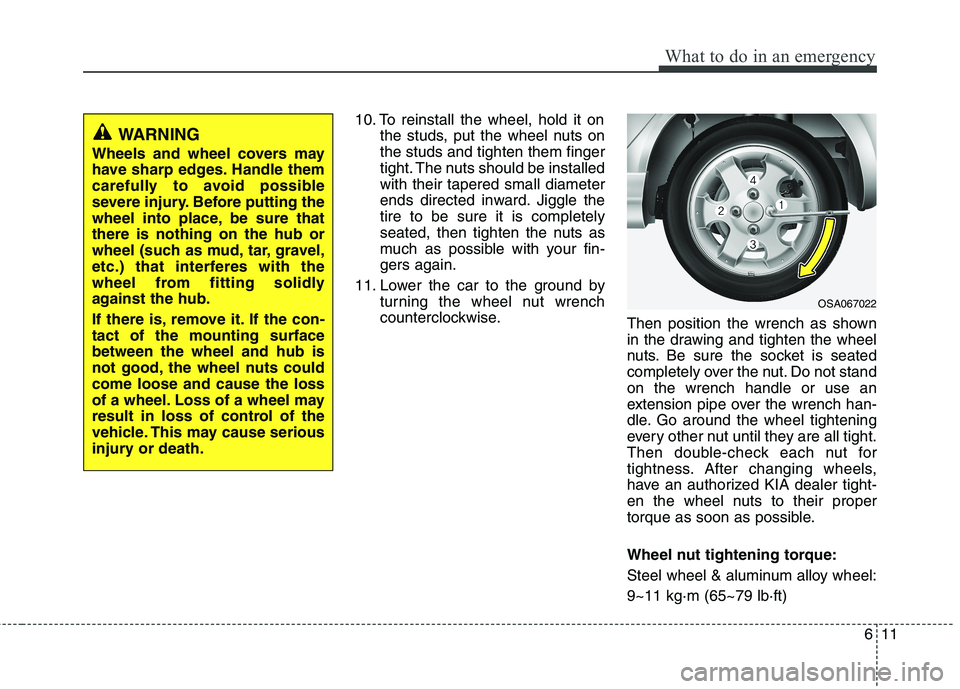
10. To reinstall the wheel, hold it onthe studs, put the wheel nuts on the studs and tighten them finger
tight. The nuts should be installedwith their tapered small diameter
ends directed inward. Jiggle thetire to be sure it is completely
seated, then tighten the nuts as
much as possible with your fin-gers again.
11. Lower the car to the ground by turning the wheel nut wrench
counterclockwise. Then position the wrench as shown
in the drawing and tighten the wheel
nuts. Be sure the socket is seated
completely over the nut. Do not standon the wrench handle or use an
extension pipe over the wrench han-
dle. Go around the wheel tightening
every other nut until they are all tight.
Then double-check each nut for
tightness. After changing wheels,
have an authorized KIA dealer tight-
en the wheel nuts to their proper
torque as soon as possible.
Wheel nut tightening torque:
Steel wheel & aluminum alloy wheel:9~11 kg·m (65~79 lb·ft)
WARNING
Wheels and wheel covers may
have sharp edges. Handle them
carefully to avoid possible
severe injury. Before putting the
wheel into place, be sure thatthere is nothing on the hub or
wheel (such as mud, tar, gravel,
etc.) that interferes with the
wheel from fitting solidly
against the hub.
If there is, remove it. If the con- tact of the mounting surfacebetween the wheel and hub is
not good, the wheel nuts couldcome loose and cause the loss
of a wheel. Loss of a wheel may
result in loss of control of the
vehicle. This may cause serious
injury or death.
OSA067022
Page 242 of 336
617
What to do in an emergency
3. Unscrew the bottle holder cap (4)and the lid of the sealant bottle (5). 4. Screw the bottle clockwise into the
bottle socket (6) until it is tight. 5. Unscrew the valve cap from the
defective tire.
6. Screw the hose (7) of the TireMobilityKit firmly onto the tire
valve.
7. Ensure that the On/Off switch (8) is in the "O"-position.
8. Place the electric plug (9) into the cigarette lighter socket (12 Volt).
Do not use any other electric sock-
et in the car.
9. Start the engine of the vehicle. (Only if the vehicle is outdoors!)
OUN066102LOUN066103L
CAUTION
Screwing the sealant bottle into
the socket will break the bottleseal. Do not unscrew the filledbottle from the socket - sealantcould come out.
WARNING
Carbonmonoxide poisoning
and suffocation is possible ifthe engine is left running in a
poorly ventilated or unventilat-
ed location (such as inside a
building).
Page 250 of 336

625
What to do in an emergency
When towing your vehicle in an emer- gency without wheel dollies :
1. Set the ignition switch in the ACC posi-tion.
2. Place the transaxle shift lever in N (Neutral).
3. Release the parking brake.
F080400AUN
Tie-down hook
(for flatbed towing) (if equipped)F080200APA
Removable towing hook (front) (if equipped)
1. Open the tailgate, and remove the tow-
ing hook from the tool case.
2. Remove the hole cover pressing the lower part of the cover on the front
bumper (1).
3. Install the towing hook by turning it clockwise into the hole until it is fullysecured (2).
4. Remove the towing hook and install the cover after use.
CAUTION
Failure to place the transaxle shift
lever in N (Neutral) may cause inter-nal damage to the transaxle.
CAUTION
Do not use the hooks under the
front and rear of the vehicle for tow-ing purposes. These hooks are
designed ONLY for transport tie- down. If the tie-down hooks are
used for towing, the tie-down hookswill be damaged and this could lead
to serious injury.
OSA067031OSA067029
OSA067028OSA067030
Page 252 of 336

627
What to do in an emergency
Use a towing strap less than 5 m (16feet) long. Attach a white or red cloth (about 30 cm (12 inches) wide) in the
middle of the strap for easy visibility.
Drive carefully so that the towing strap does not get loose during towing.
F080301AUN
Emergency towing precautions
Turn the ignition switch to ACC so the steering wheel isn’t locked.
Place the transaxle shift lever in N (Neutral).
Release the parking bake.
Press the brake pedal with more force than normal since you will have
reduced brake performance. More steering effort will be required
because the power steering system
will be disabled.
If you are driving down a long hill, the brakes may overheat and brake per-
formance will be reduced. Stop often
and let the brakes cool off.
WARNING
Use extreme caution when towing
the vehicle.
driving maneuvers which would
place excessive stress on the
emergency towing hook and tow-
ing cable or chain. The hook and
towing cable or chain may break
and cause serious injury or dam-
age.
If the disabled vehicle is unable to move, do not forcibly continue
the towing. Contact an authorized
KIA dealer or a commercial tow
truck service for assistance.
Tow the vehicle as straight ahead as possible.
Keep away from the vehicle dur- ing towing.
OPA067014
CAUTION - Automatic transaxle
If the car is being towed with all
four wheels on the ground, it canbe towed only from the front. Be
sure that the transaxle is in neu-tral. Be sure the steering isunlocked by placing the ignition
switch in the ACC position. Adriver must be in the towed vehi-
cle to operate the steering andbrakes.
To avoid serious damage to the automatic transaxle, limit thevehicle speed to 15 km/h (10 mph)
and drive less than 1.5 km (1mile) when towing.
Before towing, check the level of the automatic transaxle fluid. If itis below the "HOT" range on the
dipstick, add fluid. If you cannotadd fluid, a towing dolly must be
used.
Page 260 of 336

77
Maintenance
G030103AUN
At least monthly:
Check coolant level in the enginecoolant reservoir.
Check the operation of all exterior lights, including the stoplights, turn sig-
nals and hazard warning flashers.
Check the inflation pressures of all tires including the spare. G030104AUN
At least twice a year
(i.e., every Spring and Fall):
Check radiator, heater and air condi- tioning hoses for leaks or damage.
Check windshield washer spray and wiper operation. Clean the wiper
blades with clean cloth dampened with
washer fluid.
Check the headlight alignment.
Check the muffler, exhaust pipes, shields and clamps.
Check the lap/shoulder belts for wear and function.
Check for worn tires and loose wheel lug nuts. G030105APA
At least once a year:
Clean body and door drain holes.
Lubricate door hinges and checks, and
hood hinges.
Lubricate door and hood locks and latches.
Lubricate door rubber weatherstrips.
Check the air conditioning system.
Inspect and lubricate automatic transaxle linkage and controls.
Clean battery and terminals.
Check the brake/clutch fluid level.
Page 278 of 336

725
Maintenance
ENGINE COOLANT
G070000AUN The high-pressure cooling system has a
reservoir filled with year-round antifreeze
coolant. The reservoir is filled at the fac-
tory.
Check the antifreeze protection and
coolant level at least once a year, at thebeginning of the winter season, and
before traveling to a colder climate. G070100ASA
Checking the coolant level Check the condition and connections of all cooling system hoses and heater
hoses. Replace any swollen or deterio-
rated hoses.
The coolant level should be filled
between F and L marks on the side of the
coolant reservoir when the engine iscool.
WARNING- Removing
radiator cap
Never attempt to remove the radi- ator cap while the engine is oper-
ating or hot. Doing so might leadto cooling system and engine
damage and hot coolant or steam
could cause serious personal
injury.
(Continued)
(Continued)
Turn the engine off and wait untilit cools down. Use extreme care
when removing the radiator cap.
Wrap a thick towel around it, and
turn it counterclockwise slowly to
the first stop. Step back while the
pressure is released from the
cooling system. When you aresure all the pressure has been
released, press down on the cap,
using a thick towel, and continue
turning counterclockwise to
remove it.
Even if the engine is not operat- ing, do not remove the radiatorcap or the drain plug while the
engine and radiator are hot. Hot
coolant and steam may still blow
out under pressure, causing seri-
ous injury.
OSA070005
OSA077005
■Gasoline Engine
■Diesel Engine
Page 287 of 336
Maintenance
34
7
AIR CLEANER
G160100AUN Filter replacement
It must be replaced when necessary, and should not be cleaned and reused. 1. Loosen the air cleaner cover attaching
clips and open the cover.
2. Replace the air cleaner filter.
3. Lock the cover with the cover attachingclips.
OSA077012OSA077013
OSA077014
OSA077015
Page 290 of 336

737
Maintenance
WIPER BLADES
G180100AUN Blade inspection
✽✽ NOTICE
Commercial hot waxes applied by auto-
matic car washes have been known to
make the windshield difficult to clean.
Contamination of either the windshield or
the wiper blades with foreign matter can
reduce the effectiveness of the wind-
shield wipers. Common sources of con-
tamination are insects, tree sap, and hot
wax treatments used by some commer-
cial car washes. If the blades don’t wipe
properly, clean both the window and the
blades with a good cleaner or mild deter-
gent, and rinse thoroughly with clean
water. G180200AUN Blade replacement When the wipers no longer clean ade-
quately, the blades may be worn or
cracked, and require replacement.
G180201AUN
Front windshield wiper blade
1. Raise the wiper arm and turn the wiperblade assembly to expose the plastic
locking clip.
1JBA5122
CAUTION
To prevent damage to the wiper
blades, do not use gasoline,
kerosene, paint thinner, or othersolvents on or near them.
CAUTION
To prevent damage to the wiperarms or other components, do notattempt to move the wipers manual-
ly.
CAUTION
The use of a non-specified wiperblade could cause wiper malfunc- tion and failure.
1LDA5023
CAUTION
Do not allow the wiper arm to fall
against the windshield, since it may chip or crack the windshield.

