Page 262 of 352

617
What to do in an emergency
When towing your vehicle in an emer- gency without wheel dollies :
1. Set the ignition switch in the ACC posi-tion.
2. Place the shift lever in N (Neutral).
3. Release the parking brake.
Emergency towing
If towing is necessary, we recommend
you to have it done by an authorized
KIA dealer or a commercial tow truck
service.If towing service is not available in an
emergency, your vehicle may be tem-
porarily towed using a cable or chain
secured to the emergency towing hook
under the rear of the vehicle. Use
extreme caution when towing the vehicle.
A driver must be in the vehicle to steer it
and operate the brakes.
Towing in this manner may be done only
on hard-surfaced roads for a short dis-
tance and at low speeds. Also, the
wheels, axles, power train, steering and
brakes must all be in good condition.
Do not use the tow hooks to pull a vehi-
cle out of mud, sand or other condi-
tions from which the vehicle cannot be
driven out under its own power.
Avoid towing a vehicle heavier than the vehicle doing the towing.
The drivers of both vehicles should communicate with each other frequent-
ly.
CAUTION
Failure to place the shift lever in N
(Neutral) may cause internal dam-age to the transaxle.
OVG069007
Page 264 of 352

619
What to do in an emergency
Emergency towing precautions
Place the ignition switch in ACC so thesteering wheel isn’t locked.
Place the transaxle shift lever in N (Neutral).
Release the parking bake.
Press the brake pedal with more force than normal since you will have
reduced brake performance.
More steering effort will be required because the power steering system
will be disabled.
If you are driving down a long hill, the brakes may overheat and brake per-
formance will be reduced. Stop often
and let the brakes cool off.CAUTION - Automatic
transaxle
If the car is being towed with all four wheels on the ground, it can
be towed only from the front. Besure that the transaxle is in neu-tral. Be sure the steering is unlocked by placing the ignition
switch in the ACC position. Adriver must be in the towed vehi-cle to operate the steering and
brakes.
To avoid serious damage to the automatic transaxle, limit thevehicle speed to 15 km/h (10 mph)and drive less than 1.5 km (1
mile) when towing.
Before towing, check the auto- matic transaxle for fluid leaksunder your vehicle. If the auto- matic transaxle fluid is leaking, a
flatbed equipment or towing dollymust be used.
Page 296 of 352

731
Maintenance
Battery recharging
Your vehicle has a maintenance-free,
calcium-based battery.
If the battery becomes discharged in ashort time (because, for example, the
headlights or interior lights were left on
while the vehicle was not in use),
recharge it by slow charging (trickle)
for 10 hours.
If the battery gradually discharges because of high electric load while the
vehicle is being used, recharge it at 20-
30A for two hours.(Continued)
When lifting a plastic-cased bat-tery, excessive pressure on the
case may cause battery acid to
leak, resulting in personal injury.
Lift with a battery carrier or with
your hands on opposite corners.
Never attempt to recharge the battery when the battery cables are connected.
The electrical ignition system works with high voltage. Never
touch these components with theengine running or the ignition
switched on.
Failure to follow the above warn-
ings can result in serious bodily
injury or death.CAUTION
When you don’t use the vehicle for a long time in the low temper-
ature area, separate the batteryand keep it indoors.
Always charge the battery fully to prevent battery case damage in
low temperature area.
WARNING
Separating the battery from the
vehicle should be done in an
authorized KIA dealer.
Page 309 of 352
Maintenance
44
7
Instrument panel fuse replace- ment
1. Turn the ignition switch and all other
switches off.
2. Open the fuse panel cover. 3. Pull the suspected fuse straight out.
Use the removal tool provided in the
engine compartment fuse panel.
4. Check the removed fuse; replace it if it is blown.
5. Push in a new fuse of the same rating, and make sure it fits tightly in the clips.
If it fits loosely, consult an authorized KIA
dealer.
If you do not have a spare, use a fuse of the same rating from a circuit you may
not need for operating the vehicle, such as the cigarette lighter fuse.
If the headlights or other electrical com-
ponents do not work and the fuses are
OK, check the fuse panel in the engine
compartment. If a fuse is blown, it mustbe replaced.
OVG079018OVG079019L
Page 310 of 352

745
Maintenance
Memory fuse
Your vehicle is equipped with a memory
fuse to prevent battery discharge if your
vehicle is parked without being operated
for prolonged periods. Use the following
procedures before parking the vehicle for
prolonged periods.
1. Turn off the engine.
2. Turn off the headlights and tail lights.
3. Open the driver’s side panel cover andpull up the memory fuse.
✽✽ NOTICE
If the memory fuse is pulled up from the fuse panel, the warning chime,
audio, clock and interior lamps, etc.,
will not operate. Some items must be
reset after replacement. Refer to
“Battery” in this section.
Even when the memory fuse is pulled
up, the battery can still be discharged
by operation of the headlights or other
electrical devices.
Engine compartment fuse replacement
1. Turn the ignition switch and all other switches off.
2. Remove the fuse panel cover by pressing the tab and pulling the cover
up.
3. Check the removed fuse; replace it if it is blown. To remove or insert the fuse,use the fuse puller in the engine com-
partment fuse panel.
4. Push in a new fuse of the same rating, and make sure it fits tightly in the clips.
If it fits loosely, consult an authorized
KIA dealer.
OVG079020OVG079021L
Page 316 of 352
751
Maintenance
DescriptionSymbolFuse ratingProtected component
P/SEATDRIDRV30ADriver Lumbar Support Switch, Driver Cushion Extension Switch, Driver Manual Switch, IMS Control Module
P/HANDLEP/
HANDLE15AKey Solenoid, Tilt & Telescopic Module, Sport Mode Switch
A/CON10AA/C Control Module, Ionizer, E/R Fuse & Relay Box (RLY. 14)
HTD MRR10ADriver/Passenger Power Outside Mirror, A/C Control Module
START410A[W/O Smart Key] Ignition Switch, Burglar Alarm Relay,
E/R Fuse & Relay Box (RLY. 3-G4KE, RLY. 6-G6DC)
[With Smart Key] PDM, E/R Fuse & Relay Box (RLY. 6)
Page 317 of 352
Maintenance
52
7
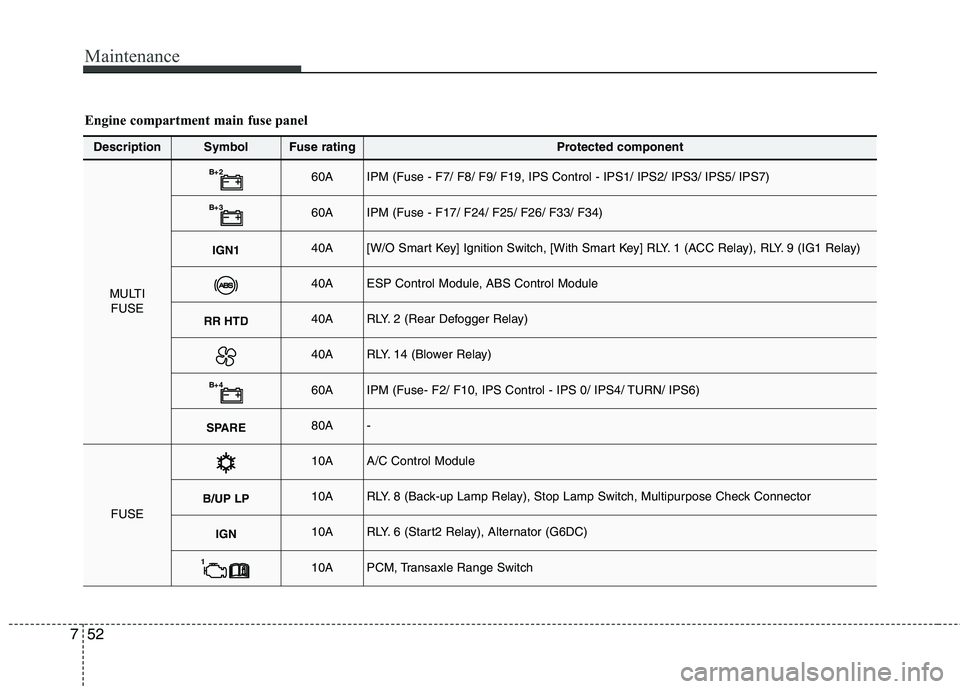
DescriptionSymbolFuse ratingProtected component
MULTI
FUSE
B+260AIPM (Fuse - F7/ F8/ F9/ F19, IPS Control - IPS1/ IPS2/ IPS3/ IPS5/ IPS7)
B+360AIPM (Fuse - F17/ F24/ F25/ F26/ F33/ F34)
IGN140A[W/O Smart Key] Ignition Switch, [With Smart Key] RLY. 1 (ACC Relay), RLY. 9 (IG1 Relay)
40AESP Control Module, ABS Control Module
RR HTD40ARLY. 2 (Rear Defogger Relay)
40ARLY. 14 (Blower Relay)
B+460AIPM (Fuse- F2/ F10, IPS Control - IPS 0/ IPS4/ TURN/ IPS6)
SPARE80A-
FUSE
10AA/C Control Module
B/UP LP10ARLY. 8 (Back-up Lamp Relay), Stop Lamp Switch, Multipurpose Check Connector
IGN10ARLY. 6 (Start2 Relay), Alternator (G6DC)
110APCM, Transaxle Range Switch
Engine compartment main fuse panel
Page 318 of 352
753
Maintenance
DescriptionSymbolFuse ratingProtected component
FUSE
SPARE30A-
IGN 230A[W/O Smart Key] Ignition Switch, RLY. 3 (Start1 Relay),
[With Smart Key] RLY. 3 (Start1 Relay), RLY. 10 (IG2 Relay)
B+140AIPM (Fuse - F4/ F12/ F18/ F35, Power Connector - F27/ F28)
240AEMS Box (Fuse - F35/ F36/ F37/ F38)
30AESP Control Module, ABS Control Module
10AIPM, RLY. 11 (Wiper Relay), Front Wiper Motor
AMS10A(Not Used)
20AICM Relay Box (Head Lamp Washer Relay)
320APCM (G4KE)
STOP LP15AStop Lamp Switch
20ARLY. 7 (Front Wiper Deicer Relay)
DIAGNOSIS20AMultipurpose Check Connector
40ARLY. 4 (Cooling Fan (Low) Relay), RLY. 5 (Cooling Fan (High) Relay)


![KIA CADENZA 2011 Owners Manual 753
Maintenance
DescriptionSymbolFuse ratingProtected component
FUSE
SPARE30A-
IGN 230A[W/O Smart Key] Ignition Switch, RLY. 3 (Start1 Relay),
[With Smart Key] RLY. 3 (Start1 Relay), RLY. 10 (IG2 Re](/manual-img/2/57935/w960_57935-317.png "KIA CADENZA 2011 Owners Manual 753
Maintenance
DescriptionSymbolFuse ratingProtected component
FUSE
SPARE30A-
IGN 230A[W/O Smart Key] Ignition Switch, RLY. 3 (Start1 Relay),
[With Smart Key] RLY. 3 (Start1 Relay), RLY. 10 (IG2 Re")