Page 270 of 603
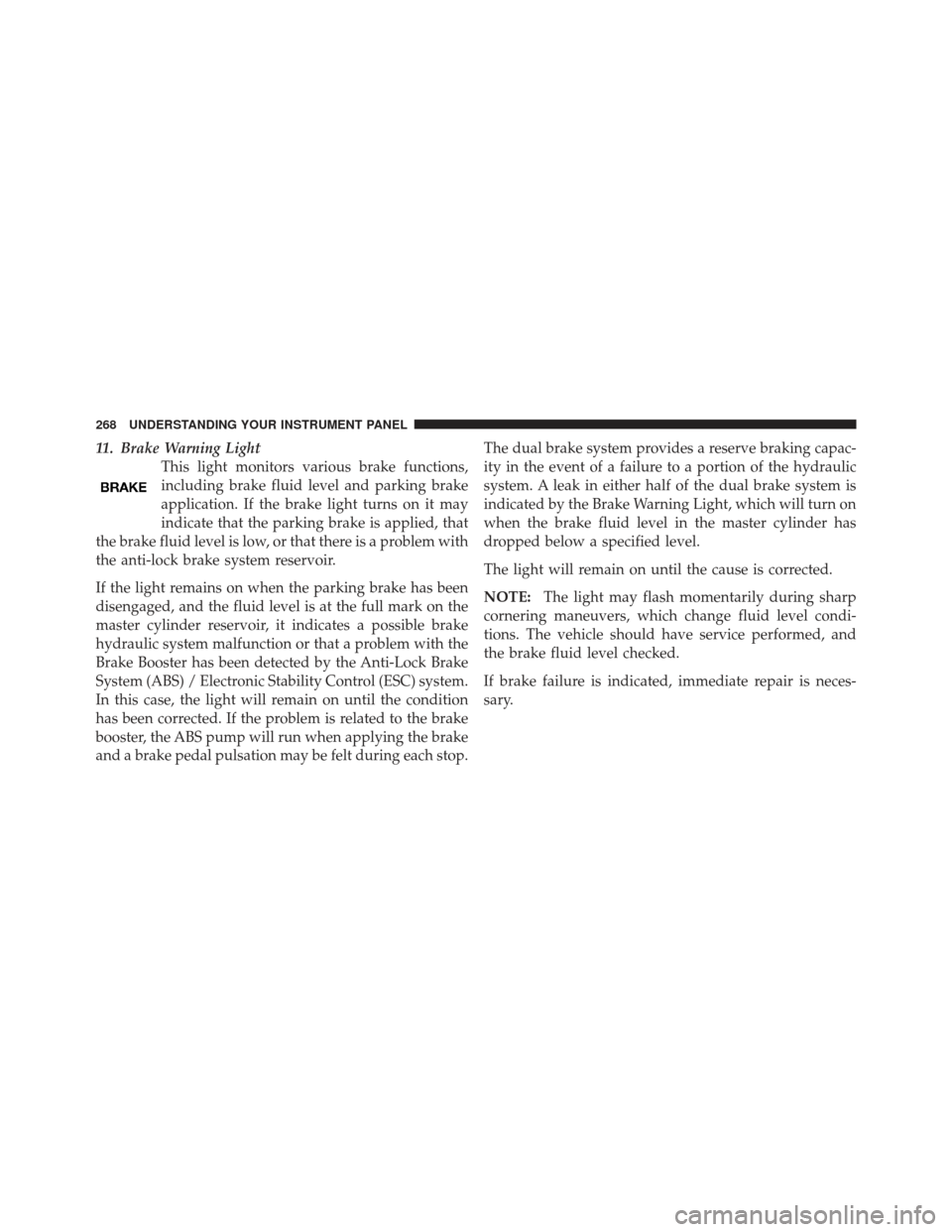
11. Brake Warning LightThis light monitors various brake functions,
including brake fluid level and parking brake
application. If the brake light turns on it may
indicate that the parking brake is applied, that
the brake fluid level is low, or that there is a problem with
the anti-lock brake system reservoir.
If the light remains on when the parking brake has been
disengaged, and the fluid level is at the full mark on the
master cylinder reservoir, it indicates a possible brake
hydraulic system malfunction or that a problem with the
Brake Booster has been detected by the Anti-Lock Brake
System (ABS) / Electronic Stability Control (ESC) system.
In this case, the light will remain on until the condition
has been corrected. If the problem is related to the brake
booster, the ABS pump will run when applying the brake
and a brake pedal pulsation may be felt during each stop. The dual brake system provides a reserve braking capac-
ity in the event of a failure to a portion of the hydraulic
system. A leak in either half of the dual brake system is
indicated by the Brake Warning Light, which will turn on
when the brake fluid level in the master cylinder has
dropped below a specified level.
The light will remain on until the cause is corrected.
NOTE:
The light may flash momentarily during sharp
cornering maneuvers, which change fluid level condi-
tions. The vehicle should have service performed, and
the brake fluid level checked.
If brake failure is indicated, immediate repair is neces-
sary.
268 UNDERSTANDING YOUR INSTRUMENT PANEL
Page 271 of 603

WARNING!
Driving a vehicle with the red brake light on is
dangerous. Part of the brake system may have failed.
It will take longer to stop the vehicle. You could have
a collision. Have the vehicle checked immediately.
Vehicles equipped with the Anti-Lock Brake System
(ABS), are also equipped with Electronic Brake Force
Distribution (EBD). In the event of an EBD failure, the
Brake Warning Light will turn on along with the ABS
Light. Immediate repair to the ABS system is required.
Operation of the Brake Warning Light can be checked by
turning the ignition switch from the OFF position to the
ON/RUN position. The light should illuminate for ap-
proximately two seconds. The light should then turn off
unless the parking brake is applied or a brake fault is
detected. If the light does not illuminate, have the light
inspected by an authorized dealer. The light also will turn on when the parking brake is
applied with the ignition switch in the ON/RUN posi-
tion.
NOTE:
This light shows only that the parking brake is
applied. It does not show the degree of brake application.
12. Anti-Lock Brake (ABS) Light After the ignition is turned on, the Anti-Lock
Brake System (ABS) light illuminates to indicate
function check at vehicle start-up. If the light remains on
after start-up or comes on and stays on at road speeds, it
may indicate that the ABS has detected a malfunction or
has become inoperative. The system reverts to standard
non-anti-lock brakes.
If both the Brake Warning Light and the ABS Warning
Light are on, see an authorized dealer immediately. Refer
to “Anti-Lock Brake System” in “Starting And Operat-
ing”.
4
UNDERSTANDING YOUR INSTRUMENT PANEL 269
Page 299 of 603

Nav–Turn By Turn
When this feature is selected, the navigation system
utilizes voice commands, guiding through the drive
route, mile by mile, turn-by-turn until the final destina-
tion is reached. To make your selection, press and release
the SELECT button until a check-mark appears next to
the feature showing the system has been activated or the
check-mark is removed showing the system has been
deactivated.
Hill Start Assist (HSA) — If Equipped
When on is selected, the HSA system is active. Refer to
“Electronic Brake Control System” in “Starting And
Operating” for system function and operating informa-
tion. To make your selection, press and release the
SELECT button until “On” or “Off” appears.
Display Fuel Saver — If Equipped
The “ECO” message is located in the Compass/
Temperature display; this message can be turned on or
off. To make your selection, press and release the SELECT
button until “ON” or “OFF” appears.
Compass Variance
Refer to “Compass Display” for more information.
Calibrate Compass
Refer to “Compass Display” for more information.
4
UNDERSTANDING YOUR INSTRUMENT PANEL 297
Page 367 of 603
STARTING AND OPERATING
CONTENTS
�Starting Procedures .................... 370
▫ Manual Transmission – If Equipped ....... 370
▫ Automatic Transmission – If Equipped ..... 370
▫ Normal Starting ..................... 370
▫ Extreme Cold Weather (Below –20°F Or
–29°C) ............................ 371
▫ If Engine Fails To Start ................ 371
▫ After Starting ....................... 373
� Engine Block Heater — If Equipped ........ 373�
Manual Transmission — If Equipped ........ 373
▫ Shifting ........................... 374
▫ Downshifting ....................... 375
▫ Reverse Shifting ..................... 376
� Automatic Transmission — If Equipped ...... 377
▫ Key Ignition Park Interlock ............. 378
▫ Brake/Transmission Interlock System ...... 378
▫ Automatic Transmission With Overdrive .... 378
5
Page 368 of 603

�Four–Wheel Drive Operation
(Command-Trac I� Or Rock-Trac�).......... 383
▫ Operating Instructions/Precautions ....... 383
▫ Shift Positions ...................... 385
▫ Shifting Procedure ................... 386
� Trac-Lok� Rear Axle — If Equipped ........ 387
� Axle Lock (Tru–Lok�) — Rubicon Models .... 388
� Electronic Sway Bar Disconnect —
If Equipped .......................... 389
� On-Road Driving Tips .................. 391
� Off-Road Driving Tips .................. 392
▫ Side Step Removal – If Equipped ......... 392
▫ The Basics Of Off-Road Driving .......... 393
▫ When To Use 4L (Low) Range ........... 394▫
Simultaneous Brake And Throttle
Operation .......................... 394
▫ Driving In Snow, Mud And Sand ......... 394
▫ Crossing Obstacles
(Rocks And Other High Points) .......... 396
▫ Hill Climbing ....................... 398
▫ Driving Through Water ................ 401
▫ After Driving Off-Road ................ 403
� Power Steering ....................... 405
▫ Power Steering Fluid Check ............. 406
� Parking Brake ........................ 406
� Anti-Lock Brake System ................. 409
� Electronic Brake Control System ........... 410
▫ Traction Control System (TCS) ........... 411
366 STARTING AND OPERATING
Page 369 of 603
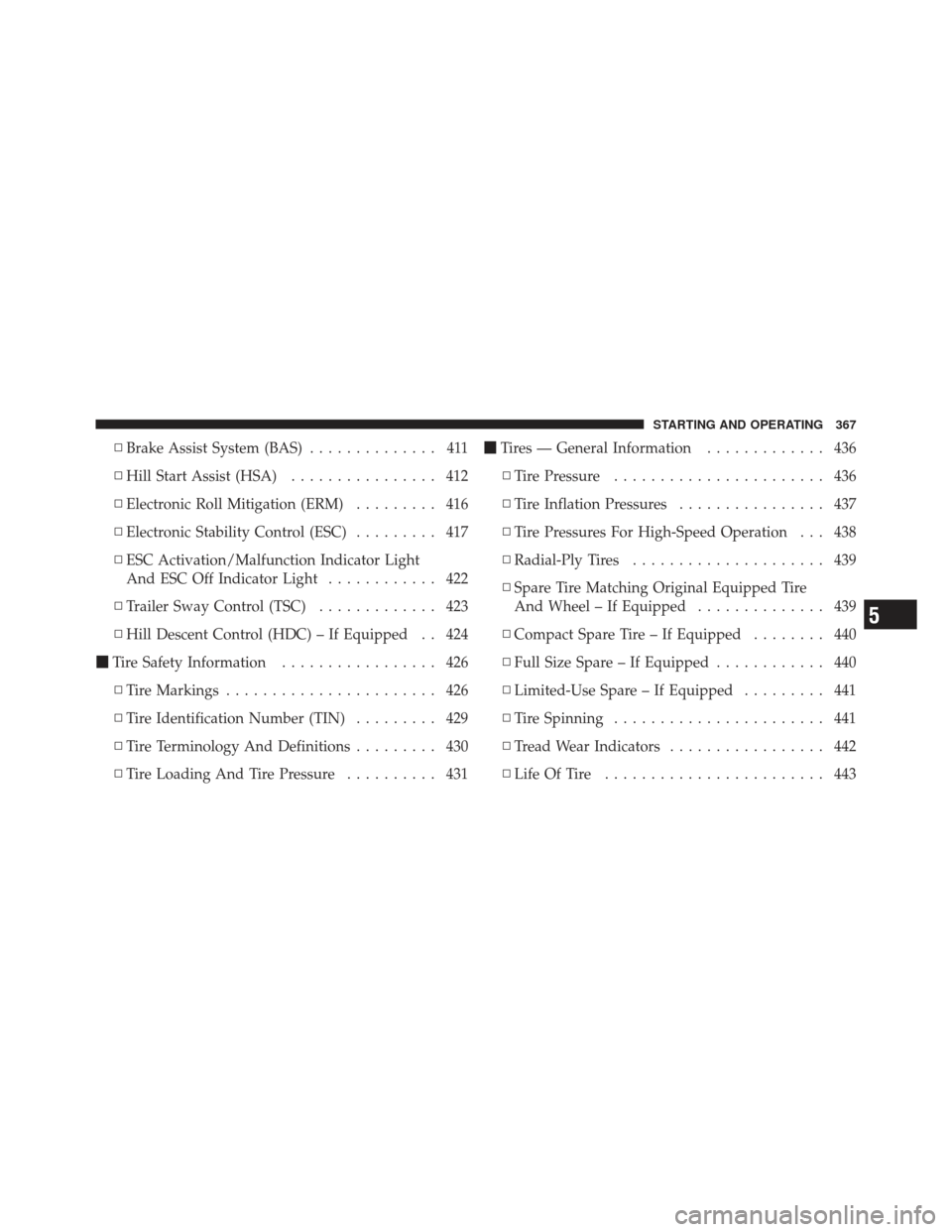
▫Brake Assist System (BAS) .............. 411
▫ Hill Start Assist (HSA) ................ 412
▫ Electronic Roll Mitigation (ERM) ......... 416
▫ Electronic Stability Control (ESC) ......... 417
▫ ESC Activation/Malfunction Indicator Light
And ESC Off Indicator Light ............ 422
▫ Trailer Sway Control (TSC) ............. 423
▫ Hill Descent Control (HDC) – If Equipped . . 424
� Tire Safety Information ................. 426
▫ Tire Markings ....................... 426
▫ Tire Identification Number (TIN) ......... 429
▫ Tire Terminology And Definitions ......... 430
▫ Tire Loading And Tire Pressure .......... 431�
Tires — General Information ............. 436
▫ Tire Pressure ....................... 436
▫ Tire Inflation Pressures ................ 437
▫ Tire Pressures For High-Speed Operation . . . 438
▫ Radial-Ply Tires ..................... 439
▫ Spare Tire Matching Original Equipped Tire
And Wheel – If Equipped .............. 439
▫ Compact Spare Tire – If Equipped ........ 440
▫ Full Size Spare – If Equipped ............ 440
▫ Limited-Use Spare – If Equipped ......... 441
▫ Tire Spinning ....................... 441
▫ Tread Wear Indicators ................. 442
▫ Life Of Tire ........................ 443
5
STARTING AND OPERATING 367
Page 372 of 603

STARTING PROCEDURES
Before starting your vehicle, adjust your seat, adjust both
inside and outside mirrors, and fasten your seat belts.
WARNING!
Never leave children in the vehicle alone. Leaving
unattended children in a vehicle is dangerous for a
number of reasons. The child or others could be
seriously or fatally injured. The child could operate
power windows, other controls or move the vehicle.
Manual Transmission – If Equipped
Apply the parking brake, place the shift lever in NEU-
TRAL, and press the clutch pedal before starting the
vehicle. This vehicle is equipped with a clutch interlock-
ing ignition system. It will not start unless the clutch
pedal is pressed to the floor.Four-Wheel Drive Models Only
In 4L mode, this vehicle will start regardless of whether
or not the clutch pedal is pressed to the floor. This feature
enhances off-road performance by allowing the vehicle to
start when in 4L without having to press the clutch pedal.
The “4WD Indicator Light” will illuminate when the
transfer case has been shifted into this mode.
Automatic Transmission – If Equipped
Start the vehicle with the shift lever in the PARK position
(vehicle can also be started in NEUTRAL). Apply the
brake before shifting to any driving range.
Normal Starting
NOTE:
Normal starting of either a cold or a warm
engine is obtained without pumping or pressing the
accelerator pedal.
370 STARTING AND OPERATING
Page 375 of 603

CAUTION!
To prevent damage to the starter, wait 10 to 15 sec-
onds before trying again.
After Starting
The idle speed will automatically decrease as the engine
warms up.
ENGINE BLOCK HEATER — IF EQUIPPED
The engine block heater warms the engine, and permits
quicker starts in cold weather. Connect the cord to a
standard 110-115 Volt AC electrical outlet with a
grounded, three-wire extension cord.
The engine block heater cord is found under the hood
bundled in front of the battery tray.
The engine block heater must be plugged in at least one
hour to have an adequate warming effect on the engine.
WARNING!
Remember to disconnect the engine block heater
cord before driving. Damage to the 110-115 Volt AC
electrical cord could cause electrocution.
MANUAL TRANSMISSION — IF EQUIPPED
WARNING!
You or others could be injured if you leave the
vehicle unattended without having the parking
brake fully applied. The parking brake should al-
ways be applied when the driver is not in the vehicle,
especially on an incline.5
STARTING AND OPERATING 373
