Page 28 of 490
•Remote Start Aborted - Hood Ajar
•Remote Start Aborted - Fuel Low
•Remote Start Aborted - System Fault
The EVIC message stays active until the ignition is turned
to the ON/RUN position.
To Enter Remote Start
Press and release the REMOTE START button
on the RKE transmitter twice within five sec-
onds. The parking lights will flash and the horn
will chirp twice (if programmed). Then, the
engine will start and the vehicle will remain in the
Remote Start mode for a 15-minute cycle.
NOTE:
•The park lamps will turn on and remain on during
Remote Start mode.
•For security, power window and power sunroof op-
eration (if equipped) are disabled when the vehicle is
in the Remote Start mode.
•The engine can be started two consecutive times (two
15-minute cycles) with the RKE transmitter. However,
the ignition switch must be cycled to the ON/RUN
position before you can repeat the start sequence for a
third cycle.
Remote start will also cancel if any of the following occur:
•The engine stalls or RPM exceeds 2500
•Any engine warning lamps come on
•Fuel lamp turns on
•The hood is opened
•The hazard switch is pressed
•The transmission is moved out of PARK
26 THINGS TO KNOW BEFORE STARTING YOUR VEHICLE
Page 148 of 490
Reclining Rear Seat — If Equipped
For additional comfort, pull the strap forward just
enough to release the seatback latch. Then push the
seatback to a reclined position, approximately 35 degrees
maximum, and release the strap.
WARNING!
Do not ride with the seatback reclined so that the
shoulder belt is no longer resting against your chest.
In a collision you could slide under the seat belt and
be seriously or even fatally injured. Use the recliner
only with the vehicle is parked.
TO OPEN AND CLOSE THE HOOD
To open the hood, two latches must be released.
1. Pull the hood release lever located on the left kick
panel.
Hood Release Lever
146 UNDERSTANDING THE FEATURES OF YOUR VEHICLE
Page 414 of 490
hood latching components to ensure proper function.
When performing other underhood services, the hood
latch, release mechanism and safety catch should be
cleaned and lubricated.
The external lock cylinders should be lubricated twice a
year, preferably in the Fall and Spring. Apply a small
amount of a high quality lubricant, such as MOPAR�
Lock Cylinder Lubricant or equivalent directly into the
lock cylinder.
Windshield Wiper Blades
Clean the rubber edges of the wiper blades and the
windshield periodically with a sponge or soft cloth and a
mild, nonabrasive cleaner or use the washer solvent. This
will remove accumulations of salt, waxes or road film
and help reduce streaking and smearing.
Operation of the wipers on dry glass for long periods
may cause deterioration of the wiper blades. Always use
washer fluid when using the wipers to remove salt or dirt from a dry windshield. Avoid using the wiper blades to
remove frost or ice from the windshield. Make sure that
they are not frozen to the glass before turning them on to
avoid damaging the blade. Keep the blade rubber out of
contact with petroleum products such as engine oil,
gasoline, etc.
NOTE:
Life expectancy of wiper blades varies depend-
ing on geographical area and frequency of use. Poor
performance of blades may be present with chattering,
marks, water lines or wet spots. If any of these conditions
are present, clean the wiper blades or replace as
necessary.
Adding Washer Fluid
The washer fluid reservoir is located in the engine
compartment, and the fluid level should be checked at
regular intervals. Fill the reservoir with windshield
washer solvent only (not radiator antifreeze).
412 MAINTAINING YOUR VEHICLE
Page 423 of 490
WARNING!
Riding the brakes can lead to brake failure and
possibly a collision. Driving with your foot resting or
riding on the brake pedal can result in abnormally
high brake temperatures, excessive lining wear, and
possible brake damage. You would not have your full
braking capacity in an emergency.
Brake Master Cylinder
The fluid level in the master cylinder should be checked
when performing under hood services, or immediately if
the brake system warning light is on.
Be sure to clean the top of the master cylinder area before
removing the cap. If necessary, add fluid to bring the
fluid level up to the requirements described on the brake
fluid reservoir. Fluid level can be expected to fall as the
brake pads wear. The brake fluid level should be checkedwhen the pads are replaced. However, low fluid level
may be caused by a leak and a checkup may be needed.
NOTE:
If your vehicle is equipped with a manual
transmission , the brake fluid reservoir supplies fluid to
both the brake system and the clutch release system. The
two systems are separated in the reservoir, and a leak in
one system will not affect the other system. The manual
transmission clutch release system should not require
fluid replacement during the life of the vehicle. If the
brake fluid reservoir is low and the brake system does
not indicate any leaks or other problems, it may be a
result of a leak in the hydraulic clutch release system. See
your local authorized dealer for service.
Use only manufacturer’s recommended brake fluid. Re-
fer to “Fluids, Lubricants, and Genuine Parts” in “Main-
taining Your Vehicle” for further information.
7
MAINTAINING YOUR VEHICLE 421
Page 477 of 490
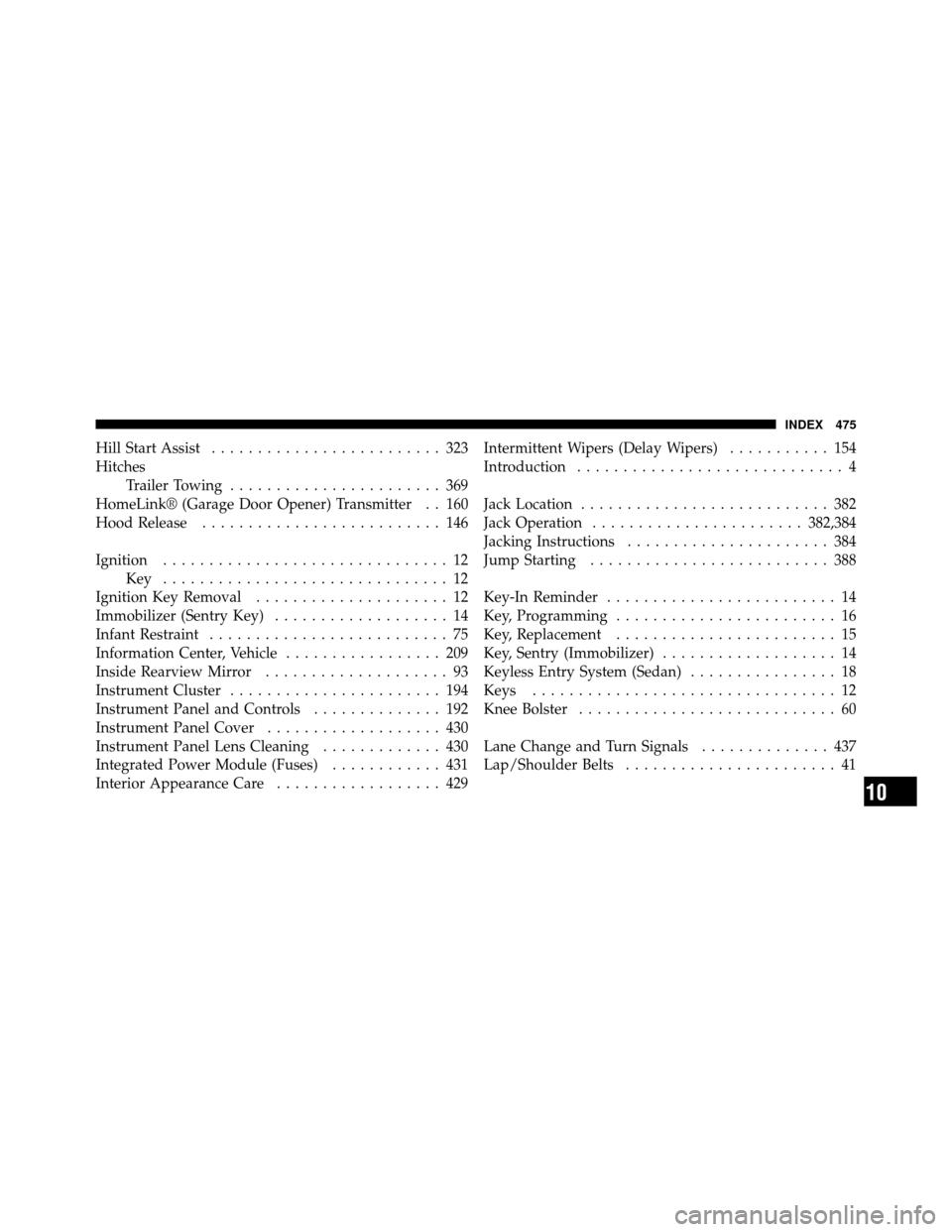
Hill Start Assist......................... 323
Hitches Trailer Towing ....................... 369
HomeLink® (Garage Door Opener) Transmitter . . 160
Hood Release .......................... 146
Ignition ............................... 12
Key ............................... 12
Ignition Key Removal ..................... 12
Immobilizer (Sentry Key) ................... 14
Infant Restraint .......................... 75
Information Center, Vehicle ................. 209
Inside Rearview Mirror .................... 93
Instrument Cluster ....................... 194
Instrument Panel and Controls .............. 192
Instrument Panel Cover ................... 430
Instrument Panel Lens Cleaning ............. 430
Integrated Power Module (Fuses) ............ 431
Interior Appearance Care .................. 429 Intermittent Wipers (Delay Wipers)
........... 154
Introduction ............................. 4
Jack Location ........................... 382
Jack Operation ....................... 382,384
Jacking Instructions ...................... 384
Jump Starting .......................... 388
Key-In Reminder ......................... 14
Key, Programming ........................ 16
Key, Replacement ........................ 15
Key, Sentry (Immobilizer) ................... 14
Keyless Entry System (Sedan) ................ 18
Keys ................................. 12
Knee Bolster ............................ 60
Lane Change and Turn Signals .............. 437
Lap/Shoulder Belts ....................... 41
10
INDEX 475