Page 308 of 490
CAUTION!
Reduced tire pressures may cause tire unseating and
total loss of air pressure. To reduce the risk of tire
unseating, while at a reduced tire pressure, reduce
your speed and avoid sharp turns or abrupt maneu-
vers.
Hill Climbing
Hill climbing requires good judgment and a good under-
standing of your abilities and your vehicle’s limitations.
Hills can cause serious problems. Some are just too steep
to climb and should not be attempted. You should always
feel confident with the vehicle and your abilities. You
should always climb hills straight up and down. Never
attempt to climb a hill on an angle.
Before Climbing A Steep Hill
As you approach a hill consider its grade or steepness.
Determine if it is too steep. Look to see what the traction
is on the hill side trail. Is the trail straight up and down?
What is on top and the other side? Are there ruts, rocks,
branches or other obstacles on the path? Can you safely
recover the vehicle if something goes wrong? If every-
thing looks good and you feel confident, then you should
use low (L Off-Road) with the 4WD LOCK engaged and
proceed with caution maintaining your momentum as
you climb the hill.
Driving Up Hill
Once you have determined your ability to proceed and
have shifted into the appropriate gear, line your vehicle
up for the straightest possible run. Accelerate with an
easy constant throttle and apply more power as you start
up the hill. Do not race forward into a steep grade, the
abrupt change of grade could cause you to lose control. If
the front end begins to bounce, ease off the throttle
306 STARTING AND OPERATING
Page 309 of 490

slightly to bring all four tires back on the ground. As you
approach the crest of the hill ease off the throttle and
slowly proceed over the top. If the wheels start to slip as
you approach the crest of a hill, ease off the accelerator
and maintain headway by turning the steering wheel no
more than a 1/4 turn quickly back and forth. This will
provide a fresh�bite�into the surface and will usually
provide enough traction to complete the climb. If you do
not make it to the top, place the vehicle in REVERSE and
back straight down the grade using engine resistance
along with the vehicle brakes.
WARNING!
Never attempt to climb a hill at an angle or turn
around on a steep grade. Driving across an incline
increases the risk of a rollover, which may result in
severe injury.
Driving Down Hill
Before driving down a steep hill you need to determine if
it is too steep for a safe descent. What is the surface
traction? Is the grade too steep to maintain a slow
controlled descent? Are there obstacles? Is it a straight
descent? Is there plenty of distance at the base of the hill
to regain control if the vehicle descends to fast? If you feel
confident in your ability to proceed then make sure you
are in low (L Off-Road) with the 4WD LOCK engaged
and proceed with caution. Allow engine and hill descent
braking to control the descent and apply your brakes if
necessary, but do not allow the tires to lock.
WARNING!
Do not descend a steep grade in NEUTRAL. Use
vehicle brakes in conjunction with engine braking.
Descending a grade too fast could cause you to lose
control and be seriously injured.
5
STARTING AND OPERATING 307
Page 311 of 490
designated and approved. You should tread lightly and
avoid damage to the environment. You should know
your vehicles abilities and be able to recover it if some-
thing goes wrong. You should never stop or shut a
vehicle off when crossing deep water unless you ingested
water into the engine air intake. If the engine stalls, do
not attempt to restart it. Determine if it has ingested
water first. The key to any crossing is low and slow. You
want to use low (L Off-Road) with the 4WD LOCK
engaged and proceed very slowly with a constant slow
speed {3-5 mph (5–8 km/h) maximum} and light throttle.
Keep the vehicle moving; do not try to accelerate through
the crossing. After crossing any water higher than the
bottom of the axle differentials, you should inspect all of
the vehicle fluids for signs of water ingestion.CAUTION!
Water ingestion into the transaxle, transfer case,
engine or vehicle interior can occur if you drive too
fast or through too deep of water. Water can cause
permanent damage to engine, driveline or other
vehicle components and your brakes will be less
effective once wet and/or muddy.
Before You Cross Any Type Of Water
As you approach any type of water you need to deter-
mine if you can cross it safely and responsibly. If neces-
sary, get out and walk through the water or probe it with
a stick. You need to be sure of its depth, approach angle,
current and bottom condition. Be careful of murky or
muddy waters, check for hidden obstacles. Make sure
you will not be intruding on any wildlife and you can
recover the vehicle if necessary. The key to a safe crossing
is the water depth, current and bottom conditions. On
5
STARTING AND OPERATING 309
Page 400 of 490
▫Exhaust System ..................... 413
▫ Cooling System ..................... 415
▫ Brake System ....................... 420
▫ Automatic Transmission
(CVT) – If Equipped .................. 423
▫ Manual Transmission – If Equipped ....... 424
▫ Rear Drive Assembly (RDA) – AWD/4WD
Models Only ....................... 425
▫ Power Transfer Unit (PTU) – AWD/4WD
Models Only ....................... 425
▫ Appearance Care And Protection From
Corrosion .......................... 426
� Fuses .............................. 431
▫ Integrated Power Module .............. 431�
Vehicle Storage ....................... 435
� Replacement Bulbs .................... 435
� Bulb Replacement ..................... 436
▫ Headlamps ........................ 436
▫ Fog Lamps ......................... 436
▫ Rear Tail, Turn Signal And Backup Lamps . . . 437
▫ License Lamps ...................... 437
▫ Center High-Mounted Stoplamp ......... 437
� Fluid Capacities ...................... 438
� Fluids, Lubricants, And Genuine Parts ....... 439
▫ Engine ............................ 439
▫ Chassis ........................... 440
398 MAINTAINING YOUR VEHICLE
Page 427 of 490
the vehicle. Fluid changes are not necessary unless lubri-
cant has become contaminated with water.
NOTE:If contaminated with water, the fluid should be
changed immediately.
Rear Drive Assembly (RDA) – AWD/4WD Models
Only
Lubricant Selection
Use only the manufacturer’s recommended fluid. Refer
to “Fluids, Lubricants, and Genuine Parts” in “Maintain-
ing Your Vehicle” for further information.
Fluid Level Check
Visually inspect the unit at each oil change for leakage. If
leakage is detected, check the fluid level by removing the
fill plug. The fluid level should be maintained between
the bottom of the fill hole to 1/8 in (4 mm) below the fill
hole.
Add fluid, if necessary, to maintain the proper level.
Frequency Of Fluid Change
Refer to the “Maintenance Schedule” for the proper
maintenance interval.
Power Transfer Unit (PTU) – AWD/4WD Models
Only
Lubricant Selection
Use only the manufacturer’s recommended fluid. Refer
to “Fluids, Lubricants, and Genuine Parts” in “Maintain-
ing Your Vehicle” for further information.
Fluid Level Check
Visually inspected the unit at each oil change for leakage.
If leakage is detected, Check the fluid level by removing
the fill plug. The fluid level should be maintained be-
tween the bottom of the fill hole to 1/8 in (4 mm) below
the fill hole.
Add fluid, if necessary, to maintain the proper level.
7
MAINTAINING YOUR VEHICLE 425
Page 433 of 490
Seat Belt Maintenance
Do not bleach, dye or clean the seat belts with chemical
solvents or abrasive cleaners. This will weaken the fabric.
Sun damage can also weaken the fabric.
If the seat belts need cleaning, use a mild soap solution or
lukewarm water. Do not remove the seat belts from the
car to wash them. Dry with a soft cloth.
Replace the seat belts if they appear frayed or worn or if
the buckles do not work properly.
FUSES
Integrated Power Module
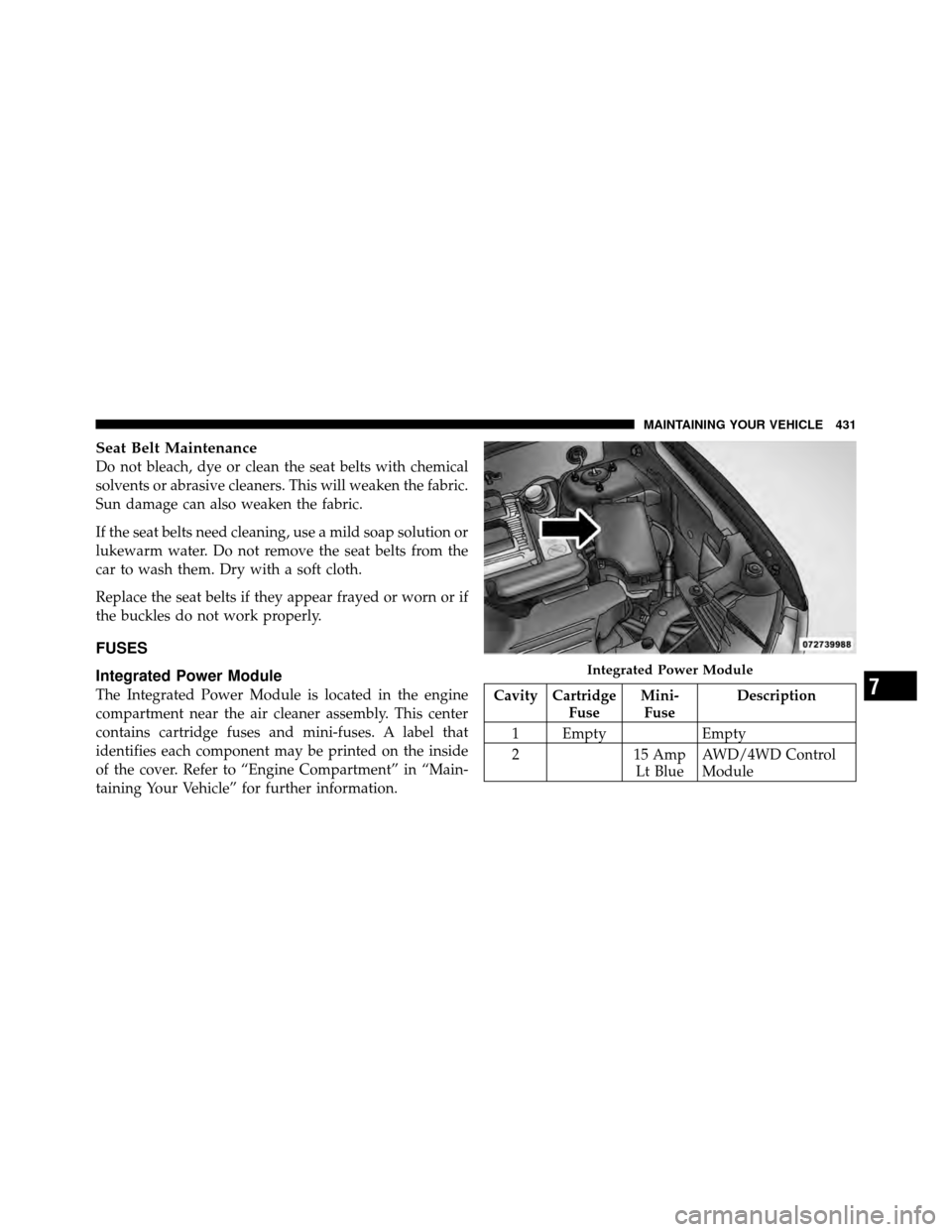
The Integrated Power Module is located in the engine
compartment near the air cleaner assembly. This center
contains cartridge fuses and mini-fuses. A label that
identifies each component may be printed on the inside
of the cover. Refer to “Engine Compartment” in “Main-
taining Your Vehicle” for further information.Cavity CartridgeFuseMini-
Fuse Description
1 Empty Empty
2 15 Amp
Lt Blue AWD/4WD Control
Module
Integrated Power Module
7
MAINTAINING YOUR VEHICLE 431