Page 497 of 587
Air Conditioner Maintenance
For best possible performance, your air conditioner
should be checked and serviced by an authorized dealer
at the start of each warm season. This service should
include cleaning of the condenser fins and a performance
test. Drive belt condition should also be checked at this
time.
CAUTION!
Do not use chemical flushes in your air conditioning
system as the chemicals can damage your air condi-
tioning components. Such damage is not covered by
the New Vehicle Limited Warranty.
WARNING!
•Use only refrigerants and compressor lubricants
approved by the manufacturer for your air condi-
tioning system. Some unapproved refrigerants are
flammable and can explode, injuring you. Other
unapproved refrigerants or lubricants can cause
the system to fail, requiring costly repairs. Refer to
Warranty Information Book, located on the DVD,
for further warranty information.
•The air conditioning system contains refrigerant
under high pressure. To avoid risk of personal
injury or damage to the system, adding refrigerant
or any repair requiring lines to be disconnected
should be done by an experienced repairman.
NOTE: Use only manufacturer approved A/C System
Sealers, Stop Leak Products, Seal Conditioners, Compres-
sor Oil, and Refrigerants.
7
MAINTAINING YOUR VEHICLE 495
Page 498 of 587

Refrigerant Recovery and Recycling
R-134a Air Conditioning Refrigerant is a hydrofluoro-
carbon (HFC) that is endorsed by the Environmental
Protection Agency (EPA) and is an ozone-saving product.
However, the manufacturer recommends that air condi-
tioning service be performed by authorized dealers or
other service facilities using recovery and recycling
equipment.
Body Lubrication
Locks and all body pivot points, including such items as
seat tracks, door hinge pivot points and rollers, liftgate,
tailgate, sliding doors and hood hinges, should be lubri-
cated periodically with a lithium based grease, such as
MOPAR�Spray White Lube or equivalent to assure
quiet, easy operation and to protect against rust and
wear. Prior to the application of any lubricant, the parts
concerned should be wiped clean to remove dust and
grit; after lubricating excess oil and grease should be
removed. Particular attention should also be given to hood latching components to ensure proper function.
When performing other underhood services, the hood
latch, release mechanism and safety catch should be
cleaned and lubricated.
The external lock cylinders should be lubricated twice a
year, preferably in the Fall and Spring. Apply a small
amount of a high quality lubricant, such as MOPAR�
Lock Cylinder Lubricant or equivalent directly into the
lock cylinder.Windshield Wiper Blades
Clean the rubber edges of the wiper blades and the
windshield periodically with a sponge or soft cloth and a
mild nonabrasive cleaner to remove accumulations of salt
or road film.
Operation of the wipers on dry glass for long periods
may cause deterioration of the wiper blades. Always use
washer fluid when using the wipers to remove salt or dirt
from a dry windshield.
496 MAINTAINING YOUR VEHICLE
Page 499 of 587
Avoid using the wiper blades to wipe frost or ice from the
windshield. Keep the blade rubber out of contact with
petroleum products such as engine oil, gasoline, etc.
NOTE:Life expectancy of wiper blades varies depend-
ing on geographical area and frequency of use. Poor
performance of blades may be present with chattering,
marks, water lines or wet spots. If any of these conditions
are present, clean the wiper blades or replace as neces-
sary.
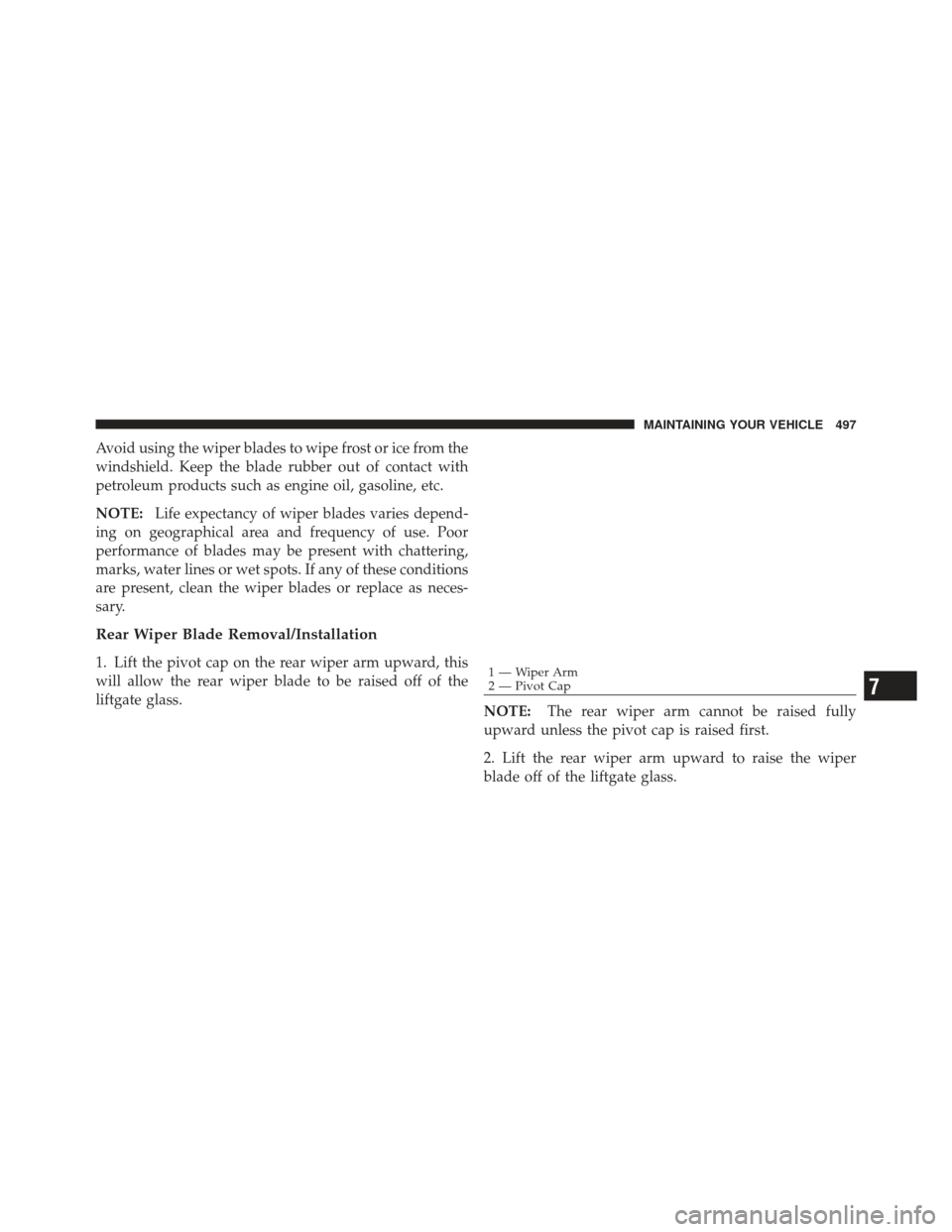
Rear Wiper Blade Removal/Installation
1. Lift the pivot cap on the rear wiper arm upward, this
will allow the rear wiper blade to be raised off of the
liftgate glass. NOTE:The rear wiper arm cannot be raised fully
upward unless the pivot cap is raised first.
2. Lift the rear wiper arm upward to raise the wiper
blade off of the liftgate glass.1—WiperArm
2 — Pivot Cap
7
MAINTAINING YOUR VEHICLE 497
Page 501 of 587

clean the wiper blades, this will help blade performance.
To prevent freeze-up of your windshield washer system
in cold weather, select a solution or mixture that meets or
exceeds the temperature range of your climate. This
rating information can be found on most washer fluid
containers.
WARNING!
Commercially available windshield washer solvents
are flammable. They could ignite and burn you. Care
must be exercised when filling or working around
the washer solution.
Exhaust System
The best protection against carbon monoxide entry into
the vehicle body is a properly maintained engine exhaust
system.
If you notice a change in the sound of the exhaust system;
or if the exhaust fumes can be detected inside the vehicle;
or when the underside or rear of the vehicle is damaged;
have an authorized technician inspect the complete ex-
haust system and adjacent body areas for broken, dam-
aged, deteriorated, or mispositioned parts. Open seams
or loose connections could permit exhaust fumes to seep
into the passenger compartment. In addition, inspect the
exhaust system each time the vehicle is raised for lubri-
cation or oil change. Replace as required.
7
MAINTAINING YOUR VEHICLE 499
Page 511 of 587
WARNING! (Continued)
•To avoid contamination from foreign matter or
moisture, use only new brake fluid or fluid that
has been in a tightly closed container. Keep the
master cylinder reservoir cap secured at all times.
Brake fluid in a open container absorbs moisture
from the air resulting in a lower boiling point.
This may cause it to boil unexpectedly during hard
or prolonged braking, resulting in sudden brake
failure. This could result in a collision.
•Overfilling the brake fluid reservoir can result in
spilling brake fluid on hot engine parts, causing
the brake fluid to catch fire. Brake fluid can also
damage painted and vinyl surfaces, care should be
taken to avoid its contact with these surfaces.(Continued)
WARNING! (Continued)
•Do not allow petroleum based fluid to contami-
nate the brake fluid. Brake seal components could
be damaged, causing partial or complete brake
failure. This could result in a collision.
Front/Rear Axle Fluid
For normal service, periodic fluid level checks are not
required. When the vehicle is serviced for other reasons
the exterior surfaces of the axle assembly should be
inspected. If gear oil leakage is suspected inspect the
fluid level. Refer to “Fluids, Lubricants, and Genuine
Parts” in “Maintaining Your Vehicle” for further informa-
tion.
Front Axle Fluid Level Check
The front axle oil level needs to be between 1/8 in (3 mm)
below the bottom of the fill hole and the bottom of the fill
hole.
7
MAINTAINING YOUR VEHICLE 509
Page 512 of 587
The front axle fill and drain plugs should be tightened to
22 to 29 ft lbs (30 to 40 N·m).
CAUTION!
Do not over tighten the plugs as it could damage
them and cause them to leak.
Rear Axle Fluid Level Check
The rear axle oil level needs to be between 1/8 in (3 mm)
below the bottom of the fill hole and the bottom of the fill
hole.
The rear axle fill and drain plugs should be tightened to
22 to 29 ft lbs (30 to 40 N·m) on axles with aluminum
housings. The rear axle fill and drain plugs should be
tightened to 22 to 52 ft lbs (30 to 70 N·m) on axles with
cast iron housings.
CAUTION!
Do not over tighten the plugs as it could damage then
and cause them to leak.
Selection of Lubricant
Use only the manufacturer’s recommended fluid. Refer
to “Fluids, Lubricants, and Genuine Parts” in “Maintain-
ing Your Vehicle” for further information.
Transfer Case
Fluid Level Check
Inspect the transfer case for fluid leaks. If a fluid leak is
found, the transfer case fluid level can be checked by
removing the filler plug located on the back side of the
transfer case. The fluid level should be at the bottom edge
of the filler plug hole when the vehicle is in a level
position.
510 MAINTAINING YOUR VEHICLE
Page 516 of 587
6. Remove the dipstick again, and note the fluid level on
both sides. The fluid level should be between the “HOT”
(upper) reference holes on the dipstick at normal operat-
ing temperature. The fluid level is only valid if there is a
solid coating of oil on both sides of the dipstick. If the
fluid is low, add as required into the dipstick tube.Do
not overfill. After adding any quantity of oil through the
oil fill tube, wait a minimum of two minutes for the oil to
fully drain into the transmission before rechecking the
fluid level.
NOTE: If it is necessary to check the transmission below
the operating temperature, the fluid level should be
between the two “COLD” (lower) holes on the dipstick
with the fluid at approximately 70°F (21°C) (room tem-
perature). If the fluid level is correctly established at
room temperature, it should be between the “HOT”
(upper) reference holes when the transmission reaches
180°F (82°C). Remember it is best to check the level at the
normal operating temperature.CAUTION!
Be aware that if the fluid temperature is below 50°F
(10°C) it may not register on the dipstick. Do not add
fluid until the temperature is elevated enough to
produce an accurate reading.
7. Check for leaks. Release parking brake.
To prevent dirt and water from entering the transmission
after checking or replenishing fluid, make certain that the
dipstick cap is properly reseated. It is normal for the
dipstick cap to spring back slightly from its fully seated
position, as long as its seal remains engaged in the
dipstick tube.
514 MAINTAINING YOUR VEHICLE
Page 519 of 587
•Use MOPAR�Touch Up Paint or equivalent on
scratches or chips as soon as possible. Your authorized
dealer has touch up paint to match the color of your
vehicle.
Wheel and Wheel Trim Care
All wheels and wheel trim, especially aluminum and
chrome-plated wheels should be cleaned regularly with a
mild soap and water to prevent corrosion. To remove
heavy soil, use MOPAR� Wheel Cleaner or select a
nonabrasive, non-acidic cleaner. Do not use scouring
pads, steel wool, a bristle brush or metal polishes. Only
MOPAR� cleaners or equivalent are recommended. Do
not use oven cleaner. Avoid automatic car washes that
use acidic solutions or harsh brushes that may damage
the wheels’ protective finish.
Stain Repel Fabric Cleaning Procedure –
If Equipped
Stain Repel seats may be cleaned in the following man-
ner:
•Remove as much of the stain as possible by blotting
with a clean, dry towel.
•Blot any remaining stain with a clean, damp towel.
•For tough stains, apply MOPAR� Total Clean or a mild
soap solution to a clean, damp cloth and remove the
stain. Use a fresh, damp towel to remove soap residue.
•For grease stains, apply MOPAR� Multi-Purpose
Cleaner or equivalent to a clean, damp cloth and
remove the stain. Use a fresh, damp towel to remove
soap residue.
•Do not use any harsh solvents or any other form of
protectants on Stain Repel products.
7
MAINTAINING YOUR VEHICLE 517