2011 JAGUAR XF Start
[x] Cancel search: StartPage 169 of 225

R
(FM8) SEMCON JLR OWNER GUIDE VER 1.00 EURO
LANGUAGE: english-en; MARQUE: jaguar; MODEL: XF
Fluid level checks
169
V6 petrol engines
Note: If it is necessary to check the oil level
when the engine is hot, switch off the engine
and let stand for five minutes to allow the oil to
drain into the sump. Do not start the engine.
1. Withdraw the dipstick and wipe the blade
clean with a lint free cloth.
2. Fully re-insert the dipstick and withdraw
again to check the oil level. Never allow the
oil level to fall below the lower mark or
notch on the dipstick.
As a general guide, if the level on the
dipstick:
•Is nearer to the upper mark or notch
than the lower, add no oil.
• Is nearer to the lower mark or notch
than the upper, add half a litre (one
pint) of oil.
• Is below the lower mark or notch, add
one litre (two pints) of oil and re-check
the level after a further five minutes.ENGINE OIL SPECIFICATION
Low quality or obsolete oils do not
provide the protection required by
modern, high perfor mance engines.
Failure to use an oil that meets the
required specification could cause
excessive engine wear, a build up of
sludge and deposit s and increased
pollution. It could also lead to engine
failure.
Your vehicle’s warranty may be
invalidated if damage is caused by the
use of unapproved engine oil.
Do not use oil additives of any type as
engine damage could occur. Use only
specified lubricants.
Model Specification
V6 Petrol
engines SAE 5W-30 engine oil meeting
Jaguar specification WSS
M2C913-C is preferred. Oil
meeting ACEA A1/B1 or ACEA
A3/B3 specification may be
used.
V8 Petrol
engines SAE 5W-20 meeting Jaguar
specification WSS M2C925-A
only.
Diesel
engines 5W-30 engine oil, meeting
Jaguar specification WSS
M2C934-B only.
Japan V6
Petrol
engines SAE 5W-30 engine oil meeting
specification ILSAC GF-4 with
API SM is prefe
rred. Oil meeting
ILSAC GF-3 API SL specification
may be used.
Japan V8
Petrol
engines SAE 5W-20 engine oil meeting
Jaguar specification WSS
M2C925-A only.
Page 173 of 225

R
(FM8) SEMCON JLR OWNER GUIDE VER 1.00 EURO
LANGUAGE: english-en; MARQUE: jaguar; MODEL: XF
Fluid level checks
173
POWER STEERING FLUID CHECK
Power steering fluid is highly toxic.
Keep containers sealed and out of
reach of children. If accidental
consumption of fluid is suspected,
seek medical atte ntion immediately.
If the fluid comes into contact with the
skin or eyes, rinse immediately with
plenty of water.
Power steering fluid is highly
inflammable. Do not allow power
steering fluid to come into contact
with naked flames or other sources of
ignition (e.g. a hot engine).
The engine must not be started if the
fluid level has dropped below the MIN
mark.
Seek qualified assistance immediately if
there is a noticeable drop in the fluid
level.
If fluid loss is slow, the reservoir may
be topped-up to the upper level mark to
enable the vehicle to be driven to a
repair facility for examination. However,
it is recommended that you seek
qualified assistance before driving the
vehicle.
Check and top-up the flui d with the vehicle on
level ground, with the e ngine switched off and
the system cold. Ensure that the steering wheel
is not turned after stopping the engine.
The level of fluid can be seen through the
translucent body of the reservoir.
The fluid level should be between the MIN and
the MAX marks.
TOPPING UP THE POWER STEERING
FLUID
It is imperative that the power steering
system does not become contaminated
in any way. Always use new fluid and
clean the area around the filler neck
both before removing the filler cap and
after topping up. Never return drained
fluid to the system.
Power steering fluid will damage
painted surfaces. Soak up any spillage
with an absorbent cloth immediately
and wash the area with a mixture of car
shampoo and water.
1. Clean the filler cap before removing to
prevent dirt from entering the reservoir.
2. Remove filler cap.
3. Using Mobil ATF320 PAS fluid, top-up the
reservoir until the fluid level is between the
MIN and MAX marks.
4. Replace filler cap.
Page 182 of 225
L
(FM8) SEMCON JLR OWNER GUIDE VER 1.00 EURO
LANGUAGE: english-en; MARQUE: jaguar; MODEL: XF
Vehicle battery
182
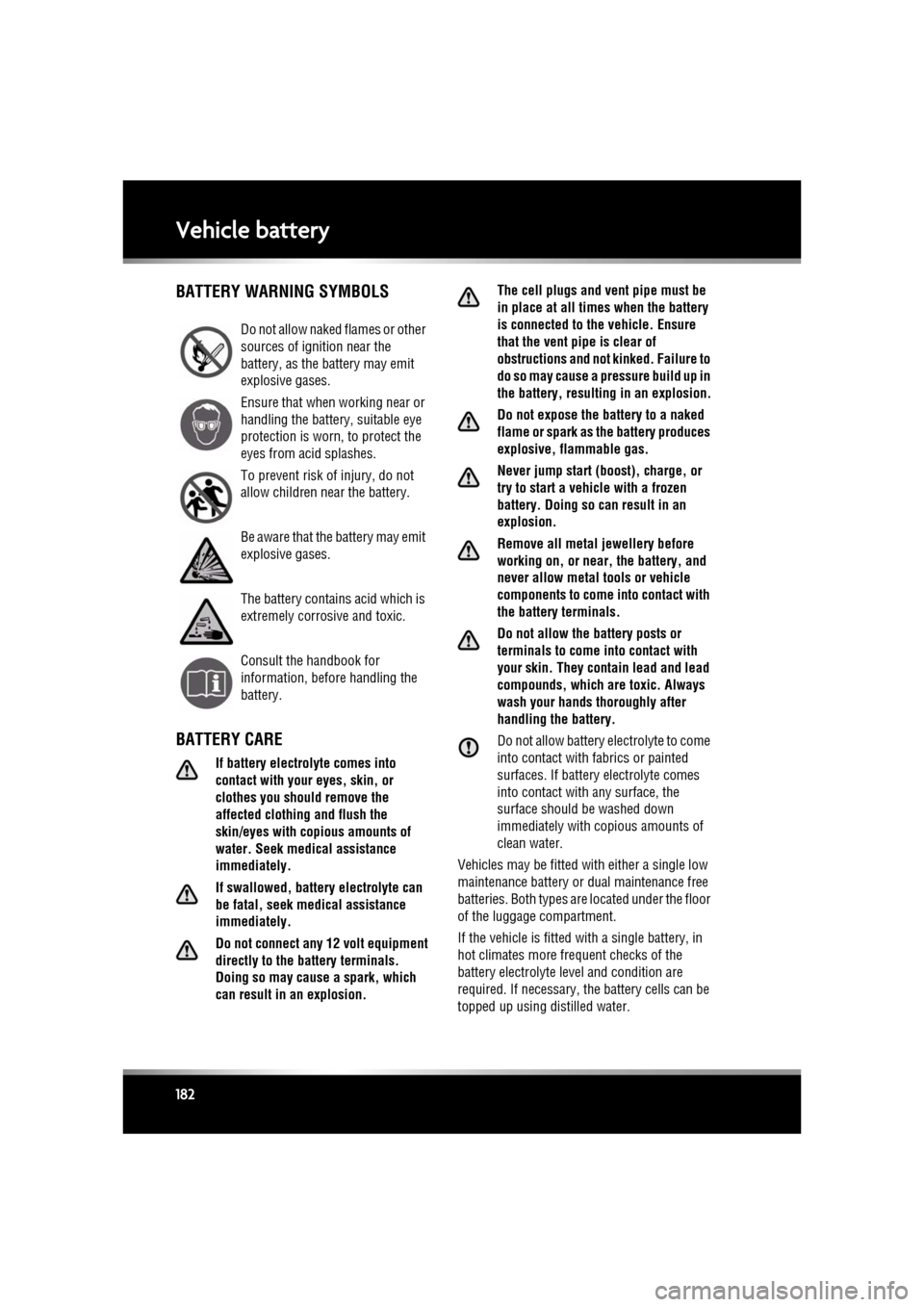
Vehicle batteryBATTERY WARNING SYMBOLS
BATTERY CARE
If battery electrolyte comes into
contact with your eyes, skin, or
clothes you should remove the
affected clothing and flush the
skin/eyes with copious amounts of
water. Seek medical assistance
immediately.
If swallowed, battery electrolyte can
be fatal, seek medical assistance
immediately.
Do not connect any 12 volt equipment
directly to the bat tery terminals.
Doing so may cause a spark, which
can result in an explosion. The cell plugs and vent pipe must be
in place at all tim
es when the battery
is connected to t he vehicle. Ensure
that the vent pipe is clear of
obstructions and not kinked. Failure to
do so may cause a pressure build up in
the battery, resulting in an explosion.
Do not expose the battery to a naked
flame or spark as the battery produces
explosive, flammable gas.
Never jump start (boost), charge, or
try to start a vehicle with a frozen
battery. Doing so can result in an
explosion.
Remove all metal jewellery before
working on, or near, the battery, and
never allow metal tools or vehicle
components to come into contact with
the battery terminals.
Do not allow the battery posts or
terminals to come into contact with
your skin. They contain lead and lead
compounds, which are toxic. Always
wash your hands thoroughly after
handling the battery.
Do not allow battery electrolyte to come
into contact with fabrics or painted
surfaces. If battery electrolyte comes
into contact with any surface, the
surface should be washed down
immediately with copious amounts of
clean water.
Vehicles may be fitted with either a single low
maintenance battery or dual maintenance free
batteries. Both types are located under the floor
of the luggage compartment.
If the vehicle is fitted with a single battery, in
hot climates more fre quent checks of the
battery electrolyte level and condition are
required. If necessary, the battery cells can be
topped up using distilled water.
Do not allow naked flames or other
sources of ignition near the
battery, as the battery may emit
explosive gases.
Ensure that when working near or
handling the battery, suitable eye
protection is worn, to protect the
eyes from acid splashes.
To prevent risk of injury, do not
allow children near the battery.
Be aware that the battery may emit
explosive gases.
The battery contains acid which is
extremely corrosive and toxic.
Consult the handbook for
information, before handling the
battery.
Page 183 of 225

R
(FM8) SEMCON JLR OWNER GUIDE VER 1.00 EURO
LANGUAGE: english-en; MARQUE: jaguar; MODEL: XF
Vehicle battery
183
BATTERY MONITORING SYSTEM
(BMS)
If excessive battery discharge is occurring
when the engine isn't running, the system will
shut down non-essential el ectrical systems to
protect battery power.
CONNECTING BOOSTER CABLES
Always wear appropriate eye
protection when working with
batteries.
Make sure both batteries are of the 12
volt type and that the booster cables
have insulated clamps and are
approved for use with 12 volt
batteries.
Do not disconnect the discharged
battery.
Do not connect a booster cable to the
negative (-) terminal of the battery.
Always connect to the recommended
earthing point.
Ensure the bodywork of the donor and
disabled vehicles do not touch.
If the vehicle is fitted with a dual
battery system, the larger of the two
batteries must be used when
connecting booster cables.
Note: Before connecting booster cables,
ensure that the battery connections on the
disabled vehicle are correct and that all
electrical equipment has been switched off.
1. Connect the positive booster cable to the
positive terminal on the donor vehicle's
battery.
2. Connect the other e nd of the positive
booster cable to the positive terminal on
the disabled vehicle's battery. If the vehicle is fitted with a dual
battery system, t
he larger of the
two batteries must be used when
connecting booster cables.
3. Connect the negative booster cable to the
recommended jump starting earth point of
the donor vehicle.
4. Connect the other e nd of the negative
booster cable to a suitable earth point on
the disabled vehicle. The earth point should
be at least 0.5 metres (20 inches) away
from the battery and as far as possible
from any fuel or brake pipes.
• Check that all cables are clear of any
moving components and that all four
connections are secure.
5. Start the engine of the donor vehicle, and
allow it to idle for a few minutes.
6. Start the engine of the disabled vehicle.
7. Allow both vehicles to idle for two minutes.
8. Switch off the donor vehicle.
DISCONNECTING THE BOOSTER
CABLES
To avoid serious injury use extreme
caution when removing the booster
cables as the engine will be running
on the previously disabled vehicle.
This means that you may be working
close to components which are
moving at high speed, carry high
voltage, or may be hot.
Note: Do not switch on any electrical
equipment until after th e cables have been
disconnected.
The engine should be running on the
previously disabled ve hicle and the engine
switched off on the donor vehicle. Disconnect
the booster cables in the exact reverse order of
that used for connection.
Page 186 of 225
L
(FM8) SEMCON JLR OWNER GUIDE VER 1.00 EURO
LANGUAGE: english-en; MARQUE: jaguar; MODEL: XF
Tyres
186
PUNCTURED TYRES
Do not drive the vehicle with a
punctured tyre. Even if the punctured
tyre has not deflated, it is unsafe to
use, as the tyre may deflate suddenly
at any time.
REPLACEMENT TYRES
Always fit replacement tyres of the
same type, and wherever possible of
the same make and tread pattern.
If the use of tyres not recommended by
Jaguar is unavoidable, ensure that
you read, and fully comply with, the
tyre manufacturer’s instructions.
Ideally, tyres should be re placed in sets of four.
If this is not possible, replace the tyres in pairs
(both front or both rear). When tyres are
replaced, the wheels should always be
re-balanced and alignment checked.
The correct tyre specification for your vehicle
can be found on the ty re placard label.
PRESSURE COMPENSATION FOR
TEMPERATURE CHANGES
A colder ambient local temperature will reduce
pressure within the tyre. An effect is to
decrease sidewall height and to increase tyre
shoulder wear with the potential for tyre failure.
Vehicle dynamics could also be adversely
affected.
Tyre pressures can be adjusted to compensate
before the start of the journey. Alternatively,
tyre pressures can be adjusted when the area
of lower ambient temperature is reached.
In this situation, the vehicle must be left in the
ambient local temperature for at least one hour
before tyre pressure is adjusted. To compensate for colder ambient
temperatures, tyre pressures should be
increased by 0.14 bar (2 psi, 14 kPa) for each
10°C (20°F) decrease.
Note:
Ensure that correct tyre pressures are
maintained when moving to areas of differing
ambient temperature.
AVOIDING FLAT SPOTS
In order to minimise fl at spotting, the tyre
pressures can be increased to the maximum as
stated on the tyre sidewall, for the period when
the vehicle is stationary. Tyres must be
returned to the specified running pressures
before driving.
TYRE DEGRADATION
Tyres degrade over time due to the effects of
ultraviolet light, extreme temperatures, high
loads, and environmen tal conditions. It is
recommended that tyres are replaced at least
every six years, but they may require
replacement more frequently.
USING WINTER TYRES
Do not exceed 240 km/h (150 mph) when
using Jaguar approv ed winter tyres.
Winter tyres must be fitted to all four wheels.
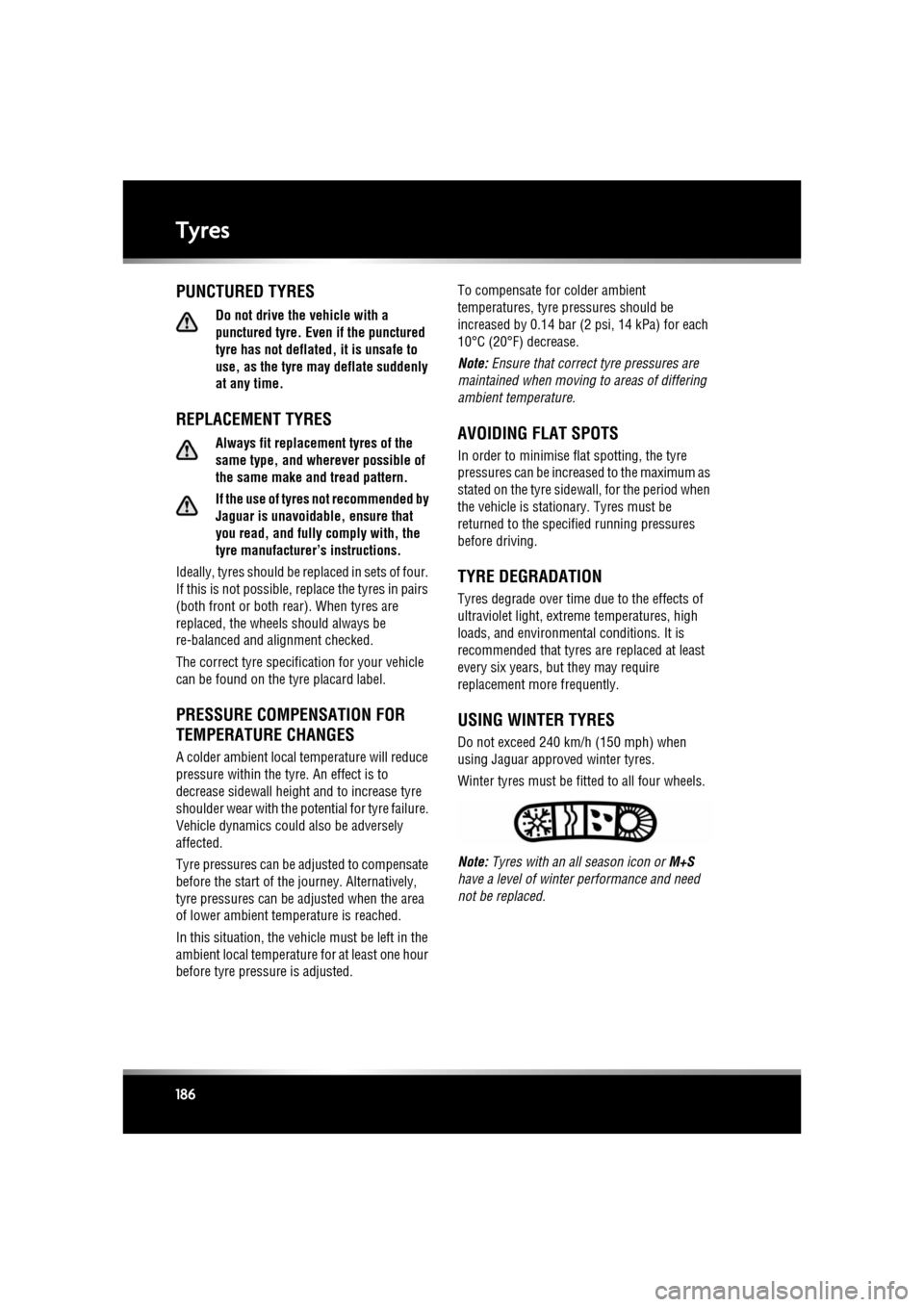
Note: Tyres with an all season icon or M+S
have a level of winter performance and need
not be replaced.
Page 189 of 225

R
(FM8) SEMCON JLR OWNER GUIDE VER 1.00 EURO
LANGUAGE: english-en; MARQUE: jaguar; MODEL: XF
Fuses
189
ENGINE COMPARTMENT FUSE BOX
Fuse No Rating
(amps) Fuse
ColourCircuit
F1 - - -
F2 - - -
F3 20A Yellow Emissions system (petrol only).
F4 20A Yellow Emissions system (petrol only).
F5 40A Orange ABS pump.
F6 30A Green Power wash pump.
F7 50A Red Cigar lighter.
F8 - - -
F9 50A Red Engine management system.
F10 - - -
F11 - - -
F12 50A Red Secondary air inje ction (V6 petrol only).
F13 30A Green Wipers.
F14 30A Green Starter solenoid.
F15 40A Orange Front screen heater - RH.
F16 40A Orange Front screen heater - LH.
F17 80A Natural Radiator fan (V6 petrol only).
F18 60A Aqua Glow pl ugs (diesel only).
F19 5A Tan Adaptive cruise control. FLS.
F20 15A Blue Horn.
F21 25A Clear ABS valves.
F22 - - -
F23 - - -
F24 - - -
F25 10A Red ABS ECM.
F26 10A Red Engine management syst em ECM. Transmission control
module.
F27 5A Tan Secondary air inje ction (V6 petrol only).
F28 5A Tan Adaptive front lighting - LH.
F29 5A Tan Adaptive front lighting - RH.
Page 192 of 225

L
(FM8) SEMCON JLR OWNER GUIDE VER 1.00 EURO
LANGUAGE: english-en; MARQUE: jaguar; MODEL: XF
Fuses
192
LUGGAGE COMPARTMENT FUSE BOX
F30 10A Red Air conditioning.
F31 15A Blue Sunroof.
F32 5A Tan Starter control unit.
F33 5A Tan Diagnostic connector.
F34 5A Tan Instrument pack.
F35 15A Blue Interior lamps.
F36 10A Red Suspension system.
Fuse
No Rating
(amps) Fuse
Colour Circuit
F1 30A Green Air blower.
F2 30A Green Electric parking brake.
F3 - - -
F4 - - -
F5 - - -
F6 - - -
F7 30A Green Heated rear screen.
F8 30A Green Audio system (premium audio only).
F9 50A Red RBD link.
F10 40A Orange Rear electronic differential (e-Diff).
F11 - - -
F12 - - -
F13 - - -
F14 5A Tan Telephone.
F15 10A Red TV. DVD. DAB radio.
F16 - - -
F17 - - -
F18 - - -
F19 - - -
F20 - - -
F21 - - -
Fuse No Rating
(amps) Fuse
Colour Circuit
Page 194 of 225

L
(FM8) SEMCON JLR OWNER GUIDE VER 1.00 EURO
LANGUAGE: english-en; MARQUE: jaguar; MODEL: XF
Wheel changing
194
Wheel changingWHEEL CHANGING SAFETY
Before raising the vehicl e, or changing a wheel
ensure that you read, and comply with the
following warnings.
Always find a safe place to stop, off
the highway and aw ay from traffic.
Ensure that the vehicle and jack are
both on firm level ground.
Apply the parking brake, and engage
Park (P).
Switch on the hazard warning lamps.
Ensure that the front wheels are in the
straight ahead position, and engage
the steering lock.
Disconnect trailer/ca ravan from the
vehicle.
Ensure that all passengers, and
animals, are out of the vehicle and in
a safe place away from the highway.
Place a warning triangle at a suitable
distance behind the v ehicle, facing
towards oncoming traffic.
When one rear wheel is lifted off the
ground the selection P (Park) position
will not prevent the vehicle from
moving and possibly slipping off the
jack as the park brake only operates
on the rear wheels. Use the wheel
chock when jacking the vehicle.
Always chock the wheel diagonally
opposite the wheel to be changed,
using the wheel chock supplied in the
tool kit. Chock the front of a front
wheel, or the rear of a rear wheel.
If jacking the vehicle on a slight slope
is unavoidable, place chocks on the
downhill side of the two opposite
wheels. An additional chock will be
needed. Never place anything between the jack
and the ground, or the jack and the
vehicle.
Do not attempt to raise the vehicle
unless the jack head is fully engaged
in the jacking point. Only jack the
vehicle using the approved jacking
points.
Remove the spare wheel prior to
jacking the vehicle, to avoid
destabilising the vehicle when raised.
Take care when lifting the spare
wheel, and removing the punctured
wheel. The wheels are heavy, and can
cause injuries if not handled correctly.
Do not start or run the engine while the
vehicle is support
ed only by a jack.
Do not get under a vehicle that is
supported by a jack.
Never work or allow any person to
place any part of their body beneath
the vehicle with the jack as the only
means of support - use vehicle
support stands.
Take care when loosening the wheel
nuts. The wheel brace may slip off if
not properly attached, and the wheel
nuts may release suddenly. Either
unexpected movement may cause an
injury.
After use, the tool kit should be
returned to the under floor storage
area and correctly stowed.
Always ensure replacement tyres
have the correct rating and
specifications (e.g. load index, size,
speed rating) for your vehicle.