2011 JAGUAR XF diesel
[x] Cancel search: dieselPage 156 of 225

L
(FM8) SEMCON JLR OWNER GUIDE VER 1.00 EURO
LANGUAGE: english-en; MARQUE: jaguar; MODEL: XF
Fuel and refuelling
156
To reset the misfuelling device:-
1. Insert the reset tool with teeth uppermost,
as far as it will go into the filler neck.
2. Locate the teeth by pushing down the top
of the reset tool.
3. With the top of the tool pressed down and
the teeth engaged, slowly pull the tool out
of the filler neck to reset the device.
Do not twist the device, once the teeth
have engaged.
Note: The yellow part of the protection device
should no longer be visible in the filler neck.
Replace the reset tool in position on the battery
restraining bar.
FUEL TANK CAPACITY
Avoid the risk of running out of fuel and never
intentionally drive the vehicle when the fuel
gauge indicates that the tank is empty. When
refuelling your vehicle after the fuel gauge
reads empty, you may not be able to add the
fuel quantity shown below, as there will be a
small reserve remaining in the tank.
FUEL SPECIFICATION
Total tank capacity (usable):
Petrol engines 69.5 litres (15.3 gallons)
Diesel engines 68.1 litres (15 gallons)
Fill capacity (when fuel
gauge reads empty) 64 litres (14.1
gallons)
Reserve capacity (when fuel
gauge reads empty) 5.5 litres (1.2
gallons)
Petrol Diesel
95-98 RON EN 590
Page 157 of 225
R
(FM8) SEMCON JLR OWNER GUIDE VER 1.00 EURO
LANGUAGE: english-en; MARQUE: jaguar; MODEL: XF
Fuel and refuelling
157
FUEL CONSUMPTION
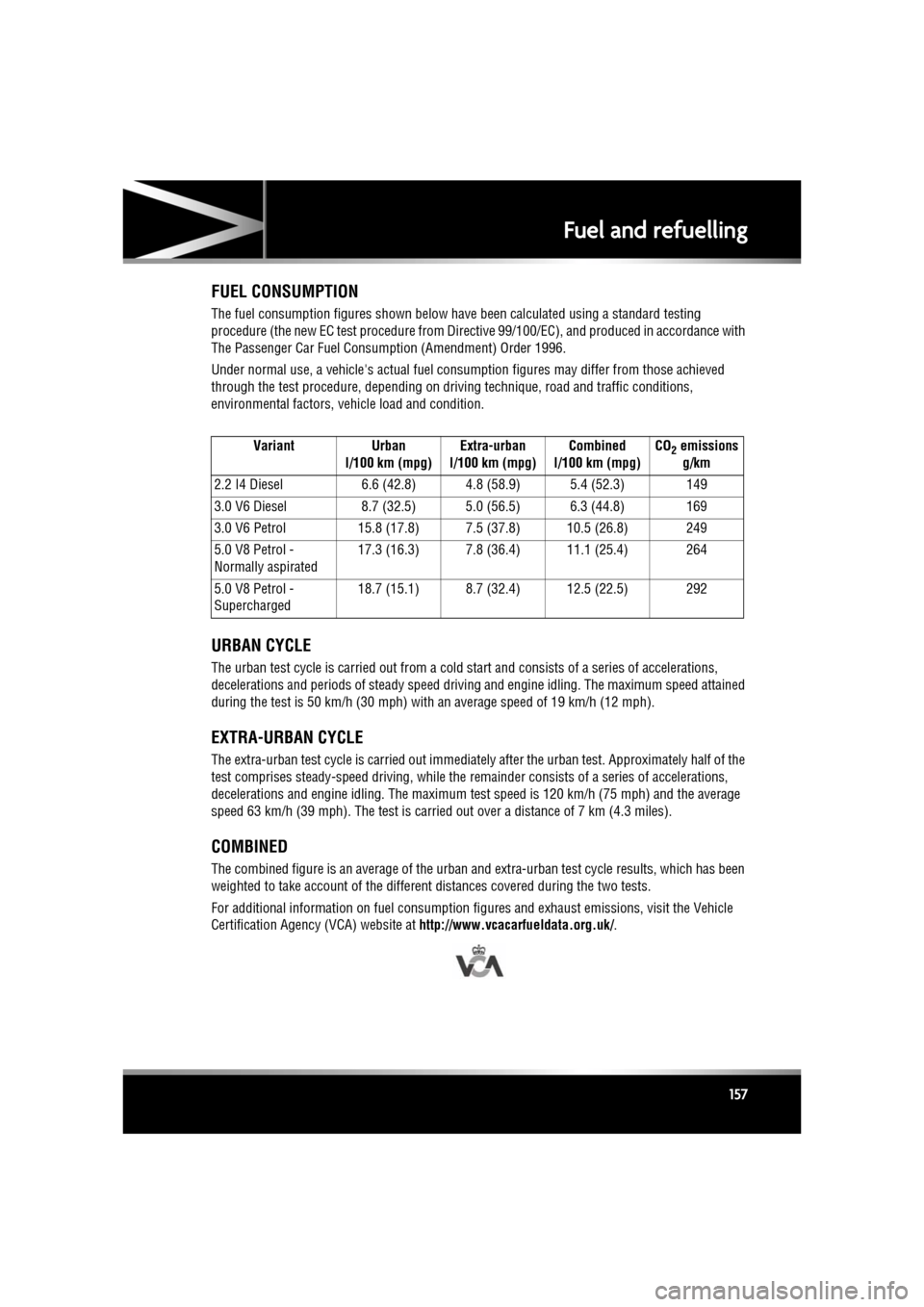
The fuel consumption figures shown below have been calculated using a standard testing
procedure (the new EC test proc edure from Directive 99/100/EC), and produced in accordance with
The Passenger Car Fuel Cons umption (Amendment) Order 1996.
Under normal use, a vehicle's actu al fuel consumption figures may differ from those achieved
through the test procedure, de pending on driving technique, ro ad and traffic conditions,
environmental factors, ve hicle load and condition.
URBAN CYCLE
The urban test cycle is carried out from a cold start and cons ists of a series of accelerations,
decelerations and periods of stea dy speed driving and engine idling. The maximum speed attained
during the test is 50 km/h (30 mph) with an average speed of 19 km/h (12 mph).
EXTRA-URBAN CYCLE
The extra-urban test cycle is carried out immediatel y after the urban test. Approximately half of the
test comprises steady-speed driving, while the re mainder consists of a series of accelerations,
decelerations and engine idling . The maximum test speed is 120 km/h (75 mph) and the average
speed 63 km/h (39 mph). The test is carried out over a distance of 7 km (4.3 miles).
COMBINED
The combined figure is an average of the urban an d extra-urban test cycle results, which has been
weighted to take account of the differ ent distances covered during the two tests.
For additional information on fuel consumption figures and exhaust emissions, visit the Vehicle
Certification Agency (VCA) website at http://www.vcacarfueldata.org.uk/.
Variant
Urban
l/100 km (mpg) Extra-urban
l/100 km (mpg) Combined
l/100 km (mpg) CO
2 emissions
g/km
2.2 I4 Diesel 6.6 (42.8) 4.8 (58.9) 5.4 (52.3) 149
3.0 V6 Diesel 8.7 (32.5) 5.0 (56.5) 6.3 (44.8) 169
3.0 V6 Petrol 15.8 (17.8) 7.5 (37.8) 10.5 (26.8) 249
5.0 V8 Petrol -
Normally aspirated 17.3 (16.3) 7.8 (36.4) 11.1 (25.4) 264
5.0 V8 Petrol -
Supercharged 18.7 (15.1) 8.7 (32.4) 12.5 (22.5) 292
Page 159 of 225

R
(FM8) SEMCON JLR OWNER GUIDE VER 1.00 EURO
LANGUAGE: english-en; MARQUE: jaguar; MODEL: XF
Maintenance
159
DIESEL PARTICULATE FILTER (DPF)
Diesel vehicles equipped with a particle filter
have more efficient emission control. The
particles in the exhaust gases are collected in
the filter during normal driving.
When a DPF message is displayed, the filter
requires a regeneration cy cle to clean itself.
This requires the engine to have reached
normal operating temp erature. Regeneration
takes place automatically at an interval of
approximately 300-900 km (190-560 miles)
depending on driving c onditions. Regeneration
normally takes 10-20 minutes and is
automatically requested by the engine control
module if the vehicle is driven steadily at
vehicle speeds between 40mph to 70mph. It is
possible that the rege neration process will
occur at lower vehicle speeds, but the events
may take a little longer at a 50 km/h (30mph)
average speed.
DRIVING SHORT DISTANCES OR IN
COLD WEATHER
If the vehicle is fre quently driven short
distances or in cold weather conditions then
the engine may not re ach normal operating
temperature. This means that regeneration of
the diesel particle filter does not take place and
the filter is not efficiently cleaned. When the
filter reaches a condition when a filter
regeneration is approp riate and the current
drive style is not appropriate, a warning
triangle on the instrument panel illuminates,
and the message DPF Full. See manual is
displayed on the instrument panel. This is not
indicating a fault conditi on with the vehicle and
no dealership support should be required. Start
regeneration of the filter by driving the vehicle,
preferably on a main road or motorway. The
vehicle should then be driven for approximately
20 minutes or more. When regeneration is complete the warning
text is cleared automatically.
Note:
A small increase in fuel consumption
may be noticed temporarily during
regeneration.
ARDUOUS DRIVING CONDITIONS
When a vehicle is operated in severe or
arduous conditions, more frequent attention
must be paid to servic ing requirements. Refer
to your Service Portfolio for details or contact
your Dealer/Authorised Repairer for advice.
SAFETY IN THE GARAGE
If the vehicle has been driven
recently, do not touch exhaust and
cooling system co mponents until the
engine has cooled.
Never leave the engine running in an
unventilated area.
Do not work beneath the vehicle with a
jack as the only means of support.
Keep your hands and clothing away
from drive belts, pulleys and fans.
Some fans may continue to operate
after the engine has stopped.
Remove metal wrist bands and
jewellery, before working in the
engine compartment.
Do not touch electrical leads or
components while the engine is
running, or with the starter switch
turned on.
Do not allow tools or metal parts of the
vehicle to make contact with the
battery leads or terminals.
Page 161 of 225
R
(FM8) SEMCON JLR OWNER GUIDE VER 1.00 EURO
LANGUAGE: english-en; MARQUE: jaguar; MODEL: XF
Maintenance
161
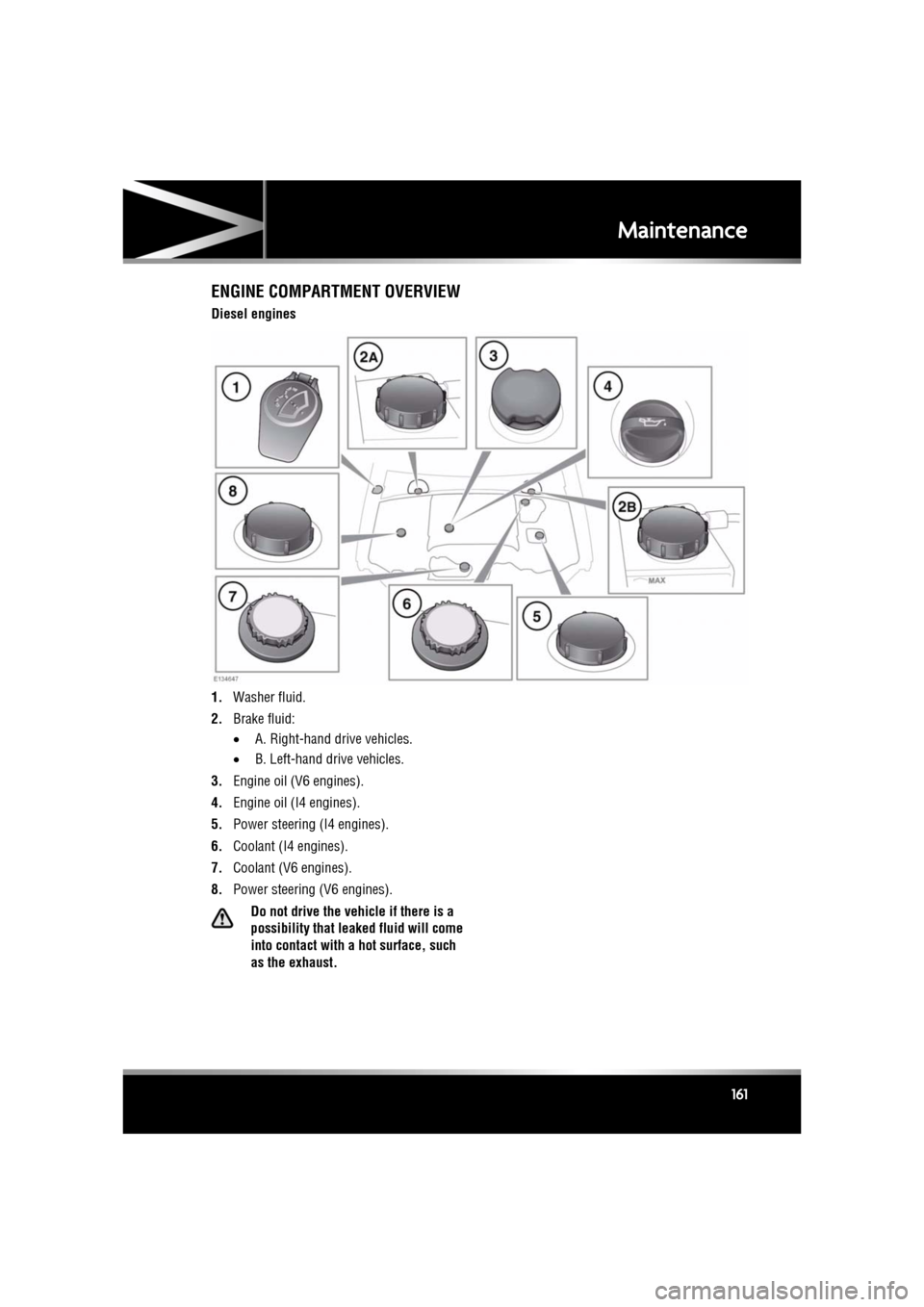
ENGINE COMPARTMENT OVERVIEW
Diesel engines
1. Washer fluid.
2. Brake fluid:
•A. Right-hand drive vehicles.
• B. Left-hand dr ive vehicles.
3. Engine oil (V6 engines).
4. Engine oil (I4 engines).
5. Power steering (I4 engines).
6. Coolant (I4 engines).
7. Coolant (V6 engines).
8. Power steering (V6 engines).
Do not drive the vehicle if there is a
possibility that leak ed fluid will come
into contact with a hot surface, such
as the exhaust.
Page 169 of 225

R
(FM8) SEMCON JLR OWNER GUIDE VER 1.00 EURO
LANGUAGE: english-en; MARQUE: jaguar; MODEL: XF
Fluid level checks
169
V6 petrol engines
Note: If it is necessary to check the oil level
when the engine is hot, switch off the engine
and let stand for five minutes to allow the oil to
drain into the sump. Do not start the engine.
1. Withdraw the dipstick and wipe the blade
clean with a lint free cloth.
2. Fully re-insert the dipstick and withdraw
again to check the oil level. Never allow the
oil level to fall below the lower mark or
notch on the dipstick.
As a general guide, if the level on the
dipstick:
•Is nearer to the upper mark or notch
than the lower, add no oil.
• Is nearer to the lower mark or notch
than the upper, add half a litre (one
pint) of oil.
• Is below the lower mark or notch, add
one litre (two pints) of oil and re-check
the level after a further five minutes.ENGINE OIL SPECIFICATION
Low quality or obsolete oils do not
provide the protection required by
modern, high perfor mance engines.
Failure to use an oil that meets the
required specification could cause
excessive engine wear, a build up of
sludge and deposit s and increased
pollution. It could also lead to engine
failure.
Your vehicle’s warranty may be
invalidated if damage is caused by the
use of unapproved engine oil.
Do not use oil additives of any type as
engine damage could occur. Use only
specified lubricants.
Model Specification
V6 Petrol
engines SAE 5W-30 engine oil meeting
Jaguar specification WSS
M2C913-C is preferred. Oil
meeting ACEA A1/B1 or ACEA
A3/B3 specification may be
used.
V8 Petrol
engines SAE 5W-20 meeting Jaguar
specification WSS M2C925-A
only.
Diesel
engines 5W-30 engine oil, meeting
Jaguar specification WSS
M2C934-B only.
Japan V6
Petrol
engines SAE 5W-30 engine oil meeting
specification ILSAC GF-4 with
API SM is prefe
rred. Oil meeting
ILSAC GF-3 API SL specification
may be used.
Japan V8
Petrol
engines SAE 5W-20 engine oil meeting
Jaguar specification WSS
M2C925-A only.
Page 170 of 225

L
(FM8) SEMCON JLR OWNER GUIDE VER 1.00 EURO
LANGUAGE: english-en; MARQUE: jaguar; MODEL: XF
Fluid level checks
170
Jaguar recommends:
TOPPING UP THE OIL
Overfilling with oil could result in severe
engine damage.
1. Unscrew the oil filler cap.
2. Add oil as indicated by the message centre
display.
3. Wait five minutes fo r the oil level to
stabilise then re-check.
It is essential to use the correct specification
oil, and to ensure it is suitable for the climatic
conditions in which the vehicle is to be
operated.
ENGINE OIL CONSUMPTION
A certain amount of oil consumption is normal.
The rate of consumpt ion will depend on the
following:
• The quality and viscosity of the oil.
• Climatic conditions.
• The speed at which the engine is being
operated.
• Road conditions.
Drivers should expect above normal
consumption when the engi ne is new, and after
running-in if high speeds are sustained.
CHECKING THE COOLANT LEVEL
Running the engine without coolant will
cause serious engine damage.
If persistent coolant loss is noticed,
seek qualified assistance immediately.
The coolant level in the expansion tank should
be checked at least weekly (more frequently in
high mileage or severe operating conditions).
Always check the level when the system is
cold.
Ensure the coolant level is maintained between
the level indicator marks, as shown in the
illustrations.
Diesel engines
Petrol engines
Page 175 of 225

R
(FM8) SEMCON JLR OWNER GUIDE VER 1.00 EURO
LANGUAGE: english-en; MARQUE: jaguar; MODEL: XF
Technical specifications
175
Technical specificationsENGINE SPECIFICATIONS
LUBRICANTS AND FLUIDS
Data I4 Diesel V6 Diesel V6 Petrol V8 Petrol
(Normally
Aspirated) V8 Petrol
(Supercharged)
Number of
cylinders 466 8 8
Displacement
(cc) 2179 2993 2967 5000
5000
Compression
ratio 15.8:1 16.1:1 10.5:1 11.5:1 9.5:1
Part Variant Specification
Engine oil V6 Petrol enginesSAE 5W-30 engine oil meeti
ng Jaguar specification WSS
M2C913-C is preferred. Oil meet ing ACEA A3/B3 specification
may be used.
V8 Petrol
engines SAE 5W-20 engine oil meeti
ng Jaguar specification WSS
M2C925-A only.
Diesel
engines SAE 5W-30 engine oil meeti
ng Jaguar specification WSS
M2C934-B only.
Japan V6
Petrol
engines SAE 5W-30 engine oil meeting spec
ification ILSAC GF-5 with API
SM is preferred. O il meeting ILSAC GF-4 API SL specification
may be used.
Japan V8
Petrol
engines SAE 5W-20 engine oil meeti
ng Jaguar specification WSS
M2C925-A only.
Power steering
fluid All vehicles Mobil ATF320 PAS fluid.
Brake fluid All vehicles Shell DOT4 ESL is prefe rred. If unavailable, a low viscosity brake
fluid that meets ISO 4925 class 6 specification may be used.
Screen washer All vehicles Screen wash with frost protection.
Coolant All vehicles 50% mixture of water and antifreeze specification WSS M97B44 (coloured orange) Extended Life Coolant.
If in doubt about the required spec ification of a lubricant or fluid for your vehicle, seek advice from
your Dealer/Authorised Repairer.
Page 176 of 225

L
(FM8) SEMCON JLR OWNER GUIDE VER 1.00 EURO
LANGUAGE: english-en; MARQUE: jaguar; MODEL: XF
Technical specifications
176
WEIGHTS
The maximum permitted roof load,
including the weight of the roof rack/
roof bars, is 75 kg (165 lb). The roof
load must be included when
calculating the Gross Vehicle Weight
(GVW).
Jaguar recommend that only approved
accessories are used. If in any doubt,
consult your Jaguar Dealer/ Approved
Repairer before fitting a roof rack/ roof
bars or carrying a roof load.
Variant Vehicle weight
fromFront axle weight
from Rear axle weight
from Max. luggage
compartment load
1
I4 Diesel 1745 kg
3847 lb 932 kg
2054 lb 813 kg
1793 lb 35 kg
77 lb
V6 Diesel 1810 kg
3990 lb 1011 kg
2229 lb 799 kg
1761 lb 35 kg
77 lb
V6 Petrol 1690 kg
3726 lb 883 kg
1947 lb 807 kg
1779 lb 35 kg
77 lb
V8 Normally
Aspirated Petrol 1780 kg
3924 lb 961 kg
2119 lb 819 kg
1806 lb 35 kg
77 lb
V8 Supercharged
Petrol 1891 kg
4169 lb 1022 kg
2253 lb 869 kg
1916 lb 35 kg
77 lb
1The maximum permitted luggage co mpartment load can be exceeded, provided the requirements
regarding the maximum permissible axle weights and tyre pressures are followed.