2011 INFINITI QX56 fuel line 2011
[x] Cancel search: fuel line 2011Page 2541 of 5598
![INFINITI QX56 2011 Factory Service Manual
ON BOARD REFUELING VAPOR RECOVERY (ORVR)EC-517
< DTC/CIRCUIT DIAGNOSIS > [VK56VD]
C
D
E
F
G H
I
J
K L
M A
EC
NP
O
Is the inspection result normal?
YES >> INSPECTION END
NO >> Replace refueling EVAP v](/manual-img/42/57033/w960_57033-2540.png "INFINITI QX56 2011 Factory Service Manual
ON BOARD REFUELING VAPOR RECOVERY (ORVR)EC-517
< DTC/CIRCUIT DIAGNOSIS > [VK56VD]
C
D
E
F
G H
I
J
K L
M A
EC
NP
O
Is the inspection result normal?
YES >> INSPECTION END
NO >> Replace refueling EVAP v")
ON BOARD REFUELING VAPOR RECOVERY (ORVR)EC-517
< DTC/CIRCUIT DIAGNOSIS > [VK56VD]
C
D
E
F
G H
I
J
K L
M A
EC
NP
O
Is the inspection result normal?
YES >> INSPECTION END
NO >> Replace refueling EVAP vapor cut valve with fuel tank.
7.CHECK EVAP CANISTER
1. Remove EVAP canister with EVAP canister vent c ontrol valve and EVAP control system pressure sensor
attached.
2. Weigh the EVAP canister with EVAP canister vent control valve and EVAP control system pressure sensor
attached.
The weight should be l ess than 2.5 kg (5.5 lb).
Is the inspection result normal?
YES >> GO TO 8.
NO >> GO TO 9.
8.CHECK IF EVAP CANISTER IS SATURATED WITH WATER
Check if water will drain from EVAP canister (1).
EVAP canister vent control valve (2)
Does water drain from the EVAP canister?
YES >> GO TO 9.
NO >> GO TO 11.
9.REPLACE EVAP CANISTER
Replace EVAP canister with a new one.
>> GO TO 10.
10.DETECT MALFUNCTIONING PART
Check the EVAP hose between EVAP canister and vehicle frame for clogging or poor connection.
>> Repair or replace EVAP hose.
11 .CHECK VENT HOSES AND VENT TUBES
Check hoses and tubes between EVAP c anister and refueling control valve for clogging, kinks, looseness and
improper connection.
Is the inspection result normal?
YES >> GO TO 12.
NO >> Repair or replace hoses and tubes.
12.CHECK FILLER NECK TUBE
Check recirculation line for clogging, dents and cracks.
Is the inspection result normal?
YES >> GO TO 13.
NO >> Replace filler neck tube.
13.CHECK REFUELING EVAP VAPOR CUT VALVE
Refer to EC-518, "
Component Inspection (EVAP Vapor Cut Valve)".
Is the inspection result normal?
YES >> GO TO 14.
NO >> Replace refueling EVAP vapor cut valve with fuel tank.
14.CHECK FUEL FILLER TUBE
Check filler neck tube and hose connected to the fuel tank for clogging, dents and cracks.
JSBIA0692ZZ
Revision: 2010 May2011 QX56
Page 2542 of 5598
![INFINITI QX56 2011 Factory Service Manual
EC-518
< DTC/CIRCUIT DIAGNOSIS >[VK56VD]
ON BOARD REFUELING VAPOR RECOVERY (ORVR)
Is the inspection result normal?
YES >> GO TO 15.
NO >> Replace fuel filler tube.
15.CHECK ONE-WAY FUEL VALVE-I
Check](/manual-img/42/57033/w960_57033-2541.png "INFINITI QX56 2011 Factory Service Manual
EC-518
< DTC/CIRCUIT DIAGNOSIS >[VK56VD]
ON BOARD REFUELING VAPOR RECOVERY (ORVR)
Is the inspection result normal?
YES >> GO TO 15.
NO >> Replace fuel filler tube.
15.CHECK ONE-WAY FUEL VALVE-I
Check")
EC-518
< DTC/CIRCUIT DIAGNOSIS >[VK56VD]
ON BOARD REFUELING VAPOR RECOVERY (ORVR)
Is the inspection result normal?
YES >> GO TO 15.
NO >> Replace fuel filler tube.
15.CHECK ONE-WAY FUEL VALVE-I
Check one-way fuel valve for clogging.
Is the inspection result normal?
YES >> GO TO 16.
NO >> Repair or replace one-way fuel valve with fuel tank.
16.CHECK ONE-WAY FUEL VALVE-II
1. Check that fuel is drained from the tank.
2. Remove fuel filler tube and hose.
3. Check one-way fuel valve for operation as per the following.
When a stick is inserted, the valve should open, when removing
stick it should close.
Do not drop any material into the tank.
Is the inspection result normal?
YES >> INSPECTION END
NO >> Replace fuel filler tube or replace one-way fuel valve with fuel tank.
Component Inspection (EVAP Vapor Cut Valve)INFOID:0000000006256492
1.CHECK REFUELING EVAP VAPOR CUT VALVE
1. Turn ignition switch OFF.
2. Remove fuel tank. Refer to FL-8, "
Removal and Installation".
3. Drain fuel from the tank as per the following:
- Remove fuel gauge retainer.
- Drain fuel from the tank using a handy pump into a fuel container.
4. Check refueling EVAP vapor cut valve for being stuck to close as per the following.
Blow air into the refueling EVAP vapor cut valv e (from the end of EVAP/ORVR line hose), and check that
the air flows freely into the tank.
5. Check refueling EVAP vapor cut valve for being stuck to open as per the following.
- Connect vacuum pump to hose end.
- Remove fuel gauge retainer with fuel gauge unit. Always replace O-ri ng with new one.
- Turn fuel tank upside down.
SEF665U
Revision: 2010 May2011 QX56
Page 2550 of 5598
![INFINITI QX56 2011 Factory Service Manual
EC-526
< SYMPTOM DIAGNOSIS >[VK56VD]
ENGINE CONTROL SYSTEM SYMPTOMS
1 - 6: The numbers refer to the order of inspection.
(continued on next page)
SYSTEM — ENGINE MECHANICAL & OTHER
Manifold absolut](/manual-img/42/57033/w960_57033-2549.png "INFINITI QX56 2011 Factory Service Manual
EC-526
< SYMPTOM DIAGNOSIS >[VK56VD]
ENGINE CONTROL SYSTEM SYMPTOMS
1 - 6: The numbers refer to the order of inspection.
(continued on next page)
SYSTEM — ENGINE MECHANICAL & OTHER
Manifold absolut")
EC-526
< SYMPTOM DIAGNOSIS >[VK56VD]
ENGINE CONTROL SYSTEM SYMPTOMS
1 - 6: The numbers refer to the order of inspection.
(continued on next page)
SYSTEM — ENGINE MECHANICAL & OTHER
Manifold absolute pressure sensor circuit 3
EC-210
Battery current sensor 4 5 5 3EC-412EC-420
EC-424
Heated oxygen sensor 2 6 6 6 6 5EC-243EC-249
EC-257
SYMPTOM
Reference
page
HARD/NO START/RESTART (EXCP. HA)
ENGINE STALL
HESITATION/SURGING/FLAT SPOT
SPARK KNOCK/DETONATION
LACK OF POWER/POOR ACCELERATION
HIGH IDLE/LOW IDLE
ROUGH IDLE/HUNTING
IDLING VIBRATION
SLOW/NO RETURN TO IDLE
OVERHEATS/WATER TEMPERATURE HIGH
EXCESSIVE FUEL CONSUMPTION
EXCESSIVE OIL CONSUMPTION
BATTERY DEAD (UNDER CHARGE)
Warranty symptom code AA AB AC AD AE AF AG AH AJ AK AL AM HA
SYMPTOM
Reference
page
HARD/NO START/RESTART (EXCP. HA)
ENGINE STALL
HESITATION/SURGING/FLAT SPOT
SPARK KNOCK/DETONATION
LACK OF POWER/POOR ACCELERATION
HIGH IDLE/LOW IDLE
ROUGH IDLE/HUNTING
IDLING VIBRATION
SLOW/NO RETURN TO IDLE
OVERHEATS/WATER TEMPERATURE HIGH
EXCESSIVE FUEL CONSUMPTION
EXCESSIVE OIL CONSUMPTION
BATTERY DEAD (UNDER CHARGE)
Warranty symptom code AA AB AC AD AE AF AG AH AJ AK AL AM HA
Fuel Fuel tank 5
5 FL-4
Fuel piping 555 55 5
FL-4
Vapor lock —
Valve deposit 5 555 55 5 —
Poor fuel (Heavy weight gasoline,
Low octane) —
Revision: 2010 May2011 QX56
Page 2553 of 5598
![INFINITI QX56 2011 Factory Service Manual
NORMAL OPERATING CONDITIONEC-529
< SYMPTOM DIAGNOSIS > [VK56VD]
C
D
E
F
G H
I
J
K L
M A
EC
NP
O
NORMAL OPERATING CONDITION
DescriptionINFOID:0000000006218029
FUEL CUT CONTROL (AT NO LOAD AND HIGH ENG](/manual-img/42/57033/w960_57033-2552.png "INFINITI QX56 2011 Factory Service Manual
NORMAL OPERATING CONDITIONEC-529
< SYMPTOM DIAGNOSIS > [VK56VD]
C
D
E
F
G H
I
J
K L
M A
EC
NP
O
NORMAL OPERATING CONDITION
DescriptionINFOID:0000000006218029
FUEL CUT CONTROL (AT NO LOAD AND HIGH ENG")
NORMAL OPERATING CONDITIONEC-529
< SYMPTOM DIAGNOSIS > [VK56VD]
C
D
E
F
G H
I
J
K L
M A
EC
NP
O
NORMAL OPERATING CONDITION
DescriptionINFOID:0000000006218029
FUEL CUT CONTROL (AT NO LOAD AND HIGH ENGINE SPEED)
If the engine speed is above 1,800 rpm under no load (for ex
ample, the selector lever position is neutral and
engine speed is over 1,800 rpm) fuel will be cut off after some time. The exact time when the fuel is cut off var-
ies based on engine speed.
Fuel cut will be operated until the engine speed reaches 1,500 rpm, then fuel cut will be cancelled.
NOTE:
This function is different from deceleration cont rol listed under direct injection gasoline System, EC-36,
"DIRECT INJECTION GASOLINE SYSTEM : System Description".
Revision: 2010 May2011 QX56
Page 2567 of 5598
PRECAUTIONSEM-5
< PRECAUTION >
C
DE
F
G H
I
J
K L
M A
EM
NP
O
Avoid damaging sliding or mating surfaces. Completely re
move foreign materials such as cloth lint or dust.
Before assembly, oil sliding surfaces well.
Release air within route when refilling after draining engine coolant.
After repairing, start engine and increase engine speed to check engine coolant, fuel, engine oil, and
exhaust gases for leakage.
Parts Requiring Angle TighteningINFOID:0000000006289515
Use angle wrench [SST: KV10112100 (BT8653-A)] for the final tightening of the following engine parts:
- Cylinder head bolts
- Main bearing cap bolts
- Main bearing cap sub bolts
- Connecting rod cap bolts
- Crankshaft pulley bolt (No angle wrench is required as the bolt flange is provided with notches for angletightening)
Ensure thread and seat surfaces are clean and coated with engine oil.
Precaution for Liquid GasketINFOID:0000000006289516
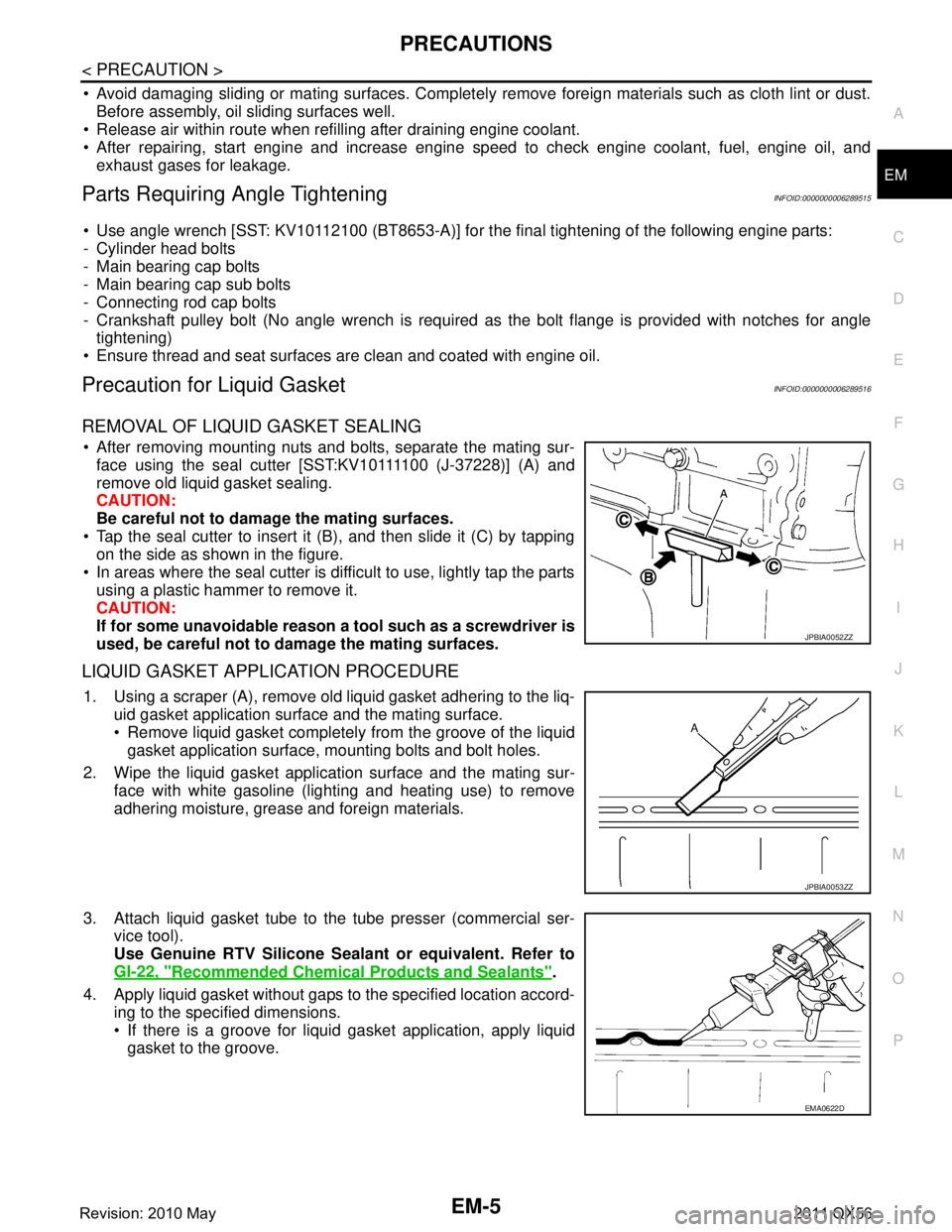
REMOVAL OF LIQUID GASKET SEALING
After removing mounting nuts and bolts, separate the mating sur- face using the seal cutter [SST:KV10111100 (J-37228)] (A) and
remove old liquid gasket sealing.
CAUTION:
Be careful not to damage the mating surfaces.
Tap the seal cutter to insert it (B), and then slide it (C) by tapping on the side as shown in the figure.
In areas where the seal cutter is difficult to use, lightly tap the parts using a plastic hammer to remove it.
CAUTION:
If for some unavoidable reason a tool such as a screwdriver is
used, be careful not to damage the mating surfaces.
LIQUID GASKET APPLICATION PROCEDURE
1. Using a scraper (A), remove old liquid gasket adhering to the liq- uid gasket application surface and the mating surface.
Remove liquid gasket completely from the groove of the liquidgasket application surface, mounting bolts and bolt holes.
2. Wipe the liquid gasket application surface and the mating sur- face with white gasoline (lighting and heating use) to remove
adhering moisture, grease and foreign materials.
3. Attach liquid gasket tube to the tube presser (commercial ser- vice tool).
Use Genuine RTV Silicone Seal ant or equivalent. Refer to
GI-22, "
Recommended Chemical Products and Sealants".
4. Apply liquid gasket without gaps to the specified location accord- ing to the specified dimensions.
If there is a groove for liquid gasket application, apply liquidgasket to the groove.
JPBIA0052ZZ
JPBIA0053ZZ
EMA0622D
Revision: 2010 May2011 QX56
Page 2608 of 5598
EM-46
< REMOVAL AND INSTALLATION >
HIGH PRESSURE FUEL PUMP AND FUEL HOSE
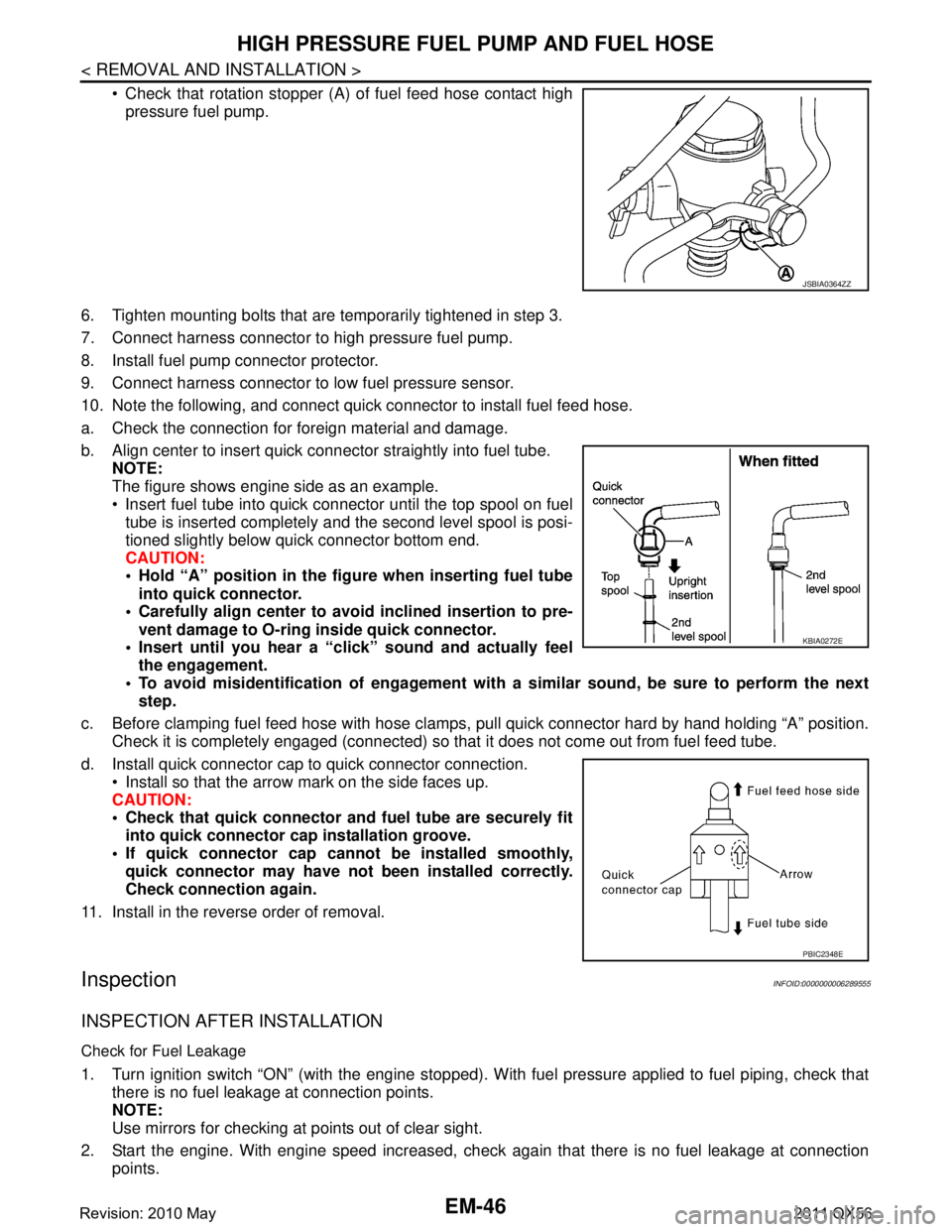
Check that rotation stopper (A) of fuel feed hose contact highpressure fuel pump.
6. Tighten mounting bolts that are temporarily tightened in step 3.
7. Connect harness connector to high pressure fuel pump.
8. Install fuel pump connector protector.
9. Connect harness connector to low fuel pressure sensor.
10. Note the following, and connect quick connector to install fuel feed hose.
a. Check the connection for foreign material and damage.
b. Align center to insert quick connector straightly into fuel tube. NOTE:
The figure shows engine side as an example.
Insert fuel tube into quick connector until the top spool on fueltube is inserted completely and the second level spool is posi-
tioned slightly below quick connector bottom end.
CAUTION:
Hold “A” position in the figure when inserting fuel tube
into quick connector.
Carefully align center to avoid inclined insertion to pre-
vent damage to O-ring inside quick connector.
Insert until you hear a “c lick” sound and actually feel
the engagement.
To avoid misidentification of engagement with a similar sound , be sure to perform the next
step.
c. Before clamping fuel feed hose with hose clamps, pull quick connector hard by hand holding “A” position.
Check it is completely engaged (connected) so that it does not come out from fuel feed tube.
d. Install quick connector cap to quick connector connection. Install so that the arrow mark on the side faces up.
CAUTION:
Check that quick connector and fuel tube are securely fitinto quick connector cap installation groove.
If quick connector cap canno t be installed smoothly,
quick connector may have not been installed correctly.
Check connection again.
11. Install in the reverse order of removal.
InspectionINFOID:0000000006289555
INSPECTION AFTER INSTALLATION
Check for Fuel Leakage
1. Turn ignition switch “ON” (with the engine stopped). With fuel pressure applied to fuel piping, check that
there is no fuel leakage at connection points.
NOTE:
Use mirrors for checking at points out of clear sight.
2. Start the engine. With engine speed increased, check again that there is no fuel leakage at connection
points.
JSBIA0364ZZ
KBIA0272E
PBIC2348E
Revision: 2010 May2011 QX56
Page 2635 of 5598
TIMING CHAINEM-73
< REMOVAL AND INSTALLATION >
C
DE
F
G H
I
J
K L
M A
EM
NP
O
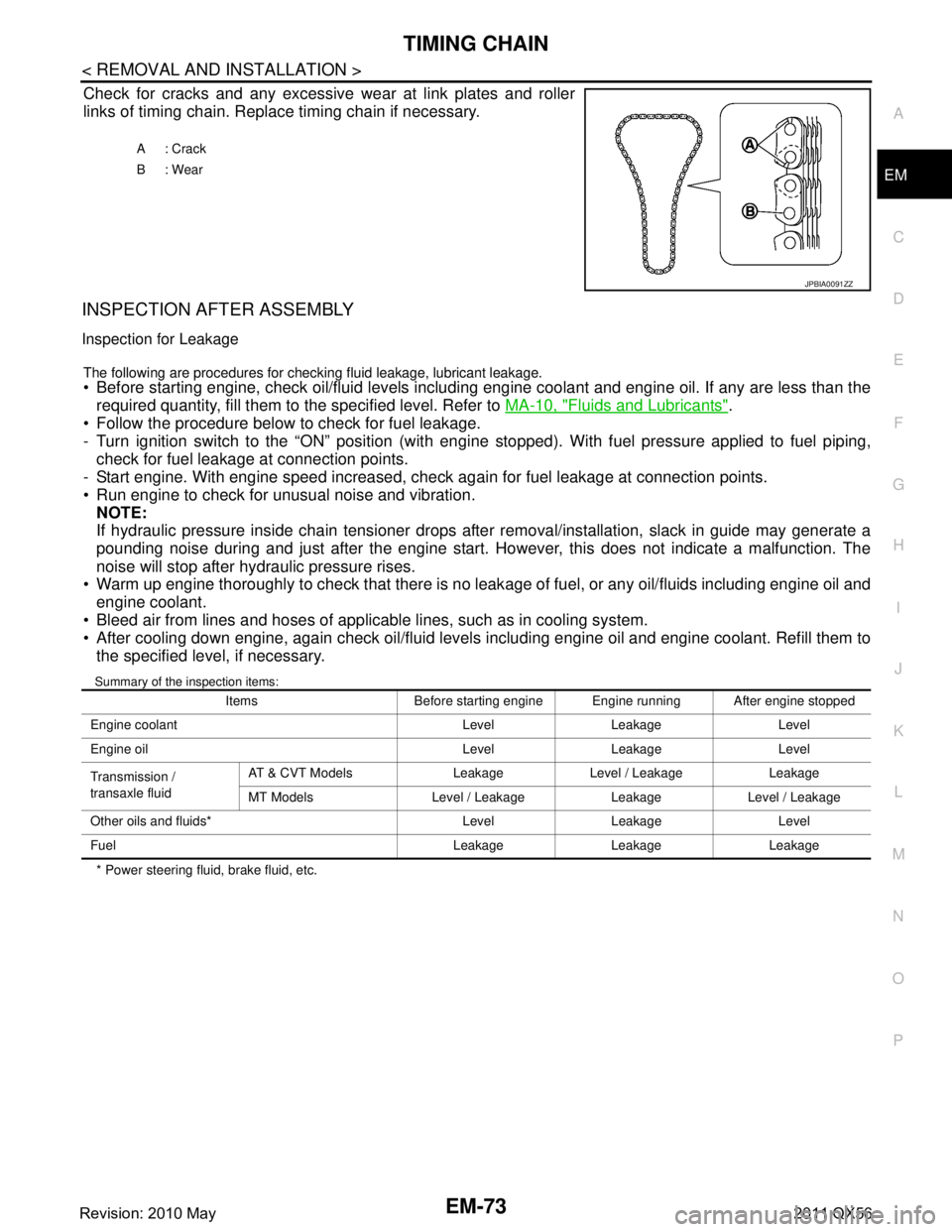
Check for cracks and any excessive
wear at link plates and roller
links of timing chain. Replace timing chain if necessary.
INSPECTION AFTER ASSEMBLY
Inspection for Leakage
The following are procedures for chec king fluid leakage, lubricant leakage. Before starting engine, check oil/fluid levels including engine coolant and engine oil. If any are less than the
required quantity, fill them to the specified level. Refer to MA-10, "
Fluids and Lubricants".
Follow the procedure below to check for fuel leakage.
- Turn ignition switch to the “ON” position (with engi ne stopped). With fuel pressure applied to fuel piping,
check for fuel leakage at connection points.
- Start engine. With engine speed increased, check again for fuel leakage at connection points.
Run engine to check for unusual noise and vibration.
NOTE:
If hydraulic pressure inside chain tensioner drops after removal/installation, slack in guide may generate a
pounding noise during and just after the engine start. However, this does not indicate a malfunction. The
noise will stop after hydraulic pressure rises.
Warm up engine thoroughly to check that there is no leak age of fuel, or any oil/fluids including engine oil and
engine coolant.
Bleed air from lines and hoses of applicable lines, such as in cooling system.
After cooling down engine, again check oil/fluid levels including engine oil and engine coolant. Refill them to the specified level, if necessary.
Summary of the inspection items:
* Power steering fluid, brake fluid, etc. A: Crack
B: Wear
JPBIA0091ZZ
Items Before starting engine Engine running After engine stopped
Engine coolant Level Leakage Level
Engine oil Level Leakage Level
Transmission /
transaxle fluid AT & CVT Models Leakage Level / Leakage Leakage
MT Models Level / Leakage Leakage Level / Leakage
Other oils and fluids* Level Leakage Level
Fuel Leakage Leakage Leakage
Revision: 2010 May2011 QX56
Page 2647 of 5598
CAMSHAFTEM-85
< REMOVAL AND INSTALLATION >
C
DE
F
G H
I
J
K L
M A
EM
NP
O
5. Perform the following inspection if engine oil does not
come out from valve timing control solenoid valve
oil hole of the valve timing control cover.
Remove oil filter, and then clean it. Refer to EM-61, "
Exploded View".
Clean oil groove between oil strainer and valve timing control solenoid valve. Refer to LU-5, "
Engine
Lubrication System" and LU-6, "Engine Lubrication System Schematic".
6. Remove components between valve timing control solenoid valve and camshaft sprocket, and then check each oil groove for clogging.
Clean oil groove if necessary. Refer to LU-5, "
Engine Lubrication System" and LU-6, "Engine Lubrica-
tion System Schematic".
7. After inspection, install removed parts in the reverse order.
Inspection for Leakage
The following are procedures for chec king fluid leakage, lubricant leakage.
Before starting engine, check oil/fluid levels including engine coolant and engine oil. If any are less than the
required quantity, fill them to the specified level. Refer to MA-10, "
Fluids and Lubricants".
Follow the procedure below to check for fuel leakage.
- Turn ignition switch to the “ON” position (with engi ne stopped). With fuel pressure applied to fuel piping,
check for fuel leakage at connection points.
- Start engine. With engine speed increased, check again for fuel leakage at connection points.
Run engine to check for unusual noise and vibration. NOTE:
If hydraulic pressure inside chain tensioner drops after removal/installation, slack in guide may generate a
pounding noise during and just after the engine start. However, this does not indicate a malfunction. The
noise will stop after hydraulic pressure rises.
Warm up engine thoroughly to check that there is no leak age of fuel, or any oil/fluids including engine oil and
engine coolant.
Bleed air from lines and hoses of applicable lines, such as in cooling system.
After cooling down engine, again check oil/fluid levels including engine oil and engine coolant. Refill them to
the specified level, if necessary.
Summary of the inspection items:
* Power steering fluid, brake fluid, etc. Items Before starting engine Engine running After engine stopped
Engine coolant Level Leakage Level
Engine oil Level Leakage Level
Transmission /
transaxle fluid AT & CVT Models Leakage Level / Leakage Leakage
MT Models Level / Leakage Leakage Level / Leakage
Other oils and fluids* Level Leakage Level
Fuel Leakage Leakage Leakage
Revision: 2010 May2011 QX56