2011 Hyundai Sonata abs
[x] Cancel search: absPage 244 of 380

Driving your vehicle28
5Indicator lightWhen ignition switch is turned to ON, the
indicator light illuminates, then goes off if
the ESC system is operating normally.
The ESC indicator light blinks whenever
ESC is operating or illuminates when
ESC fails to operate.
The ESC OFF indicator light comes on
when the ESC is turned off with the but-
ton.
ESC OFF usageWhen driving
• ESC should be turned on for daily driv-
ing whenever possible.
• To turn ESC off while driving, press the ESC OFF button while driving on a flat
road surface.
Never press the ESC OFF button while
ESC is operating (ESC indicator light
blinks).
If ESC is turned off while ESC is operat-
ing, the vehicle may slip out of control.✽ NOTICE• When operating the vehicle on a
dynamometer, ensure that the ESC is
turned off (ESC OFF light illuminat-
ed).
• Turning the ESC off does not affect ABS or brake system operation.
CAUTION
Driving with varying tire or wheel
sizes may cause the ESC system tomalfunction. When replacing tires,make sure they are the same size asyour original tires.
WARNING
The Electronic Stability Control sys-
tem is only a driving aid; use pre-
cautions for safe driving by slowing
down on curved, snowy, or icy
roads. Drive slowly and don’t
attempt to accelerate whenever the
ESC indicator light is blinking, or
when the road surface is slippery.
■ESC indicator light ■ ESC OFF indicator light
YF hma 5.qxp 11/25/2009 5:45 PM Page 28
Page 253 of 380
537
Driving your vehicle
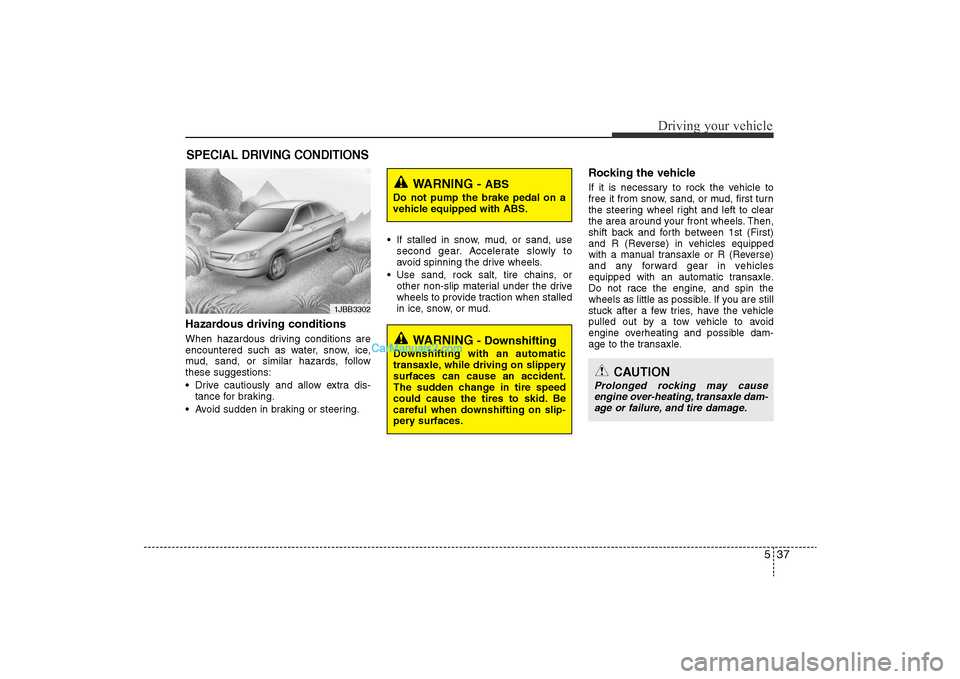
Hazardous driving conditions When hazardous driving conditions are
encountered such as water, snow, ice,
mud, sand, or similar hazards, follow
these suggestions:
• Drive cautiously and allow extra dis-tance for braking.
• Avoid sudden in braking or steering. • If stalled in snow, mud, or sand, use
second gear. Accelerate slowly to
avoid spinning the drive wheels.
• Use sand, rock salt, tire chains, or other non-slip material under the drive
wheels to provide traction when stalled
in ice, snow, or mud.
Rocking the vehicle If it is necessary to rock the vehicle to
free it from snow, sand, or mud, first turn
the steering wheel right and left to clear
the area around your front wheels. Then,
shift back and forth between 1st (First)
and R (Reverse) in vehicles equipped
with a manual transaxle or R (Reverse)
and any forward gear in vehicles
equipped with an automatic transaxle.
Do not race the engine, and spin the
wheels as little as possible. If you are still
stuck after a few tries, have the vehicle
pulled out by a tow vehicle to avoid
engine overheating and possible dam-
age to the transaxle.
SPECIAL DRIVING CONDITIONS
1JBB3302
WARNING -
ABS
Do not pump the brake pedal on a
vehicle equipped with ABS.
WARNING
- Downshifting
Downshifting with an automatic
transaxle, while driving on slippery
surfaces can cause an accident.
The sudden change in tire speed
could cause the tires to skid. Be
careful when downshifting on slip-
pery surfaces.
CAUTION
Prolonged rocking may causeengine over-heating, transaxle dam-age or failure, and tire damage.
YF hma 5.qxp 11/25/2009 5:47 PM Page 37
Page 328 of 380

Maintenance40
7Tire replacement
If the tire is worn evenly, a tread wear
indicator will appear as a solid band
across the tread. This shows there is
less than 1/16 inch (1.6 mm) of tread
left on the tire. Replace the tire when
this happens.
Do not wait for the band to appear
across the entire tread before replac-
ing the tire.
OEN076053
Tread wear indicator
WARNING
- Replacing
tires
To reduce the chance or serious
or fatal injuries from an acci-
dent caused by tire failure or
loss of vehicle control:
• Replace tires that are worn, show uneven wear, or are
damaged. Worn tires can
cause loss of braking effec-
tiveness, steering control, and
traction.
• Do not drive your vehicle with too little or too much pressure
in your tires. This can lead to
uneven wear and tire failure.
• When replacing tires, never mix radial and bias-ply tires
on the same car. You must
replace all tires (including the
spare) if moving from radial to
bias-ply tires.
(Continued)
(Continued)
• Using tires and wheel otherthan the recommended sizes
could cause unusual handling
characteristics and poor vehi-
cle control, resulting in a seri-
ous accident.
• Wheels that do not meet HYUNDAI’s specifications
may fit poorly and result in
damage to the vehicle or
unusual handling and poor
vehicle control.
• The ABS works by comparing the speed of the wheels. Tire
size can affect wheel speed.
When replacing tires, all 4
tires must use the same size
originally supplied with the
vehicle. Using tires of a differ-
ent size can cause the ABS
(Anti-lock Brake System) and
ESC (Electronic Stability
Control) to work irregularly.
YF HMA 7.QXP 11/25/2009 1:48 PM Page 40
Page 349 of 380

761
Maintenance
Rear combination light bulb
replacement(1) Back-up light
(2) Tail light
(3) Rear turn signal light
(4) Stop and tail light
(5) Side marker
Rear turn signal, stop and tail light,side marker1. Open the trunk lid.
2. Remove the service cover by pulling out the service cover. 3. Remove the socket from the assembly
by turning the socket counterclockwise
until the tabs on the socket align with
the slots on the assembly.
4. Remove the bulb from the socket by pressing it in and rotating it counter-
clockwise until the tabs on the bulb
align with the slots in the socket. Pull
the bulb out of the socket.
5. Insert a new bulb by inserting it into the socket and rotating it until it locks
into place.
6. Install the socket in the assembly by aligning the tabs on the socket with the
slots in the assembly. Push the socket
into the assembly and turn the socket
clockwise.
7. Install the service cover by putting it into the service hole.
Back-up lightIf the light is not operating, have the vehi-
cle checked by an authorized HYUNDAI
dealer.
OYF079042N
OYF079035
OYF079043
YF HMA 7.QXP 11/26/2009 10:55 AM Page 61
Page 351 of 380

763
Maintenance
Interior light bulb replacement1. Using a flat-blade screwdriver, gentlypry the lens from the interior light
housing.
2. Remove the bulb by pulling it straight out.
3. Install a new bulb in the socket.
4. Align the lens tabs with the interior light housing notches and snap the
lens into place.
WARNING
Prior to working on the Interior
Lights, ensure that the “OFF” but-
ton is depressed to avoid burning
your fingers or receiving an electric
shock.
CAUTION
Use care not to dirty or damagelens, lens tab, and plastic housings.
Luggage lamp (if equipped)
Map lamp
Sunvisor lamp
Room lamp
OYF079038/OYF079039 OYF079040/OTD079035
YF HMA 7.QXP 11/25/2009 1:54 PM Page 63
Page 359 of 380
CanisterFuel vapors generated inside the fuel
tank are absorbed and stored in the
onboard canister. When the engine is
running, the fuel vapors absorbed in the
canister are drawn into the surge tank
through the purge control solenoid valve.G270202AUNPurge Control Solenoid Valve (PCSV)The purge control solenoid valve is con-
trolled by the Engine Control Module
(ECM); when the engine coolant temper-
ature is low during idling, the PCSV clos-
es so that evaporated fuel is not taken
into the engine. After the engine warms-
up during ordinary driving, the PCSV
opens to introduce evaporated fuel to the
engine.
3. Exhaust emission control systemThe Exhaust Emission Control System is
a highly effective system which controls
exhaust emissions while maintaining
good vehicle performance.G270301AUNVehicle modifications This vehicle should not be modified.
Modification of your vehicle could affect
its performance, safety or durability and
may even violate governmental safety
and emissions regulations.
In addition, damage or performance
problems resulting from any modification
may not be covered under warranty.Engine exhaust gas precautions (car-
bon monoxide) • Carbon monoxide can be present with other exhaust fumes. Therefore, if you
smell exhaust fumes of any kind inside
your vehicle, have it inspected and
repaired immediately. If you ever sus-
pect exhaust fumes are coming into
your vehicle, drive it only with all the
windows fully open. Have your vehicle
checked and repaired immediately.
WARNING
-Exhaust
Engine exhaust gases contain car-
bon monoxide (CO). Though color-
less and odorless, it is dangerous
and could be lethal if inhaled.
Follow the instructions on this
page to avoid CO poisoning.
CALIFORNIA PROPOSI-
TION 65 WARNING
Engine exhaust and a wide variety
of automobile components and
parts, including components found
in the interior furnishings in a vehi-
cle, contain or emit chemicals
known to the State of California to
cause cancer and birth defects and
reproductive harm. In addition, cer-
tain fluids contained in vehicles
and certain products of component
wear contain or emit chemicals
known to the State of California to
cause cancer and birth defects or
other reproductive harm.
Maintenance
71
7
YF HMA 7.QXP 11/25/2009 1:54 PM Page 71
Page 372 of 380

Index2I
Air bags··················\
··················\
··················\
··················\
··3-37Air bag warning label··················\
··················\
············3-63
Air bag warning light ··················\
··················\
············3-40
Curtain air bag··················\
··················\
··················\
·····3-54
Driver's and passenger's front air bag ··················\
·····3-49
Occupant classification system ··················\
···············3-44
Side impact air bag··················\
··················\
················3-53
SRS components and functions ··················\
··············3-40
Air cleaner ··················\
··················\
··················\
···············7-28
Alarm system ··················\
··················\
··················\
···········4-14
Antenna (glass) ··················\
··················\
··················\
······4-104
Anti-lock brake system ··················\
··················\
··(ABS) 5-24
Appearance care··················\
··················\
··················\
·······7-64 Exterior care ··················\
··················\
··················\
········7-64
Interior care ··················\
··················\
··················\
·········7-68
Armrest ··················\
··················\
··················\
··················\
··3-13
Audio system ··················\
··················\
··················\
·········4-104 Glass antenna ··················\
··················\
··················\
····4-104
Steering wheel audio control··················\
·················4-10\
4
Automatic climate control system ··················\
···············4-88 Air conditioning ··················\
··················\
··················\
··4-94
Automatic heating and air conditioning··················\
··4-89
Manual heating and air conditioning ··················\
······4-90 Automatic transaxle ··················\
··················\
··················\
·5-14
Ignition key interlock system ··················\
··················\
5-19
Paddle shifter··················\
··················\
··················\
·······5-17
Shift lock system ··················\
··················\
··················\
·5-18
Sports mode··················\
··················\
··················\
·········5-17
Battery··················\
··················\
··················\
··················\
····7-33
Battery saver function··················\
··················\
················4-68
Before driving ··················\
··················\
··················\
············5-3
Binding arbitration ··················\
··················\
··················\
·····8-9
Bottle holders, see cup holders ··················\
··················\
4-100
Brake system··················\
··················\
··················\
············5-21 Anti-lock brake system (ABS) ··················\
················5-24
Electronic stability control (ESC) ··················\
···········5-26
Parking brake ··················\
··················\
··················\
······5-22
Power brakes ··················\
··················\
··················\
·······5-21
Brakes/clutch fluid ··················\
··················\
··················\
···7-25
Bulb replacement ··················\
··················\
··················\
·····7-58
Bulb wattage ··················\
··················\
··················\
··············8-2
Button start/stop, see engine start/stop button·················5-7A
B
YF HMA INDEX.QXP 1/13/2010 2:11 PM Page 2