2011 Hyundai Sonata child seat
[x] Cancel search: child seatPage 17 of 358
3
Seats / 3-2
Seat belts / 3-17
Child restraint system / 3-30
Air bag - supplemental restraint system / 3-36
Safety features of your vehicle
Page 21 of 358
35
Safety features of your vehicle
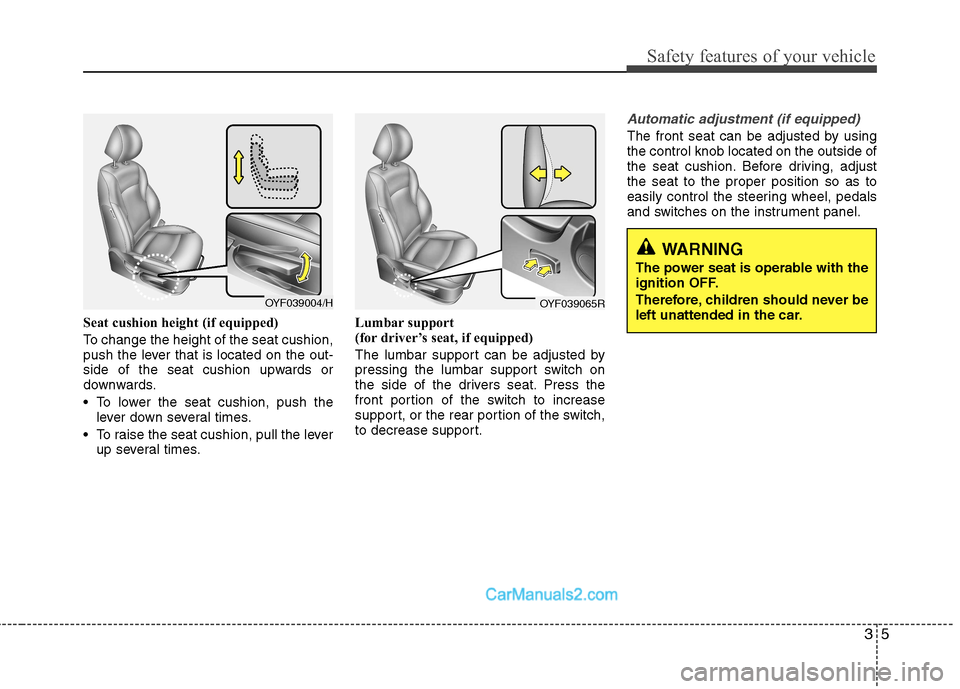
Seat cushion height (if equipped)
To change the height of the seat cushion,
push the lever that is located on the out-
side of the seat cushion upwards or
downwards.
• To lower the seat cushion, push thelever down several times.
To raise the seat cushion, pull the lever up several times. Lumbar support
(for driver’s seat, if equipped)
The lumbar support can be adjusted by
pressing the lumbar support switch on
the side of the drivers seat. Press the
front portion of the switch to increase
support, or the rear portion of the switch,
to decrease support.
Automatic adjustment (if equipped)
The front seat can be adjusted by using the control knob located on the outside of
the seat cushion. Before driving, adjustthe seat to the proper position so as to
easily control the steering wheel, pedals
and switches on the instrument panel.
WARNING
The power seat is operable with the
ignition OFF.
Therefore, children should never be
left unattended in the car.
OYF039004/HOYF039065R
Page 26 of 358
Safety features of your vehicle
10
3
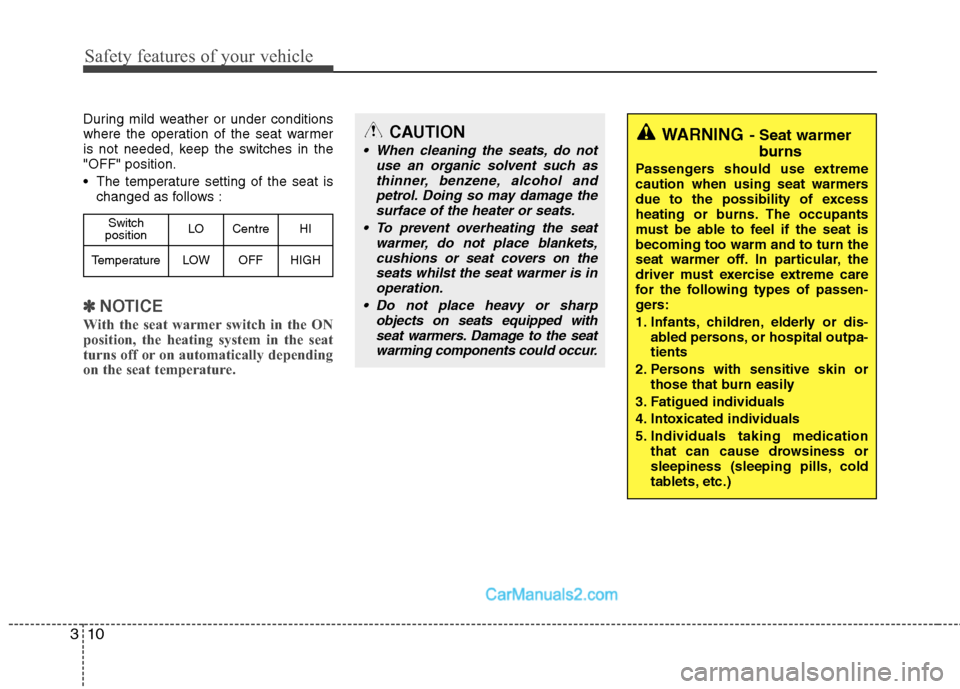
During mild weather or under conditions
where the operation of the seat warmer
is not needed, keep the switches in the"OFF" position.
The temperature setting of the seat is
changed as follows :
✽✽ NOTICE
With the seat warmer switch in the ON
position, the heating system in the seat
turns off or on automatically depending
on the seat temperature.
WARNING - Seat warmer
burns
Passengers should use extreme
caution when using seat warmers
due to the possibility of excess
heating or burns. The occupants
must be able to feel if the seat isbecoming too warm and to turn the
seat warmer off. In particular, the
driver must exercise extreme care
for the following types of passen-
gers:
1. Infants, children, elderly or dis- abled persons, or hospital outpa- tients
2. Persons with sensitive skin or those that burn easily
3. Fatigued individuals
4. Intoxicated individuals
5. Individuals taking medication that can cause drowsiness or
sleepiness (sleeping pills, cold
tablets, etc.)CAUTION
When cleaning the seats, do not
use an organic solvent such as
thinner, benzene, alcohol andpetrol. Doing so may damage thesurface of the heater or seats.
To prevent overheating the seat warmer, do not place blankets,cushions or seat covers on theseats whilst the seat warmer is inoperation.
Do not place heavy or sharp objects on seats equipped withseat warmers. Damage to the seat warming components could occur.
Switch
position LO Centre HI
TemperatureLOWOFFHIGH
Page 29 of 358
313
Safety features of your vehicle
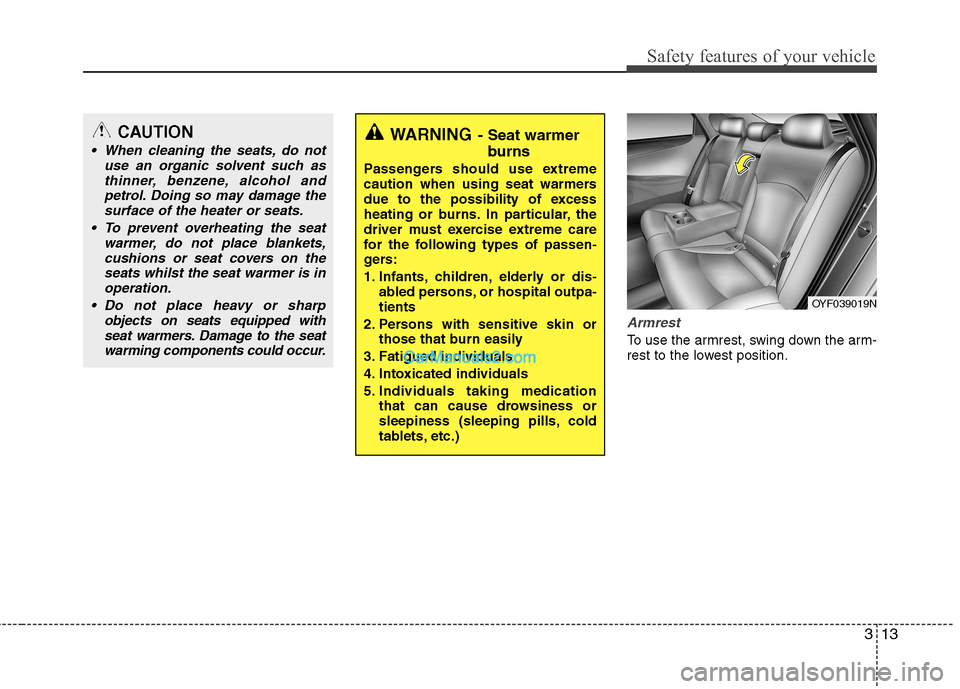
Armrest
To use the armrest, swing down the arm-
rest to the lowest position.
WARNING- Seat warmer
burns
Passengers should use extreme
caution when using seat warmers
due to the possibility of excess
heating or burns. In particular, the
driver must exercise extreme care
for the following types of passen-
gers:
1. Infants, children, elderly or dis- abled persons, or hospital outpa- tients
2. Persons with sensitive skin or those that burn easily
3. Fatigued individuals
4. Intoxicated individuals
5. Individuals taking medication that can cause drowsiness or
sleepiness (sleeping pills, cold
tablets, etc.)
OYF039019N
CAUTION
When cleaning the seats, do not
use an organic solvent such as
thinner, benzene, alcohol andpetrol. Doing so may damage thesurface of the heater or seats.
To prevent overheating the seat warmer, do not place blankets,cushions or seat covers on theseats whilst the seat warmer is in operation.
Do not place heavy or sharp objects on seats equipped withseat warmers. Damage to the seatwarming components could occur.
Page 33 of 358
317
Safety features of your vehicle
Seat belt restraint system
The use of seat belts reduces the risk of
accident injury by avoiding collision with
the interior of the car and by preventing
the occupants from being thrown out of
the car. This makes them the most impor-
tant safety feature available for you and
your passengers. Adequate protection is
afforded only when the belt is worn cor-
rectly. You should always fasten and
adjust your seatbelts before the car is put
in motion and encourage your passen-
gers to do the same.SEAT BELTS
WARNING
For maximum restraint system protection, the seat belts must
always be used whenever the car
is moving.
Seat belts are most effective when seatbacks are in theupright position.
Children age 12 and younger must always be properly
restrained in the rear seat. Never
allow children to ride in the front
passenger seat. If a child over 12
must be seated in the front seat,
he/she must be properly belted
and the seat should be moved as
far back as possible.
Never wear the shoulder belt under your arm or behind your
back. An improperly positionedshoulder belt can cause serious
injuries in a crash. The shoulder
belt should be positioned midway
over your shoulder across your
collarbone.
(Continued)(Continued)
Avoid wearing twisted seat belts.A twisted belt can't do its job as
well. In a collision, it could even
cut into you. Be sure the beltwebbing is straight and not twist-ed.
Be careful not to damage the belt webbing or hardware. If the belt
webbing or hardware is dam-
aged, replace it.
Page 34 of 358
Safety features of your vehicle
18
3
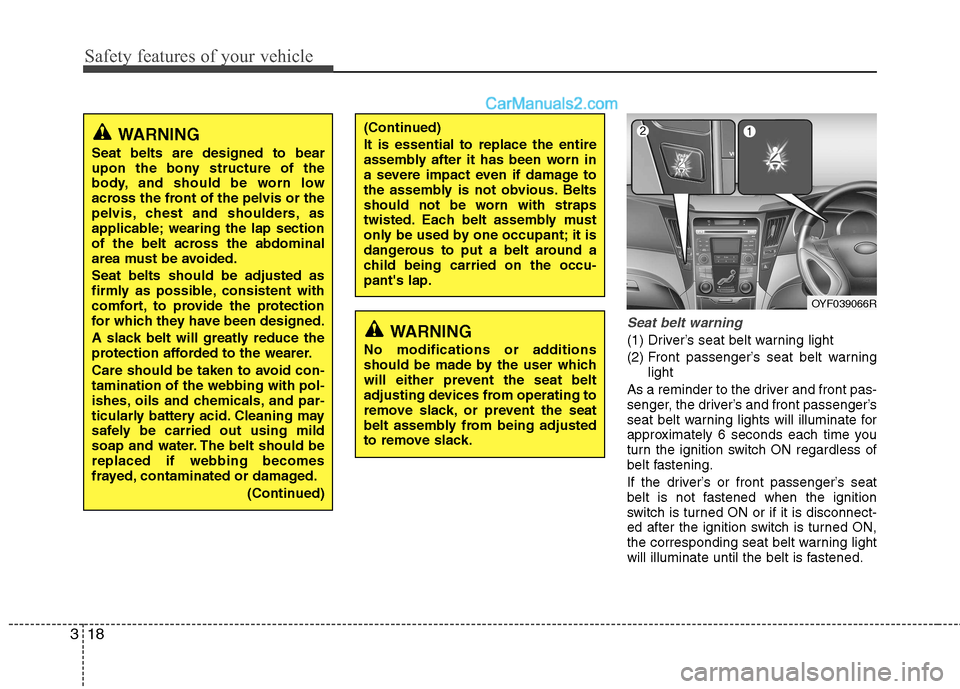
Seat belt warning
(1) Driver’s seat belt warning light
(2) Front passenger’s seat belt warning
light
As a reminder to the driver and front pas-
senger, the driver’s and front passenger’s
seat belt warning lights will illuminate for
approximately 6 seconds each time you
turn the ignition switch ON regardless of
belt fastening.
If the driver’s or front passenger’s seat
belt is not fastened when the ignition
switch is turned ON or if it is disconnect-
ed after the ignition switch is turned ON,
the corresponding seat belt warning light
will illuminate until the belt is fastened.
(Continued) It is essential to replace the entire
assembly after it has been worn in
a severe impact even if damage to
the assembly is not obvious. Belts
should not be worn with straps
twisted. Each belt assembly must
only be used by one occupant; it is
dangerous to put a belt around a
child being carried on the occu-pant's lap.
WARNING
No modifications or additions
should be made by the user which
will either prevent the seat belt
adjusting devices from operating to
remove slack, or prevent the seat
belt assembly from being adjusted
to remove slack.
WARNING
Seat belts are designed to bear
upon the bony structure of the
body, and should be worn low
across the front of the pelvis or the
pelvis, chest and shoulders, as
applicable; wearing the lap section
of the belt across the abdominal
area must be avoided. Seat belts should be adjusted as
firmly as possible, consistent with
comfort, to provide the protection
for which they have been designed.
A slack belt will greatly reduce the
protection afforded to the wearer.
Care should be taken to avoid con- tamination of the webbing with pol-
ishes, oils and chemicals, and par-
ticularly battery acid. Cleaning may
safely be carried out using mild
soap and water. The belt should bereplaced if webbing becomes
frayed, contaminated or damaged.
(Continued)
OYF039066R
Page 42 of 358
Safety features of your vehicle
26
3
WARNING
All occupants of the vehicle must wear their seat belts at all times.
Seat belts and child restraintsreduce the risk of serious or fatal
injuries for all occupants in the
event of a collision or sudden stop.
Without a seat belt, occupants
could be shifted too close to a
deploying air bag, strike the interior
structure or be thrown from the
vehicle. Properly worn seat belts
greatly reduce these hazards.
Always follow the precautions
about seat belts, air bags and occu-
pant seat contained in this manual.
WARNING
Every person in your vehicle needs
to be properly restrained at all
times, including infants and chil-
dren. Never hold a child in yourarms or lap when riding in a vehi-
cle. The violent forces created dur-
ing a crash will tear the child from
your arms and throw the child
against the interior. Always use a
child restraint appropriate for your
child's height and weight.
Seat belt precautionsInfant or small child
You should be aware of the specific
requirements in your country. Child
and/or infant seats must be properly
placed and installed in the rear seat. For
more information about the use of these
restraints, refer to “Child restraint sys-
tem” in this section.(Continued)
Improper handling of the pre-ten- sioner seat belt assemblies, and failure to heed the warnings not
to strike, modify, inspect, replace,
service or repair the pre-tension-
er seat belt assemblies may lead
to improper operation or inadver-
tent activation and serious injury.
Always wear the seat belts when driving or riding in a motor vehi-
cle.
If the vehicle or pre-tensioner seat belt must be discarded, con-
tact an authorised HYUNDAI deal-
er.
Page 43 of 358
327
Safety features of your vehicle
✽✽NOTICE
Small children are best protected from
injury in an accident when properly
restrained in the rear seat by a child
restraint system that meets the require-
ments of the Safety Standards of your
country. Before buying any child
restraint system, make sure that it has a
label certifying that it meets Safety
Standards of your country. The restraint
must be appropriate for your child's
height and weight. Check the label on
the child restraint for this information.
Refer to “Child restraint system” in this
section.Larger children
Children who are too large for child
restraint systems should always occupy
the rear seat and use the available
lap/shoulder belts. The lap portion should
be fastened snug on the hips and as low
as possible. Check belt fit periodically. A
child's squirming could put the belt out of
position. Children are afforded the most
safety in the event of an accident when
they are restrained by a proper restraint
system in the rear seat. If a larger child
(over age 12) must be seated in the frontseat, the child should be securely
restrained by the available lap/shoulderbelt and the seat should be placed in the
rearmost position. Children age 12 and
under should be restrained securely in
the rear seat. NEVER place a child age
12 and under in the front seat. NEVER
place a rear facing child seat in the front
seat of a vehicle. If the shoulder belt portion slightly touch-
es the child’s neck or face, try placing the
child closer to the centre of the vehicle. If
the shoulder belt still touches their face
or neck they need to be returned to a
child restraint system.
WARNING
- Shoulder belts
on small children
Never allow a shoulder belt to be in contact with a child’s neck or
face whilst the vehicle is inmotion.
If seat belts are not properly worn and adjusted on children, there is
a risk of death or serious injury.