Specifications
4
9
RECOMMENDED LUBRICANTS AND CAPACITIES
I040000GTQ
To help achieve proper engine and powertrain performance and durability, use only lubricants of the proper quality. The correct
lubricants also help promote engine efficiency that results in improved fuel economy.
These lubricants and fluids are recommended for use in your vehicle.
* 1
Refer to the recommended SAE viscosity numbers on page 9-6.
* 2
Engine oils labeled Energy Conserving Oil are now available. Along with other additional benefits, they contribute to fuel econo my by reducing
the amount of fuel necessary to overcome engine friction. Often, these improvements are difficult to measure in everyday driving, but in a year’s
time, they can offer significant cost and energy savings.
* 3
VGT : Variable Geometry Turbocharger
* 4
WGT : Waste Gate Turbocharger
* 5
If the API service SM engine oil is not available in your country, you are able to use API service SL. Lubricant
Volume (
l/ US qt.)
Classification
Engine oil * 1
*2
(drain and refill) Recommends Diesel engineA2.5 7.4 (7.82)
VGT*
3
: API Service CH-4 or above, ACEA B4
WGT* 4
: API Service CF-4 or above, ACEA B4
4D56 5.4 (5.71) PI Service CF-4 or above, ACEA B2 or B3
Gasoline engine 5.1 (5.39) API Service SM* 5
, ILSAC GF-4 or above
Engine oil consumption Normal driving condition
MAX. 1
l/1500 km
-
Severe driving condition MAX. 1
l/1000 km
-
Manual transmissionfluid A2.5 Diesel engine 3.0 (3.17)
API Service GL-4
SAE 75W/85
4D56 Diesel engine &
Gasoline engine 1.95 (2.06)
Automatic transmis-sion fluid A2.5 Diesel engine 10.0 (10.60) APOLLOIL ATF RED-1
4D56 Diesel engine & Gasoline engine 8.0 (8.45)CASTLE AUTO FLUID T-IV, DIAMOND ATF SP-I or
other brans approved by Hyundai Motor Co.
Power steering 0.9~1.0 (0.95~1.06) PSF-3
Specifications
6
9
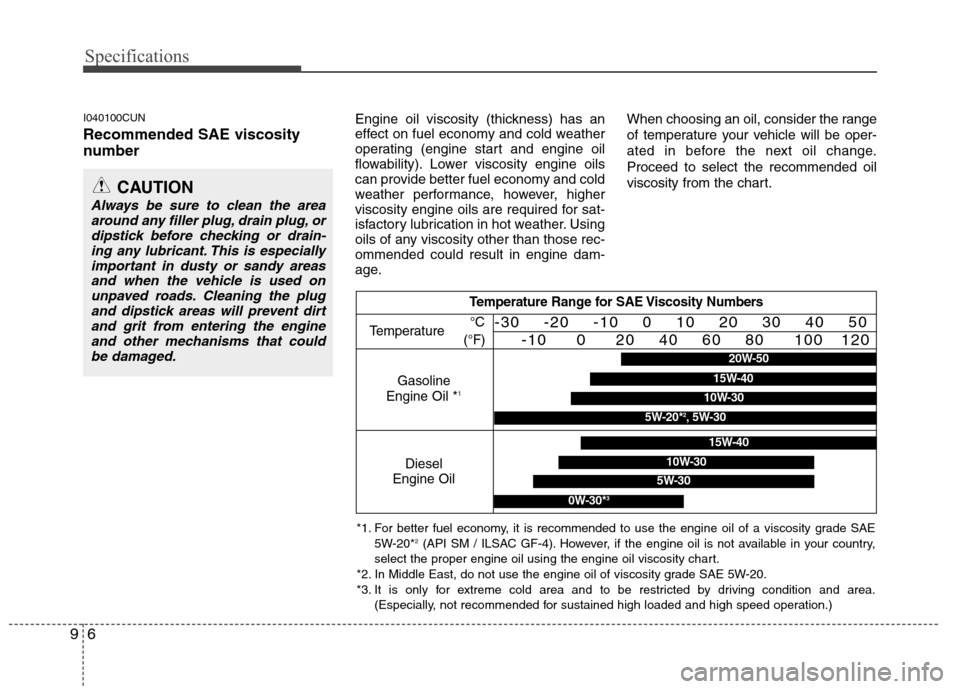
I040100CUN Recommended SAE viscosity
number Engine oil viscosity (thickness) has an
effect on fuel economy and cold weather
operating (engine start and engine oil
flowability). Lower viscosity engine oils
can provide better fuel economy and cold
weather performance, however, higher
viscosity engine oils are required for sat-
isfactory lubrication in hot weather. Using
oils of any viscosity other than those rec-ommended could result in engine dam-
age.When choosing an oil, consider the range
of temperature your vehicle will be oper-
ated in before the next oil change.Proceed to select the recommended oil
viscosity from the chart.
CAUTION
Always be sure to clean the area
around any filler plug, drain plug, or
dipstick before checking or drain-ing any lubricant. This is especiallyimportant in dusty or sandy areas
and when the vehicle is used on unpaved roads. Cleaning the plugand dipstick areas will prevent dirt and grit from entering the engine and other mechanisms that could
be damaged.
Temperature Range for SAE Viscosity Numbers
Temperature
Gasoline
Engine Oil * 1°C
(°F)-30 -20 -10 0 10 20 30 40 50 -10 0 20 40 60 80 100 120
Diesel
Engine Oil
5W-30
15W-40
10W-30
0W-30* 3
*1. For better fuel economy, it is recommended to use the engine oil of a viscosity grade SAE
5W-20* 2
(API SM / ILSAC GF-4). However, if the engine oil is not available in your country,
select the proper engine oil using the engine oil viscosity chart.
*2. In Middle East, do not use the engine oil of viscosity grade SAE 5W-20.
*3. It is only for extreme cold area and to be restricted by driving condition and area. (Especially, not recommended for sustained high loaded and high speed operation.)
20W-50
10W-30
15W-40
5W-20* 2
, 5W-30