2011 Hyundai Accent Engine
[x] Cancel search: EnginePage 76 of 282

1
FEATURES OF YOUR HYUNDAI
651
FEATURES OF YOUR HYUNDAI
65
B260G01A-AAT
Low Oil Pressure Warning
LightCAUTION:
If the oil pressure warning light stays on
while the engine is running, serious en-
gine damage may result. The oil pres-
sure warning light comes on whenever
there is insufficient oil pressure. In nor-
mal operation, it should come on when
the ignition switch is turned on, then go
out when the engine is started. If the oil
pressure warning light stays on while
the engine is running, there is a serious
malfunction.
If this happens, stop the car as soon as
it is safe to do so, turn off the engine and
check the oil level. If the oil level is low,
fill the engine oil to the proper level and
start the engine again. If the light stays
on with the engine running, turn the en-
gine off immediately. In any instance
where the oil light stays on when the
engine is running, the engine should be
checked by a Hyundai dealer before the
car is driven again.
!
B260H03A-AAT
Parking Brake/
Low Brake Fluid Level
Warning Light
CAUTION:
If you suspect brake trouble, have your
brakes checked by a Hyundai dealer as
soon as possible. Driving your car with
a problem in either the brake electrical
system or brake hydraulic system is
dangerous, and could result in serious
injury or death.
!
Warning Light OperationThe parking brake/brake fluid level warn-
ing light should come on when the park-
ing brake is applied and the ignition switch
is turned to "ON" or "START". After the
engine is started, the light should go out
when the parking brake is released.
If the parking brake is not applied, the
warning light should come on when the
ignition switch is turned to "ON" or
"START", then go out when the engine
starts.
D150312AUN
Automatic Transaxle Position
Indicator Light (If Installed)
The indicator displays which automatic
transaxle shift position is selected.
Manual Transaxle Shift Indi-
cator (If Installed)
This indicator informs you which gear is
desired while driving to save fuel.
For example:
: Indicates that shifting up to the 3rd
gear is desired (currently the shift
lever is in the 2nd gear).: Indicates that shifting down to the
3rd gear is desired (currently the
shift lever is in the 4th gear).
NOTE :When the system is not working prop-
erly, up & down arrow indicator will blink
(Gear is not displayed.).
Page 77 of 282
1FEATURES OF YOUR HYUNDAI66
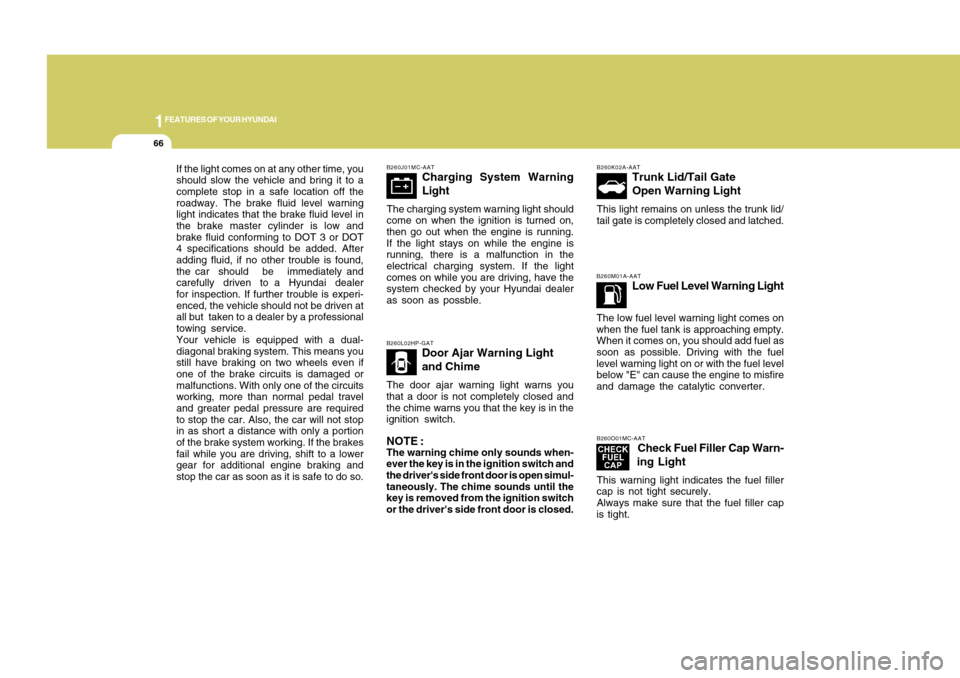
B260J01MC-AAT
Charging System Warning
Light
The charging system warning light should
come on when the ignition is turned on,
then go out when the engine is running.
If the light stays on while the engine is
running, there is a malfunction in the
electrical charging system. If the light
comes on while you are driving, have the
system checked by your Hyundai dealer
as soon as possble.
B260M01A-AAT
Low Fuel Level Warning Light
The low fuel level warning light comes on
when the fuel tank is approaching empty.
When it comes on, you should add fuel as
soon as possible. Driving with the fuel
level warning light on or with the fuel level
below "E" can cause the engine to misfire
and damage the catalytic converter.
B260L02HP-GAT
Door Ajar Warning Light
and Chime
The door ajar warning light warns you
that a door is not completely closed and
the chime warns you that the key is in the
ignition switch.NOTE :The warning chime only sounds when-
ever the key is in the ignition switch and
the driver's side front door is open simul-
taneously. The chime sounds until the
key is removed from the ignition switch
or the driver's side front door is closed.
B260K02A-AAT
Trunk Lid/Tail Gate
Open Warning Light
This light remains on unless the trunk lid/
tail gate is completely closed and latched.B260O01MC-AAT
Check Fuel Filler Cap Warn-
ing Light
This warning light indicates the fuel filler
cap is not tight securely.
Always make sure that the fuel filler cap
is tight.
If the light comes on at any other time, you
should slow the vehicle and bring it to a
complete stop in a safe location off the
roadway. The brake fluid level warning
light indicates that the brake fluid level in
the brake master cylinder is low and
brake fluid conforming to DOT 3 or DOT
4 specifications should be added. After
adding fluid, if no other trouble is found,
the car should be immediately and
carefully driven to a Hyundai dealer
for inspection. If further trouble is experi-
enced, the vehicle should not be driven at
all but taken to a dealer by a professional
towing service.
Your vehicle is equipped with a dual-
diagonal braking system. This means you
still have braking on two wheels even if
one of the brake circuits is damaged or
malfunctions. With only one of the circuits
working, more than normal pedal travel
and greater pedal pressure are required
to stop the car. Also, the car will not stop
in as short a distance with only a portion
of the brake system working. If the brakes
fail while you are driving, shift to a lower
gear for additional engine braking and
stop the car as soon as it is safe to do so.
Page 78 of 282

1
FEATURES OF YOUR HYUNDAI
671
FEATURES OF YOUR HYUNDAI
67
B260N01MC-AAT
Malfunction Indicator Light
This light illuminates when there is a
malfunction of an exhaust gas related
component and the system is not func-
tioning properly. This light will also illumi-
nate when the ignition key is turned to the
"ON" position, and will go out in a few
seconds after the engine is started. If it
illuminates while driving, or does not illumi-
nate when the ignition key is turned to the
"ON" position, take your car to your nearest
authorized Hyundai dealer and have the
system checked.
!
CAUTION:
Prolonged driving with the Emission
Control System Malfunction Indicator
Light illuminated may cause damage to
the emission control systems which
could effect drivability or fuel economy.
If the Emission Control System Malfunc-
tion Indicator Light begins to flash ON
and OFF, potential catalytic converter
damage is possible. This could result in
loss of engine power. Have the Engine
Control System inspected as soon as
possible by an authorized Hyundai
dealer.The driver's seat belt warning light and
chime will activate to the following table
when the ignition switch is in "ON" posi-
tion.
B265E01MC-AAT
Seat Belt Warning Light
and Chime
*1) Warning pattern repeats 11 times with
an interval of 24 seconds. If the driver's
seat belt is buckled, the light will stop
within 6 seconds and chime will stop
immediately.
*2) The light will stop within 6 seconds
and chime will stop immediately.
Conditions Warning Pattern
Seat BeltVehicle SpeedLight-Blink Chime-SoundUnbuckled
Buckled
Buckled
→ →→ →
→ Unbuckled
UnbuckledAbove 6mph
(10 km/h)
↓
Below 3mph
(5 km/h)6 seconds
6 seconds
6 seconds *1)
↓Stop *2)
6 secondsNone
B290A02MC-AAT
Engine Coolant Temperature
Warning Light
WARNING:
Never remove the radiator cap when the
engine is hot. The engine coolant is un-
der pressure and could erupt and cause
severe burns. Wait until the engine is
cool before removing the radiator cap.
!
This warning light shows the temperature
of the engine coolant when the ignition
switch is ON. The warning light illumi-
nates if the temperature of the engine
coolant is above 253.4±5.4°F (123±3°C).
If the warning light illuminates, pull over
and stop as soon as possible and turn off
the engine. Then open the hood and
check the coolant level (See "If the en-
gine overheats" on the page 3-4.) and the
water pump drive belt. If you suspect
cooling system trouble, have your cool-
ing system checked by a Hyundai dealer
as soon as possible.NOTE:If the engine coolant temperature warn-
ing light illuminates, it indicates over-
heating that may damage the engine.
Page 81 of 282

1FEATURES OF YOUR HYUNDAI70
B330A03A-AATTACHOMETERThe tachometer registers the speed of
your engine in revolutions per minute
(rpm).
CAUTION:
The engine should not be increased to
such a speed that the needle enters the
red zone on the tachometer face. This
can cause severe engine damage and
may void your warranty.
!
B300A01A-AATSPEEDOMETERYour Hyundai's speedometer is calibrated
in miles per hour (on the outer scale) and
kilometers per hour (on the inner scale).
OMC029513N
INSTRUMENT CLUSTERB280A02TG-AATFUEL GAUGEThe needle on the gauge indicates the
approximate fuel level in the fuel tank.
The fuel capacity is given in Section 9.NOTE:The "
" symbol means the fuel filler
lid is placed on the left side of the vehicle.
OMC029420K
Type A
Type B
OMC029512N
CAUTION:
Avoid driving with a very low fuel level. If
you run out of fuel, it could cause the
engine to misfire and result in excessive
loading of the catalytic converter.
!
Page 92 of 282

1
FEATURES OF YOUR HYUNDAI
811
FEATURES OF YOUR HYUNDAI
81
HAZARD WARNING SYS-
TEMB370A01A-AATThe hazard warning system should be
used whenever you find it necessary to
stop the car in a hazardous location.
When you must make such an emer-
gency stop, always pull off the road as far
as possible.
The hazard warning lights are turned on
by pushing in the hazard switch. This
causes all turn signal lights to blink. The
hazard warning lights will operate even
though the key is not in the ignition.
To turn the hazard warning lights off,
push the switch a second time.
OMC025067
CAUTION:
Do not clean the inner side of the rear
window glass with an abrasive type of
glass cleaner or use a scraper to re-
move foreign deposits from the inner
surface of the glass as this may cause
damage to the defroster elements.NOTE:The engine must be running for the rear
window defroster to operate.
!
The rear window defroster is turned on by
pushing in the switch. To turn the de-
froster off, push the switch a second time.
The rear window defroster automatically
turns itself off after about 20 minutes. To
restart the defroster cycle, push in the
switch again after it has turned itself off.
OMC025072
REAR WINDOW DEFROSTER
SWITCHB380A01MC-AAT
Page 94 of 282

1
FEATURES OF YOUR HYUNDAI
831
FEATURES OF YOUR HYUNDAI
83
POWER OUTLETB500D01MC-GATThese supply 12V electric power to oper-
ate electric accessories or equipment.
OMC029106
ASHTRAYTo use the ashtray, open the cover. To
remove the ashtray to empty or clean it,
pull it all the way out.B430A01MC-GAT
OMC025103
!
CAUTION:
o Only use the power outlet when the
engine is running. Unplug the plug
from the power outlet when the en-
gine is off if the key will be left in the
"ACC" or "ON" (not recommended)
positions, to prevent discharging the
battery. Using when the engine stops
or leaving the electric appliance
plugged in for many hours may cause
the battery to discharge.
o Do not use the power outlet to con-
nect electric accessories or equip-
ment other than those designed to
operate on 12 volts.
o Some electronic devices can cause
electronic interference when plugged
into the power outlet. These devices
may cause excessive audio noise
and malfunctions in other electronic
systems or devices used in your
vehicle.
Page 104 of 282

1
FEATURES OF YOUR HYUNDAI
931
FEATURES OF YOUR HYUNDAI
93
3. Pull the support rod from the hood.
B570A01MC
4. Hold the hood open with the support
rod.
B570A02MC
CAUTION:
Make sure that the support rod has been
released prior to closing the hood.
!
Before closing the hood, return the sup-
port rod to its clip to prevent it from rattling.
Lower the hood until it is about 1 ft. (30
cm) above the closed position and let it
drop. Make sure that it locks into place.
OMC025020
2. Pull the secondary latch lever up and
lift the hood. 1. Pull the release knob to unlatch the
hood.
OMC025019
HOOD RELEASEB570A01MC-GAT
!
WARNING:
o Always double check to be sure that
the hood is firmly latched before driv-
ing away. If it is not latched, the hood
could fly open while the vehicle is
being driven, causing a total loss of
visibility, which might result in an
accident.
o The support rod must be inserted
completely into the hole provided in
the hood whenever you inspect the
engine compartment. This will pre-
vent the hood from falling and possi-
bly injuring you.
o Do not move the vehicle with the
hood in the raised position, as vision
is obstructed and the hood could fall
or be damaged.
Page 106 of 282

1
FEATURES OF YOUR HYUNDAI
951
FEATURES OF YOUR HYUNDAI
95
!
WARNING:
If you must re-enter the vehicle,
you should once again eliminate
potentially dangerous static elec-
tricity discharge by touching a
metal part of the vehicle, away
from the fuel filler neck, nozzle or
other gasoline source.
- When using a portable fuel con-
tainer be sure to place the con-
tainer on the ground prior to refu-
eling. Static electricity discharge
from the container can ignite fuel
vapors causing a fire. Once refu-
eling has begun, contact with the
vehicle should be maintained until
the filling is complete. Use only
portable fuel containers designed
to carry and store gasoline.
- Do not use cellular phones around
a gas station or while refueling any
vehicle. Electric current and/or
electronic interference from cellu-
lar phones can potentially ignite
fuel vapors causing a fire. If you
must use your cellular phone use
it in a place away from the gas
station.
!
WARNING:
o Gasoline vapors are dangerous.
Before refueling, always stop the
engine and never smoke or allow
sparks and open flames near the
filler area.
o Never operate your vehicle without a
filler cap properly installed, flam-
mable vapors and gasoline could
leak out in dangerous situations such
as a collision or rollover. If the filler
cap must be replaced, only use genu-
ine Hyundai replacement parts.
o After refueling, make sure the fuel
cap is installed securely to prevent
fuel spillage in the event of an acci-
dent.
o Tighten the cap until it clicks one
time, otherwise the "
"light will
illuminate.
o If you open the fuel filler cap during
high ambient temperatures, a slight
"pressure sound" may be heard.
This is normal and not a cause for
concern. Whenever you open the fuel
filler cap, turn it slowly.
o Do not "top off" after the nozzle au-
tomatically shuts off when refueling.
o Automotive fuels are flammable/ex-
plosive materials. When refueling,
please note the following guidelines
carefully. Failure to follow these
guidelines may result in severe per-
sonal injury, severe burns or death
by fire or explosion.
- Read and follow all warnings posted
at the gas station facility.
- Before refueling, note the location
of the Emergency Gasoline Shut-
Off, if available, at the gas station
facility.
- Before touching the fuel nozzle or
fuel filler cap, you should eliminate
potentially dangerous static elec-
tricity discharge by touching an-
other metal part of the front of the
vehicle, a safe distance away from
the fuel filler neck, nozzle, or other
gas source.
- Do not get back into a vehicle once
you have begun refueling. Do not
touch, rub or slide against any item
or fabric (polyester, satin, nylon,
etc.) capable of producing static
electricity. Static electricity dis-
charge can ignite fuel vapors re-
sulting in explosion.
!
WARNING: