2011 Hyundai Accent ECU
[x] Cancel search: ECUPage 43 of 282

1FEATURES OF YOUR HYUNDAI32
!
o Never hold a child in your arms or lap
when riding in a vehicle. The violent
forces created during a crash will
tear the child from your arms and
throw the child against the car’s inte-
rior.
o Never put a seat belt over yourself
and a child. During a crash, the belt
could press deep into the child caus-
ing serious internal injuries.
o Never leave children unattended in a
vehicle – not even for a short time.
The car can heat up very quickly,
resulting in serious injuries to chil-
dren inside. Even very young chil-
dren may inadvertently cause the
vehicle to move, entangle them-
selves in the windows, or lock them-
selves or others inside the vehicle.
o Never allow two children, or any two
persons, to use the same seat belt.
o Children often squirm and reposition
themselves improperly. Never let a
child ride with the shoulder belt un-
der their arm or behind their back.
Always properly position and secure
children in rear seat.
WARNING:
o When the child restraint system is
not in use, store it in the trunk or
fasten it with a safety belt so that it
will not be thrown forward in case of
a sudden stop or an accident.
o Children may be seriously injured or
killed by an inflating airbag. All chil-
dren, even those too large for child
restraints, must ride in the rear seat.
To reduce the chance or serious or fatal
injuries:
o Children of all ages are safer when
restrained in the rear seat. A child
riding in the front passenger seat
can be forcefully struck by an inflat-
ing airbag resulting in serious or fa-
tal injuries.
o Always follow the instructions for
installation and use of the child re-
straint maker.
o Always make sure the child seat is
secured properly in the car and your
child is securely restrained in the
child seat.
!
WARNING:
WARNING:
o A child restraint system must be
placed in the rear seat. Never install
a child or infant seat on the front
passenger's seat.
Should an accident occur and cause
the passenger side airbag to deploy,
it could severely injure or kill an
infant or child seated in an infant or
child seat. Thus, only use a child
restraint in the rear seat of your
vehicle.
o Since a safety belt or child restraint
system can become very hot if it is
left in a closed vehicle, be sure to
check the seat cover and buckles
before placing a child there.
!
For small children and babies, a child
seat or infant seat must be used. Before
buying a particular child restraint system,
make sure it fits your car seat and seat
belts, and fits your child. Follow all the
instructions provided by the manufacturer
when installing the child restraint system.
Page 44 of 282

1
FEATURES OF YOUR HYUNDAI
331
FEATURES OF YOUR HYUNDAI
33
!
WARNING:
o Never allow a child to stand-up or
kneel on the seat or floorboard of a
moving vehicle. During a collision or
sudden stop, the child can be vio-
lently thrown against the vehicle's
interior, resulting in serious injury.
o Never use an infant carrier or a child
safety seat that "hooks" over a
seatback, it may not provide ad-
equate security in an accident.
o Seat belts can become very hot, es-
pecially when the car is parked in
direct sunlight. Always check seat
belt buckles before fastening them
over a child.
o Always store or secure a child seat,
even when it is not in use. During a
collision or sudden stop, the child
seat could be thrown inside the ve-
hicle.
B230B01E-AATUsing a Child Restraint System with
the "Tether Anchorage" SystemFor small children and babies, the use of
a child seat or infant seat is required. This
child seat or infant seat should be of
appropriate size for the child and should
be installed in accordance with the
manufacturer's instructions. It is further
required that the seat be placed in the
vehicle's rear seat since this can make an
important contribution to safety. Your ve-
hicle is provided with three child restraint
hook holders for installing the child seat
or infant seat.
B230C02MC-AATInstalling a Child Restraint Seat with
the "Tether Anchorage" System
(4 Door)Three child restraint hook holders are
located on the rear seat package tray.To install the child restraint seat
B230C01MC
1. Open the tether anchor cover on the
rear seat package tray.
Page 45 of 282

1FEATURES OF YOUR HYUNDAI34
B230E02MC-AATInstalling a Child Restraint Seat with
the "Tether Anchorage" System
(3 Door)Three child restraint hook holders are
located on the rear floor panel.To install the child restraint seat
!
WARNING:
o A child can be seriously injured or
killed in a collision if the child re-
straint is not properly anchored.
Always follow the child seat
manufacturer’s instructions for in-
stallation and use.
o Never mount more than one child
restraint to a single tether anchor or
to a single lower anchorage point.
The increased load caused by mul-
tiple seats may cause the tethers or
lower anchorage points to break,
causing serious injury or death.
1. Open the tether anchor cover on the
rear floor panel.
B230E01MC
2. Route the child restraint seat tether
strap over the seatback.
For vehicles with adjustable headrests,
route the tether strap under the head-
rest and between the headrest posts,
otherwise route the tether strap over
the top of the seatback.
3. Connect the tether strap hook (2) to the
child restraint hook holder (1) and
tighten to secure the seat.
B230C02MC
Page 46 of 282

1
FEATURES OF YOUR HYUNDAI
351
FEATURES OF YOUR HYUNDAI
35
B230C02MC
2. Route the child restraint seat tether
strap over the seatback.
For vehicles with adjustable headrests,
route the tether strap under the head-
rest and between the headrest posts,
otherwise route the tether strap over
the top of the seatback.
3. Connect the tether strap hook (2) to the
child restraint hook holder (1) through
the hole on the covering shelf and
tighten to secure the seat.
!
WARNING:
o A child can be seriously injured or
killed in a collision if the child re-
straint is not properly anchored.
Always follow the child seat
manufacturer’s instructions for in-
stallation and use.
o Never mount more than one child
restraint to a single tether anchor or
to a single lower anchorage point.
The increased load caused by mul-
tiple seats may cause the tethers or
lower anchorage points to break,
causing serious injury or death.
B230D08E-AATSecuring the Child Restraint Seat
with the "Child Seat Lower Anchor"
systemSome child seat manufacturers make
safety seats that are labeled as LATCH or
LATCH-compatible child seats. LATCH
stands for "Lower Anchors and Tethers
for Children". These seats include two
rigid or webbing mounted attachments
that connect to two LATCH anchors at
specific seating positions in your vehicle.
This type of child seat eliminates the
need to use seat belts to attach the child
seat in the rear seats.
LATCH anchors have been provided in
your vehicle. The LATCH anchors are
located in the left and right outboard rear
seating positions.
B230D01MC
Page 48 of 282

1
FEATURES OF YOUR HYUNDAI
371
FEATURES OF YOUR HYUNDAI
37
Follow the child seat manufacturer's in-
structions to properly install child restraint
seats with LATCH or LATCH-compatible
attachments.
Once you have installed the LATCH child
restraint seat, assure that the seat is prop-
erly attached to the LATCH and tether
anchors. Also, test the safety seat before
you place the child in it. Tilt the seat from
side to side. Also try to tug the seat for-
ward. Check to see if the anchors hold the
seat in place.
!
B230F01A-AATChild Restraint System Installation
on Rear Seat Center PositionUse the center seat belt for the rear seat
to secure the child restraint system as
illustrated. After installation of the child
restraint system, rock the child seat back
and forth, and side to side to ensure that
it is properly secured by the seat belt. If
the child seat moves, readjust the length
of the seat belt. Then, if equipped, insert
the child restraint tether strap hook into
the child restraint hook holder and tighten
to secure the seat. Always refer to the
child restraint system manufacturer's rec-
ommendation before installing the child
restraint system in your vehicle.
B230F02MC
B230D03MC
!
CAUTION:
Do not allow the rear seat belt webbing to
get scratched or pinched by the child
seat latch and LATCH anchor during the
installation.
WARNING:
A child can be seriously injured or killed
in a collision if the child restraint is not
properly anchored to the car and the
child is not properly restrained in the
child restraint. Always follow the child
seat manufacturer’s instructions for in-
stallation and use.
Page 49 of 282

1FEATURES OF YOUR HYUNDAI38
!
WARNING:
o If the retractor is not in the Auto-
matic Locking mode, the child re-
straint can move when your vehicle
turns or stops suddenly. A child can
be seriously injured or killed if the
child restraint is not properly an-
chored to the car, including setting
the retractor to the Automatic Lock-
ing mode.
o Do not install any child restraint sys-
tem in the front passenger seat.
Should an accident occur and cause
the passenger side airbag to deploy,
it could severely injure or kill an
infant or child seated in an infant or
child seat. Therefore, only use a child
restraint system in the rear seat of
your vehicle.
o Before installing a Child Restraint
System to vehicles fitted with Curtain
Airbags, always refer to safety no-
tices for Curtain Airbag systems in
this manual. Whenever installing child
restraints, use only approved devices
and refer to the "Child Restraint Sys-
tem" section to ensure correct instal-
lation and that occupant protection is
maximized. If the retractor is in the automatic locking
mode, the belt will be locked. After instal-
lation of the child restraint system, try to
move it in all directions to be sure the
child restraint system is securely installed.
If you need to tighten the belt, pull more
webbing toward the retractor. When you
unbuckle the seat belt and allow it to
retract, the retractor will automatically
revert back to its normal seated passen-
ger emergency locking usage condition.
NOTE:o Before installing the child restraint
system, read the instructions sup-
plied by the child restraint system
manufacturer.
o If the seat belt does not operate as
described, have the system checked
immediately by your authorized
Hyundai dealer.
To install a child restraint system in the
outboard rear seats, extend the shoulder/
lap belt entirely from its retractor until a
"click" is felt. This will engage the seat belt
retractor automatic locking feature, which
allows the seat belt to retract but not
extend. Install the child restraint system,
buckle the seat belt and allow the seat
belt to take up any slack. Make sure that
the lap portion of the belt is tight around
the child restraint system and the shoul-
der portion of the belt is positioned so that
it cannot interfere with the child's head or
neck. Also, double check to be sure that
the retractor has engaged the automatic
locking feature by trying to extend web-
bing out of the retractor.B230G02MC-AATChild Restraint System Installation
on Outboard Rear Seats
OMC039304
Page 65 of 282

1FEATURES OF YOUR HYUNDAI54
!
WARNING:
If the occupant classification system is
not working properly, the SRS air bag
warning light on the instrument panel
will illuminate because the passenger's
front air bag is connected with the occu-
pant classification system. If there is a
malfunction of the occupant classifica-
tion system, the "PASSENGER AIR BAG
OFF" indicator will not illuminate and the
passenger's front air bag will inflate in
frontal impact crashes even if there is no
occupant in the front passenger's seat.
If the SRS air bag warning light does not
illuminate when the ignition switch is
turned to the ON position, remains illu-
minated after approximately 6 seconds
when the ignition switch is turned to the
ON position, or if it illuminates while the
vehicle is being driven, have an autho-
rized HYUNDAI dealer inspect the occu-
pant classification system and the SRS
air bag system as soon as possible.
!
WARNING:
o Accident statistics show that chil-
dren are safer if they are restrained
in the rear, as opposed to the front
seat. It is recommended that child
restraints be secured in a rear seat,
including an infant riding in a rear-
facing infant seat, a child riding in a
forward-facing child seat and an older
child riding in a booster seat.
o Air bags can only be used once –
have an authorized HYUNDAI dealer
replace the air bag immediately after
deployment.
o The occupant classification system
may not work properly if water, cof-
fee or any other liquid including rain
gets on the seat. Keep the front seat
dry at all times.
o Do not place an electronic device
such as a laptop computer on the
front passenger seat. Its electronic
field may cause the OCS to switch to
the "on" condition and thus allow the
passenger airbag to deploy need-
lessly in a collision, increasing your
repair costs.
B990B02MC-AATSide Impact AirbagYour Hyundai is equipped with a side
impact airbag in each front seat. The
purpose of the airbag is to provide the
vehicle's driver and/or the front passen-
ger with additional protection than that
offered by the seat belt alone. The side
impact airbags are designed to deploy
only during certain side-impact collisions,
depending on the crash severity, angle,
speed and point of impact. The side im-
pact airbags are not designed to deploy
in all side impact situations.
B990B02LZ
Page 77 of 282
1FEATURES OF YOUR HYUNDAI66
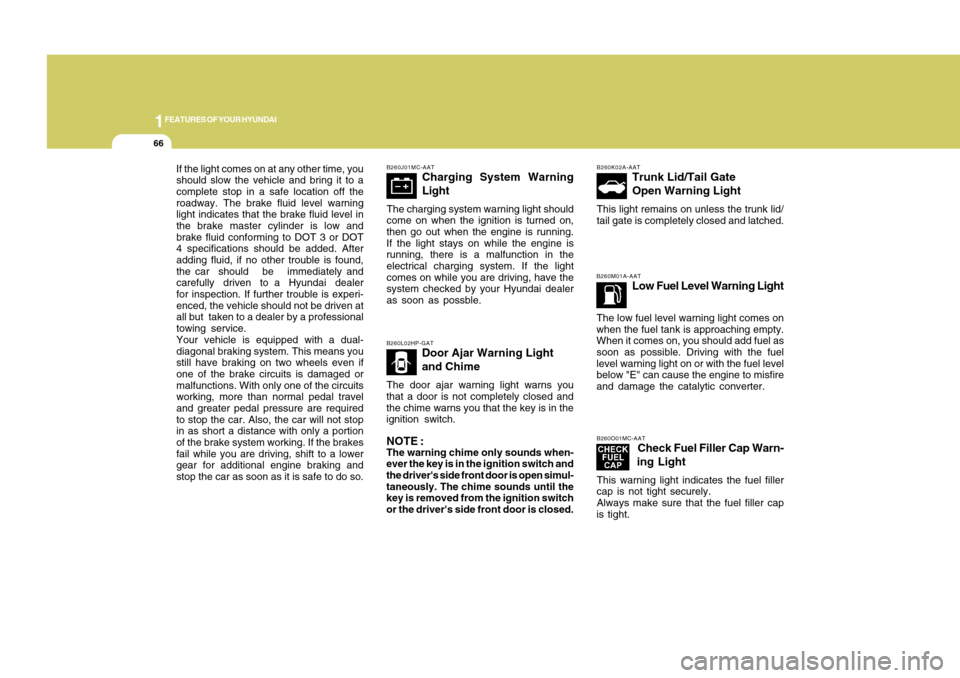
B260J01MC-AAT
Charging System Warning
Light
The charging system warning light should
come on when the ignition is turned on,
then go out when the engine is running.
If the light stays on while the engine is
running, there is a malfunction in the
electrical charging system. If the light
comes on while you are driving, have the
system checked by your Hyundai dealer
as soon as possble.
B260M01A-AAT
Low Fuel Level Warning Light
The low fuel level warning light comes on
when the fuel tank is approaching empty.
When it comes on, you should add fuel as
soon as possible. Driving with the fuel
level warning light on or with the fuel level
below "E" can cause the engine to misfire
and damage the catalytic converter.
B260L02HP-GAT
Door Ajar Warning Light
and Chime
The door ajar warning light warns you
that a door is not completely closed and
the chime warns you that the key is in the
ignition switch.NOTE :The warning chime only sounds when-
ever the key is in the ignition switch and
the driver's side front door is open simul-
taneously. The chime sounds until the
key is removed from the ignition switch
or the driver's side front door is closed.
B260K02A-AAT
Trunk Lid/Tail Gate
Open Warning Light
This light remains on unless the trunk lid/
tail gate is completely closed and latched.B260O01MC-AAT
Check Fuel Filler Cap Warn-
ing Light
This warning light indicates the fuel filler
cap is not tight securely.
Always make sure that the fuel filler cap
is tight.
If the light comes on at any other time, you
should slow the vehicle and bring it to a
complete stop in a safe location off the
roadway. The brake fluid level warning
light indicates that the brake fluid level in
the brake master cylinder is low and
brake fluid conforming to DOT 3 or DOT
4 specifications should be added. After
adding fluid, if no other trouble is found,
the car should be immediately and
carefully driven to a Hyundai dealer
for inspection. If further trouble is experi-
enced, the vehicle should not be driven at
all but taken to a dealer by a professional
towing service.
Your vehicle is equipped with a dual-
diagonal braking system. This means you
still have braking on two wheels even if
one of the brake circuits is damaged or
malfunctions. With only one of the circuits
working, more than normal pedal travel
and greater pedal pressure are required
to stop the car. Also, the car will not stop
in as short a distance with only a portion
of the brake system working. If the brakes
fail while you are driving, shift to a lower
gear for additional engine braking and
stop the car as soon as it is safe to do so.