2011 Hyundai Accent check engine
[x] Cancel search: check enginePage 188 of 232
6
DO-IT-YOURSELF MAINTENANCE
7
!
CHECKING AND CHANG- ING THE ENGINE COOLANT
35% 40%50%60%
Ambient
temperature °C ( °F)-15 (5)
-25 (-13)-35 (-31)-45 (-49)
Antifreeze solution Water
Engine coolant concentration
65% 60%50%40%
G050A01TG-DAT
WARNING:
Do not remove the radiator cap when the engine is hot. When the engine is hot, the engine coolant is under pres-sure and may erupt through the open- ing if the cap is removed. You could be seriously burned if you do notobserve this precaution. Do not re- move the radiator cap until the radia- tor is cool to touch. NOTE: It is recommended that the engine coolant should be changed by an authorised Hyundai dealer. G050B01A-AAT Recommended Engine Coolant Use a high quality ethylene-glycol cool- ant in a 50/50 mix with water. Theengine coolant should be compatible with aluminum engine parts. Additional corrosion inhibitors or additives shouldnot be used. The cooling system must be maintained with the correct con- centration and type of engine coolantto prevent freezing and corrosion. Never allow the concentration of anti- freeze to exceed the 60% level or gobelow the 35% level, or damage to the cooling system may result. For proper concentration when adding or replac-ing the engine coolant, refer to the following table.
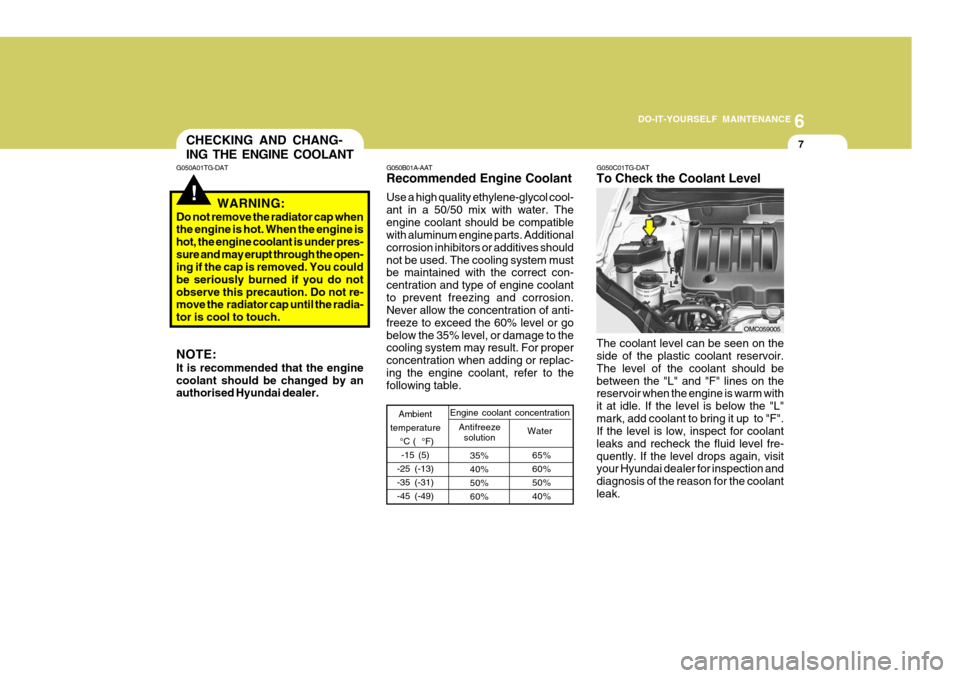
G050C01TG-DAT To Check the Coolant Level The coolant level can be seen on the side of the plastic coolant reservoir. The level of the coolant should bebetween the "L" and "F" lines on the reservoir when the engine is warm with it at idle. If the level is below the "L"mark, add coolant to bring it up to "F". If the level is low, inspect for coolant leaks and recheck the fluid level fre-quently. If the level drops again, visit your Hyundai dealer for inspection and diagnosis of the reason for the coolantleak.
OMC059005
Page 192 of 232
6
DO-IT-YOURSELF MAINTENANCE
11
!
G100A01MC-DAT Transaxle lubricant in the manual transaxle should be checked at thoseintervals specified in the vehicle main- tenance schedule in Section 5.
!
CAUTION:
o Radiator anti-freeze (engine cool- ant) should not be used in the washer system because it will damage the car's finish.
o The washer should not be oper- ated if the washer reservoir isempty. This can damage the wash-er fluid pump.
!WARNING:
o Windshield washer fluid agents contain some amounts of alcohol and can be flammable under cer- tain circumstances. Do not allowsparks or flame to contact the washer fluid or the washer fluid reservoir. Damage to the vehicleor its occupants could occur.
o Windshield washer fluid is poi-
sonous to humans and animals.Do not drink windshield washer fluid. Serious injury or death could occur. WARNING:
It is always better to check thetransaxle oil level when the engine is cool or cold. If the engine is hot, you should exercise great caution toavoid burning yourself on hot en- gine or exhaust parts. NOTE: It is recommended that the manual transaxle fluid should be checked by an authorised Hyundai dealer. CHECKING THE TRANSAXLE OIL (MANUAL)
CHECKING THE TRANSAXLE FLUID(AUTOMATIC)
G110A01MC-AAT Transaxle fluid in the automatic transaxle should be checked at those intervals specified in the vehicle main- tenance schedule in Section 5. NOTE: Automatic transaxle fluid is basi- cally a red color. As driving distance increases, the fluid color turns dark-ish red gradually. It is normal condi- tion and you should not judge the need to replace based upon thechanging color. You must replace the automatic transaxle fluid in accordance withintervals specified in the vehicle maintenance schedule in section 5.
Page 193 of 232
6 DO-IT-YOURSELF MAINTENANCE
12
!
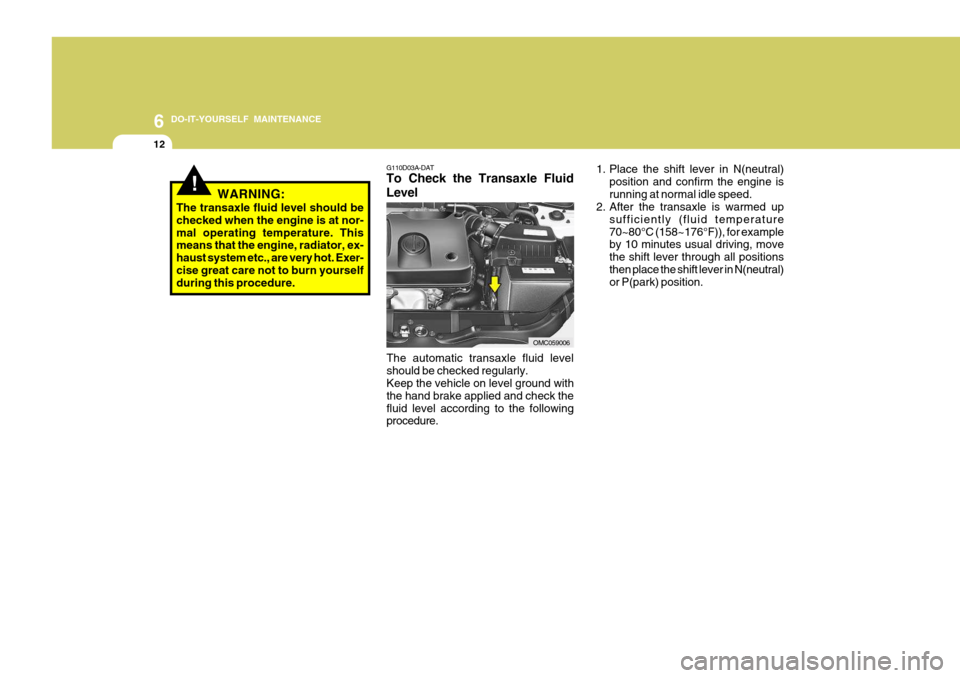
G110D03A-DAT To Check the Transaxle Fluid Level
The automatic transaxle fluid level should be checked regularly. Keep the vehicle on level ground with the hand brake applied and check thefluid level according to the following procedure. 1. Place the shift lever in N(neutral)
position and confirm the engine is running at normal idle speed.
2. After the transaxle is warmed up
sufficiently (fluid temperature70~80°C (158~176°F)), for example by 10 minutes usual driving, move the shift lever through all positionsthen place the shift lever in N(neutral) or P(park) position.
WARNING:
The transaxle fluid level should be checked when the engine is at nor-mal operating temperature. This means that the engine, radiator, ex- haust system etc., are very hot. Exer-cise great care not to burn yourself during this procedure.
OMC059006
Page 194 of 232
6
DO-IT-YOURSELF MAINTENANCE
13
!
!
CHECKING THE BRAKES
G120B01A-AAT Checking the Brake Fluid Level WARNING:
Use caution when handling brake fluid. It can damage your vision if it gets into your eyes. It will also dam-age your vehicle's paint if spilled on it and not removed immediately.
G120A01A-AAT
!
CAUTION:
Because brakes are essential to the safe operation of the car, it is sug- gested that they be checked andinspected by your Hyundai dealer. The brakes should be checked and inspected for wear at those inter-vals specified in the vehicle mainte- nance schedule in Section 5.
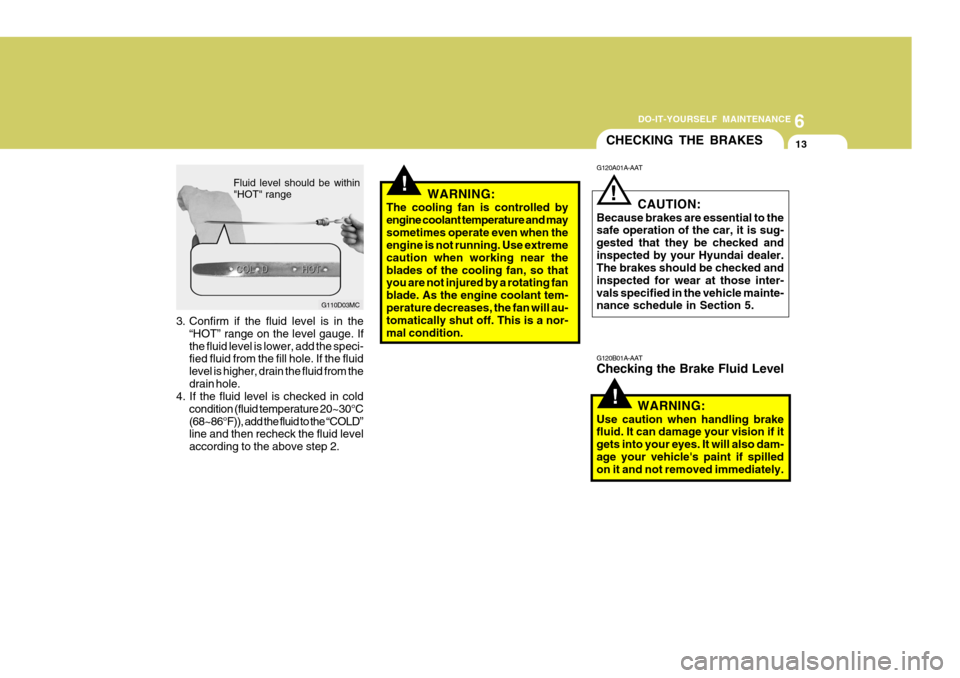
3. Confirm if the fluid level is in the “HOT” range on the level gauge. If the fluid level is lower, add the speci- fied fluid from the fill hole. If the fluid level is higher, drain the fluid from thedrain hole.
4. If the fluid level is checked in cold
condition (fluid temperature 20~30°C(68~86°F)), add the fluid to the “COLD” line and then recheck the fluid level according to the above step 2.
G110D03MC
Fluid level should be within "HOT" range
WARNING:
The cooling fan is controlled by engine coolant temperature and maysometimes operate even when the engine is not running. Use extreme caution when working near theblades of the cooling fan, so that you are not injured by a rotating fan blade. As the engine coolant tem-perature decreases, the fan will au- tomatically shut off. This is a nor- mal condition.
Page 196 of 232
6
DO-IT-YOURSELF MAINTENANCE
15AIR CONDITIONING CARE
G140C01A-AAT Lubrication To lubricate the compressor and the seals in the system, the air condition-ing should be run for at least 10 min- utes each week. This is particularly important during cool weather whenthe air conditioning system is not oth- erwise in use.
G140A01A-DAT Keeping the Condenser Clean The air conditioning condenser (and engine radiator) should be checked periodically for accumulation of dirt, dead insects, leaves, etc. These caninterfere with maximum cooling effi- ciency. When removing such accumu- lations, brush or hose them away care-fully to avoid bending the cooling fans. Replacement of the filter drier To comply with local Australian State codes and Laws the filter drier must be replaced if the system has been openedto the atmosphere for any reason or if
during servicing no refrigerant is found in the system.
!
G140B01A-AAT Checking the Air Conditioning Operation
1. Start the engine and let it run at fast
idle for several minutes with the air conditioning set at the maximum cold setting.
2. If the air coming out of the in-dash
vents is not cold, have the air condi-tioning system inspected by your Hyundai dealer.
CAUTION:
Running the air conditioning systemfor extended periods of time with a low refrigerant level may damage the compressor.
Page 198 of 232

6
DO-IT-YOURSELF MAINTENANCE
17CHECKING AND REPLAC- ING FUSES
!
CAUTION:
When replacing a fusible link, never use anything but a new fusible linkwith the same or lower amperage rating. Never use a piece of wire or a higher-rated fusible link. Thiscould result in serious damage and create a fire hazard. G200B02HP-AAT Replacing Accessory Fuse The fuse box for the lights and other electrical accessories will be found lowon the dashboard on the driver's side. Inside the box you will find a list show- ing the circuits protected by each fuse.If any of your car's lights or other elec- trical accessories stop working, a blown fuse could be the reason. If the fuse hasburned out, you will see that the metal strip inside the fuse has burned through. If you suspect a blown fuse, follow thisprocedure:
1. Turn off the ignition and all other
switches.
2. Open the fuse box and examine
each fuse. Remove each fuse by pulling it toward you (a small "fuse puller" tool is contained in the relay and fuse box of the engine room tosimplify this operation).
3. Be sure to check all other fuses even
if you find one that appears to haveburned out.
G200A01A-AAT Replacing a Fusible Link
OMC045003
A fusible link will melt if the electrical circuits from the battery are ever over- loaded, thus preventing damage to the entire wiring harness. (This could becaused by a short in the system draw- ing too much current.) If this ever happens, have a Hyundai dealer de-termine the cause, repair the system and replace the fusible link. The fusible links are located in a fuse box for easyinspection.
OMC045001R
Page 201 of 232
6 DO-IT-YOURSELF MAINTENANCE
20
!
o When lifting a plastic-cased bat-
tery, excessive pressure on the case may cause battery acid toleak, resulting in personal injury. Lift with a battery carrier or with your hands on opposite corners.
o Never attempt to charge the bat- tery when the battery cables areconnected.
o The electrical ignition system works with high voltage.Never touch these componentswith the engine running or the ignition switched on.
!
G210B01Y-AAT Checking the Battery Keep the battery clean. Any evidence of corrosion around the battery postsor terminals should be removed using a solution of household baking soda and warm water. After the battery ter-minals are dry, cover them with a light coating of grease.
WARNING:
Always read the following instructions carefully when handling a battery.Keep lighted cigarettes and all other flames or sparks away from the battery.Hydrogen, which is a highly combustible gas, is always present in battery cells andmay explode if ignited. Keep batteries out of the reach of children becausebatteries contain highly cor- rosive SULFURIC ACID. Do not allow battery acid to con-tact your skin, eyes, cloth- ing or paint finish.
If any electrolyte gets into your eyes, flush your eyes with clean water for at least15 minutes and get immedi- ate medical attention. If pos- sible, continue to applywater with a sponge or cloth until medical attention is re- ceived.If electrolyte gets on your skin, thoroughly wash the contacted area.If you feel a pain or a burn- ing sensation, get medical attention immediately.Wear eye protection when charging or working near a battery.Always provide ventilation when working in an en- closed space.An inappropriately disposed battery can be harmful to the environment and humanhealth. Dispose the battery according to your local law(s) or regulation.
Page 202 of 232
6
DO-IT-YOURSELF MAINTENANCE
21
!
G220B01A-AAT Checking Engine Cooling Fan The engine coolant fan should come on automatically if the engine coolanttemperature is high. G220C01TB-GAT Checking Condenser Cooling Fan When the air conditioning is in opera- tion, the condenser cooling fan comeson automatically, being controlled by
the engine ECU.
WARNING:
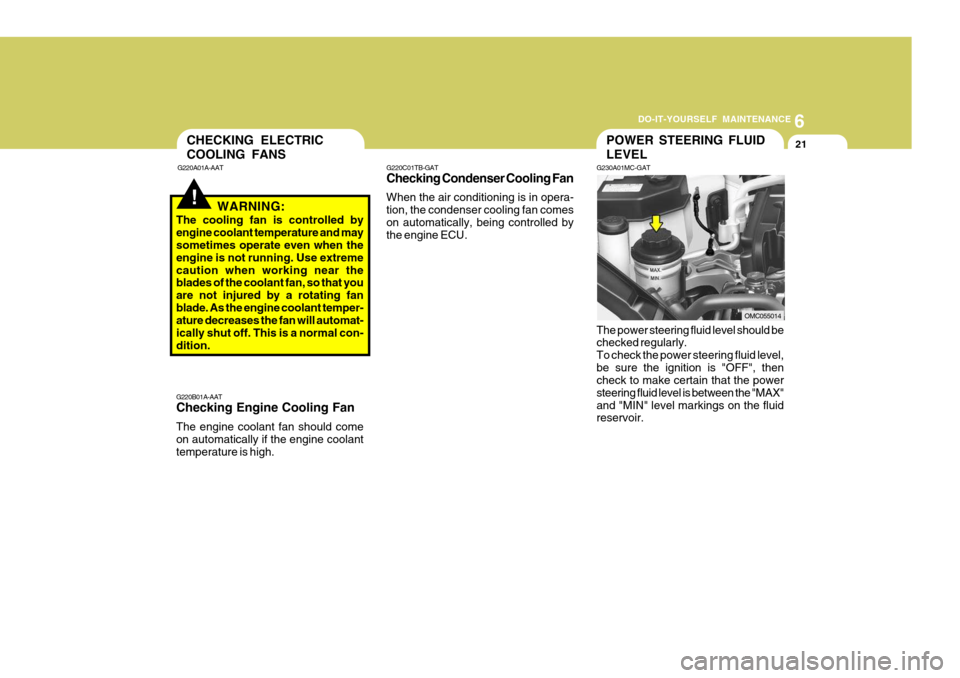
The cooling fan is controlled by engine coolant temperature and may sometimes operate even when the engine is not running. Use extremecaution when working near the blades of the coolant fan, so that you are not injured by a rotating fanblade. As the engine coolant temper- ature decreases the fan will automat- ically shut off. This is a normal con-dition. The power steering fluid level should be checked regularly. To check the power steering fluid level,be sure the ignition is "OFF", then check to make certain that the power steering fluid level is between the "MAX"and "MIN" level markings on the fluid reservoir.
CHECKING ELECTRIC COOLING FANS
G220A01A-AATPOWER STEERING FLUID LEVEL
G230A01MC-GAT
OMC055014