Page 255 of 427
Whenever f illing a f uel container,
use an approved f uel container, and
place it on the ground. Do not f ill the
f uel container in the vehicle,
including the pickup bed and the
In-Bed Trunk. Make sure to put the
f uel pump nozzle in the f uel f iller of
the container securely and to handle
it properly.Gasoline or f uel vapors are
extremely f lammable and explosive.
Improperly handling f uel can cause
anexplosioninwhichyoucanbe
seriously injured.
Before placing the fuel container in
the vehicle, wipe up any spill
completely.
Your vehicle has a warning label f or
f illing a portable f uel container on
the lef t rear side of the pickup bed.
Filling a Port able Fuel Cont ainer
Service Station Procedures
Bef ore Driving
251
Do not fill a portable fuel
container in the pickup bed.
Static electricity can ignite gas
vapors and you can be burned.
Main MenuTable of Contents
Page 256 of 427
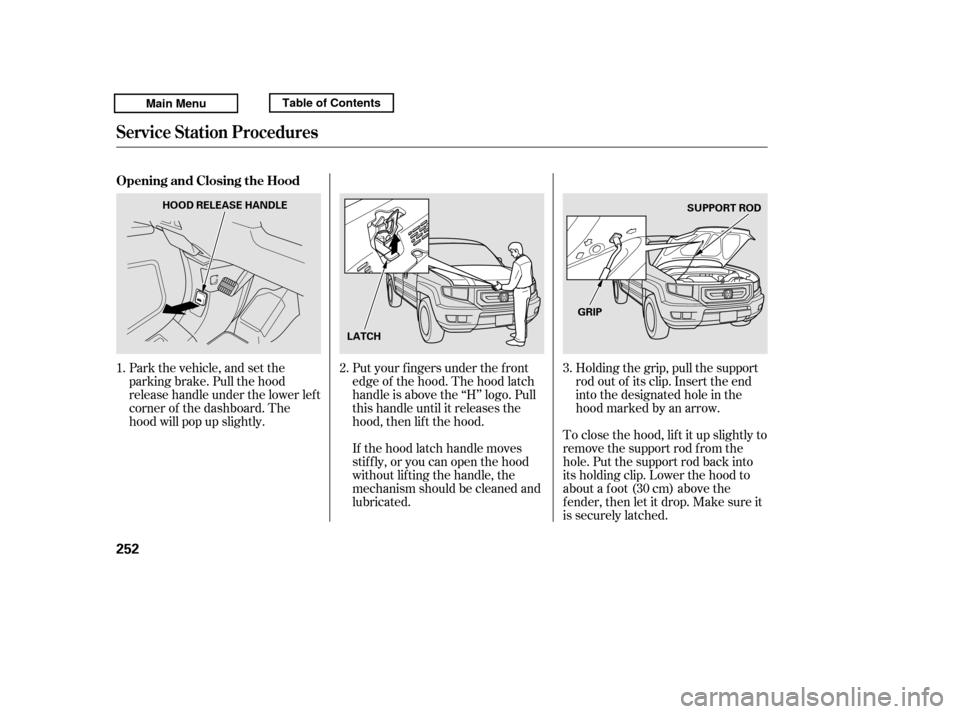
Put your f ingers under the f ront
edge of the hood. The hood latch
handle is above the ‘‘H’’ logo. Pull
this handle until it releases the
hood, then lif t the hood.To close the hood, lif t it up slightly to
remove the support rod f rom the
hole. Put the support rod back into
its holding clip. Lower the hood to
about a f oot (30 cm) above the
f ender, then let it drop. Make sure it
is securely latched.
If the hood latch handle moves
stif f ly, or you can open the hood
without lifting the handle, the
mechanism should be cleaned and
lubricated.
Park the vehicle, and set the
parking brake. Pull the hood
release handle under the lower lef t
corner of the dashboard. The
hood will pop up slightly.
Holding the grip, pull the support
rod out of its clip. Insert the end
into the designated hole in the
hood marked by an arrow.
1.
2.3.
Opening and Closing the Hood
Service Station Procedures
252
GRIP
HOOD RELEASE HANDLE
LATCH SUPPORT ROD
Main MenuTable of Contents
Page 266 of 427

Store or secure all items that could
be thrown around and hurt
someone during a crash.Distribute cargo evenly on the
f loor in the In-Bed Trunk, placing
the heaviest items on the bottom
and as far forward as possible. Tie
down items that could be thrown
during a crash or sudden stop.
Make sure the In-Bed Trunk lid is
closed securely bef ore driving.
Be sure the total weight of the
items in the In-Bed Trunk does not
exceed 300 lbs (136 kg).
If you use an accessory roof rack,
the roof rack weight limit may be
lower. Ref er to the inf ormation that
came with your roof rack.
Be sure items placed on the f loor
behind the f ront seats cannot roll
underneath and interf ere with the
proper operation of the seats, the
sensors under the seats, or the
driver’s ability to operate the
pedals.
Keep the glove box closed while
driving. If it is open, a passenger
could injure their knees during a
crash or sudden stop.
If youfoldtherearseatsup,tie
down items that could be thrown
about the vehicle during a crash or
sudden stop. Also, keep all cargo
below the bottom of the windows.
If it is higher, it could interf ere
with the proper operation of the
side curtain airbags.
Distribute cargo evenly on the
floor of the cargo area with the
rear seats f olded up, placing the
heaviest items on the bottom and
as far forward as possible. Tie
down items that could be thrown
about the vehicle during a crash or
sudden stop. If you carry any items on a roof
rack,besurethetotalweightof
the rack and the items does not
exceed 110 lbs (50 kg).
Carrying Items in the Passenger
Compartment
Carrying Cargo in the In-Bed
T runk or on a Roof Rack
Carrying Cargo
262
Main MenuTable of Contents
Page 267 of 427

Your vehicle can carry a large
amount of cargo in the pickup bed.
However, the pickup bed is not
intended f or carrying passengers.
Peoplewhorideinthepickupbed
can be very seriously injured or
killed in a crash (see page ).
Make sure your cargo is properly
loaded and all items are secured so
they will not shif t or f all out while
driving.When loading and unloading cargo,
make sure all passengers or any
objects are clear of the tailgate
bef ore opening or closing it. The
tailgate should be closed securely
bef ore driving when it is not used
as the extended pickup bed.
The maximum allowable loading
weight on the pickup bed is 1,100
lbs (500 kg). Do not exceed the
load limit (see page ).
Distribute cargo evenly on the
pickup bed. Place the heaviest
items on the bottom and as f ar
f orward as possible of the rear
axle. Tie down and secure all
items that could be thrown out of
the vehicle during a crash or
sudden stop.If you stack items higher than the
bed sides, tailgate, or back window,
secure them with a net or cover.
This will reduce the risk of items
beingthrownoutof thepickup
bed during a crash or sudden stop.
When the tailgate is dropped open,
itcanbeusedasanextended
pickup bed. The maximum
allowable weight on the tailgate
while driving is 300 lbs (136 kg).
Exceeding this limit could damage
the tailgate.
Carrying heavy cargo in the
pickup bed will raise your vehicle’s
center of gravity. This can affect
handling and perf ormance. Drive
more slowly and cautiously, and
allow extra time and distance f or
braking.
8
260
CONT INUED
Carrying Cargo in the Pickup Bed
Carrying Cargo
Bef ore Driving
263
Allowing passengers to ride in
the pickup bed or on the tailgate
can result in death or serious
injury in a crash.
Make sure all passengers ride
in a seat and wear a seat beltproperly.
Main MenuTable of Contents
Page 268 of 427
You can also support motorcycles on
the pickup bed floor with the cleats.
The f loor panel of the pickup bed is
designed to hold motorcycle tires. Be
sure to tighten motorcycles securely,
with an approved tie-down or
motorcycle strap, according to the
motorcycle maker’s instructions.
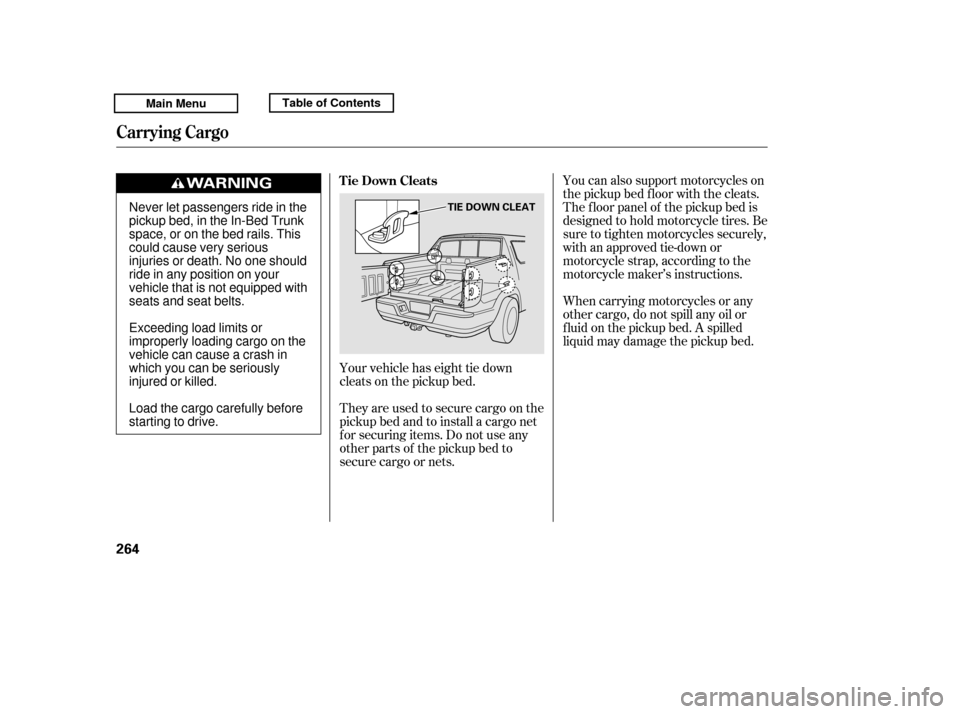
They are used to secure cargo on the
pickup bed and to install a cargo net
f or securing items. Do not use any
other parts of the pickup bed to
secure cargo or nets. When carrying motorcycles or any
other cargo, do not spill any oil or
f luid on the pickup bed. A spilled
liquid may damage the pickup bed.
Your vehicle has eight tie down
cleats on the pickup bed.
Tie Down Cleats
Carrying Cargo
264
TIE DOWN CLEAT
Exceeding load limits or
improperly loading cargo on the
vehicle can cause a crash in
which you can be seriously
injured or killed.
Load the cargo carefully before
starting to drive.
Never let passengers ride in the
pickup bed, in the In-Bed Trunk
space, or on the bed rails. This
could cause very serious
injuries or death. No one should
ride in any position on your
vehicle that is not equipped with
seats and seat belts.
Main MenuTable of Contents
Page 269 of 427
The cargo net can be used to hold
lightweight items in the pickup bed.
Secure all items properly. The net
may not prevent heavy items f rom
beingthrownoutwardinacrashora
sudden stop.The cargo cover can be used to
cover the cargo area on the pickup
bed.
Your vehicle’s pickup bed has a rust
resistant surf ace. To repair small
chips and scratches in the bed, a
repair kit is available f rom your
dealer. More extensive damage
should be repaired by your dealer.
To avoid problems with the bed
surf ace and the In-Bed Trunk lid, do
not use spray-in bed liner products.
Optional Cargo Net Optional Cargo Cover
Pickup Bed Repair
Carrying Cargo
Bef ore Driving
265
Main MenuTable of Contents
Page 272 of 427

Your vehicle has higher ground
clearance that allows you to travel
over bumps, obstacles, and rough
terrain. It also provides good
visibility so you can anticipate
problems earlier.With heavy cargo on the pickup bed,
your vehicle has a higher center of
gravity. Drive slowly and cautiously,
and allow more time and distance f or
braking. Loading heavy cargo could
af f ect your vehicle’s handling and
perf ormance.
To prevent rollovers or loss of
control:
Take corners at slower speeds
than you would with a passenger
vehicle.
Avoid sharp turns and abrupt
maneuvers whenever possible.
Make sure the cargo is properly
loaded and all items are secured so
they will not shif t while driving.
Do not modif y your vehicle in any
way that would raise the center of
gravity.
Do not carry heavy cargo on the
roof .
Your vehicle allows you to carry
more cargo than a typical passenger
vehicle.
Because your vehicle rides higher
of f the ground, it has a high center
of gravity that can cause it to roll
over if you make abrupt turns. Utility
vehicles have a signif icantly higher
roll over rate than other types of
vehicles.
See page f or of f -highway driving
guidelines. 306
Driving Guidelines
268
Main MenuTable of Contents
Page 273 of 427

Youshoulddothefollowingchecks
and adjustments bef ore you drive
your vehicle.Make sure all windows, mirrors,
and outside lights are clean and
unobstructed. Remove f rost, snow,
or ice.
Check that the hood is f ully closed.
Check that the tailgate is f ully
closed when it is not used as an
extended pickup bed.
Visually check the tires. If a tire
looks low, use a gauge to check its
pressure.
Check that any items you may be
carrying are stored properly or
f astened down securely. Check the adjustment of the
inside and outside mirrors (see
page ).
Check the steering wheel
adjustment (see page ).
Make sure the doors and In-Bed
Trunk are securely closed and
locked.
Fasten your seat belt. Check that
your passengers have f astened
their seat belts (see page ).
Check the seat adjustment (see
pages and ). When you start the engine, check
the gauges and indicators in the
instrument panel, and the
messages on the inf ormation
display or multi-inf ormation
display (depending on models)(
s e e pag es,,, an d
).
1. 2. 3. 4.5.6. 8.
7. 9.
10. 11.
121 133
99
16
61 76 77
90
119
Preparing to Drive
Driving
269
Main MenuTable of Contents