Page 128 of 427
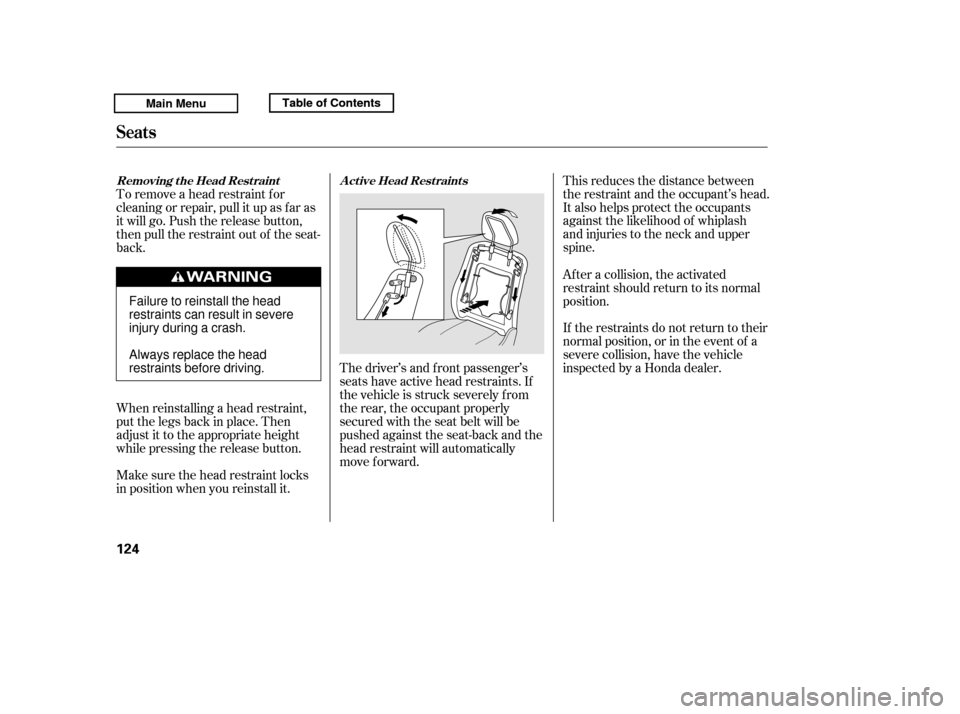
The driver’s and f ront passenger’s
seats have active head restraints. If
the vehicle is struck severely f rom
the rear, the occupant properly
secured with the seat belt will be
pushed against the seat-back and the
head restraint will automatically
move f orward.This reduces the distance between
the restraint and the occupant’s head.
It also helps protect the occupants
against the likelihood of whiplash
and injuries to the neck and upper
spine.
To remove a head restraint f or
cleaning or repair, pull it up as f ar as
it will go. Push the release button,
then pull the restraint out of the seat-
back.
When reinstalling a head restraint,
put the legs back in place. Then
adjust it to the appropriate height
while pressing the release button.
Make sure the head restraint locks
in position when you reinstall it. If the restraints do not return to their
normal position, or in the event of a
severe collision, have the vehicle
inspected by a Honda dealer.
Af ter a collision, the activated
restraint should return to its normal
position.
Seats
A ct ive Head Rest raint s
Removing t he Head Rest raint
124
Failure to reinstall the head
restraints can result in severe
injury during a crash.
Always replace the head
restraints before driving.
Main MenuTable of ContentsTable of Contents
Page 129 of 427
CONT INUED
For a head restraint system to work
properly:Do not hang any items on the head
restraints, or f rom the restraint
legs.
Do not place any object between
an occupant and the seat-back.
Install each restraint in its proper
location.
Only use genuine Honda
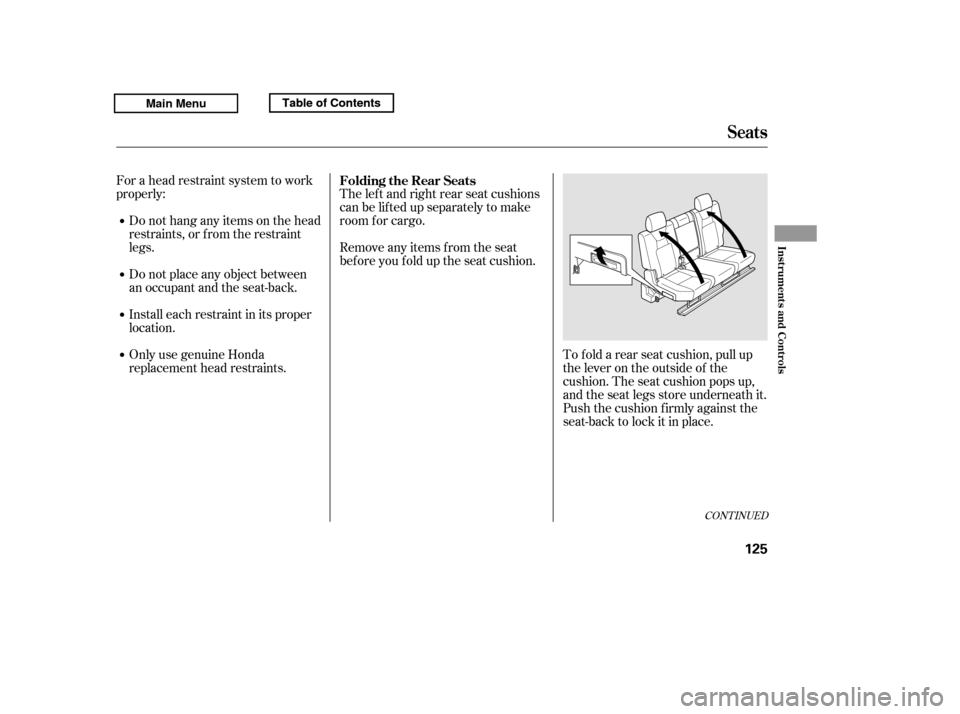
replacement head restraints. The lef t and right rear seat cushions
can be lifted up separately to make
room f or cargo.
To f old a rear seat cushion, pull up
the lever on the outside of the
cushion. The seat cushion pops up,
and the seat legs store underneath it.
Push the cushion firmly against the
seat-back to lock it in place.
Remove any items from the seat
beforeyoufolduptheseatcushion.
Folding the Rear Seats
Seats
Inst rument s and Cont rols
125
Main MenuTable of ContentsTable of Contents
Page 130 of 427
If equipped
Make sure all items in the cargo area
are secured. Loose items can f ly
f orward and cause injury if you have
to brake hard (See
on page ).
You can also store small items under
the rear seats. Make sure to secure
the items so they will not shift while
you are driving.
To return the seat cushion to its
original position, pull the lever
outward, then push down the seat
cushion slowly.
Make sure the seat cushion is locked
securely and the seat legs are
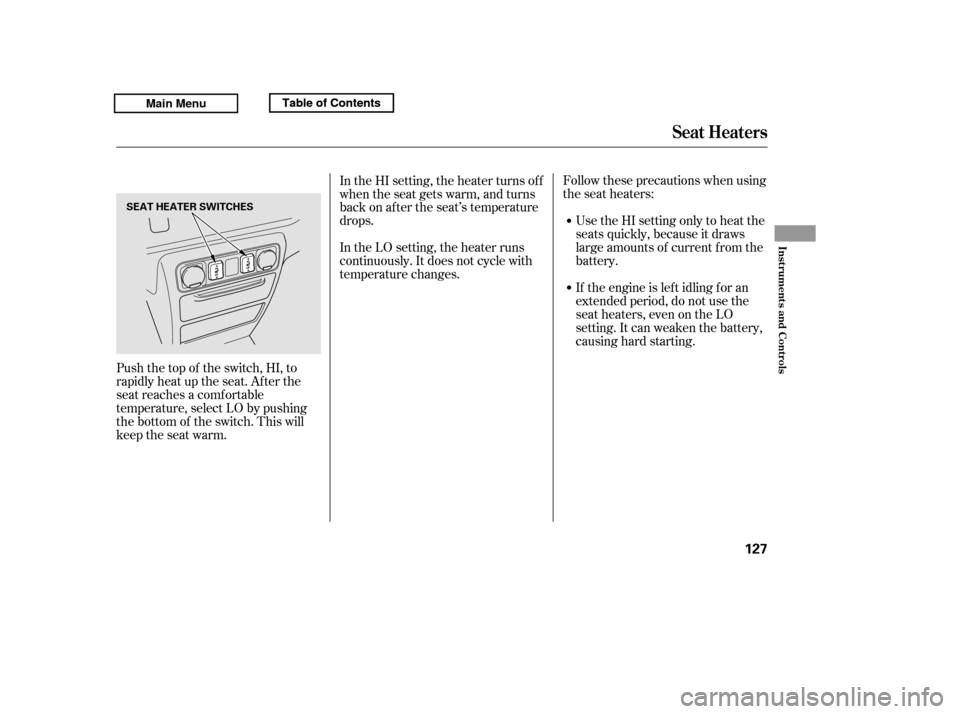
positioned properly in the f loor guide. Both f ront seats are equipped with
seat heaters. Because of the sensors
f or the side airbag cutof f system,
there is no heater in the passenger’s
seat-back. The ignition switch must
be in the ON (II) position to use the
heaters.
259
Seat Heaters
Carrying Cargo
Seats, Seat Heaters
126
Passenger’s Seat
Driver’sSeat
LEGS
FLOOR GUIDE HEATERS
Main MenuTable of ContentsTable of Contents
Page 131 of 427
Follow these precautions when using
the seat heaters:Use the HI setting only to heat the
seats quickly, because it draws
large amounts of current f rom the
battery.
If the engine is lef t idling f or an
extended period, do not use the
seat heaters, even on the LO
setting. It can weaken the battery,
causing hard starting.
In the HI setting, the heater turns off
when the seat gets warm, and turns
back on after the seat’s temperature
drops.
In the LO setting, the heater runs
continuously. It does not cycle with
temperature changes.
Push the top of the switch, HI, to
rapidly heat up the seat. Af ter the
seat reaches a comfortable
temperature, select LO by pushing
the bottom of the switch. This will
keep the seat warm.
Seat Heaters
Inst rument s and Cont rols
127
SEAT HEATER SWITCHES
Main MenuTable of ContentsTable of Contents
Page 266 of 427

Store or secure all items that could
be thrown around and hurt
someone during a crash.Distribute cargo evenly on the
f loor in the In-Bed Trunk, placing
the heaviest items on the bottom
and as far forward as possible. Tie
down items that could be thrown
during a crash or sudden stop.
Make sure the In-Bed Trunk lid is
closed securely bef ore driving.
Be sure the total weight of the
items in the In-Bed Trunk does not
exceed 300 lbs (136 kg).
If you use an accessory roof rack,
the roof rack weight limit may be
lower. Ref er to the inf ormation that
came with your roof rack.
Be sure items placed on the f loor
behind the f ront seats cannot roll
underneath and interf ere with the
proper operation of the seats, the
sensors under the seats, or the
driver’s ability to operate the
pedals.
Keep the glove box closed while
driving. If it is open, a passenger
could injure their knees during a
crash or sudden stop.
If youfoldtherearseatsup,tie
down items that could be thrown
about the vehicle during a crash or
sudden stop. Also, keep all cargo
below the bottom of the windows.
If it is higher, it could interf ere
with the proper operation of the
side curtain airbags.
Distribute cargo evenly on the
floor of the cargo area with the
rear seats f olded up, placing the
heaviest items on the bottom and
as far forward as possible. Tie
down items that could be thrown
about the vehicle during a crash or
sudden stop. If you carry any items on a roof
rack,besurethetotalweightof
the rack and the items does not
exceed 110 lbs (50 kg).
Carrying Items in the Passenger
Compartment
Carrying Cargo in the In-Bed
T runk or on a Roof Rack
Carrying Cargo
262
Main MenuTable of Contents
Page 268 of 427
You can also support motorcycles on
the pickup bed floor with the cleats.
The f loor panel of the pickup bed is
designed to hold motorcycle tires. Be
sure to tighten motorcycles securely,
with an approved tie-down or
motorcycle strap, according to the
motorcycle maker’s instructions.
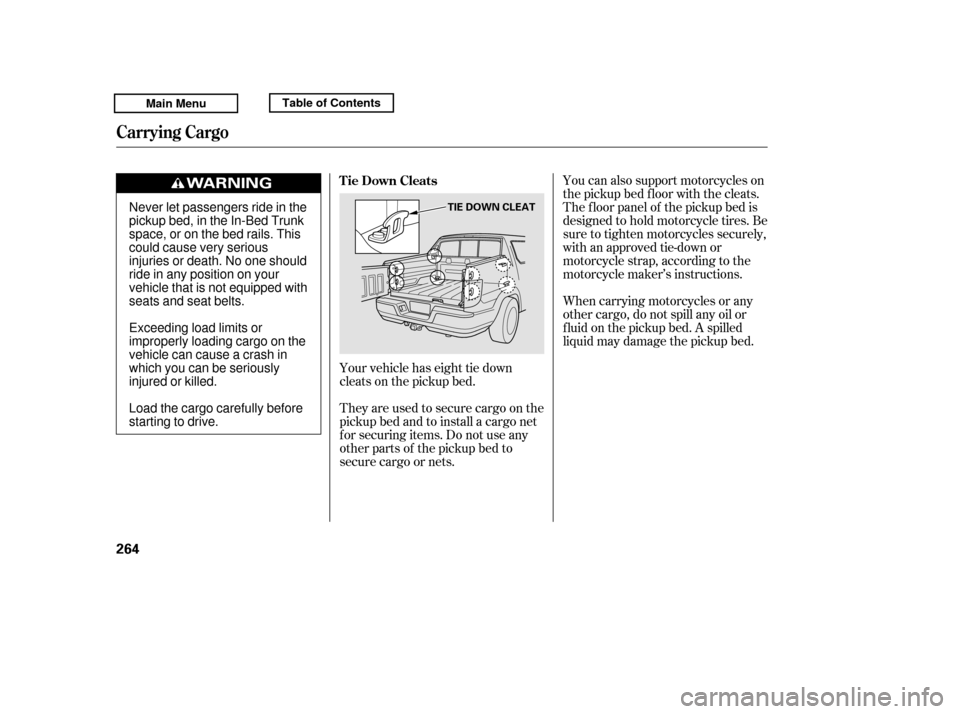
They are used to secure cargo on the
pickup bed and to install a cargo net
f or securing items. Do not use any
other parts of the pickup bed to
secure cargo or nets. When carrying motorcycles or any
other cargo, do not spill any oil or
f luid on the pickup bed. A spilled
liquid may damage the pickup bed.
Your vehicle has eight tie down
cleats on the pickup bed.
Tie Down Cleats
Carrying Cargo
264
TIE DOWN CLEAT
Exceeding load limits or
improperly loading cargo on the
vehicle can cause a crash in
which you can be seriously
injured or killed.
Load the cargo carefully before
starting to drive.
Never let passengers ride in the
pickup bed, in the In-Bed Trunk
space, or on the bed rails. This
could cause very serious
injuries or death. No one should
ride in any position on your
vehicle that is not equipped with
seats and seat belts.
Main MenuTable of Contents
Page 299 of 427
�Î�Î�Î
�Î
�Î�Î
�µ�µ
Number of
Occupants 2 345 Max. T ongue Load
Max. T railer Weight
T owing Weight Guidelines
Driving
295
Total Trailer Weight and Tongue Load Guidelines:
600 lbs (272 kg)
600 lbs (272 kg)
570 lbs (258 kg)
516 lbs (234 kg)
5,000 lbs (2268 kg)
4,750 lbs (2155 kg)
4,750 lbs (2155 kg)
4,500 lbs (2041 kg)
Recommended tongue load should be 5 15% of the total trailer weight for boat trailers, and 10 15% of the total tr
ailer weight for all other
trailers.
The corresponding weight limits assume occupants fill seats from the front of the vehicle to the back
, each occupant weighs 150 lbs (70 kg),
and each has 15 lbs (7 kg) of cargo in the cab, pickup bed, or In-Bed Trunk. Any additional weight, i ncluding cargo or accessories, reduces
the maximum trailer weight and maximum tongue load. Never exceed the gross axle weight ratings (see page ). 294
Main MenuTable of Contents
Page 349 of 427

The floor mats that came with your
vehicle hook over the f loor mat
anchors. This keeps the f loor mats
f rom sliding f orward, possibly
interf ering with the pedals, or
backwards, making the f ront
passenger’s weight sensors
inef f ective.
If you remove a f loor mat, make sure
tore-anchoritwhenyouputitback
in your vehicle.A non-Honda f loor mat may not f it
your vehicle properly. This could
prevent the proper operation of the
f olding rear seats and the passenger’s
seat weight sensors. We recommend
using genuine Honda f loor mats. Do
not put additional f loor mats on top
of the anchored mats.
This f ilter removes the dust and
pollenthatisbroughtinfromthe
outside through the heating and
cooling system/climate control
system.
Have your dealer replace the filter
when this service is indicated by a
maintenance message on the
inf ormation display or multi-
inf ormation display (depending on
the models). It should be replaced
every 15,000 miles (24,000 km) if you
drive primarily in urban areas that
have high concentrations of soot in
the air, or if the flow from the
heating and cooling system/climate
control system becomes less than
usual.
Floor Mats, Dust and Pollen Filter
Floor Mats
Dust and Pollen Filter
Maint enance
345
Main MenuTable of Contents