Page 249 of 427
As required by the FCC:This device complies with Part 15 of theFCC rules. Operation is subject to the
f ollowing two conditions: (1) This devicemay not cause harmf ul interf erence, and (2) this device must accept any
interf erence received, includinginterf erence that may cause undesiredoperation.
Changes or modif ications not expresslyapproved by the party responsible f or
compliance could void the user’sauthority to operate the equipment.
This device complies with IndustryCanada Standard RSS-210.Operation is subject to the f ollowing two
conditions: (1) this device may not causeinterf erence, and (2) this device must accept any interf erence that may cause
undesired operation of the device.
BluetoothHandsFreeL ink
Features
245
Main MenuTable of Contents
Page 284 of 427

As required by the FCC:This device complies with Part 15 of theFCC rules. Operation is subject to the
f ollowing two conditions: (1) This device may not cause harmf ul interf erence, and(2) this device must accept any
interf erence received, including interf erence that may cause undesiredoperation.
Changes or modif ications not expresslyapproved by the party responsible f or
compliance could void the user’sauthority to operate the equipment.
This device complies with IndustryCanada Standard RSS-210.Operation is subject to the f ollowing two
conditions: (1) this device may not causeinterf erence, and (2) this device mustaccept any interf erence that may cause
undesired operation of the device.
If you have a f lat tire, the low tire
pressure indicator will come on.
Replace the indicated f lat tire with
thecompactsparetire(seepage ).
Each wheel (except the compact
sparetirewheel)isequippedwitha
tire pressure sensor. You must use
TPMS specif ic wheels. It is
recommended that you always have
your tires serviced by your dealer or
qualif ied technician.
After you replace the flat tire with
thecompactsparetire,thelowtire
pressure indicator stays on. This is
normal; the system is not monitoring
the spare tire pressure. Manually
check the spare tire pressure to be
sure it is correct. Af ter several miles
(kilometers) driving with the
compact spare tire, the TPMS
indicator comes on and the low tire
pressure indicator goes of f . The low tire pressure indicator or
the TPMS indicator will go off, after
several miles (kilometers) driving,
when you replace the spare tire with
the specif ied regular tire equipped
with the tire pressure monitor sensor.
Never use a puncture-repairing agent
in a f lat tire. If used, you will have to
replace the tire pressure sensor.
Havetheflattirerepairedbyyour
dealer as soon as possible.
361
Tire Pressure Monitoring System (TPMS)
Changing a T ire with T PMS
280
Main MenuTable of Contents
Page 290 of 427

As required by the FCC:This device complies with Part 15 of theFCC rules. Operation is subject to the
f ollowing two conditions: (1) This devicemay not cause harmf ul interf erence, and (2) this device must accept any
interf erence received, includinginterf erence that may cause undesiredoperation.
Changes or modif ications not expresslyapproved by the party responsible f or
compliance could void the user’sauthority to operate the equipment. This device complies with Industry
Canada Standard RSS-210.Operation is subject to the f ollowing two
conditions: (1) this device may not cause interf erence, and (2) this device mustaccept any interf erence that may cause
undesired operation of the device.
Always use the parking brake when
you park your vehicle. Make sure
the parking brake is set f irmly, or
your vehicle may roll if it is parked
on an incline.
Set the parking brake bef ore you put
the transmission in Park. This keeps
the vehicle from moving and putting
pressure on the parking mechanism
in the transmission.
Tire Pressure Monitoring System (TPMS), Parking
Parking
286
Main MenuTable of Contents
Page 295 of 427

The vehicle stability assist (VSA)
system helps to stabilize the vehicle
during cornering if the vehicle turns
more or less than desired. It also
assists you in maintaining traction
while accelerating on loose or
slippery road surf aces. It does this
by regulating the engine’s output and
by selectively applying the brakes.
The VSA system cannot enhance the
vehicle’s driving stability in all
situations and does not control your
vehicle’s entire braking system. It is
still your responsibility to drive and
corner at reasonable speeds and to
leave a sufficient margin of safety.
When VSA activates, you may notice
that the engine does not respond to
the accelerator in the same way it
does at other times. There may also
be some noise f rom the VSA
hydraulic system. You will also see
the VSA activation indicator blink. When VSA activates, you will see the
VSA Activation indicator blink.
If this indicator comes on while
driving, pull to the side of the road
when it is saf e, and turn of f the
engine. Reset the system by
restarting the engine. If the VSA
system indicator stays on or comes
back on while driving, have the VSA
system inspected by your dealer.
If the indicator does not come on
when the ignition switch is turned to
the ON (II) position, there may be a
problem with the VSA system. Have
your dealer inspect your vehicle as
soon as possible.You will also see a ‘‘CHECK VSA
SYSTEM’’ message on the multi-
inf ormation display if there is a
problem with the VSA system.
If the low tire pressure indicator or
TPMS indicator comes on, see
page .
If the low tire pressure/TPMS
indicator comes on, see page .
Or, if the multi-inf ormation display
shows a ‘‘CHECK TPMS
SYSTEM’’ message with the
indicator f lashing, see page .
Without VSA, your vehicle will have
normal braking and cornering ability,
but it will not have VSA traction and
stability enhancement.
In this case, you cannot turn of f the
VSA using the OFF switch again.
91281
278On models with navigation system
On models with navigation system
On models without navigation systemVSA A ctivation Indicator
Vehicle Stability Assist
(VSA ) System Indicator
Vehicle Stability A ssist (VSA), aka Electronic Stability Control (ESC), System
Driving
291
Main MenuTable of Contents
Page 299 of 427
�Î�Î�Î
�Î
�Î�Î
�µ�µ
Number of
Occupants 2 345 Max. T ongue Load
Max. T railer Weight
T owing Weight Guidelines
Driving
295
Total Trailer Weight and Tongue Load Guidelines:
600 lbs (272 kg)
600 lbs (272 kg)
570 lbs (258 kg)
516 lbs (234 kg)
5,000 lbs (2268 kg)
4,750 lbs (2155 kg)
4,750 lbs (2155 kg)
4,500 lbs (2041 kg)
Recommended tongue load should be 5 15% of the total trailer weight for boat trailers, and 10 15% of the total tr
ailer weight for all other
trailers.
The corresponding weight limits assume occupants fill seats from the front of the vehicle to the back
, each occupant weighs 150 lbs (70 kg),
and each has 15 lbs (7 kg) of cargo in the cab, pickup bed, or In-Bed Trunk. Any additional weight, i ncluding cargo or accessories, reduces
the maximum trailer weight and maximum tongue load. Never exceed the gross axle weight ratings (see page ). 294
Main MenuTable of Contents
Page 372 of 427
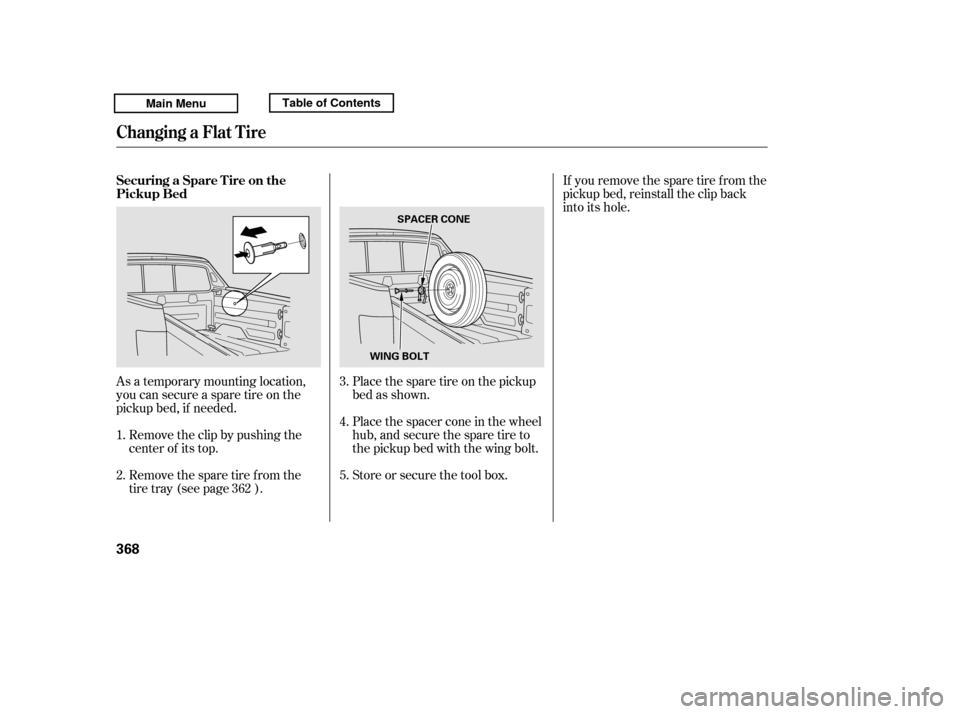
As a temporary mounting location,
you can secure a spare tire on the
pickup bed, if needed.Placethesparetireonthepickup
bed as shown.
Place the spacer cone in the wheel
hub,andsecurethesparetireto
the pickup bed with the wing bolt.If youremovethesparetirefromthe
pickup bed, reinstall the clip back
into its hole.
Remove the clip by pushing the
center of its top.
Remove the spare tire from the
tire tray (see page ). Store or secure the tool box.
1. 2. 3.4. 5.
362
Changing a Flat T ire
Securing a Spare Tire on the
Pickup Bed
368
SPACER CONE
WING BOLT
Main MenuTable of Contents
Page 384 of 427
If the driver’s power window f use is
removed, the AUTO f unction of the
driver’s window may be disabled. To
reset the AUTO f unction, see page.
If you cannot drive the vehicle
without f ixing the problem, and you
do not have a spare fuse, take a fuse
of the same rating or a lower rating
f rom one of the other circuits. Make
sureyoucandowithoutthatcircuit
temporarily (such as the accessory
power socket or radio).
If you replace the blown f use with a
spare f use that has a lower rating, it
might blow out again. This does not
indicate anything wrong. Replace the
f use with one of the correct rating as
soon as you can.
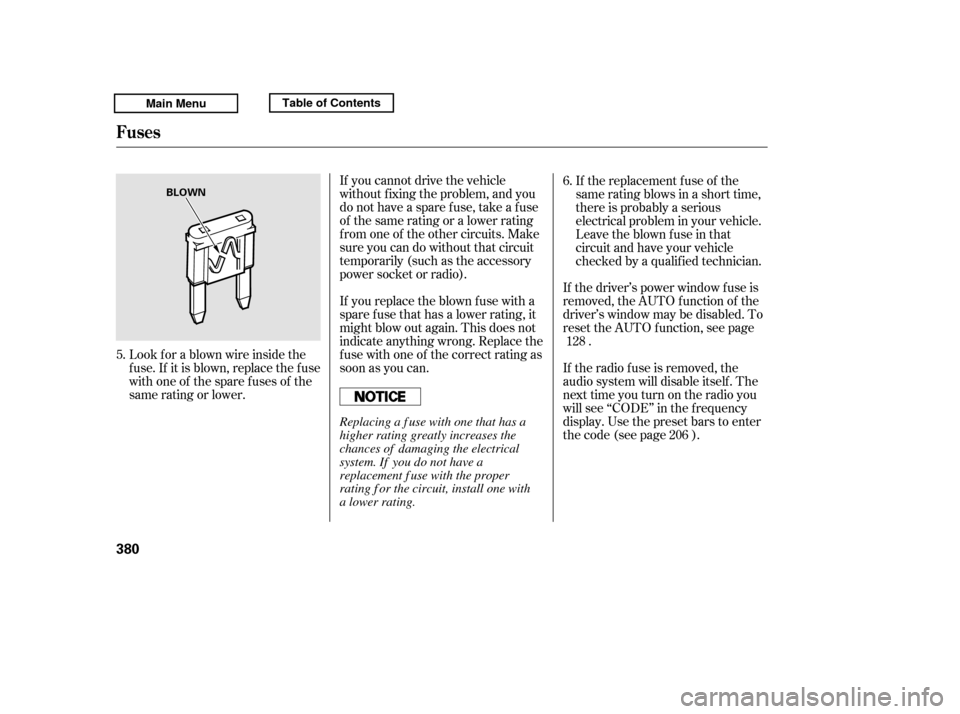
Look f or a blown wire inside the
fuse.If itisblown,replacethefuse
withoneof thesparefusesof the
same rating or lower. If the radio f use is removed, the
audio system will disable itself . The
nexttimeyouturnontheradioyou
will see ‘‘CODE’’ in the f requency
display. Use the preset bars to enter
thecode(seepage ).If the replacement fuse of the
same rating blows in a short time,
there is probably a serious
electrical problem in your vehicle.
Leave the blown fuse in that
circuit and have your vehicle
checked by a qualif ied technician.
5. 6.
128 206
Fuses
380
BLOWN
Replacing a f use with one that has a
higher rating greatly increases the
chances of damaging the electrical
system. If you do not have a
replacement f use with the proper
rating f or the circuit, install one with
a lower rating.
Main MenuTable of Contents
Page 395 of 427

Warning: The temperature grade f or
this tire is established f or a tire that
is properly inf lated and not
overloaded. Excessive speed,
underinf lation, or excessive loading,
either separately or in combination,
can cause heat buildup and possible
tire f ailure.
The temperature grades are A (the
highest), B, and C, representing the
tire’s resistance to the generation of
heat and its ability to dissipate heat
when tested under controlled
conditions on a specif ied indoor
laboratory test wheel. Sustained high
temperature can cause the material
of the tire to degenerate and reduce
tire life, and excessive temperature
can lead to sudden tire f ailure. The
grade C corresponds to a level of
perf ormance which all passenger car
tires must meet under the Federal
Motor Vehicle Saf ety Standard No.
109. Grades B and A represent
higher levels of perf ormance on the
laboratory test wheel than the
minimum required by law.
DOT Tire Quality Grading (U.S. Vehicles)
Temperature
T echnical Inf ormation
391
Main MenuTable of Contents