Page 128 of 427
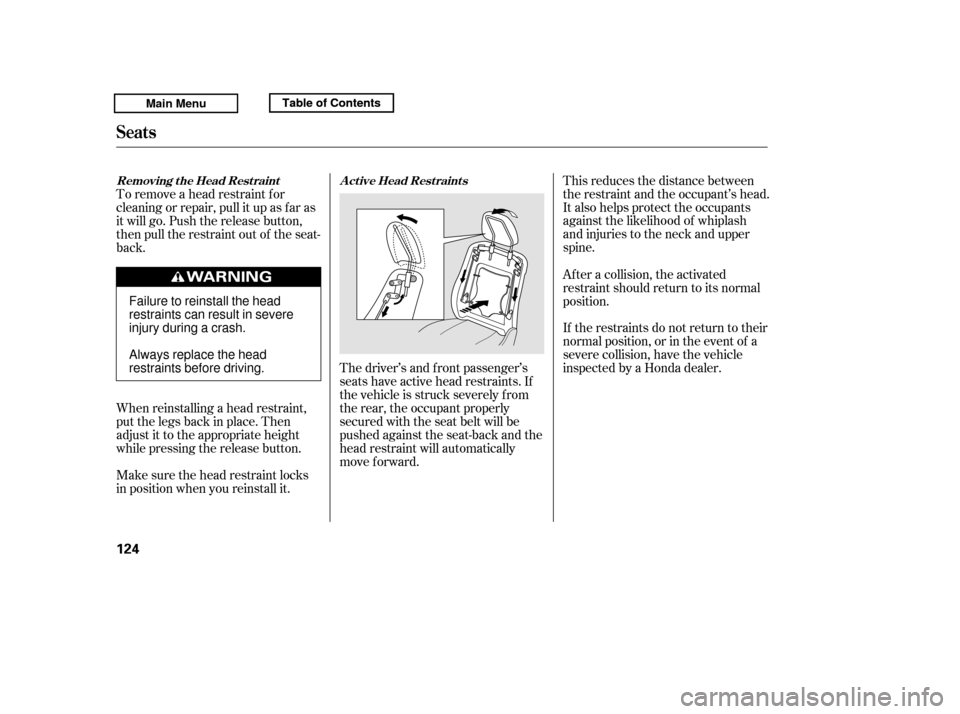
The driver’s and f ront passenger’s
seats have active head restraints. If
the vehicle is struck severely f rom
the rear, the occupant properly
secured with the seat belt will be
pushed against the seat-back and the
head restraint will automatically
move f orward.This reduces the distance between
the restraint and the occupant’s head.
It also helps protect the occupants
against the likelihood of whiplash
and injuries to the neck and upper
spine.
To remove a head restraint f or
cleaning or repair, pull it up as f ar as
it will go. Push the release button,
then pull the restraint out of the seat-
back.
When reinstalling a head restraint,
put the legs back in place. Then
adjust it to the appropriate height
while pressing the release button.
Make sure the head restraint locks
in position when you reinstall it. If the restraints do not return to their
normal position, or in the event of a
severe collision, have the vehicle
inspected by a Honda dealer.
Af ter a collision, the activated
restraint should return to its normal
position.
Seats
A ct ive Head Rest raint s
Removing t he Head Rest raint
124
Failure to reinstall the head
restraints can result in severe
injury during a crash.
Always replace the head
restraints before driving.
Main MenuTable of ContentsTable of Contents
Page 301 of 427
Check the weight of the unhitched
trailer. Limit: See page .Towing generally requires a variety
of supplemental equipment. To
ensure the best quality, we
recommend that you purchase
Honda equipment whenever possible.
Discuss any additional needs with
your trailer sales or rental agency,
and make sure all equipment is
properly installed, maintained, and
also meets state, f ederal, province,
and local regulations.
Your dealer of f ers trailer packages
that include a ball mount, hitch plug,
and hitch pin. A wiring harness kit is
also available f rom your dealer. Read the trailer manufacturer’s
instructions, and select the
appropriate draw bar f or the height
of the trailer you will be towing.
A weight distributing hitch is not
recommended f or use with your
vehicle, as an improperly adjusted
weight distributing hitch may reduce
handling, stability, and braking
perf ormance.
Calculate the tongue load.
Subtract the weight in step 6 f rom
the weight in step 7.
Limit: See page .
Recommended: see page .
Range: 5-15% f or boat trailers
10-15% f or other trailers
7. 8.
293
295 295
CONT INUED
T owing Equipment and
A ccessoriesHitch
Weight Distributing Hitch
Towing a Trailer
Driving
297
Main MenuTable of Contents
Page 307 of 427

The added weight, length, and
height of a trailer will af f ect your
vehicle’s handling and perf ormance,
so driving with a trailer requires
some special driving skills and
techniques.
The vehicle has been properly
serviced, and the tires, brakes,
suspension, cooling system, and
lights are in good operating
condition.
The trailer has been properly
serviced and is in good condition.
All weights and loads are within
limits.
Thehitch,safetychains,andany
other attachments are secure.
Allitemsonandinthetrailerare
properly secured and cannot shif t
while you drive.
When preparing to tow, and bef ore
driving away, be sure to check the
f ollowing:
Towing perf ormance can be
af f ected by high altitude, high
temperature, or when climbing
steep grades. Theref ore, premium
f uel (premium unleaded gasoline
with pump octane number of 91 or
higher) is recommended when
towing more than 3,500 lbs (1,590
kg).
The trailer tires and spare are in
good condition and inf lated as
recommended by the trailer
maker.
Your vehicle tires and spare are in
good condition and properly
inf lated.
The lights and brakes on your
vehicle and the trailer are working
properly.
Foryoursafetyandthesafetyof
others,taketimetopracticedriving
maneuvers bef ore heading f or the
open road, and f ollow the guidelines
on the f ollowing page.
CONT INUED
Driving Saf ely With a T railer
Pre-T ow Checklist
Towing a Trailer
Driving
303
Main MenuTable of Contents
Page 392 of 427

�µ�µ
�Î �Î
�Î �Î �Î
�Î
�Î
�Î
�Î�Î�Î �Î
�Î
�Î
Specif icat ions
388
Air Conditioning
Seating Capacities
Dimensions
Capacities
Weights 206.9 in (5,255 mm)
77.8 in (1,976 mm)
70.3 in (1,786 mm)
Refrigerant type
Charge quantity
Lubricant type HFC-134a (R-134a)
19.4 21.2 oz (550 600 g)
ND-OIL8
Total
FrontRear 32
5
1,470 lbs (670 kg)
1,520 lbs (690 kg)
10,088 lbs (4,575 kg)
Length
Width
Height
Wheelbase
Track
66.9 in (1,700 mm)
67.1 in (1,705 mm)
122.0 in (3,100 mm)
The GCWR must be reduced 2 percent for every 1,000 feet (305
meters) of elevation. Fuel tank
Engine
coolant
Engine oil Automatic
transmission
fluidRear
differential
fluid
22.01 US gal (83.3
)
1.64 US gal (6.2)
2.14 US gal (8.1)
4.2 US qt (4.0
)
4.5 US qt (4.3
)
5.3 US qt (5.0
)
3.3 US qt (3.1)
8.5 US qt (8.0)
2.79 US qt (2.64
)
3.01 US qt (2.85)
Including the coolant in the reserve tank and that remaining in the
engine
Reserve tank capacity:
0.16 US gal (0.6
)
Excluding the oil remaining in the engine
71.2 in (1,808 mm)
Gross vehicle weight rating
Gross combined weight
rating (GCWR)
Maximum load limit
(Payload) See the tire information label
attached to the driver’s doorjamb. Approx.
FrontRear
1: 2:
1: 2: 3:
ChangeTotal
Change
Including
filter
Without
filter
Total
ChangeTotal
Change Total
On vehicles without moonroof
On vehicles with moonroof
1:
2:
On vehicles without moonroof
On vehicles with moonroof
1
231 2
1
2
Main MenuTable of Contents
Page 396 of 427
�µ �µ �µ
�µ �µ �µ �µ
The tires that came on your vehicle
have a number of markings. Those
you should be aware of are described
below.
Rim diameter in inches.
Load index (a numerical code
associated with the maximum
load the tire can carry).
Speed symbol (an
alphabetical code indicating
the maximum speed rating).
Whenever tires are replaced, they
should be replaced with tires of the
same size. The f ollowing is an
exampleof tiresizewithan
explanation of what each component
means.
Vehicletype(Pindicates
passenger vehicle).
Tire width in millimeters.
Aspect ratio (the tire’s section
height as a percentage of its
width).
Tire construction code (R
indicates radial).
R
65
245
P 17 105 T
Tire Labeling
Tire Size
392
TIRE LABELING EXAMPLE
(1)
(2)
(3)
(4) (4) (3) (2) (1)
(1)
Tire Identification Number (TIN)
Tire Size
Maximum Tire Pressure
Maximum Tire Load
P245/65R17 105T
Main MenuTable of Contents
