Page 308 of 427

Drive slower than normal in all
driving situations, and obey posted
speed limits f or vehicles with trailers.
When towing a f ixed-sided trailer
(e.g., camper), do not exceed 55 mph
(88 km/h). At higher speeds, the
trailer may sway or affect vehicle
handling.
When towing a trailer on level roads
under normal driving conditions, do
not use D3. This will increase the
automatic transmission fluid
temperature and may cause
overheating.With heavy cargo on the pickup bed,
your vehicle has a higher center of
gravity. Drive slowly and cautiously,
and allow more time and distance f or
braking. Loading heavy cargo could
af f ect your vehicle’s handling and
perf ormance.
Maketurnsmoreslowlyandwider
than normal. The trailer tracks a
smaller arc than your vehicle, and it
canhitorrunoversomethingthe
vehicle misses.
Allow more time and distance f or
braking. Do not brake or turn
suddenly as this could cause the
trailer to jackknif e or turn over.
When driving down hills, reduce
your speed, and use D3. Do not
‘‘ride’’ the brakes.
If youmuststopwhenfacinguphill,
use the f oot brake or parking brake.
Do not try to hold the vehicle in
place by pressing on the accelerator,
as this can cause the automatic
transmission to overheat.
When climbing hills, closely watch
your temperature gauge. If it nears
the red (Hot) mark, turn the air
conditioning of f , reduce speed and, if
necessary, pull to the side of the
road to let the engine cool.
If the automatic transmission f luid
temperature increases and exceeds
the specif ied limit, the A/T
temperature indicator comes on (see
page ).
You will also see an ‘‘A/T TEMP
HIGH’’ message on the multi-
inf ormation display (see page ). 69
91
On models with navigation system
T owing Speeds and Gears
Making T urns and BrakingDriving on Hills
Towing a Trailer
Remember, it
takes longer to slow down and
stop when towing a trailer.
304
Main MenuTable of Contents
Page 315 of 427

This section explains why it is
important to keep your vehicle well
maintained and how to f ollow basic
maintenance saf ety precautions.
This section also includes
instructions on how to read the
maintenance minder messages on
the inf ormation display or multi-
inf ormation display (depending on
models), and instructions f or simple
maintenance tasks you may want to
take care of yourself .U.S. Vehicles:
If you have the skills and tools to
perf orm more complex maintenance
tasks on your vehicle, you may want
to purchase the service manual. See
page f or inf ormation on how to
obtain a copy, or see your dealer. ......................
Maintenance Saf ety . 312
.................
Maintenance Minder . 313
..............................
Fluid Locations . 325
........................
Adding Engine Oil . 326
Changing the Engine Oil and
...........................................
Filter . 327
..............................
Engine Coolant . 329
....................
Windshield Washers . 330
....
Automatic Transmission Fluid . 331
.................
Rear Dif f erential Fluid . 333
.............
Transf er Assembly Fluid . 333
....................................
Brake Fluid . 334
....................
Power Steering Fluid . 335
....................................
Timing Belt . 336
.............................................
Lights . 336
................
Cleaning the Seat Belts . 344
.....................................
Floor Mats . 345
..................
Dust and Pollen Filter . 345
.................................
Wiper Blades . 346
...........................................
Wheels . 348
...............................................
Tires . 348
...................
Checking the Battery . 356
.............................
Vehicle Storage . 357
407
Maintenance
Maintenance, replacement, or
repair of emissions control
devices and systems may be done
by any automotive repair
establishment or individual using
parts that are ‘‘certif ied’’ to EPA
standards.
Maint enance
311
TM
Main Menu
Page 327 of 427

�µ�µ�µ �µ
�µ
�µ
�Ì
Youshouldcheckthefollowing
items at the specif ied intervals. If
you are unsure of how to perf orm
any check, turn to the appropriate
page listed.
Engine oil level Check every
time you fill the fuel tank. See
page .
Engine coolant level Check the
radiator reserve tank every time
you f ill the f uel tank. See page .
Automatic transmission Check
the f luid level monthly. See page . Brakes Check the f luid level
monthly. See page .
Tires Check the tire pressure
monthly. Examine the tread f or
wear and foreign objects. See page
.
Lights Check the operation of
the headlights, parking lights,
taillights, high-mount brake light,
and license plate lights monthly.
See page .
According to state and federal
regulations, f ailure to perf orm
maintenance on the items marked
with will not void your emissions
warranties. However, all
maintenance services should be
perf ormed in accordance with the
intervals indicated by the odometer/
trip meter display or the multi-
inf ormation display. 253
253
331 334
336
348
CONT INUED
Maintenance Minder
Owner’s Maintenance Checks
Maint enance
323
TM
Main MenuTable of Contents
Page 329 of 427
�Î
�Î
Fluid Locations
Maint enance
325
RADIATOR CAP ENGINE OIL FILL CAP
POWER STEERING FLUID
(Red cap) AUTOMATIC
TRANSMISSION
FLUID DIPSTICK
(Yellow loop)
ENGINE COOLANT
RESERVOIR
ENGINE OIL DIPSTICK
(Orange loop)
WASHER FLUID
(Blue cap)
BRAKE FLUID
(Gray cap)
Under the gray cover
:
Main MenuTable of Contents
Page 335 of 427
CONT INUED
Check the f luid level with the engine
at normal operating temperature.Park the vehicle on level ground.
Start the engine, let it run until the
radiator f an comes on, then shut
of f the engine. For accurate
results, wait about 60 seconds (but
no longer than 90 seconds) bef ore
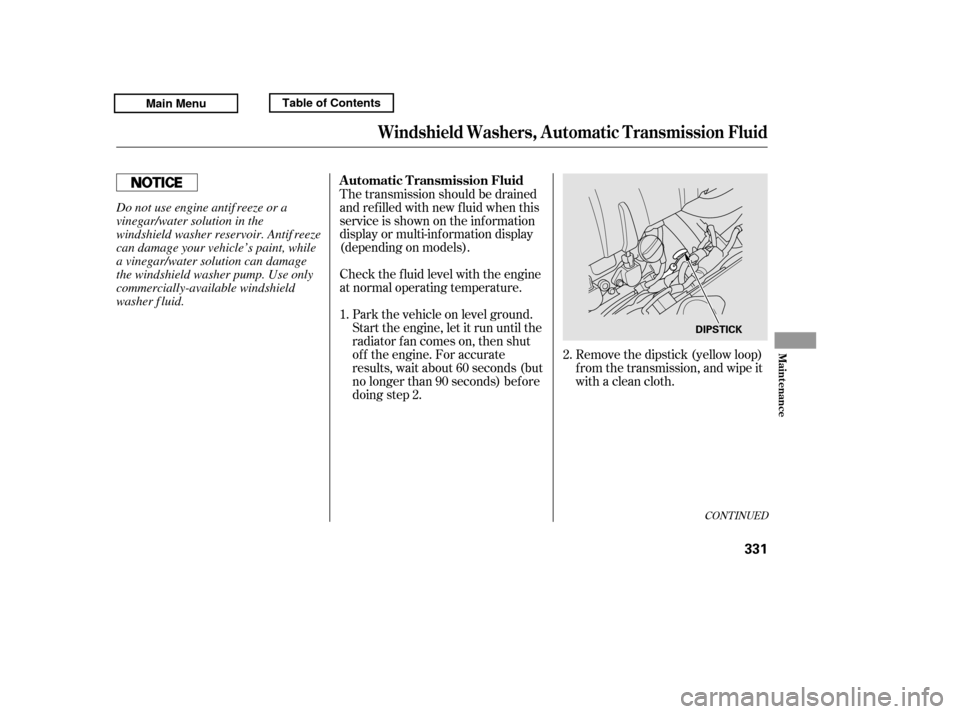
doing step 2. Remove the dipstick (yellow loop)
f rom the transmission, and wipe it
with a clean cloth.
The transmission should be drained
and ref illed with new f luid when this
service is shown on the inf ormation
display or multi-inf ormation display
(depending on models). 1.
2.
Windshield Washers, A utomatic T ransmission Fluid
Automatic Transmission Fluid
Maint enance
331
DIPSTICK
Do not use engine antif reeze or a
vinegar/water solution in the
windshield washer reservoir. Antif reeze
can damage your vehicle’s paint, while
a vinegar/water solution can damage
the windshield washer pump. Use only
commercially-available windshield
washer f luid.
Main MenuTable of Contents
Page 336 of 427
Insert the dipstick all the way back
in the transmission.
If you are not sure how to add f luid,
contact your dealer.
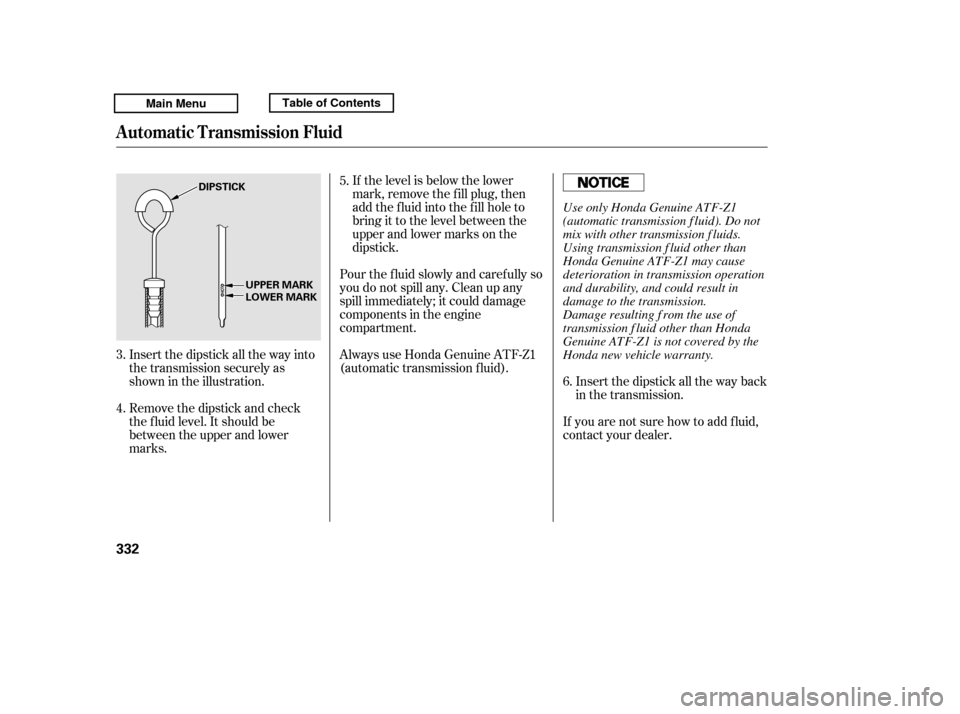
If the level is below the lower
mark, remove the f ill plug, then
add the f luid into the f ill hole to
bring it to the level between the
upper and lower marks on the
dipstick.
Pour the f luid slowly and caref ully so
you do not spill any. Clean up any
spill immediately; it could damage
components in the engine
compartment.
Always use Honda Genuine ATF-Z1
(automatic transmission f luid).
Insert the dipstick all the way into
the transmission securely as
shown in the illustration.
Remove the dipstick and check
the f luid level. It should be
between the upper and lower
marks. 6.
5.
3. 4.
Automatic Transmission Fluid
332
DIPSTICK UPPER MARKLOWER MARK
Use only Honda Genuine ATF-Z1
(automatic transmission f luid). Do not
mix with other transmission f luids.
Using transmission f luid other than
Honda Genuine ATF-Z1 may cause
deterioration in transmission operation
and durability, and could result in
damage to the transmission.
Damage resulting f rom the use of
transmission f luid other than Honda
Genuine ATF-Z1 is not covered by the
Honda new vehicle warranty.
Main MenuTable of Contents
Page 387 of 427
CONT INUED
If your vehicle needs to be towed,
call a prof essional towing service or
organization. Never tow your vehicle
with just a rope or chain. It is very
dangerous.The operator will load
your vehicle on the back of a truck.
Any other method of towing will
damage the drive system. When you
contact the towing agency, inf orm
them a f lat-bed is required. If your vehicle gets stuck in sand,
mud, or snow, call a towing service
to pull it out (see the previous
column).
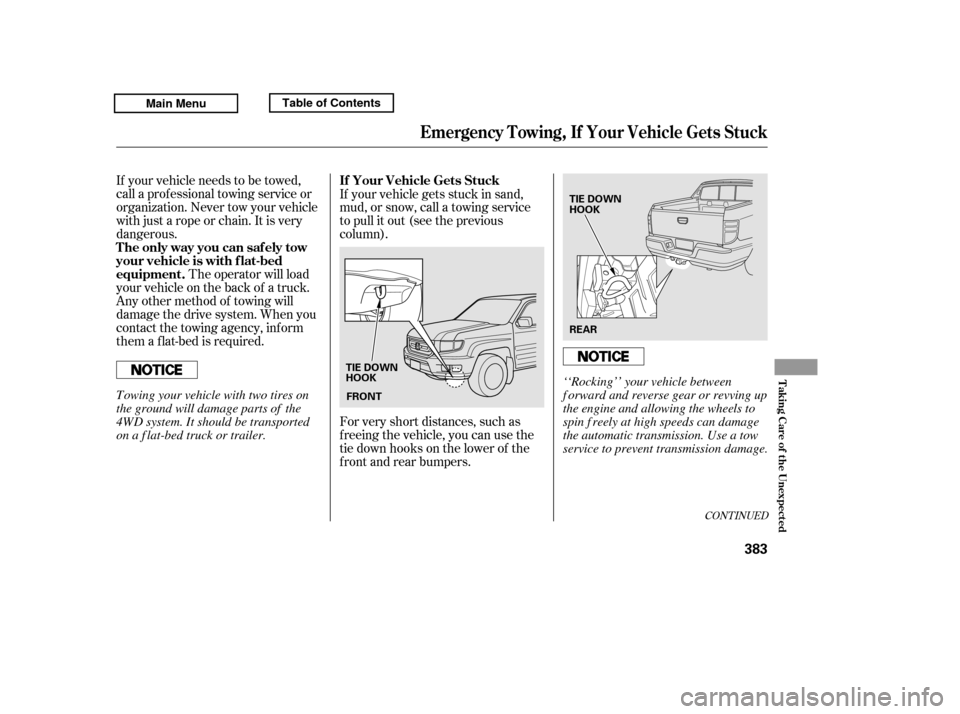
For very short distances, such as
f reeing the vehicle, you can use the
tie down hooks on the lower of the
f ront and rear bumpers.
Emergency Towing, If Your Vehicle Gets Stuck
The only way you can saf ely tow
your vehicle is with f lat-bed
equipment.
If Your Vehicle Gets Stuck
T aking Care of t he Unexpect ed
383
FRONT
REAR
TIE DOWN
HOOK TIE DOWN
HOOK
‘‘Rocking’’ your vehicle between
f orward and reverse gear or revving up
the engine and allowing the wheels to
spin f reely at high speeds can damage
the automatic transmission. Use a tow
service to prevent transmission damage.
Towing your vehicle with two tires on
the ground will damage parts of the
4WD system. It should be transported
on a f lat-bed truck or trailer.
Main MenuTable of Contents
Page 391 of 427
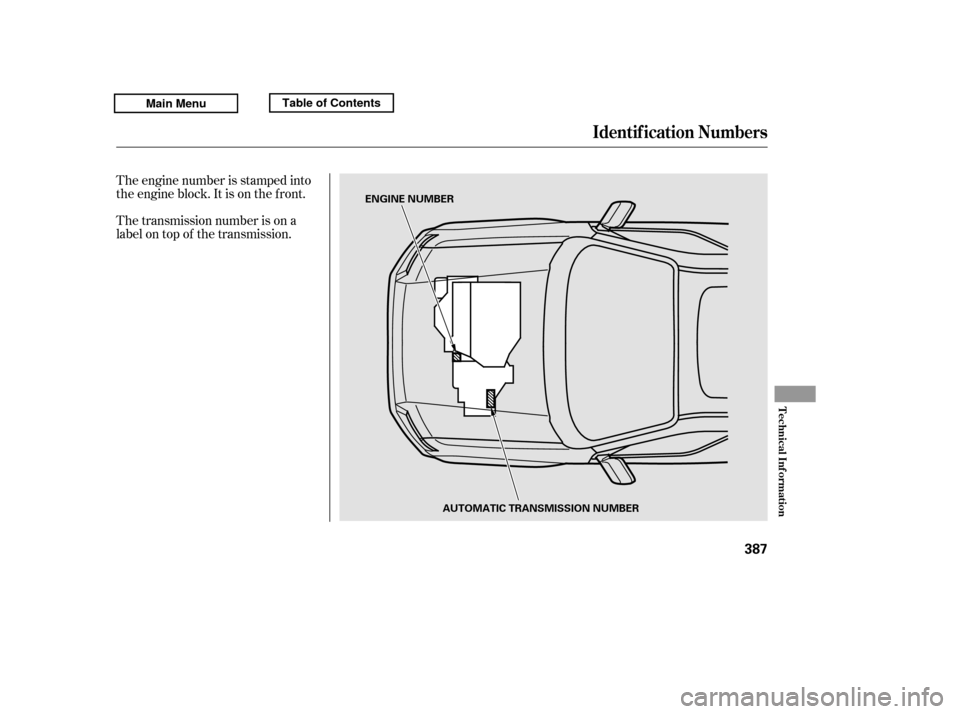
The engine number is stamped into
the engine block. It is on the f ront.
The transmission number is on a
label on top of the transmission.
Identif ication Numbers
T echnical Inf ormation
387
ENGINE NUMBERAUTOMATIC TRANSMISSION NUMBER
Main MenuTable of Contents