Page 512 of 574
Check the air pressure of the
compact spare tire every time you
check the other tires. It should be
inf lated to:
Follow these precautions:Never exceed 50 mph (80 km/h).
Do not mount snow chains on a
compact spare.
Do not use your compact spare
tire on another vehicle unless it is
thesamemakeandmodel.
Use the compact spare tire as a
temporary replacement only. Get
your regular tire repaired or replaced,
and put it back on your vehicle as
soon as you can.
This tire gives a harsher ride and
less traction on some road
surf aces. Use greater caution
while driving. If you store a f ull size tire on the
hoist, remove the spacer.
Otherwise the hoist will not f ully
return to its original position.
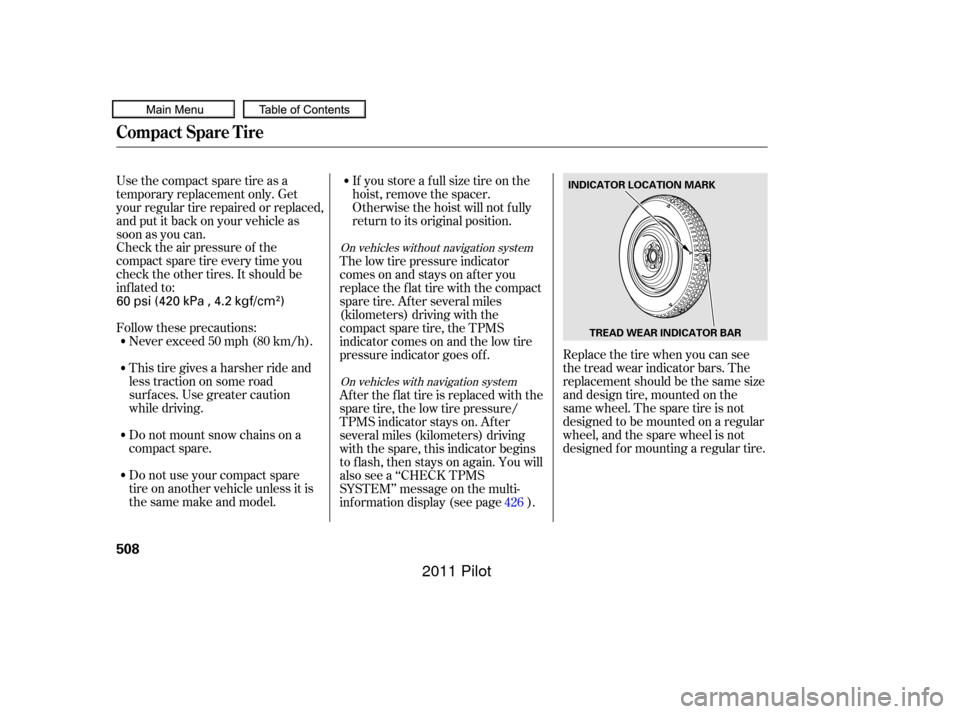
Replace the tire when you can see
the tread wear indicator bars. The
replacement should be the same size
and design tire, mounted on the
same wheel. The spare tire is not
designed to be mounted on a regular
wheel, and the spare wheel is not
designed f or mounting a regular tire.
The low tire pressure indicator
comes on and stays on af ter you
replace the flat tire with the compact
spare tire. Af ter several miles
(kilometers) driving with the
compact spare tire, the TPMS
indicator comes on and the low tire
pressure indicator goes of f .
After the flat tire is replaced with the
spare tire, the low tire pressure/
TPMS indicator stays on. After
several miles (kilometers) driving
with the spare, this indicator begins
to f lash, then stays on again. You will
also see a ‘‘CHECK TPMS
SYSTEM’’ message on the multi-
inf ormation display (see page ).
426On vehicles without navigation system
On vehicles with navigation system
Compact Spare Tire
508
INDICATOR LOCATION MARK
TREAD WEAR INDICATOR BAR
60 psi (420 kPa , 4.2 kgf/cm)
10/01/26 19:51:10 31SZA620_513
2011 Pilot
Page 539 of 574
�µ
Thediagramsinthissectiongive
you the dimensions and capacities of
your vehicle and the locations of the
identif ication numbers. It also
includes inf ormation you should
know about your vehicle’s tires and
emissions control systems. ................
Identif ication Numbers . 536
................................
Specif ications .538
DOT Tire Quality Grading ..........................
(U.S. Vehicles) .540
.................................
Tire Labeling .542
Tire Pressure Monitoring System (TPMS) Required Federal ............................
Explanation .544
.......................
Emissions Controls .547
..
Three Way Catalytic Converter . 549
........................
Emissions Testing .550
T echnical Inf ormation
Technical Inf ormation
535
10/01/26 19:55:22 31SZA620_540
2011 Pilot
Page 543 of 574

�µ
�µ
�µ
�µ
�Î �µ
�µ
�µ
�µ
�µ
�µ
�µ
�µ
�µ
�µ
�µ
�µ
�µ
�µ
�µ
�µ
�µ
�Î
Specif ications
Technical Inf ormation
539
Battery Fuses
Engine
Alignment
Tires
Lights
60 W
12 V
12 V 55 W
12 V 8 W
12 V 4 CP
8W
5W
1.4 W
2CP
12 V
12 V
12 V
12 V 12 V 12 V
28/8 W
3CP
12 V 5 W
12 V 18 W 55 W
12 V 60 W
12 V
Capacity 12 V
12 V 60 AH/5 HR
72 AH/20 HR
12 V 21/5 W
12 V 21/5 W
5W
12 V Interior
Rear
Under-hood
Type
BorexStroke
Displacement
Compression ratio
Spark plugs
Water cooled 4-stroke SOHC i-VTEC
VCM 6-cylinder (V6) gasoline engine 3.50 x 3.66 in (89.0 x 93.0 mm) 212 cu-in (3,471 cm
)
10.5 : 1
SXU22HCR11
ILZKR7B11
Toe-in
Camber
Caster 0.00 in (0.0 mm)
0.08 in (2.0 mm)
0°30’
0°30’
4°12’
Size
Pressure P245/65R17 105T
T165/80D17 104M
32 psi (220 kPa , 2.2 kgf/cm
)
60 psi (420 kPa , 4.2 kgf/cm)
See page
530or the fuse label
attached on the side panel.
See page 529or the fuse label
attached to the inside of the fuse
box lid.
See page 528and 529or the fuse
box cover.
Headlights
Daytime running lights
Front side marker lights
Front turn signal/
parking lights
Front fog lights
Rear turn signal/taillights
Stop/taillights
Rear side marker lights
Back-up lights
License plate lights
Individual map lights
Cargo area lights
High-mount brake lights
Vanity mirror lights
Door courtesy lights
Front/Rear
Spare
Front/Rear
Spare Front
Rear
Front
Rear
Front
Front
Rear
: (H11) (HB3)
(HB3)
DENSO:
NGK:
(H11)
High
Low
Except LX models
10/01/26 19:56:25 31SZA620_544
2011 Pilot
Page 546 of 574
�µ
�µ
�µ
�µ
�µ
�µ
�µ
�µ
�µ
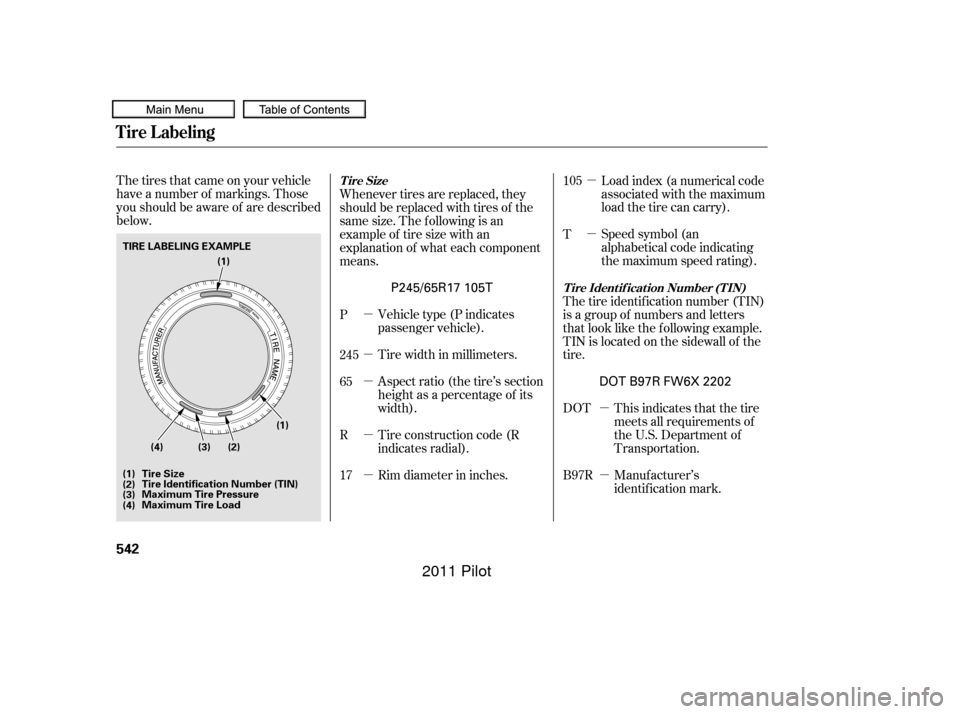
The tires that came on your vehicle
have a number of markings. Those
you should be aware of are described
below.
Load index (a numerical code
associated with the maximum
load the tire can carry).
Speed symbol (an
alphabetical code indicating
the maximum speed rating).
Whenever tires are replaced, they
should be replaced with tires of the
same size. The f ollowing is an
exampleof tiresizewithan
explanation of what each component
means.
Vehicletype(Pindicates
passenger vehicle).
Tire width in millimeters.
Aspect ratio (the tire’s section
height as a percentage of its
width).
Tire construction code (R
indicates radial).
Rim diameter in inches. The tire identif ication number (TIN)
is a group of numbers and letters
that look like the f ollowing example.
TIN is located on the sidewall of the
tire.
This indicates that the tire
meets all requirements of
the U.S. Department of
Transportation.
Manuf acturer’s
identification mark.
P
R
DOT
B97R
245
65
17 105
T
Tire Labeling
Tire Size
T ire Ident if icat ion Number (T IN)
542
TIRE LABELING EXAMPLE
(1)
(2)
(3)
(4)Tire Size
Tire Identification Number (TIN)
Maximum Tire Pressure
Maximum Tire Load (1)
(1)
(3) (2)
(4)
DOT B97R FW6X 2202
P245/65R17 105T
10/01/26 19:56:57 31SZA620_547
2011 Pilot
Page 547 of 574
�µ
�µ �µ �µ
�µ
�µ
�µ
�µ
Tire type code.
Date of manufacture.
Week Year Cold Tire Pressure The tire air
pressure when the vehicle has been
parked f or at least three hours or
driven less than 1 mile (1.6 km).
Load Rating Means the maximum
load that a tire is rated to carry for a
given inf lation pressure.
Maximum Inf lation Pressure The
maximum tire air pressure that the
tire can hold. Maximum Load Rating Means the
load rating for a tire at the maximum
permissible inf lation pressure f or
that tire.
Recommended Inf lation Pressure
The cold tire inf lation pressure
recommended by the manuf acturer.
Treadwear Indicators (TWI)
Means the projections within the
principal grooves designed to give a
visual indication of the degrees of
wear of the tread.
FW6X
2202
Tire Labeling
Glossary of T ire T erminology
Technical Inf ormation
543
10/01/26 19:57:08 31SZA620_548
2011 Pilot
Page 548 of 574

�µ
Each tire, including the spare (if
provided), should be checked
monthly when cold and inf lated to
the inf lation pressure recommended
by the vehicle manuf acturer on the
vehicle placard or tire inf lation
pressure label.
(If your vehicle has tires of a
dif f erent size than the size indicated
on the vehicle placard or tire
inf lation pressure label, you should
determine the proper tire inf lation
pressure f or those tires.)As an added safety feature, your
vehicle has been equipped with a tire
pressure monitoring system (TPMS)
that illuminates a low tire pressure
telltale
when one or more of your tires is
signif icantly under-inf lated.
Accordingly, when the low tire
pressure telltale illuminates, you
should stop and check your tires as
soon as possible, and inf late them to
the proper pressure.Driving on a signif icantly under
inf lated tire causes the tire to
overheat and can lead to tire failure.
Underinf lation also reduces f uel
efficiency and tire tread life, and may
af f ect the vehicle’s handling and
stopping ability.
Please note that the TPMS is not a
substitute for proper tire
maintenance, and it is the driver’s
responsibility to maintain correct tire
pressure, even if under-inf lation has
not reached the level to trigger
illumination of the TPMS low tire
pressure telltale.
Tire Pressure Monitoring System (TPMS) Required Federal Explanation
544
10/01/26 19:57:16 31SZA620_549
2011 Pilot
Page 549 of 574
�µ
Always check the TPMS malf unction
telltale af ter replacing one or more
tires or wheels on your vehicle to
ensure that the replacement or
alternate tires and wheels allow the
TPMS to continue to f unction
properly.
Your vehicle has also been equipped
with a TPMS malf unction indicator
to indicate when the system is not
operating properly. The TPMS
malf unction indicator is provided by
a separate telltale, which displays the
symbol ‘‘TPMS’’ when illuminated.
TPMS malf unctions may occur f or a
variety of reasons, including the
installation of replacement or
alternate tires or wheels on the
vehicle that prevent the TPMS f rom
f unctioning properly. When the malf unction indicator is
illuminated,
the system may not be able to detect
or signal low tire pressure as
intended.On vehicles without navigation system
Tire Pressure Monitoring System (TPMS) Required Federal Explanation
Technical Inf ormation
545
10/01/26 19:57:24 31SZA620_550
2011 Pilot
Page 550 of 574

�µ
TPMS malf unctions may occur f or a
variety of reasons, including the
installation of replacement or
alternate tires or wheels on the
vehicle that prevent the TPMS f rom
f unctioning properly.
Always check the TPMS malf unction
telltale af ter replacing one or more
tires or wheels on your vehicle to
ensure that the replacement or
alternate tires and wheels allow the
TPMS to continue to f unction
properly.
When the malf unction indicator is
illuminated, the system may not be
able to detect or signal low tire
pressure as intended. Your vehicle has also been equipped
with a TPMS malf unction indicator
to indicate when the system is not
operating properly. The TPMS
malf unction indicator is combined
with the low tire pressure telltale.
When the system detects a
malf unction, the telltale will f lash f or
approximately one minute and then
remain continuously illuminated.
This sequence will continue upon
subsequent vehicle start-ups as long
as the malfunction exists.On vehicles with navigation system
Tire Pressure Monitoring System (TPMS) Required Federal Explanation
546
10/01/26 19:57:31 31SZA620_551
2011 Pilot