Page 480 of 574
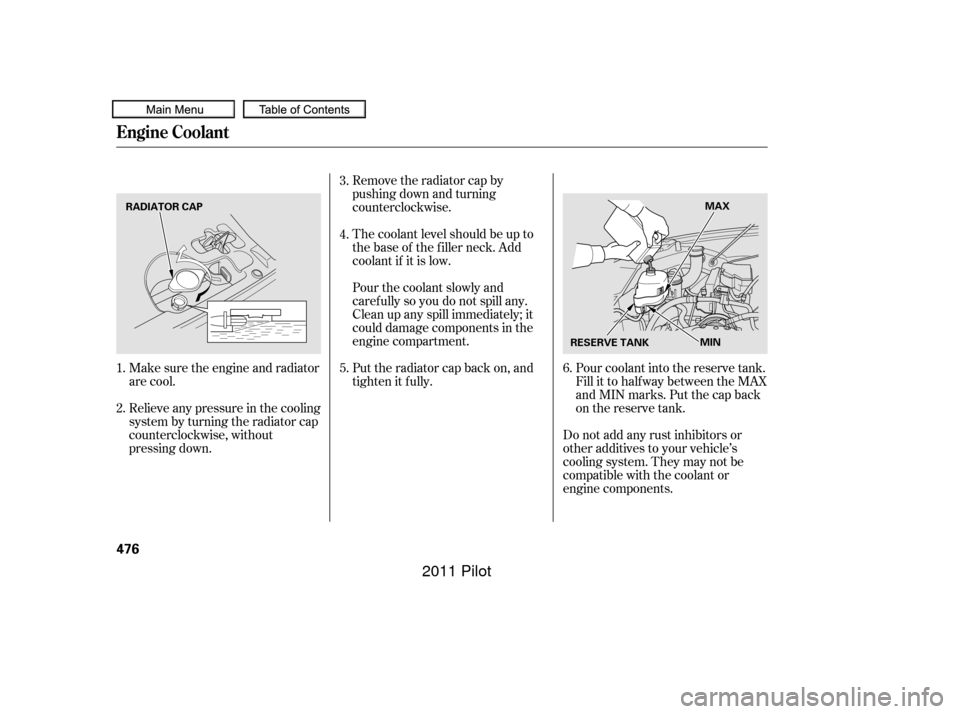
Make sure the engine and radiator
are cool.
Relieve any pressure in the cooling
system by turning the radiator cap
counterclockwise, without
pressing down.Remove the radiator cap by
pushing down and turning
counterclockwise.
The coolant level should be up to
the base of the f iller neck. Add
coolant if it is low.
Put the radiator cap back on, and
tighten it fully. Pourthecoolantslowlyand
caref ully so you do not spill any.
Clean up any spill immediately; it
could damage components in the
engine compartment.
Pour coolant into the reserve tank.
Fill it to half way between the MAX
and MIN marks. Put the cap back
on the reserve tank.
Do not add any rust inhibitors or
other additives to your vehicle’s
cooling system. They may not be
compatible with the coolant or
engine components.
3.
4.
1.
2. 5.
6.
Engine Coolant
476
RADIATOR CAP
RESERVE TANKMAX
MIN
10/01/26 19:45:53 31SZA620_481
2011 Pilot
Page 494 of 574
If your seat belts get dirty, use a sof t
brush with a mixture of mild soap
and warm water to clean them. Do
not use bleach, dye, or cleaning
solvents. Let the belts air-dry bef ore
you use the vehicle.
This f ilter removes the dust and
pollenthatisbroughtinfromthe
outside through the heating and
cooling system/climate control
system.
Have your dealer replace the filter
when this service is indicated by a
maintenance message on the
inf ormation display or multi-
inf ormation display (depending on
the models). It should be replaced
every 15,000 miles (24,000 km) if you
drive primarily in urban areas that
have high concentrations of soot in
the air, or if the flow from the
heating and cooling system/climate
control system becomes less than
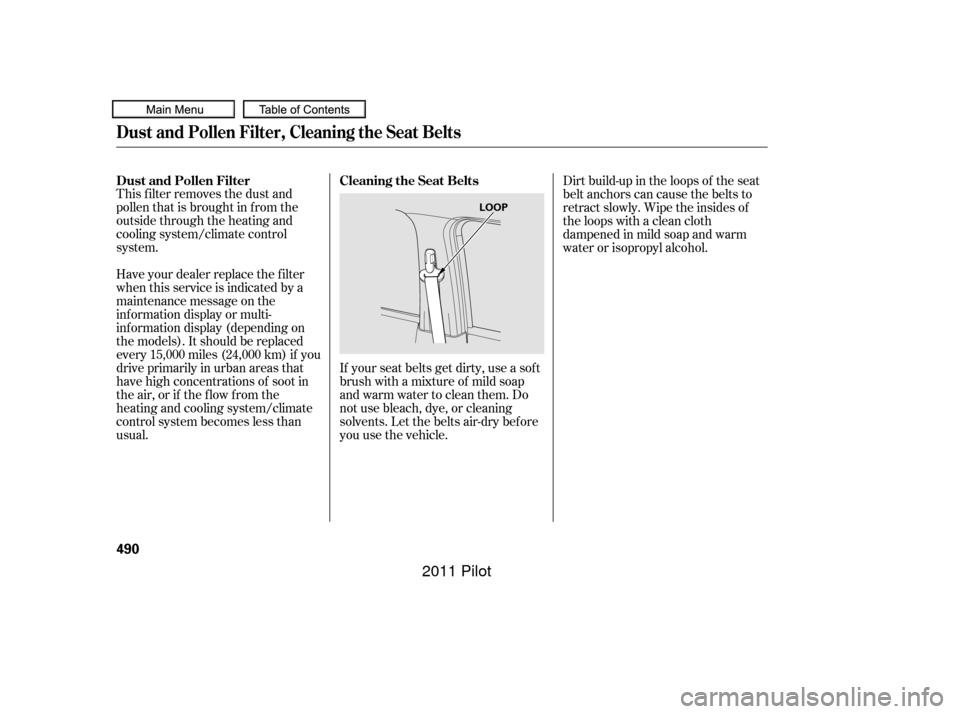
usual. Dirt build-up in the loops of the seat
belt anchors can cause the belts to
retract slowly. Wipe the insides of
the loops with a clean cloth
dampened in mild soap and warm
water or isopropyl alcohol.
Cleaning the Seat Belts
Dust and Pollen Filter
Dust and Pollen Filter, Cleaning the Seat Belts
490
LOOP
10/01/26 19:48:14 31SZA620_495
2011 Pilot
Page 510 of 574

Block the rear wheels.
If the vehicle is to be stored f or a
longer period, it should be
supported on jackstands so the
tires are of f the ground.
Leave one window open slightly (if
the vehicle is being stored
indoors).
Disconnect the battery.
Support the f ront and rear wiper
blade arms with a f olded towel or
ragsotheydonottouchthe
windshield.
To minimize sticking, apply a
silicone spray lubricant to all door
and tailgate seals. Also, apply a
vehiclebodywaxtothepainted
surfaces that mate with the door
and tailgate seals.Cover the vehicle with a
‘‘breathable’’ cover, one made
f rom a porous material such as
cotton. Non-porous materials, such
as plastic sheeting, trap moisture,
which can damage the paint.
If possible, periodically run the
engine until it reaches f ull
operating temperature (the
cooling f ans cycle on and of f
twice). Pref erably, do this once a
month.
Vacuum dirt and dust f rom the
leather f requently. Pay close
attention to the pleats and seams.
Clean the leather with a sof t cloth
dampened with a 90% water and 10%
neutral wool detergent solution.
Then buf f it with a clean, dry cloth.
Remove any dust or dirt on leather
surf aces immediately.
On EX-L and Touring models
Leather
Vehicle Storage, Interior Care
506
10/01/26 19:50:51 31SZA620_511
2011 Pilot
Page 524 of 574

If the temperature gauge stays at
the red mark, turn of f the engine.
Look f or any obvious coolant leaks,
such as a split radiator hose.
Everything is still extremely hot,
so use caution. If you f ind a leak, it
must be repaired bef ore you
continue driving (seeon page ).
If you do not f ind an obvious leak,
check the coolant level in the
radiator reserve tank. Add coolant
if the level is below the MIN mark.
If there was no coolant in the
reserve tank, you may need to add
coolant to the radiator. Let the
engine cool down until the pointer
reaches the middle of the tempera-
ture gauge, or lower, bef ore check-
ing the radiator. Using gloves or a large heavy
cloth, turn the radiator cap
counterclockwise, without pushing
down, to the f irst stop. Af ter the
pressure releases, push down on
the cap, and turn it until it comes
off.Start the engine, and set the
temperature to maximum heat
(climate control to AUTO at
‘‘ ’’). Add coolant to the
radiator up to the base of the f iller
neck. If you do not have the
proper coolant mixture available,
you can add plain water.
Remember to have the cooling
system drained and ref illed with
the proper mixture as soon as you
can.
Put the radiator cap back on
tightly. Run the engine, and check
the temperature gauge. If it goes
back to the red mark, the engine
needs repair (see
on page ).
If the temperature stays normal,
check the coolant level in the
radiator reserve tank. If it has
gone down, add coolant to the
MAX mark. Put the cap back on
tightly.
4.
5.
6.
7. 8.9.
10.
11.
531
531
Emergency
Towing
Emergency
Towing
If theEngineOverheats
520
Removing the radiator cap
while the engine is hot can
cause the coolant to spray out,
seriously scalding you.
Always let the engine and
radiator cool down before
removing the radiator cap.
10/01/26 19:53:13 31SZA620_525
2011 Pilot
Page 532 of 574
�µ
�µ
�µ
�µ
No. Amps.Amps.
No.
Circuits Protected Circuits Protected
1
2
3
4
5
6
7
8
9
10
11
12 120 A
80 A
50 A
50 A
40 A
30 A
30 A
30 A
40 A
20 A
15 A
10 A 20 A
20 A
7.5 A 20 A
20 A
15 A
15 A
7.5 A 15 A
10 A
10 A
13
14
15
16
17
18
19
20
21
22
23
Main Fuse
Not Used
OP Main
IG Main
Not Used
Not Used
Head Light Main
Power Window Main
Not Used
Condenser Fan
Cooling Fan
Rear Defroster
Blower
Front Fog Light
Sub
ACM Front Passenger’s Power
Seat Reclining
Front Passenger’s Power
Seat Slide
Oil Level
Head Light Hi Main
Radio
IG Coil
Main
MG Clutch
DBW
Interior Light
Back Up
Fuse Locations
528
PRIMARY UNDER-HOOD FUSE BOX
10/01/26 19:54:34 31SZA620_533
2011 Pilot
Page 566 of 574
CONT INUED
.....................................
Headlights .126
........................................
Aiming .483
..................
Automatic Lighting . 127
.........
Daytime Running Lights . 128
..................
High Beam Indicator . 78
.........
High Beams, Turning on . 126
....................
Lights On Indicator .78
..........
Low Beams, Turning on . 126
.......................
Reminder Chime .126
........
Replacing Halogen Bulbs . 483
.................................
Turning on .126
...................................
Headphones .346
............................
Head Restraints .157
...............................
Heated Mirror .172
...............................
Heaters, Seats .164
.............
Heating and Cooling . 192,199
...............
High-Low Beam Switch . 126
HomeLink
Universal ................................
Transceiver .357
.......................
Hood, Opening the .397
...........................................
Horn .4,123
...
Identif ication Number, Vehicle . 536Ignition
............................................
Keys .134
.........................................
Switch .137
............
Timing Control System . 548
......................
Immobilizer System .135
.........
Important Safety Precautions . 6
...
Indicators, Instrument Panel . 67,68
...............
ABS (Anti-lock Brake) . 72
....................................
A/T Temp .76
Brake (Parking and Brake ............................
System) .71, 523
................
Charging System . 70,521
.............................
Cruise Control .78
.................................
Cruise Main .78
DRL (Daytime Running ......................................
Lights) .79
...................................
Fog Lights .78
...................................
High Beam .78
........
Key (Immobilizer System) . 78
.....................................
Lights On .78
......................................
Low Fuel .80
................
Low Oil Pressure . 70,521
......................
Low Tire Pressure .74
...
Malf unction Indicator Lamp . 522
..........................
Security System .81
...........................
Side Airbag Of f .72 .......................................
Seat Belt .69
...............................................
SRS .72
...................
System Message . 77,94
...............
Tire Pressure Monitor . 75
Turn Signal and Hazard ...................................
Warning .73
............................
VSA Activation .73
.................................
VSA System .73
..................
Individual Map Lights . 177
...............................
Inf ant Restraint .44
......................................
Inf ant Seats .44
...................
Inf lation, Proper Tire . 496
..................................
INFO Buttons .87
.................................
Inside Mirror .170
.............................
Inspection, Tire .498
......................
Instrument Panel .67, 68
......
Instrument Panel Brightness . 131
..............
Instruments and Controls . 65
....................
Integrated Sunshade .183
.................................
Interf ace Dial .252
...............................
Interior Lights .176
........................................
Introduction .i
...............................................
iPod
. 288
Index
INDEXI
V
10/01/26 19:59:37 31SZA620_568
2011 Pilot