Page 422 of 574
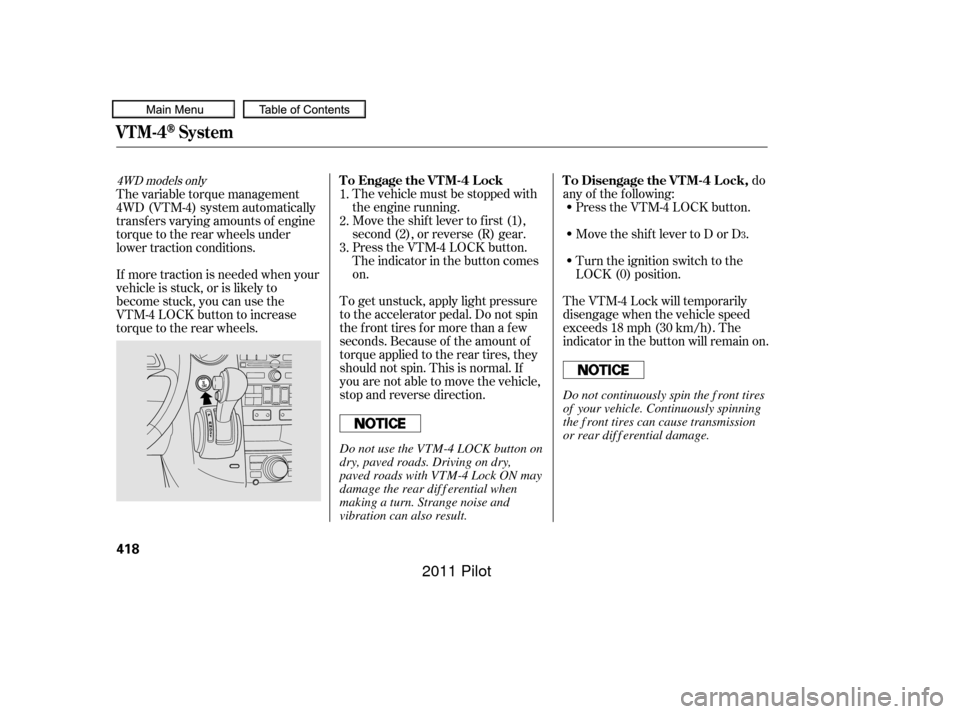
The vehicle must be stopped with
the engine running.do
any of the f ollowing: Press the VTM-4 LOCK button.
Move the shift lever to D or D .
Move the shift lever to first (1),
second (2), or reverse (R) gear.
Turn the ignition switch to the
LOCK (0) position.
Press the VTM-4 LOCK button.
The indicator in the button comes
on.
The VTM-4 Lock will temporarily
disengage when the vehicle speed
exceeds 18 mph (30 km/h). The
indicator in the button will remain on.
To get unstuck, apply light pressure
to the accelerator pedal. Do not spin
the f ront tires f or more than a f ew
seconds. Because of the amount of
torque applied to the rear tires, they
should not spin. This is normal. If
you are not able to move the vehicle,
stop and reverse direction.
If more traction is needed when your
vehicle is stuck, or is likely to
become stuck, you can use the
VTM-4 LOCK button to increase
torque to the rear wheels. The variable torque management
4WD (VTM-4) system automatically
transf ers varying amounts of engine
torque to the rear wheels under
lower traction conditions.
1.
2.
3.
3
4WD models onlyTo Engage the VTM-4 Lock To Disengage the VTM-4 Lock,
VTM-4System
418
Do not continuously spin the f ront tires
of your vehicle. Continuously spinning
the f ront tires can cause transmission
or rear dif f erential damage.
Do not use the VTM-4 LOCK button on
dry, paved roads. Driving on dry,
paved roads with VTM-4 Lock ON may
damage the rear dif f erential when
making a turn. Strange noise and
vibration can also result.
10/01/26 19:35:36 31SZA620_423
2011 Pilot
Page 439 of 574
�Î �Î
�Î �Î
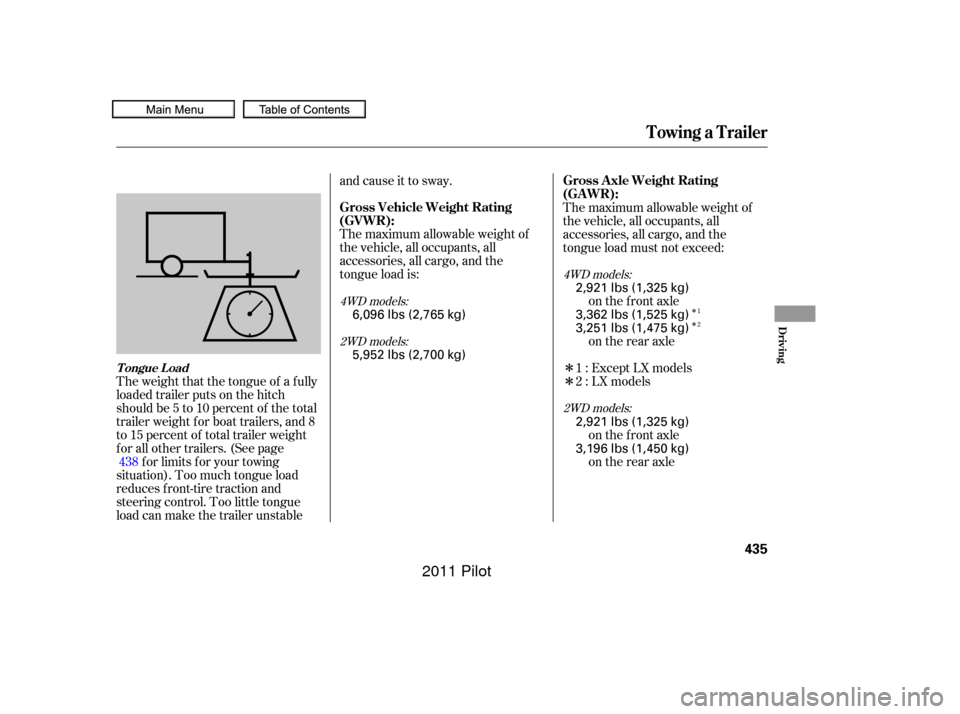
The weight that the tongue of a f ully
loaded trailer puts on the hitch
shouldbe5to10percentof thetotal
trailer weight f or boat trailers, and 8
to 15 percent of total trailer weight
f or all other trailers. (See pagef or limits f or your towing
situation). Too much tongue load
reduces front-tire traction and
steering control. Too little tongue
load can make the trailer unstable and cause it to sway.
The maximum allowable weight of
the vehicle, all occupants, all
accessories, all cargo, and the
tongue load is:
The maximum allowable weight of
the vehicle, all occupants, all
accessories, all cargo, and the
tongue load must not exceed:
on the f ront axle
on the f ront axle
on the rear axle
2:LXmodels 1:ExceptLXmodels
on the rear axle
438
4WD models: 2WD models: 4WD models:
2WD models:
2 1
Towing a Trailer
Tongue Load
Gross Vehicle Weight Rating
(GVWR): Gross Axle Weight Rating
(GA WR):
Driving
435
5,952 lbs (2,700 kg) 6,096 lbs (2,765 kg)
2,921 lbs (1,325 kg)
3,362 lbs (1,525 kg)
3,251 lbs (1,475 kg)
2,921 lbs (1,325 kg)
3,196 lbs (1,450 kg)
10/01/26 19:38:42 31SZA620_440
2011 Pilot
Page 440 of 574
Thebestwaytoconfirmthatall
loads are within limits is to check
them at a public scale. For public
scales in your area, check your local
phone book, or contact your trailer
dealer or rental agency for
assistance.
To help ensure a saf e drive to a scale,
or if you cannot get to a public scale,
we recommend that you estimate
your total trailer weight and tongue
load as described next.Add the weight of your trailer (as
quoted by the manuf acturer) with
everything in or on the trailer. Then
check the tables on page to
make sure you do not exceed the
limit f or your conditions.
The maximum allowable weight of
the f ully loaded vehicle and trailer
with the proper hitch is:
The GCWR must be reduced 2
percent f or every 1,000 f eet (305
meters) of elevation. 438
4WD models:
2WD models:
Estimating Loads
Gross Combined Weight Rating
(GCWR):To Estimate the Total Trailer Weight
Towing a Trailer
436
9,579 lbs (4,345 kg)
8,466 lbs (3,840 kg)
10/01/26 19:38:50 31SZA620_441
2011 Pilot
Page 441 of 574
Estimated
tongue load is:
150 lbs (68 kg)
250 lbs (114 kg)
350 lbs (159 kg)
Park the vehicle on level ground.
Measure and record the distance
from the ground to the bottom of
the trailer hitch.
Connect the f ully loaded trailer to
the hitch.
Measure again f rom the ground to
the same spot on the bottom of the
hitch.
Subtract the second measurement
from the first measurement, then
refer to the following table. Estimated
tongue load is:
150 lbs (68 kg)
250 lbs (114 kg)
350 lbs (159 kg)
450 lbs (205 kg)
If thedifferenceismorethan1¾
inch, you have too much load on the
tongue. Redistribute the load or
remove cargo as needed. If the
dif f erence is:
5/8’’
11/4’’
13/4’’ If the
dif f erence is:
5/8’’
11/4’’
13/4’’
21/4’’
If thedifferenceismorethan2¼
inch, you have too much load on the
tongue. Redistribute the load or
remove cargo as needed.
1.
2.
3.
4.
5.
2WD models
4WD models
Towing a Trailer
To Estimate the Tongue Load
Driving
437
10/01/26 19:39:04 31SZA620_442
2011 Pilot
Page 442 of 574

�Î�Î�Î
�Î �Î�Î
�µ�µ
�Î
�Î�Î
T owing is Not Recommended
Number of
Occupants 2
3
4
5
6
7
8 Maximum T otal T railer Weight
Maximum T ongue Load
T owing is Not Recommended
Number of
Occupants 2
3
4
5
6
7
8 Maximum T otal T railer Weight
Maximum T ongue Load
2WD models
4WD models
Towing a Trailer
438
Total Trailer Weight and Tongue Load Limits:
3,500 lbs (1,588 kg)
3,300 lbs (1,497 kg)
3,100 lbs (1,406 kg)
3,000 lbs (1,361 kg)
2,800 lbs (1,270 kg)
2,000 lbs (907 kg) 350 lbs (159 kg)
300 lbs (136 kg)
230 lbs (104 kg)
200 lbs (91 kg)
150 lbs (68 kg)
100 lbs (45 kg)
4,500 lbs (2,041 kg)
4,300 lbs (1,950 kg)
4,100 lbs (1,860 kg)
4,000 lbs (1,814 kg)
3,800 lbs (1,724 kg)
2,000 lbs (907 kg) 450 lbs (204 kg)
400 lbs (181 kg)
330 lbs (150 kg)
270 lbs (122 kg)
190 lbs (86 kg)
100 lbs (45 kg)
The corresponding weight limits assume occupants fill seats from the front of the vehicle to the back, each occupant weighs 150 lbs (68
kg), and each has 15 lbs (7 kg) of cargo in the cargo area. Any additional weight, including cargo or accessories, reduces the maximum
trailer weight and maximum tongue load. Never exceed the gross axle weight ratings (see page ).
Recommended tongue load should be 5 10% of the total trailer weight for boat trailers, and 8 15% of the total trailer weight for all other
trailers. 435
10/01/26 19:39:15 31SZA620_443
2011 Pilot
Page 443 of 574
To accurately check your loads at
the public scale, the vehicle and
trailer should be f ully loaded, and all
occupants should stay in the vehicle
while the attendant watches the
scale.Check the f ront gross axle weight.
Limit: 2,921 lbs (1,325 kg) Check the gross vehicle weight.
Limit (4WD models): 6,096 lbs
(2,765 kg)
Limit (2WD models): 5,952 lbs
(2,700 kg)If you cannot weigh the rear axle
directly, you can calculate the rear
gross axle weight by subtracting
the weight in step 1 from the
weight in step 2.
Limit (4WD models): 3,175 lbs
(1,440 kg)
Limit (2WD models): 3,031 lbs
(1,375 kg)
Check the rear gross axle weight.
Limit (4WD models): 3,362 lbs
(1,525 kg)
Limit (2WD models): 3,196 lbs
(1,450 kg)
1. 2.
3.4.
CONT INUED
Checking L oads
Towing a Trailer
Driving
439
10/01/26 19:39:25 31SZA620_444
2011 Pilot
Page 444 of 574
Calculate the tongue load.
Subtract the weight in step 6 f rom
the weight in step 7.
Limit: See page .
Recommended: see page .
Range: 5-10% f or boat trailers8-15% f or other trailers
Check the weight of the unhitched
trailer. Limit: See page .
Check the weight of the hitched
trailer. Write this number down.
Check the gross combined weight.
Limit (4WD models): 9,579 lbs
(4,345 kg)
Limit (2WD models): 8,466 lbs
(3,840 kg)
Remember, maximum gross
combined weight should be
decreased 2% f or every 1,000 f eet
(305 meters) of elevation. 7.
8.
6.
5.
438
438 435
Towing a Trailer
440
10/01/26 19:39:34 31SZA620_445
2011 Pilot
Page 473 of 574

�Î
�Î�Ì �Ì �Î
�Î
�µ�µ�Ì
�Î
�Î
Maintenance Inf ormation
469
Maintenance Main Items
Replace engine oil
Replace engine oil and oil filter
Inspect front and rear brakes
Check parking brake adjustment
Inspect these items: Tie rod ends, steering gear box, and boots
Suspension components
Driveshaft boots
Brake hoses and lines (including ABS/VSA)
All fluid levels and condition of fluids
Exhaust system
Fuel lines and connections Maintenance Sub Items
Rotate tires
Replace air cleaner element
Replace dust and pollen filter
Inspect drive belt
Replace transmission and transfer fluid
Replace spark plugs
Replace timing belt and inspect water pump
Inspect valve clearance
Replace engine coolant
Replace VTM-4 rear differential fluid
Symbol
Symbol
A B 1
2
3
4
5
61
1
22
See information on maintenance and emissions warranty on page . If the message, ‘‘SERVICE’’ does not appear more than 12 months after the
display is reset, change the engine oil every year.Independent of the maintenance messages in the information display,
replace the brake fluid every 3 years.
Inspect idle speed every 160,000 miles (256,000 km).
Adjust the valves during services A, B, 1, 2, or 3 if they are noisy.
:
NOTE : 467
1:
2 : 4WD models only
If you drive in dusty conditions, replace every 15,000
miles (24,000 km).
If you drive primarily in urban areas that have high
concentrations of soot in the air from industry and from
diesel-powered vehicles, replace every 15,000 miles
(24,000 km).
If you drive regularly in very high temperatures
(over 110°F, 43°C), in very low temperatures
(under 20°F, 29°C), or towing a trailer, replace every
60,000 miles (U.S.)/100,000 km (Canada).
Driving in mountainous areas at very low vehicle
speeds or trailer towing results in higher level of
mechanical (shear) stress to fluid. This requires
differential fluid changes more frequently than
recommended by the maintenance information. If you
regularly drive your vehicle under these conditions,
have the differential fluid changed at 7,500 miles
(12,000 km), then every 15,000 miles (24,000 km).
Maintenance Information
10/01/26 19:44:45 31SZA620_474
2011 Pilot