Page 656 of 722
This section covers the more
common problems that motorists
experience with their vehicles. It
gives you inf ormation about how to
safely evaluate the problem and what
to do to correct it. If the problem has
stranded you on the side of the road,
you may be able to get going again.
If not, you will also f ind instructions
on getting your vehicle towed.......................
Compact Spare Tire .654
....................
Changing a Flat Tire .655
.............
If the Engine Won’t Start . 662
................................
Jump Starting .665
..............
If the Engine Overheats . 667
.........
Low Oil Pressure Indicator . 669
..........
Charging System Indicator . 670
.......
Malf unction Indicator Lamp . 671
...............
Brake System Indicator . 672
..............................................
Fuses .673
..............................
Fuse Locations .678
......................
Emergency Towing .683
Taking Care of the Unexpected
Taking Care of the Unexpected
653
10/07/17 11:01:44 31TK8600_658
2011 Odyssey
Page 658 of 722
CONT INUED
Park the vehicle on f irm, level, and
non-slippery ground. Put the
transmission in Park. Apply the
parking brake.
If you are towing a trailer,
Turn on the hazard warning lights,
and turn the ignition switch to the
LOCK (0) position. Have all
passengers get out of the vehicle
while you change the tire.
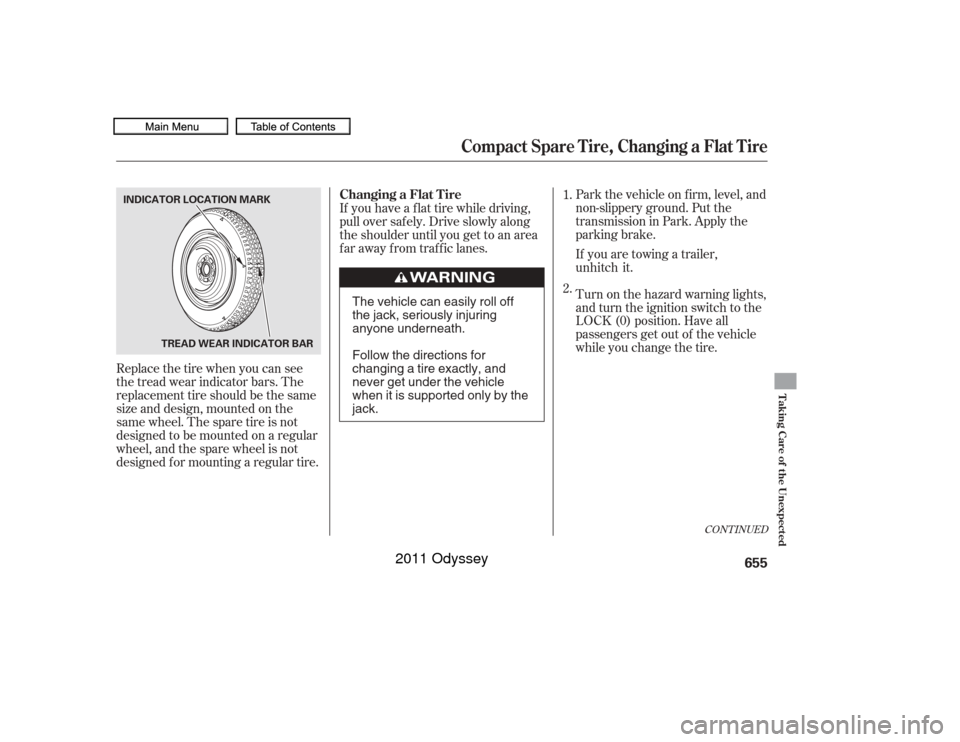
Replace the tire when you can see
the tread wear indicator bars. The
replacement tire should be the same
size and design, mounted on the
same wheel. The spare tire is not
designed to be mounted on a regular
wheel, and the spare wheel is not
designed f or mounting a regular tire. If you have a f lat tire while driving,
pull over saf ely. Drive slowly along
the shoulder until you get to an area
far away from traffic lanes.
2. 1.
Compact Spare Tire, Changing a Flat Tire
Changing a Flat T ire
Taking Care of the Unexpected
655
TREAD WEAR INDICATOR BAR
INDICATOR LOCATION MARK
The vehicle can easily roll off
the jack, seriously injuring
anyone underneath.
Follow the directions for
changing a tire exactly, and
never get under the vehicle
when it is supported only by the
jack.
10/07/17 11:01:59 31TK8600_660
unhitch it.
2011 Odyssey
Page 667 of 722
If youfindnothingwrong,youwill
need a qualif ied technician to f ind
the problem. Seeon page .
Are you using a properly coded
key? An improperly coded key will
cause the immobilizer system
indicator in the instrument panel
to blink rapidly (see page ).
There may be an electrical
problem, such as no power to the
f uel pump. Check all the f uses
(see page ).
In this case, the starter motor’s
speed sounds normal, or even f aster
than normal, when you turn the
ignition switch to the START (III)
position, but the engine does not run.
Do you have f uel? Check the f uel
gauge; the low f uel indicator may
not be working.
Are you using the proper starting
procedure? Ref er to
on page . 69
559 683
673 Emergency
Towing
T he Starter Operates Normally
Starting the
Engine
If theEngineWon’tStart664
10/07/17 11:03:06 31TK8600_669
2011 Odyssey
Page 670 of 722
The pointer of the vehicle’s
temperature gauge should stay in
the midrange. If it climbs to the red
mark, you should determine the
reason (hot day, driving up a steep
hill, etc.).
If your vehicle overheats, you should
take immediate action. The only
indication may be the temperature
gauge climbing to or above the red
mark. Or you may see steam or
spray coming f rom under the hood.If you see steam and/or spray
coming f rom under the hood, turn
of f the engine. Wait until you see
no more signs of steam or spray,
then open the hood.If the temperature gauge stays at
the red mark, turn off the engine.
Saf ely pull to the side of the road.
Put the transmission in Park, and
set the parking brake. Turn of f all
the accessories, and turn on the
hazard warning lights. If you do not see steam or spray,
leave the engine running and
watch the temperature gauge. If
the high heat is due to overloading,
the engine should start to cool
down almost immediately. If it
does, wait until the temperature
gauge comes down to the midpoint,
then continue driving.
Look f or any obvious coolant leaks,
such as a split radiator hose.
Everything is still extremely hot,
so use caution. If you f ind a leak, it
must be repaired bef ore you
continue driving (see
on page ).
1.
2. 3.
4.
5.
683
CONT INUED
If theEngineOverheats
Emergency
Towing
Taking Care of the Unexpected
667
Steam and spray from an
overheated engine can
seriously scald you.
Do not open the hood if steam
is coming out.
Driving with the temperature gauge
pointer at the red mark can cause
serious damage to the engine.
10/07/17 11:03:30 31TK8600_672
2011 Odyssey
Page 671 of 722
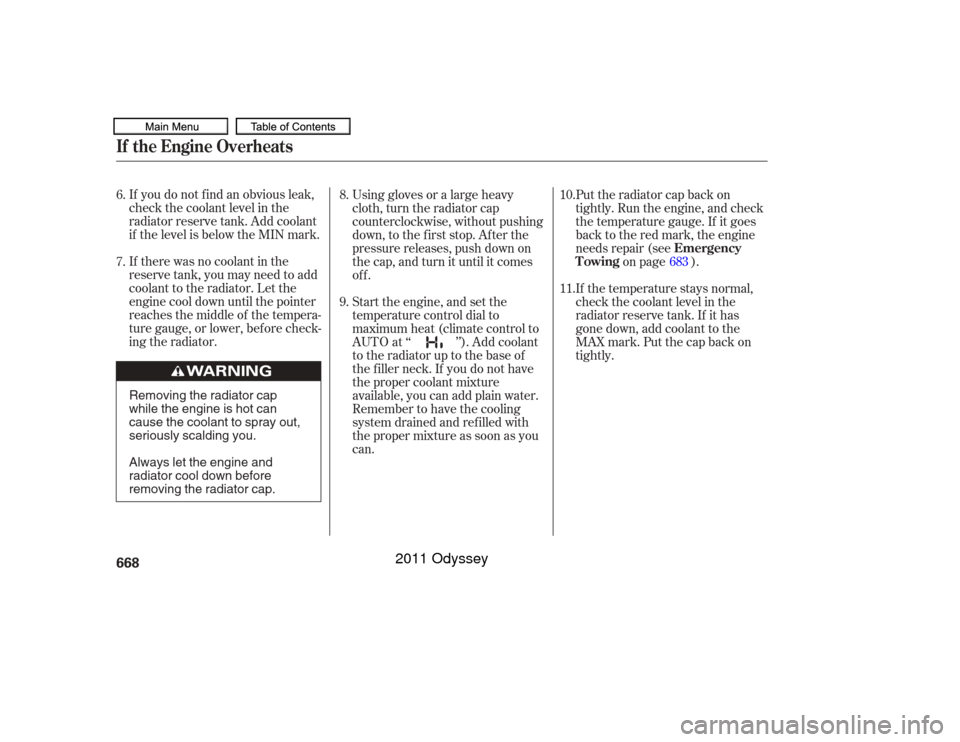
If you do not f ind an obvious leak,
check the coolant level in the
radiator reserve tank. Add coolant
if the level is below the MIN mark.
If there was no coolant in the
reserve tank, you may need to add
coolant to the radiator. Let the
engine cool down until the pointer
reaches the middle of the tempera-
ture gauge, or lower, bef ore check-
ing the radiator.Using gloves or a large heavy
cloth, turn the radiator cap
counterclockwise, without pushing
down, to the f irst stop. Af ter the
pressure releases, push down on
the cap, and turn it until it comes
off.
Start the engine, and set the
temperature control dial to
maximum heat (climate control to
AUTO at ‘‘ ’’). Add coolant
to the radiator up to the base of
the f iller neck. If you do not have
the proper coolant mixture
available, you can add plain water.
Remember to have the cooling
system drained and ref illed with
the proper mixture as soon as you
can.Put the radiator cap back on
tightly. Run the engine, and check
the temperature gauge. If it goes
back to the red mark, the engine
needs repair (see
on page ).
If the temperature stays normal,
check the coolant level in the
radiator reserve tank. If it has
gone down, add coolant to the
MAX mark. Put the cap back on
tightly.
6.
7.
8.
9.10.
11.
683
If theEngineOverheats
Emergency
Towing
668
Removing the radiator cap
while the engine is hot can
cause the coolant to spray out,
seriously scalding you.
Always let the engine and
radiator cool down before
removing the radiator cap.
10/07/17 11:03:37 31TK8600_673
2011 Odyssey
Page 675 of 722
The brake system
indicator normally
comesonwhenyou
turn the ignition switch to the ON
(II) position, and as a reminder to
check the parking brake. It will stay
on if you do not f ully release the
parking brake.
If the brake system indicator comes
on while driving, the brake f luid level
is probably low. Press lightly on the
brake pedal to see if it f eels normal.
If it does, check the brake f luid level
thenexttimeyoustopataservice
station (see page ). Slow down by shif ting to a lower
gear, and pull to the side of the road
when it is saf e. Because of the long
distance needed to stop, it is
hazardous to drive the vehicle. You
should have it towed and repaired as
soon as possible (see
on page ).
If the f luid level is low, take your
vehicle to a dealer, and have the
brake system inspected f or leaks or
worn brake pads.
However, if the brake pedal does not
f eel normal, you should take
immediate action. A problem in one
part of the system’s dual circuit
design will still give you braking at
two wheels. You will f eel the brake
pedal go down much f arther bef ore
the vehicle begins to slow down, and
you will have to press harder on the
pedal.
If the ABS indicator and the VSA
indicator come on with the brake
system indicator, have the vehicle
inspected by your dealer
immediately. If you must drive the vehicle a short
distance in this condition, drive
slowly and caref ully.
You will also see a ‘‘BRAKE FLUID
LOW’’ message on the multi-
inf ormation display. You will also see a ‘‘CHECK BRAKE
SYSTEM’’ message on the multi-
inf ormation display.
623 683
On Touring models
On Touring models
Emergency
Towing
Brake System Indicator672U.S. Canada
10/07/17 11:04:06 31TK8600_677
2011 Odyssey
Page 686 of 722
�µ�µ
If your vehicle needs to be towed,
call a prof essional towing service or
organization. Never tow your vehicle
with just a rope or chain. It is very
dangerous.
Therearetwowaystotowyour
vehicle:
With the f ront wheels on the ground,
it is best to tow the vehicle no farther
than 50 miles (80 km), and keep the
speedbelow35mph(55km/h).
The operator
loads your vehicle on the back of a
truck. The tow
truck uses two pivoting arms that go
under the tires (f ront) and lif t them
of f the ground. The other two tires
remain on the ground.
If , due to damage, your vehicle must
be towed with the f ront wheels on
the ground, do this:
Start the engine.
Shif t to the D position and hold f or
5 seconds, then to N.
Turn of f the engine.
Leave the ignition switch in the
ACCESSORY (I) position so the
steering wheel does not lock.
Release the parking brake.
CONT INUED
Flat -bed Equipment Wheel-lif t Equipment
T his is the best way to
transport your vehicle. T his is an
acceptable way to tow your
vehicle.
Emergency Towing
Taking Care of the Unexpected
683
Improper towing preparation will
damage the transmission. Follow the
above procedure exactly. If you cannot
shif t the transmission or start the
engine, your vehicle must be
transported with the f ront wheels of f
the ground.
10/07/17 11:05:23 31TK8600_688
2011 Odyssey
Page 687 of 722
Emergency Towing684
Trying to lif t or tow your vehicle by the
bumpers will cause serious damage.
The bumpers are not designed to
support the vehicle’s weight.
The steering system can be damaged if
the steering wheel is locked. Leave the
ignition switch in the ACCESSORY (I)
position, and make sure the steering
wheel turns f reely bef ore you begin
towing.
10/07/17 11:05:26 31TK8600_689
2011 Odyssey