Page 335 of 445

�µ�µ
�µ Thebestwaytoconfirmthatall
loads are within limits is to check
them at a public scale. For public
scales in your area, check your local
phone book, or contact your trailer
dealer or rental agency for
assistance.
Theweightthatthe
tongue of a f ully-loaded trailer puts
on the hitch should be approximately
10% of the total trailer weight. Too
much tongue load reduces f ront-tire
traction and steering control. Too
little tongue load can make the
trailer unstable and cause it to sway. If you normally pull the same load
each time you tow a trailer, you can
use a suitable scale or a special
tongue load gauge to check the
tongue load the f irst time you set up
a towing combination (a f ully loaded
vehicle and trailer), then recheck the
tongue load whenever the conditions
change.
If you cannot get to a public scale,
you can estimate the total trailer
weight by adding the weight of your
trailer (as quoted by the
manuf acturer) with everything in or
on the trailer.
To achieve a proper tongue load,
start by loading 60% of the load
toward the front of the trailer and 40% toward the rear, then re-adjust
the load as needed.
The maximum
allowable weight of the vehicle, all
occupants, all accessories, all cargo,
and the tongue load is 4,560 lbs
(2,070 kg).
The maximum
allowable weight of the vehicle, all
occupants, all accessories, all cargo,
and the tongue load must not exceed
2,310 lbs (1,050 kg) on the f ront axle,
and 2,290 lbs (1,040 kg) on the rear
axle.
The maximum
allowable weight of the f ully loaded
vehicle and trailer is 6,060 lbs (2,750
kg)
Towing a Trailer
Checking L oads
Tongue Load: Gross Vehicle Weight Rating
(GVWR)
Gross Axle Weight Ratings
(GA WR)
Gross Combined Weight Rating
(GCWR)
330
Main MenuTable of Contents
Page 336 of 445

Towing can require a variety of
equipment, depending on the size of
your trailer, how it will be used, how
much load you are towing, and
where you tow.Trailer lights and equipment must
comply with f ederal, state, province/
territory, and local regulations.
Check trailer light requirements f or
the areas where you plan to tow, and
use only equipment designed f or
your vehicle.
Discuss your needs with your trailer
sales or rental agency, and f ollow the
guidelines in this section. Also make
sure that all equipment is properly
installed and maintained, and that it
meets f ederal, state, province,
territory, and local regulations.
Always use saf ety chains when you
tow a trailer. Make sure the chains
are secured to the trailer and hitch,
and that they cross under the tongue
and can catch the trailer if it becomes unhitched. Leave enough
slack to allow the trailer to turn
corners easily, but do not let the
chains drag on the ground.
Any hitch used on your vehicle must
be properly bolted to the underbody. Seeyourtrailerdealerorrental
agency f or more inf ormation on
installing electric brakes.
If you choose electric brakes, be
sure they are electronically actuated.
Do not attempt to tap into your
vehicle’s hydraulic system. No
matter how successf ul it may seem,
any attempt to attach trailer brakes
to your vehicles hydraulic system
will lower braking ef f ectiveness and
create a potential hazard.
There are two common types of
trailer brakes: surge and electric.
Surge brakes are common f or boat
trailers, since the brakes will get wet.
CONT INUED
Towing a Trailer
T railer L ights
Saf et y Chains Trailer Brakes
HitchesT owing Equipment and
A ccessories
Driving
331
Main MenuTable of Contents
Page 337 of 445
When preparing to tow, and bef ore
driving away, be sure to check the
f ollowing:The vehicle has been properly
serviced, and the suspension and
the cooling system are in good
operating condition.
The trailer has been properly
serviced and is in good condition.
All weights and loads are within
limits.
Thehitch,safetychains,andany
other attachments are secure.
All items in or on the trailer are
properly secured and cannot shif t
while you drive.
Many states and Canadian
provinces/territories require special
outside mirrors when towing a trailer.
Even if they don’t, you should install
special mirrors if you cannot clearly
see behind you, or if the trailer
creates a blind spot.
Since lighting and wiring vary by
trailer type and brand, you should
have a qualif ied technician install a
suitable connector between the
vehicle and the trailer. Improper
equipment or installation can cause
damage to your vehicle’s electrical
system and af f ect your vehicle
warranty.
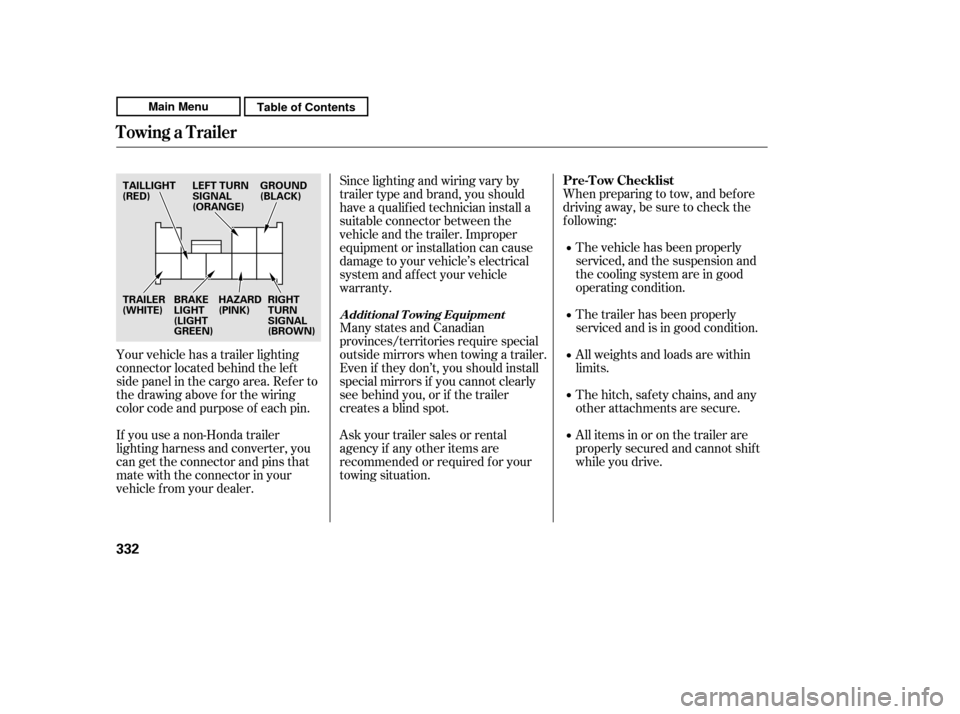
Your vehicle has a trailer lighting
connector located behind the lef t
side panel in the cargo area. Ref er to
thedrawingaboveforthewiring
color code and purpose of each pin.
If you use a non-Honda trailer
lighting harness and converter, you
can get the connector and pins that
mate with the connector in your
vehicle f rom your dealer. Askyourtrailersalesorrental
agency if any other items are
recommended or required f or your
towing situation.
Towing a Trailer
Pre-T ow Checklist
A ddit ional T owing Equipment
332
HAZARD
(PINK)
TRAILER
(WHITE)
TAILLIGHT
(RED)
RIGHT
TURN
SIGNAL
(BROWN)
BRAKE
LIGHT
(LIGHT
GREEN) GROUND
(BLACK)
LEFT TURN
SIGNAL
(ORANGE)
Main MenuTable of Contents
Page 408 of 445
�µ�µ
If your vehicle needs to be towed,
call a prof essional towing service or
organization. Never tow your vehicle
with just a rope or chain. It is very
dangerous.
Any other method of towing will
damage the drive system. When you
contact the towing agency, inf orm
them a f lat-bed is required.
The operator will load
your vehicle on the back of a truck. Therearetwowaystotowyour
vehicle:
The operator
loads your vehicle on the back of a
truck.
The tow
truck uses two pivoting arms that go
under the f ront tires and lif t them of f
the ground. The rear tires remain on
the ground. If , due to damage, your vehicle must
be towed with the f ront wheels on
the ground, do this:
Start the engine.
Shif t to the D position and hold f or
5 seconds, then to N.
Turn of f the engine.
Leave the ignition switch in the
ACCESSORY (I) position so the
steering wheel does not lock.
Release the parking brake.
On 4WD models On 2WD models
CONT INUED
Emergency Towing
The only way you can saf ely tow
your vehicle is with f lat-bed
equipment.
T his is the best way to
transport your vehicle.
This is an acceptable
way to tow your vehicle.
Flat -bed Equipment
Wheel-lif t Equipment
T aking Care of t he Unexpect ed
403
Towing with only two tires on the
ground will damage parts of the 4WD
system. It should be transported on a
f lat-bed truck or trailer. Improper towing preparation will
damage the transmission. Follow the
above procedure exactly. If you cannot
shif t the transmission or start the
engine, your vehicle must be
transported with the all f our wheels of f
the ground.
Main MenuTable of Contents