2011 HONDA CR-V wheel
[x] Cancel search: wheelPage 330 of 445
VSA is turned on every time you
start the engine, even if you turned it
off the last time you drove the
vehicle.
In certain unusual conditions when
your vehicle gets stuck in shallow
mud or f resh snow, it may be easier
to free it with the VSA temporarily
switched of f . When the VSA system
is of f , the traction control system is
alsooff.Youshouldonlyattemptto
f ree your vehicle with the VSA of f if
you are not able to f ree it when the
VSA is on.
Immediately af ter f reeing your
vehicle, be sure to switch the VSA on
again. We do not recommend driving
your vehicle with the VSA and
traction control systems switched off.Driving with varying tire or wheel
sizes may cause the VSA to
malf unction. When replacing tires,
make sure they are the same size
and type as your original tires (see
page ).
If you install winter tires, make sure
they are the same size as those that
were originally supplied with your
vehicle. Exercise the same caution
during winter driving as you would if
your vehicle was not equipped with
VSA.
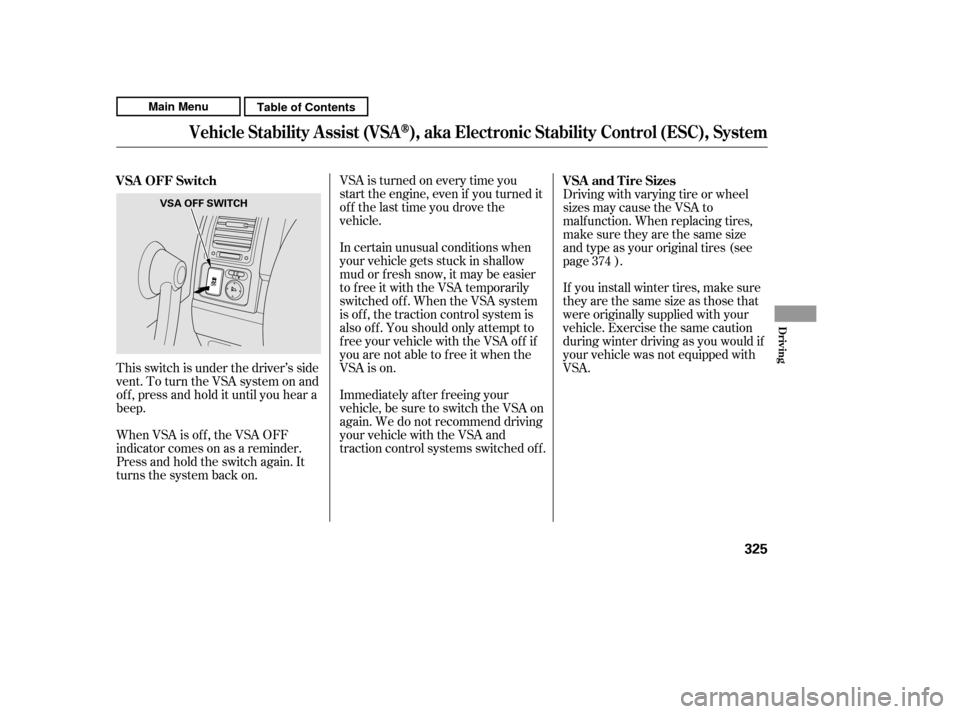
This switch is under the driver’s side
vent. To turn the VSA system on and
of f , press and hold it until you hear a
beep.
When VSA is off, the VSA OFF
indicator comes on as a reminder.
Press and hold the switch again. It
turns the system back on. 374
VSA OFF Switch
VSA and Tire Sizes
Vehicle Stability A ssist (VSA), aka Electronic Stability Control (ESC), System
Driving
325
VSA OFF SWITCH
Main MenuTable of Contents
Page 333 of 445

As required by the FCC:This device complies with Part 15 of theFCC rules. Operation is subject to thef ollowing two conditions: (1) This device may not cause harmf ul interf erence, and(2) this device must accept anyinterf erence received, including
interf erence that may cause undesiredoperation.
Changes or modif ications not expresslyapproved by the party responsible f or
compliance could void the user’sauthority to operate the equipment.
This device complies with IndustryCanada Standard RSS-210.Operation is subject to the f ollowing two conditions: (1) this device may not cause
interf erence, and (2) this device mustaccept any interf erence that may causeundesired operation of the device.
If you have a f lat tire, the low tire
pressure indicator will come on.
Replace the flat tire with the
compact spare tire (see page ).
Each wheel (except the compact
sparetirewheel)isequippedwitha
tire pressure sensor. You must use
TPMS specif ic wheels. It is
recommended that you always have
your tires serviced by your dealer or
qualif ied technician. The low tire pressure indicator or
the TPMS indicator will go off, after
several miles (kilometers) driving,
when you replace the spare tire with
the specif ied regular tire equipped
with the tire pressure monitor sensor.
Never use a puncture-repairing agent
in a f lat tire. If used, you will have to
replace the tire pressure sensor.
Havetheflattirerepairedbyyour
dealer as soon as possible.
After you replace the flat tire with
thecompactsparetire,thelowtire
pressure indicator stays on. This is
normal; the system is not monitoring
the spare tire pressure. Manually
check the spare tire pressure to be
sure it is correct. Af ter several miles
(kilometers) driving with the
compact spare tire, the TPMS
indicator comes on and the low tire
pressure indicator goes of f . 382
Tire Pressure Monitoring System (TPMS)
Changing a T ire with T PMS
328
Main MenuTable of Contents
Page 339 of 445

Your vehicle can be towed behind a
motorhome at legal highway speeds
up to 65 mph (100 km/h). Do not
exceed 65 mph (100 km/h).
Otherwise, severe transmission
damage will occur. To avoid damage
to the 4WD system, your vehicle
must be towed with all f our wheels
on the ground (f lat towing).
When purchasing a tow bar, make
sure you select a reputable
manuf acturer and installer. Follow
the manufacturer’s attachment
instructions caref ully.
Perf orm the f ollowing procedure
every day immediately bef ore you
begin towing. Otherwise severe
automatic transmission damage will
occur.Leave the ignition switch in the
ACCESSORY (I) position so the
steering wheel does not lock.
Make sure the radio and any items
plugged into the accessory power
sockets are turned of f so you do
not run down the battery.
Release the parking brake.
Shif t to D position and hold f or 5
seconds, then to N. Let the engine
runfor3minutes,thenturnitoff.
Press on the brake pedal. Move
the shif t lever through all its
positions.
Check the transmission f luid level
(see page ).
Start the engine.
Follow all normal precautions when
parking, including f irmly setting the
parking brake and putting the
transmission in Park. Also, place
wheel chocks at each of the trailer’s
tires.
Always drive slowly and have
someone guide you when backing up.
Grip the of the steering wheel,
then turn the wheel to the left to get
the trailer to move to the lef t, and
turn the wheel right to move the
trailer to the right.
Crosswinds and air turbulence
caused by passing trucks can disrupt
your steering and cause the trailer to
sway. When being passed by a large
vehicle, keep a constant speed, and
steer straight ahead. Do not try to
make quick steering or braking
corrections.
355
Do not overf ill.
bottom
T owing a T railer, T owing Your Vehicle Behind a Mot orhome
Towing Your Vehicle Behind a
Motorhome
Parking
Backing Up
Handling Crosswinds and Buf f et ing
334
Main MenuTable of Contents
Page 340 of 445
If you tow more than 8 hours in one
day, you should repeat the above
procedure at least every 8 hours
(when you stop f or f uel, etc.)Only remove the fuse after you have
perf ormed the transmission shif ting
procedure, and the key is in the
ACCESSORY (I) position. Store the
f use in an obvious location (center
tray, coin pockets, etc) as a reminder
to re-install the fuse before drivingthe vehicle.
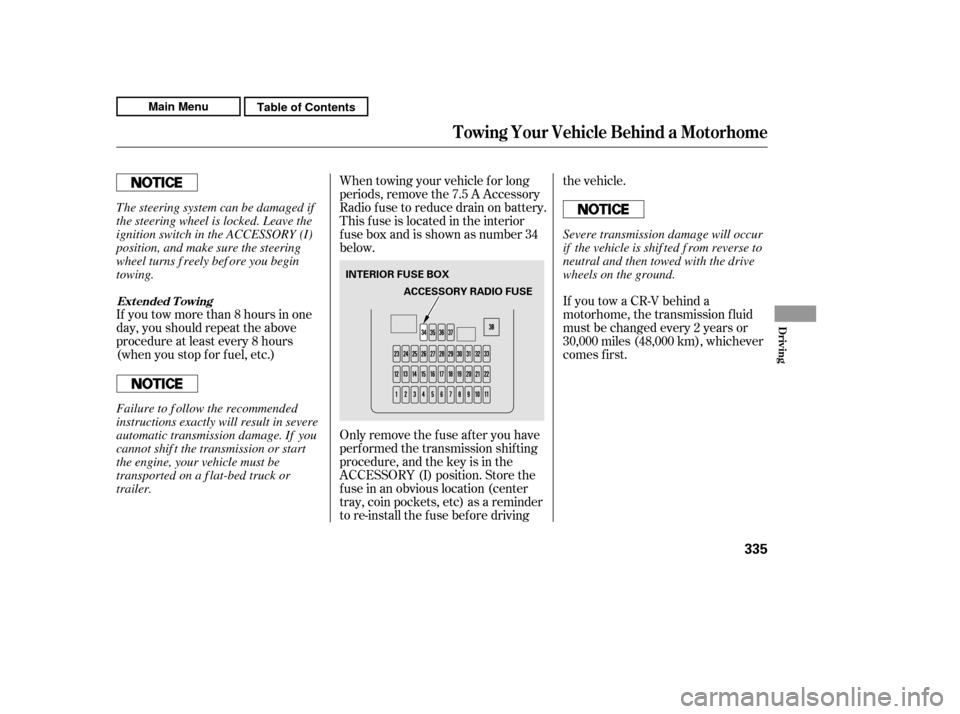
When towing your vehicle f or long
periods, remove the 7.5 A Accessory
Radio f use to reduce drain on battery.
This f use is located in the interior
f use box and is shown as number 34
below.
If you tow a CR-V behind a
motorhome, the transmission fluid
must be changed every 2 years or
30,000 miles (48,000 km), whichever
comes f irst.
Ext ended T owing
Towing Your Vehicle Behind a Motorhome
Driving
335
INTERIOR FUSE BOXACCESSORY RADIO FUSE
The steering system can be damaged if
the steering wheel is locked. Leave the
ignition switch in the ACCESSORY (I)
position, and make sure the steering
wheel turns f reely bef ore you begin
towing.
Failure to f ollow the recommended
instructions exactly will result in severe
automatic transmission damage. If you
cannot shif t the transmission or start
the engine, your vehicle must be
transported on a f lat-bed truck or
trailer. Severe transmission damage will occur
if the vehicle is shif ted f rom reverse to
neutral and then towed with the drive
wheels on the ground.
Main MenuTable of Contents
Page 342 of 445

Before you leave the pavement, be
sure to do all scheduled maintenance
and service, and inspect your vehicle
f or any problems. Pay special
attention to the condition of the tires,
and check the tire pressures.
After you return to the pavement,
caref ully inspect your vehicle to
make sure there is no damage that
could make driving it unsaf e.
Recheck the condition of the tires
and the tire pressures.
The route presents limits (too steep
or bumpy roads). You have limits
(driving skill and comf ort). And your
vehicle has limits (traction, stability,
and power).
Driving of f -highway can be
hazardous if you f ail to recognize
limits and take the proper
precautions.Forbettertractiononallsurfaces,
accelerate slowly and gradually build
up speed. If you try to start too fast
on wet soil, mud, snow, or ice, you
might not have enough traction to
get underway, and you may dig
yourself a hole. Starting with the
shif t lever in second (2) gear will
help you have a smoother start on
snow or ice.
Keep in mind that you will usually
need more time and distance to
brake to a stop on unpaved surf aces.
Avoid hard braking. Do not ‘‘pump’’
the brakes; let the anti-lock braking
system pump them f or you.
Debris in the road can damage your
suspension or other components.
Because your vehicle has a high
center of gravity, driving over a large
obstacle, or allowing a wheel to drop
into a deep hole can cause your
vehicle to tip or roll over.
If you can’t clearly see all conditions
or obstacles on a slope, walk the
slope bef ore you drive on it. If you
have any doubt whether or not you
can saf ely drive on the slope, don’t
do it. Find another route.
If you are driving up a hill and f ind
that you cannot continue,
. Your vehicle could roll
over. Slowly back down the hill,
f ollowing the same route you took up
the hill.
do not try to
turn around
Check Out Your Vehicle
Remember A ccelerating and Braking A voiding Obstacles
Driving on Slopes
Of f -Highway Driving Guidelines
Driving
337
Main MenuTable of Contents
Page 343 of 445

Avoid driving through deep water. If
you encounter water in your route (a
small stream or large puddle, f or
example), evaluate it caref ully bef ore
going ahead. Make sure it is shallow,
f lowing slowly, and has f irm ground
underneath. If you are not sure of
the depth or the ground, turn around
andfindanotherroute.
Driving through deep water can also
damage your vehicle. The water can
get into the transmission and
dif f erential, diluting the lubricant
and causing an eventual failure. It
can also wash the grease out of the
wheel bearings.Avoid driving on sof t sand, deep mud,
or other surf aces where you could
get stuck. If you do happen to get
stuck because of inclement weather
or other conditions, choose a saf e
and appropriate course of action.
You should never use a jack to try
getting unstuck. A jack only works
on f irm, level ground. Also, your
vehicle could easily slip of f the jack
and hurt you or someone else.
If you spin the wheels excessively
trying to get unstuck, you may
overheat the components of the
4-wheel drive system. If this happens,
the 4-wheel drive system shuts off
and only the f ront wheels receive
power. If this happens, stop and
allow everything to cool down. The
4-wheel drive system will work again
after its temperature drops.
If you slip the clutch f or a long time
while trying to get unstuck, you may
overheat and damage it.
If You Get Stuck
Crossing a Stream
4-Wheel Drive Vehicles
Of f -Highway Driving Guidelines
338
Main MenuTable of Contents
Page 344 of 445

This section explains why it is
important to keep your vehicle well
maintained and how to f ollow basic
maintenance saf ety precautions.
This section also includes
instructions on how to read the
Maintenance Minder messages on
the information display, and
instructions f or simple maintenance
tasks you may want to take care of
yourself .
If you have the skills and tools to
perf orm more complex maintenance
tasks on your vehicle, you may want
to purchase the service manual. See
page f or inf ormation on how to
obtain a copy, or see your dealer.U.S. Vehicles:
......................
Maintenance Saf ety . 340
.................
Maintenance Minder . 341
..............................
Fluid Locations . 348
........................
Adding Engine Oil . 349
Changing the Engine Oil and
...........................................
Filter . 350
..............................
Engine Coolant . 352
....................
Windshield Washers . 354
....
Automatic Transmission Fluid . 355
.................
Rear Dif f erential Fluid . 357
....................................
Brake Fluid . 357
....................
Power Steering Fluid . 358
.............................................
Lights . 359
................
Cleaning the Seat Belts . 365
.....................................
Floor Mats . 366
..............................
Audio Antenna . 366
..................
Dust and Pollen Filter . 366
.................................
Wiper Blades . 367
...............................................
Tires . 370
...........................................
Wheels . 376
...................
Checking the Battery . 376
.............................
Vehicle Storage . 378
..................................
Interior Care . 379
425
Maintenance
Maintenance, replacement, or
repair of emissions control
devices and systems may be done
by any automotive repair
establishment or individual using
parts that are ‘‘certif ied’’ to EPA
standards.
Maint enance
339
TM
Main Menu
Page 363 of 445

Check the level on the side of the
reservoir when the engine is cold.
The f luid should be between the
UPPER LEVEL and LOWER LEVEL.
If not, add power steering f luid to the
UPPER LEVEL.
Pour the f luid slowly and caref ully so
you do not spill any. Clean up any
spills immediately; it could damage
components in the engine
compartment.Always use Honda Power Steering
Fluid. You may use another power
steering f luid as an emergency
replacement, but have the power
steering system f lushed and ref illed
with Honda PSF as soon as possible.
A low power steering f luid level can
indicate a leak in the system. Check
the f luid level f requently, and have
the system inspected as soon as
possible.
Power Steering Fluid
358
LOWER LEVEL
UPPER LEVEL
T urning the steering wheel to f ull lef t
or right lock and holding it there can
damage the power steering pump.
Main MenuTable of Contents