Page 393 of 445

Diagnosing why the engine won’t
start f alls into two areas, depending
on what you hear when you turn the
ignition switch to the START (III)
position:You hear nothing, or almost
nothing. The engine’s starter
motor does not operate at all, or
operates very slowly.
You can hear the starter motor
operating normally, or the starter
motor sounds like it is spinning
f aster than normal, but the engine
does not start up and run. When you turn the ignition switch to
the START (III) position, you do not
hear the normal noise of the engine
trying to start. You may hear a
clicking sound, a series of clicks, or
nothing at all.
Check these things:
Check the transmission interlock.
The transmission must be in Park
or neutral or the starter will not
operate.
Turn the ignition switch to the ON
(II) position. Turn on the
headlights, and check their
brightness. If the headlights are
very dim or do not come on at all,
the battery is discharged. See on page . Turn the ignition switch to the
START (III) position. If the
headlights do not dim, check the
condition of the f uses. If the f uses
areOK,thereisprobably
something wrong with the
electrical circuit f or the ignition
switch or starter motor. You will
need a qualif ied technician to
determine the problem. See
on page .
If the headlights dim noticeably or
go out when you try to start the
engine, either the battery is
discharged or the connections are
corroded. Check the condition of the
battery and terminal connections
(see page ). You can then try
jump starting the vehicle from a
booster battery (see page ).
390 403
390
376
Nothing Happens or the Starter
Motor Operates Very Slowly
Jump Starting Emergency T owing
If theEngineWon’tStart
388
Main MenuTable of Contents
Page 395 of 445
�´�´
Although this seems like a simple
procedure, you should take several
precautions.
Open the hood, and check the
physical condition of the battery.
In very cold weather, check the
condition of the electrolyte. If it
seems slushy or f rozen, do not try
jump starting until it thaws.
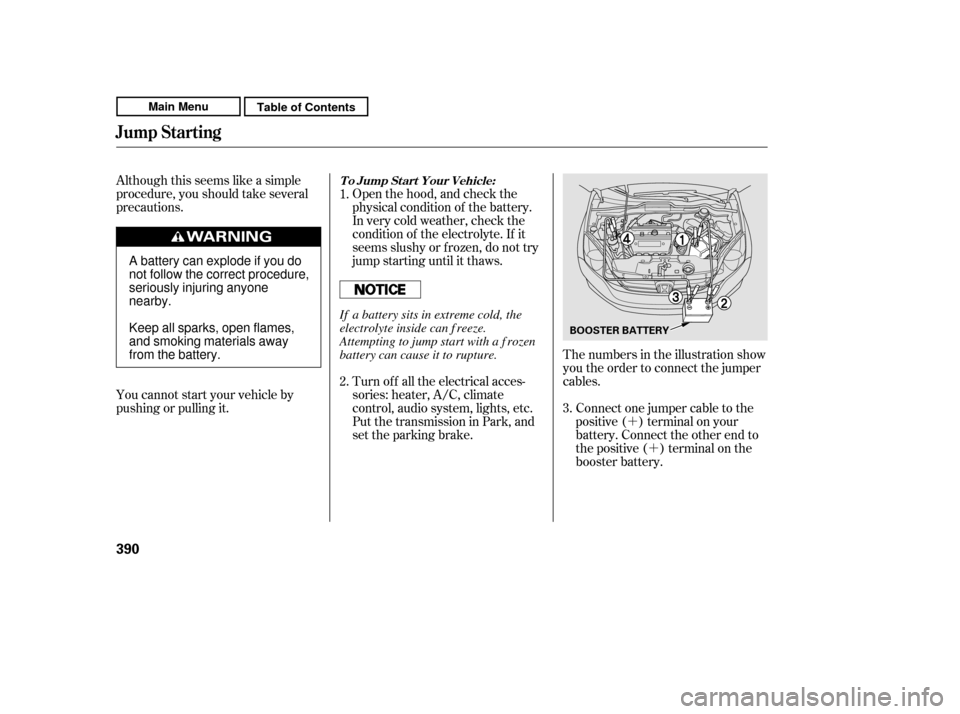
Connect one jumper cable to the
positive ( ) terminal on your
battery. Connect the other end to
the positive ( ) terminal on the
booster battery.
The numbers in the illustration show
you the order to connect the jumper
cables.
You cannot start your vehicle by
pushing or pulling it.
Put the transmission in Park, and
set the parking brake.
Turn of f all the electrical acces-
sories: heater, A/C, climate
control, audio system, lights, etc.
1. 2.
3.
To Jump Start Your Vehicle:
Jump St art ing
390
BOOSTER BATTERY
A battery can explode if you do
not follow the correct procedure,
seriously injuring anyonenearby.
Keep all sparks, open flames,
and smoking materials away
from the battery.If a battery sits in extreme cold, the
electrolyte inside can f reeze.
Attempting to jump start with a f rozen
battery can cause it to rupture.
Main MenuTable of Contents
Page 396 of 445
�µIf the booster battery is in another
vehicle, have an assistant start
that vehicle and run it at a fast idle.
Start your vehicle. If the starter
motor still operates slowly, check
that the jumper cables have good
metal-to-metal contact.
Once your vehicle is running,
disconnect the negative cable f rom
your vehicle, then f rom the
booster battery. Disconnect the
positive cable f rom your vehicle,
then from the booster battery.
Keep the ends of the jumper cables
away from each other and any metal
on the vehicle until everything is
disconnected. Otherwise, you may
cause an electrical short.
Connect the second jumper cable
to the negative ( ) terminal on
the booster battery. Connect the
other end to the stud bolt on the
engine side as shown. Do not
connect this jumper cable to any
other part of the engine. 6. 7.
5.
4.
Jump St art ing
T aking Care of t he Unexpect ed
391
Main MenuTable of Contents
Page 399 of 445

Let the vehicle sit f or a minute.
Open the hood, and check the oil
level (see page ). An engine
very low on oil can lose pressure
during cornering and other driving
maneuvers.
If necessary, add oil to bring the
level back to the full mark on the
dipstick (see page ).
Saf ely pull of f the road, and shut
of f the engine. Turn on the hazard
warning lights.
Start the engine, and watch the oil
pressure indicator. If it does not go
out within 10 seconds, turn of f the
engine. There is a mechanical
problem that needs to be repaired
bef ore you can continue driving
(see on page
).
This indicator should never come on
when the engine is running. If it
starts flashing or stays on, the oil
pressure has dropped very low or
lost pressure. Serious engine
damage is possible, and you should
take immediate action.
If the charging system indicator
comes on brightly when the engine
is running, the battery is not being
charged.
Immediately turn of f all electrical
accessories. Try not to use other
electrically operated controls such as
the power windows. Keep the engine
running; starting the engine will
discharge the battery rapidly.
Go to a service station or garage
where you can get technical
assistance.
1. 2. 4.
3.
349
403 298
Emergency T owing
L ow Oil Pressure
Indicator
Charging System
Indicator
L ow Oil Pressure Indicator, Charging System Indicator
394
Running the engine with low oil
pressure can cause serious mechanical
damage almost immediately. Turn of f
the engine as soon as you can saf ely get
the vehicle stopped.
Main MenuTable of Contents
Page 400 of 445

If the indicator comes on
while driving, it means one
of the engine’s emissions control
systems may have a problem. Even
though you may f eel no dif f erence in
your vehicle’s perf ormance, it can
reduce your f uel economy and cause
increased emissions. Continued
operation may cause serious damage. If the indicator comes on repeatedly,
even though it may turn of f as you
continue driving, have your vehicle
checked by your dealer as soon as
possible.
Your vehicle has certain ‘‘readiness
codes’’ that are part of the on-board
diagnostics f or the emissions
systems. In some states, part of the
emissions testing is to make sure
these codes are set. If they are not
set, the test cannot be completed.
The malf unction indicator lamp may
also come on with the ‘‘D’’ indicator. If the battery in your vehicle has
been disconnected or gone dead,
thesecodesmaybeerased.Itcan
take several days of driving under
various conditions to set the codes
again.
If you have recently ref ueled your
vehicle, the indicator coming on
could be due to a loose or missing
f uel f ill cap. Tighten the cap until it
clicks at least once. Tightening the
cap will not turn the indicator of f
immediately; it can take several days
of normal driving. To check if they are set, turn the
ignition switch to the ON (II)
position, without starting the engine.
The malf unction indicator lamp will
come on f or 20 seconds. If it then
goes of f , the readiness codes are set.
If it blinks f ive times, the readiness
codes are not set. If possible, do not
take your vehicle f or an emissions
test until the readiness codes are set.
Refer to for
more inf ormation (see page ).
419
Readiness Codes Emissions T esting
Malf unct ion Indicat or L amp
T aking Care of t he Unexpect ed
395
If you keep driving with the
malf unction indicator lamp on, you can
damage your vehicle’s emissions
controls and engine. Those repairs may
not be covered by your vehicle’s
warranties.
Main MenuTable of Contents
Page 407 of 445
�µ �µ�µ
�Î�Î �Î
�Î
No. Amps. Circuits Protected Circuits Protected No. Amps.
1 2345 6789
101112 100 A
80 A
50 A
20 A
40 A
50 A
40 A
20 A
20 A
30 A
40 A
15 A
15 A
15 A Battery
Not used
Option Main
Ignition Switch Main
ABS/VSA FSR
ABS/VSA Motor
Headlight Main
Power Window Main
Not used
Sub Fan Motor
Main Fan Motor
Rear Defogger
Blower
HazardLAF
Stop and Horn PowerSeatDRRRHI/
Reclining
Power Seat DR FR HI/Sliding
IGPS OIL LEVEL
Not used
High Power Sound /
Windshield Defroster
IG Coil
FI Main
MG Clutch
DBW
Interior Light
Back Up
13 14 151617 18 1920212223
(20 A)
(20 A)
7.5 A
(15 A) 15 A
15 A
7.5 A 15 A
7.5 A 10 A
: If equipped
Fuse Locations
402
UNDER-HOOD FUSE BOX
Main MenuTable of Contents
Page 414 of 445

�µ�µ�µ
�µ �µ�µ�µ
�Î
�Î
Specif icat ions
Technical Inf ormation
409
Air Conditioning
Seating Capacities
Fuses
Alignment
Tires
Battery
Lights
Refrigerant type
Charge quantity
Lubricant type SP-10
15.5 17.3 oz (440 490 g)HFC-134a (R-134a) 523
Total
FrontRear
Interior
Under-hood
Toe-in
Camber
Caster2°44’1°00’0°
0.08 in (2.0 mm) 0.0in(0mm)
Size
Pressure 60 psi (420 kPa , 4.2 kgf/cm
)
30 psi (210 kPa , 2.1 kgf/cm)
30 psi (210 kPa , 2.1 kgf/cm)
T155/90R17 101M
T155/90D17 101M 225/65R17 102T
Capacity 12 V
12 V
12 V
12 V36 AH/5 HR
38 AH/5 HR
45 AH/20 HR
47 AH/20 HR
Headlights
Front turn signal lights
Parking lights/side marker
lights
Rear turn signal lights
Stop/Taillights
Back-up lights
Taillight/Rear side marker
lights
High-mount brake light
License plate light
Ceiling light
Spotlights
Cargo area light
Vanity mirror Lights 60/55 W
21 W
3CP
21 W
21/5 W
21 W5W
21 W 5W8W8W8W2W See page 401 or the fuse label
attached under the steering
column.
See page 402 or the fuse box
cover.
FrontRear
FrontRear
Front
High/Low (HB2)
(Amber)
(Amber)
Front/Rear
Spare
Front Rear
Spare
:EX,EX-L
Main MenuTable of Contents
Page 424 of 445

If you take your vehicle f or an
emissions test shortly af ter the
battery has been disconnected or
gone dead, it may not pass the test.
This is because of certain ‘‘readiness
codes’’ that must be set in the on-
board diagnostics f or the emissions
systems. These codes are erased
when the battery is disconnected,
and set again only after several days
of driving under a variety of
conditions.If the testing f acility determines that
the readiness codes are not set, you
will be requested to return at a later
date to complete the test. If you must
get the vehicle retested within the
next two or three days, you can
condition the vehicle f or retesting by
doing the f ollowing.
Make sure the gas tank is nearly,
but not completely, f ull (around
3/4). Without touching the accelerator
pedal, start the engine, and let it
idle f or 20 seconds.
Keep the vehicle in Park. Increase
the engine speed to 2,000 rpm, and
hold it there until the temperature
gauge rises to at least 1/4 of the
scale (about 3 minutes).
Make sure the vehicle has been
parked with the engine of f f or 6
hours or more.
Make sure the ambient
temperature is between 40° and
95°F (4° and 35°C). Without touching the accelerator
pedal, let the engine idle f or 20
seconds.
1. 2.3. 4.5. 6.
CONT INUED
T esting of Readiness Codes
Emissions T est ing
T echnical Inf ormation
419
Main MenuTable of Contents

