Page 331 of 388

This section covers the more
common problems that motorists
experience with their vehicles. It
gives you inf ormation about how to
safely evaluate the problem and what
to do to correct it. If the problem has
stranded you on the side of the road,
you may be able to get going again.
If not, you will also f ind instructions
on getting your vehicle towed.......................
Compact Spare Tire . 328
....................
Changing a Flat Tire . 329
.............
If the Engine Won’t Start . 334
................................
Jump Starting . 336
..............
If the Engine Overheats . 338
.........
Low Oil Pressure Indicator . 340
..........
Charging System Indicator . 340
.......
Malf unction Indicator Lamp . 341
...............
Brake System Indicator . 342
..............................................
Fuses . 343
..............................
Fuse Locations . 347
......................
Emergency Towing . 349
Taking Care of the Unexpected
T aking Care of t he Unexpect ed
327
Main Menu
Page 333 of 388
Turn on the hazard warning lights,
and turn the ignition switch to the
LOCK (0) position. Have all
passengers get out of the vehicle
while you change the tire.
Park the vehicle on f irm, level, and
non-slippery ground. Put the
transmission in Park (automatic)
or reverse (manual). Apply the
parking brake.
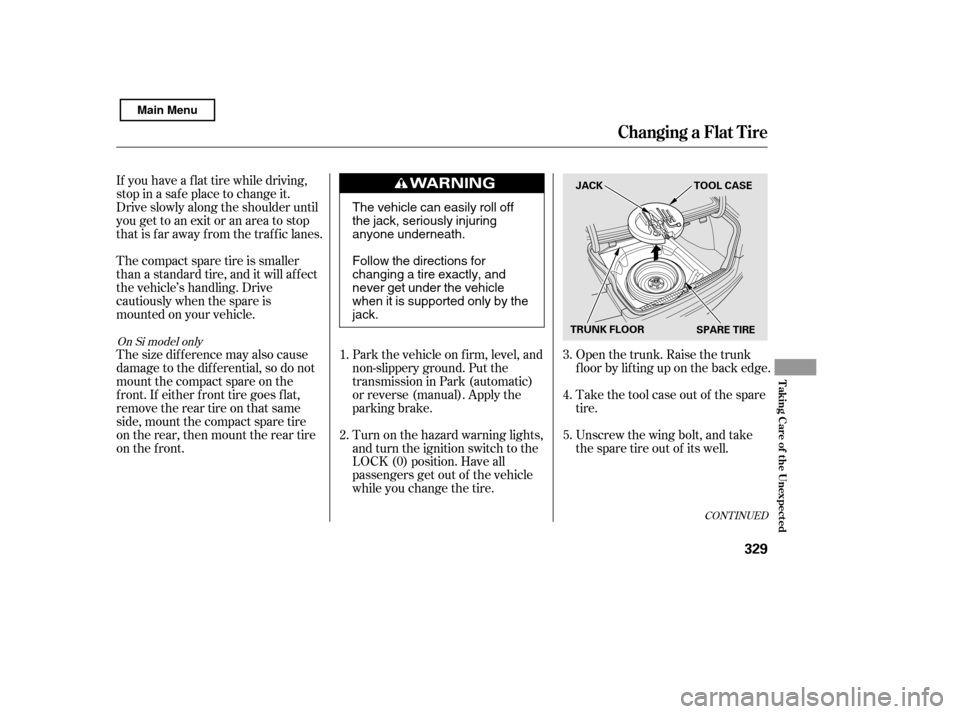
Open the trunk. Raise the trunk
f loor by lif ting up on the back edge.
Take the tool case out of the spare
tire.
Unscrew the wing bolt, and take
the spare tire out of its well.
If you have a f lat tire while driving,
stop in a saf e place to change it.
Drive slowly along the shoulder until
you get to an exit or an area to stop
that is far away from the traffic lanes.
Thecompactsparetireissmaller
than a standard tire, and it will affect
the vehicle’s handling. Drive
cautiously when the spare is
mounted on your vehicle.
Thesizedifferencemayalsocause
damage to the dif f erential, so do not
mount the compact spare on the
f ront. If either f ront tire goes f lat,
removethereartireonthatsame
side, mount the compact spare tire
on the rear, then mount the rear tire
on the f ront.
5.
4.
3.
2.
1.
CONT INUED
On Si model only
Changing a Flat T ire
T aking Care of t he Unexpect ed
329
SPARE TIRE
TRUNK FLOOR JACK TOOL CASE
The vehicle can easily roll off
the jack, seriously injuring
anyone underneath.
Follow the directions for
changing a tire exactly, and
never get under the vehicle
when it is supported only by thejack.
Main Menu
Page 335 of 388
CONT INUED
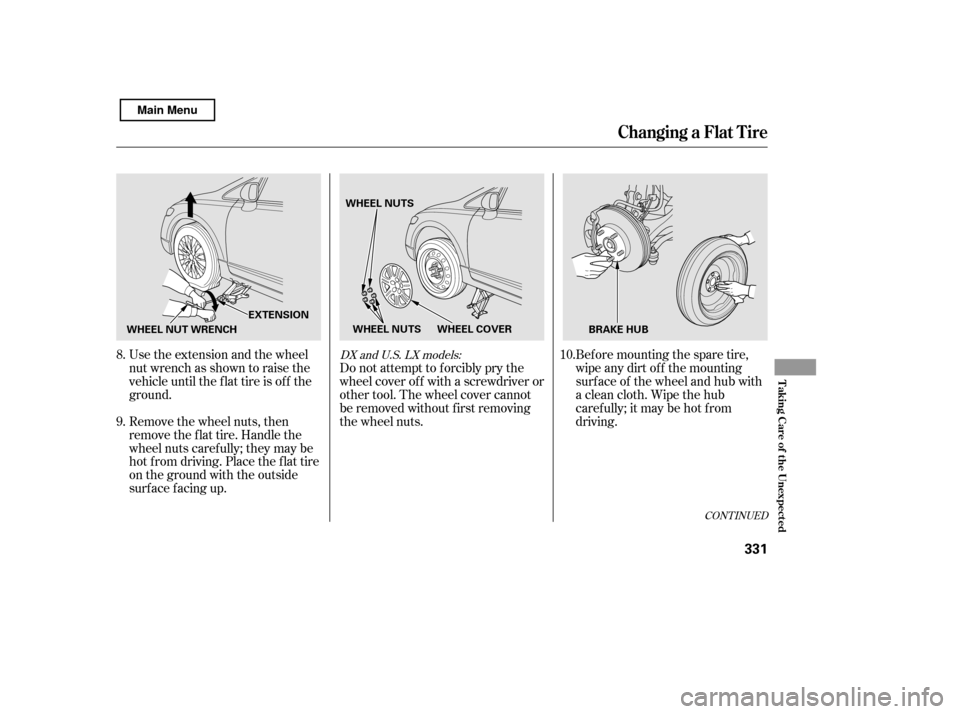
Bef ore mounting the spare tire,
wipe any dirt of f the mounting
surface of the wheel and hub with
a clean cloth. Wipe the hub
carefully;itmaybehotfrom
driving.
Do not attempt to forcibly pry the
wheel cover of f with a screwdriver or
other tool. The wheel cover cannot
be removed without f irst removing
the wheel nuts.
Use the extension and the wheel
nut wrench as shown to raise the
vehicle until the f lat tire is of f the
ground.
Remove the wheel nuts, then
remove the f lat tire. Handle the
wheel nuts caref ully; they may be
hot f rom driving. Place the f lat tire
on the ground with the outside
surface facing up. 10.
8. 9.DX and U.S. LX models:
Changing a Flat T ire
T aking Care of t he Unexpect ed
331
WHEEL NUTS WHEEL COVER
EXTENSION WHEEL NUTS
WHEEL NUT WRENCH BRAKE HUB
Main Menu
Page 340 of 388
Although this seems like a simple
procedure, you should take several
precautions.To jump start your vehicle:
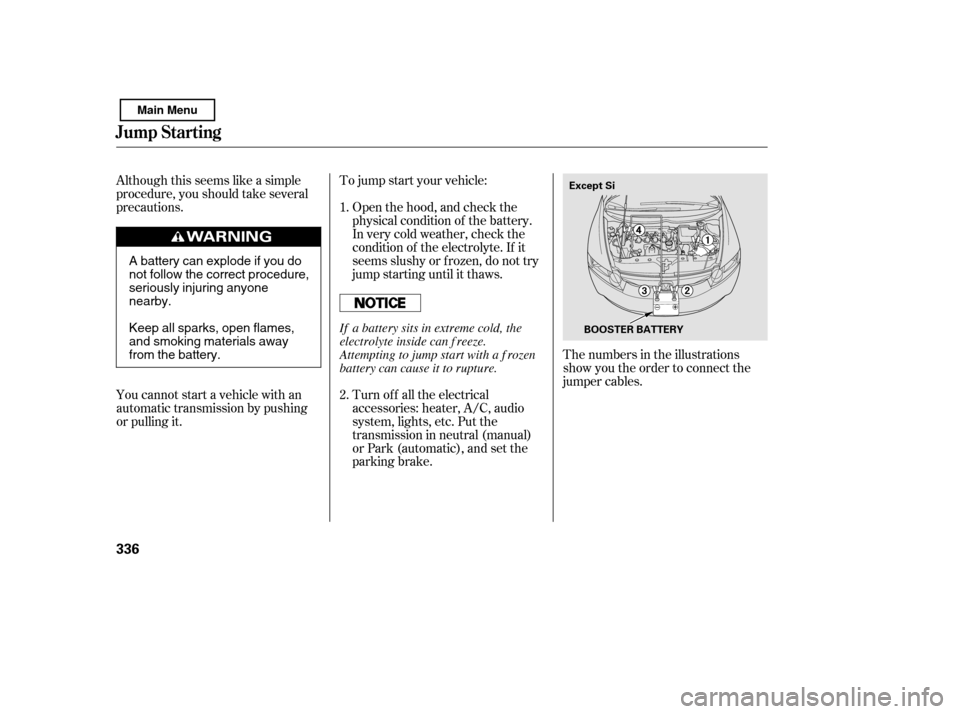
The numbers in the illustrations
show you the order to connect the
jumper cables.
Turn of f all the electrical
accessories: heater, A/C, audio
system, lights, etc. Put the
transmission in neutral (manual)
or Park (automatic), and set the
parking brake.
Open the hood, and check the
physical condition of the battery.
In very cold weather, check the
condition of the electrolyte. If it
seems slushy or f rozen, do not try
jump starting until it thaws.
You cannot start a vehicle with an
automatic transmission by pushing
or pulling it. 1. 2.
Jump Starting
336
Except Si
BOOSTER BATTERY
A battery can explode if you do
not follow the correct procedure,
seriously injuring anyonenearby.
Keep all sparks, open flames,
and smoking materials away
from the battery. If a battery sits in extreme cold, the
electrolyte inside can f reeze.
Attempting to jump start with a f rozen
battery can cause it to rupture.
Main Menu
Page 342 of 388
Once your vehicle is running,
disconnect the negative cable f rom
your vehicle, then f rom the
booster battery. Disconnect the
positive cable f rom your vehicle,
then from the booster battery.
Keep the ends of the jumper cables
away from each other and any metal
on the vehicle until everything is
disconnected. Otherwise, you may
cause an electrical short. The reading of the vehicle’s
temperature gauge should stay in
the midrange. If it climbs to the red
mark, you should determine the
reason (hot day, driving up a steep
hill, etc.).
If the vehicle overheats, you should
take immediate action. The only
indication may be the temperature
gauge climbing to or above the red
mark. Or you may see steam or
spray coming f rom under the hood.
Saf ely pull to the side of the road.
Put the transmission in neutral
(M/T) or Park (A/T), and set the
parking brake. Turn of f all
accessories, and turn on the
hazard warning lights.
If you see steam and/or spray
coming f rom under the hood, turn
of f the engine. Wait until you see
no more signs of steam or spray,
then open the hood.
7.
1. 2.
Jump Starting, If the Engine Overheats
If the Engine Overheats
338
Steam and spray from an
overheated engine can
seriously scald you.
Do not open the hood if steam
is coming out.
Driving with the temperature gauge
reading at the red mark can cause
serious damage to the engine.
Main Menu
Page 346 of 388

However, if the brake pedal does not
f eel normal, you should take
immediate action. A problem in one
part of the system’s dual circuit
design will still give you braking at
two wheels. You will f eel the brake
pedal go down much f arther bef ore
the vehicle begins to slow down, and
you will have to press harder on the
pedal.
Slow down by shif ting to a lower
gear, and pull to the side of the road
when it is saf e. Because of the long
distance needed to stop, it is
hazardous to drive the vehicle. You
should have it towed and repaired as
soon as possible (seeon page ).
If you must drive the vehicle a short
distance in this condition, drive
slowly and caref ully. If the ABS indicator comes on with
the brake system indicator, have
your vehicle inspected by your
dealer immediately.
The brake system
indicator normally
comes on when
you turn the ignition switch to the
ON (II) position and as a reminder to
check the parking brake. It will stay
on if you do not f ully release the
parking brake.
If the brake system indicator comes
on while driving, the brake f luid level
is probably low. Press lightly on the
brake pedal to see if it f eels normal.
If it does, check the brake f luid level
thenexttimeyoustopataservice
station (see page ).
If the f luid level is low, take your
vehicle to a dealer, and have the
brake system inspected f or leaks or
worn brake pads. 300
349Emergency
Towing
Brake System Indicator
342
Canada
U.S.
Main Menu
Page 347 of 388
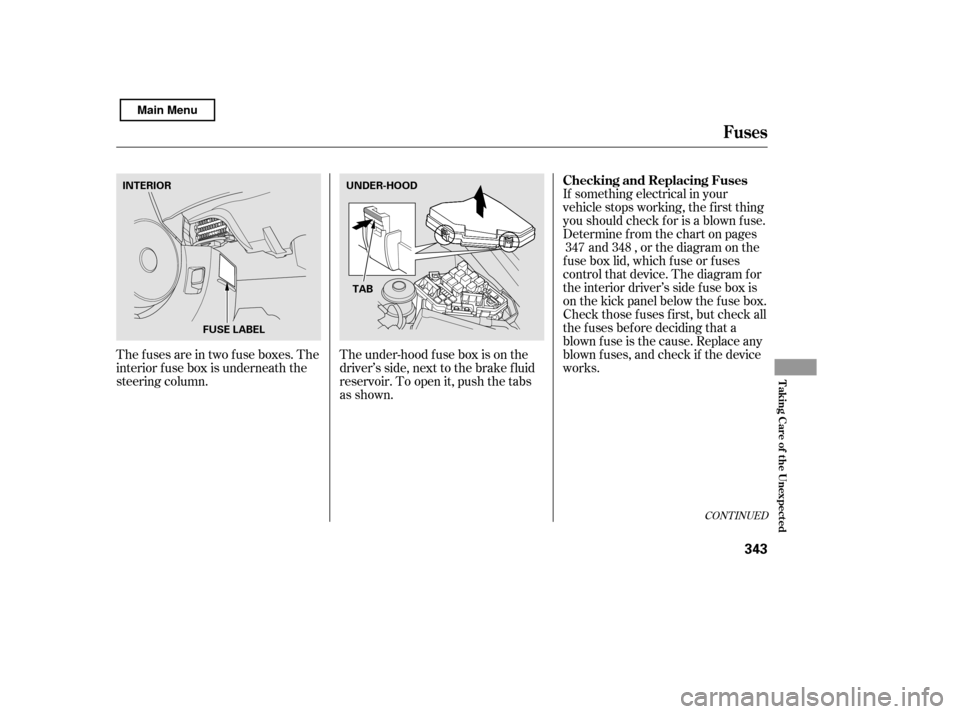
The under-hood f use box is on the
driver’s side, next to the brake f luid
reservoir. To open it, push the tabs
as shown.
Thefusesareintwofuseboxes.The
interior f use box is underneath the
steering column. If something electrical in your
vehicle stops working, the first thing
youshouldcheckforisablownfuse.
Determine f rom the chart on pages
and , or the diagram on the
f use box lid, which f use or f uses
control that device. The diagram f or
the interior driver’s side f use box is
on the kick panel below the f use box.
Check those f uses f irst, but check all
the f uses bef ore deciding that a
blown f use is the cause. Replace any
blown f uses, and check if the device
works. 347 348
CONT INUED
Checking and Replacing Fuses
Fuses
T aking Care of t he Unexpect ed
343
INTERIOR
UNDER-HOOD
TAB
FUSE LABEL
Main Menu
Page 353 of 388

�µ�µ
If your vehicle needs to be towed,
call a prof essional towing service or
organization. Never tow your vehicle
with just a rope or chain. It is very
dangerous.
The operator
loads your vehicle on the back of a
truck.
Therearetwowaystotowyour
vehicle: If , due to damage, your vehicle must
be towed with the f ront wheels on
the ground, do this:
Release the parking brake.
Shif t the transmission to neutral.
Leave the ignition switch in the
ACCESSORY (I) position so the
steering wheel does not lock.
The tow
truck uses two pivoting arms that go
under the f ront tires and lif t them of f
the ground. The rear tires remain on
the ground. With the f ront wheels on the ground,
do not tow the vehicle more than 50
miles (80 km), and keep the speed
below35mph(55km/h).
Start the engine.
Release the parking brake.
Shif t to the D position and hold f or
5 seconds, then to N.
Turn of f the engine.
Leave the ignition switch in the
ACCESSORY (I) position so the
steering wheel does not lock.
Manual transmission:
Automatic transmission:
CONT INUED
Flat -bed EquipmentWheel-lif t Equipment
T his is the best way to
transport your vehicle.
This is an acceptable
way to tow your vehicle.
Emergency T owing
T aking Care of t he Unexpect ed
349
Improper towing preparation will
damage the transmission. Follow the
above procedure exactly. If you cannot
shif t the transmission or start the
engine (automatic transmission), your
vehicle must be transported with the
f ront wheels of f the ground.
Main Menu