Page 336 of 388
Tighten the wheel nuts securely in
the same crisscross pattern. Have
the wheel nut torque checked at
the nearest automotive service
f acility.
Tighten the wheel nuts to:
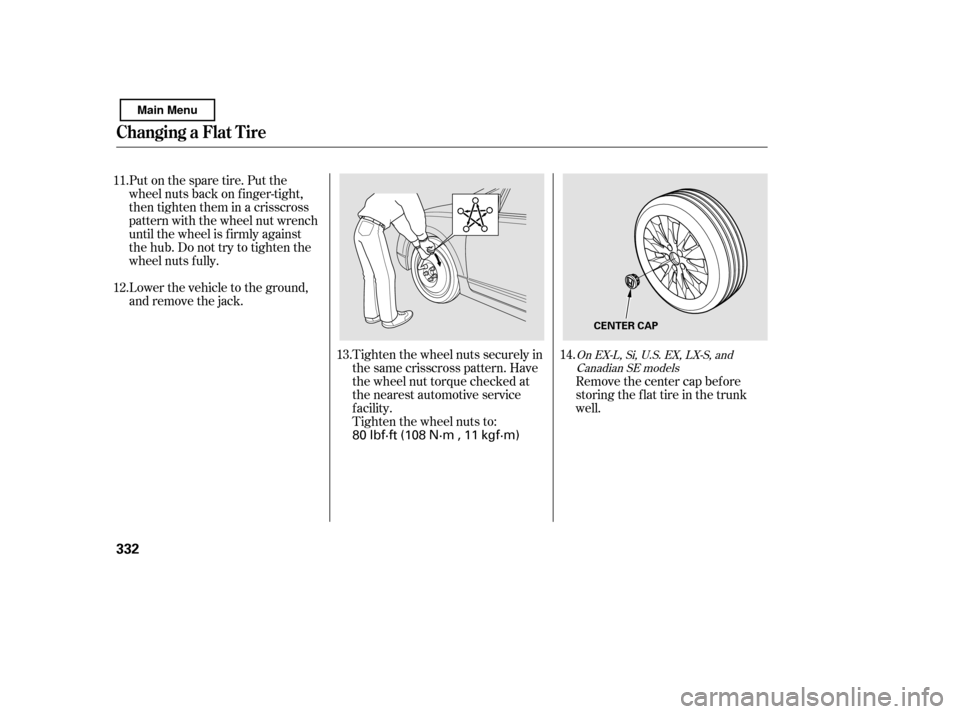
Put on the spare tire. Put the
wheel nuts back on f inger-tight,
then tighten them in a crisscross
pattern with the wheel nut wrench
until the wheel is f irmly against
the hub. Do not try to tighten the
wheel nuts f ully.
Lower the vehicle to the ground,
and remove the jack.
Remove the center cap before
storing the f lat tire in the trunk
well.
13.
11. 12.
14.On EX-L, Si, U.S. EX, LX-S, andCanadian SE models
Changing a Flat T ire
332
CENTER CAP
80 lbf·ft (108 N·m , 11 kgf·m)
Main Menu
Page 344 of 388

Let the vehicle sit f or a minute.
Open the hood, and check the oil
level (see page ). An engine
very low on oil can lose pressure
during cornering and other driving
maneuvers.
If necessary, add oil to bring the
level back to the full mark on the
dipstick (see page ).
Start the engine, and watch the oil
pressure indicator. If it does not go
out within 10 seconds, turn of f the
engine. There is a mechanical
problem that needs to be repaired
bef ore you can continue driving
(see on page).
Saf ely pull of f the road, and shut
of f the engine. Turn on the hazard
warning lights.
This indicator should never come on
when the engine is running. If it
starts flashing or stays on, the oil
pressure has dropped very low or
lost pressure. Serious engine
damage is possible, and you should
take immediate action. If the charging system indicator
comes on brightly when the engine
is running, the battery is not being
charged.
Immediately turn of f all electrical
accessories. Try not to use other
electrically operated controls such as
the power windows. Keep the engine
running; starting the engine will
discharge the battery rapidly.
Go to a service station or garage
where you can get technical
assistance.
1. 2. 3. 4.
241
290
349 Emergency T owing
L ow Oil Pressure
Indicator
Charging System
Indicator
L ow Oil Pressure Indicator, Charging System Indicator
340
Running the engine with low oil
pressure can cause serious mechanical
damage almost immediately. Turn of f
the engine as soon as you can saf ely get
the vehicle stopped.
Main Menu
Page 346 of 388

However, if the brake pedal does not
f eel normal, you should take
immediate action. A problem in one
part of the system’s dual circuit
design will still give you braking at
two wheels. You will f eel the brake
pedal go down much f arther bef ore
the vehicle begins to slow down, and
you will have to press harder on the
pedal.
Slow down by shif ting to a lower
gear, and pull to the side of the road
when it is saf e. Because of the long
distance needed to stop, it is
hazardous to drive the vehicle. You
should have it towed and repaired as
soon as possible (seeon page ).
If you must drive the vehicle a short
distance in this condition, drive
slowly and caref ully. If the ABS indicator comes on with
the brake system indicator, have
your vehicle inspected by your
dealer immediately.
The brake system
indicator normally
comes on when
you turn the ignition switch to the
ON (II) position and as a reminder to
check the parking brake. It will stay
on if you do not f ully release the
parking brake.
If the brake system indicator comes
on while driving, the brake f luid level
is probably low. Press lightly on the
brake pedal to see if it f eels normal.
If it does, check the brake f luid level
thenexttimeyoustopataservice
station (see page ).
If the f luid level is low, take your
vehicle to a dealer, and have the
brake system inspected f or leaks or
worn brake pads. 300
349Emergency
Towing
Brake System Indicator
342
Canada
U.S.
Main Menu
Page 353 of 388

�µ�µ
If your vehicle needs to be towed,
call a prof essional towing service or
organization. Never tow your vehicle
with just a rope or chain. It is very
dangerous.
The operator
loads your vehicle on the back of a
truck.
Therearetwowaystotowyour
vehicle: If , due to damage, your vehicle must
be towed with the f ront wheels on
the ground, do this:
Release the parking brake.
Shif t the transmission to neutral.
Leave the ignition switch in the
ACCESSORY (I) position so the
steering wheel does not lock.
The tow
truck uses two pivoting arms that go
under the f ront tires and lif t them of f
the ground. The rear tires remain on
the ground. With the f ront wheels on the ground,
do not tow the vehicle more than 50
miles (80 km), and keep the speed
below35mph(55km/h).
Start the engine.
Release the parking brake.
Shif t to the D position and hold f or
5 seconds, then to N.
Turn of f the engine.
Leave the ignition switch in the
ACCESSORY (I) position so the
steering wheel does not lock.
Manual transmission:
Automatic transmission:
CONT INUED
Flat -bed EquipmentWheel-lif t Equipment
T his is the best way to
transport your vehicle.
This is an acceptable
way to tow your vehicle.
Emergency T owing
T aking Care of t he Unexpect ed
349
Improper towing preparation will
damage the transmission. Follow the
above procedure exactly. If you cannot
shif t the transmission or start the
engine (automatic transmission), your
vehicle must be transported with the
f ront wheels of f the ground.
Main Menu
Page 361 of 388

Quality grades can be f ound where
applicable on the tire sidewall
between tread shoulder and
maximum section width. For
example:
All passenger car tires must conf orm
to Federal Saf ety Requirements in
addition to these grades.The treadwear grade is a compara-
tive rating based on the wear rate of
the tire when tested under controlled
conditions on a specif ied government
test course. For example, a tire
graded 150 would wear one and one-
half (1 1/2) times as well on the
government course as a tire graded
100. The relative perf ormance of
tires depends upon the actual condi-
tions of their use, however, and may
depart signif icantly f rom the norm
due to variations in driving habits,
service practices and dif f erences in
road characteristics and climate.
The traction grades, f rom highest to
lowest, are AA, A, B, and C. Those
grades represent the tire’s ability to
stop on wet pavement as measured
under controlled conditions on
specif ied government test surf aces
of asphalt and concrete. A tire
marked C may have poor traction
perf ormance.
Warning: The traction grade
assignedtothistireisbasedon
straight-ahead braking traction tests,
and does not include acceleration,
cornering, hydroplaning, or peak
traction characteristics.
The tires on your vehicle meet all
U.S. Federal Saf ety Requirements.
All tires are also graded f or
treadwear, traction, and temperature
perf ormance according to
Department of Transportation
(DOT) standards. The f ollowing
explains these gradings.
Unif orm T ire Quality Grading
T readwear 200
Traction AA
Temperature A T readwear T raction
DOT T ire Quality Grading (U.S. Vehicles)
T echnical Inf ormation
357
Main Menu
Page 373 of 388
....
Customer Service Inf ormation . 370
....................
Warranty Coverages . 371
.............
Reporting Saf ety Def ects . 372
.....................
Authorized Manuals . 373
Warranty and Customer Relations
Warrant y and Cust omer Relat ions
369
Main Menu
Page 374 of 388

Honda dealership personnel are
trained prof essionals. They should
be able to answer all your questions.
If you encounter a problem that your
dealership does not solve to your
satisf action, please discuss it with
the dealership’s management. The
service manager or general manager
can help. Almost all problems are
solved in this way.
If you are dissatisf ied with the
decision made by the dealership’s
management, contact Honda
Customer Service.
U.S. Owners:Canadian Owners: When you call or write, please give
us this inf ormation:
Vehicle Identif ication Number
(see page )
Name and address of the dealer
who services your vehicle
Date of purchase
Odometer reading of your vehicle
Your name, address, and tele-
phone number
A detailed description of the
problem
Name of the dealer who sold the
vehicle to you
In Puerto Rico and the U.S. Virgin
Islands:
352
Cust omer Service Inf ormat ion
370
American Honda Motor Co., Inc.
Automobile Customer Service
Mail Stop 500-2N-7A
1919 Torrance Boulevard
Torrance, California 90501-2746
Tel: (800) 999-1009Honda Canada Inc.
Customer Relations
180 Honda Boul
evard
Markham, ON
L6C 0H9
Tel: 1-888-9-HONDA-9
Fax: 1-877-939-0909
E-Mail: [email protected]
Bella International
P.O. Box 190816
San Juan, PR 00919-0816
Tel: (787) 620-7546
Main Menu
Page 377 of 388

T he publications shown below can be purchased f rom Helm
Incorporated. You can order by phone or online:Call Helm Inc. at 1-800-782-4356 (credit card orders only)
Go online at
If you are interested in other years or models, contact Helm Inc.
at 1-800-782-4356.
Covers maintenance and recommended procedures f or
repair to engine and chassis components. It is written
f or the journeyman mechanic, but it is simple enough
f or most mechanically inclined owners to understand.
Complements the Service Manual by providing in-depth
troubleshooting inf ormation f or each electrical circuit
in your vehicle.
Describes the procedures involved in the replacement
of damaged body parts.
Purchasing Factory Authorized Manuals Service Manual:
Electrical T roubleshooting Manual:
Body Repair Manual:
(U.S. only)
Authorized Manuals
Authorized Manuals
373
Form Description
2006-2011 Honda Civic 2/4 Door Service Manual 2006-2011 Honda Civic 2/4 Door
Electrical Troubleshooting Manual
2006-2011 Model Series Honda Civic 2/4 Door
Body Repair Manual
2011 Honda Civic 4 Door Owner’s Manual 2011 Honda Civic
Navigation System Owner’s Manual
2011 Honda Civic Honda Service History
2011 Honda Civic 4 Door Technology Reference Guide Order Form for Previous Years-Indicate
Year and Model Desired
Publication
Form Number 61SNA0C
61SNA0CEL
61SNA30
31SNA650 31SNA840
31SNAM50 31SNAQ50 HON-R
www.helminc.com
Main Menu