Page 326 of 388
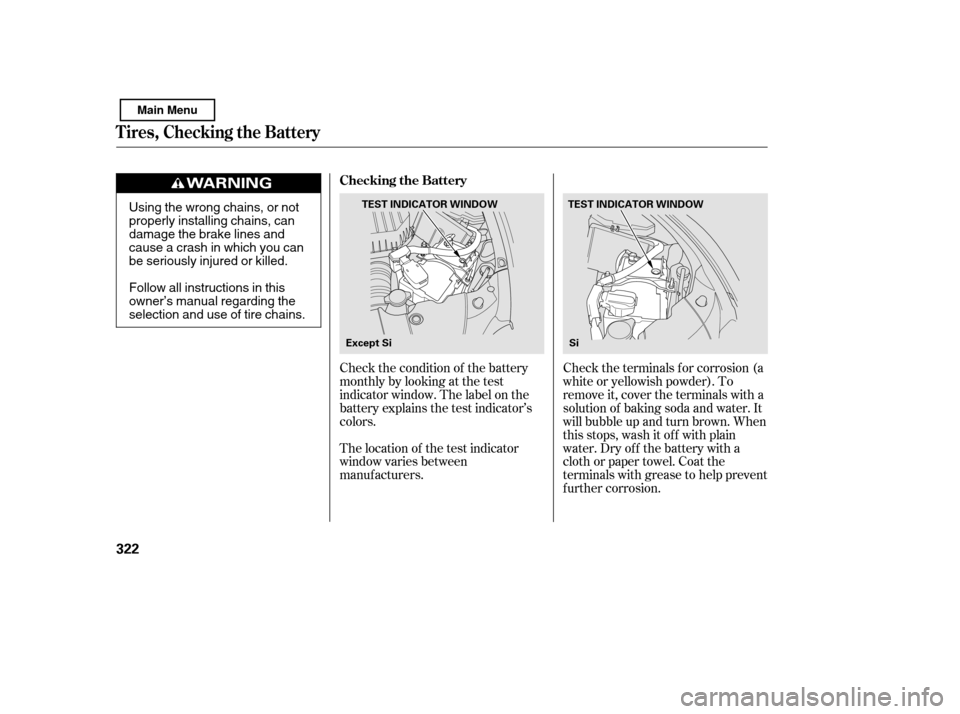
Check the condition of the battery
monthlybylookingatthetest
indicator window. The label on the
battery explains the test indicator’s
colors.Check the terminals f or corrosion (a
white or yellowish powder). To
remove it, cover the terminals with a
solution of baking soda and water. It
will bubble up and turn brown. When
this stops, wash it of f with plain
water. Dry off the battery with a
cloth or paper towel. Coat the
terminals with grease to help prevent
f urther corrosion.
The location of the test indicator
window varies between
manuf acturers.
Checking the Battery
Tires, Checking the Battery
322
TEST INDICATOR WINDOW TEST INDICATOR WINDOW
Except Si SiUsing the wrong chains, or not
properly installing chains, can
damage the brake lines and
cause a crash in which you can
be seriously injured or killed.
Follow all instructions in this
owner’s manual regarding the
selection and use of tire chains.
Main Menu
Page 328 of 388

Fill the f uel tank.Block the rear wheels.
If the vehicle is to be stored f or a
longer period, it should be
supported on jackstands so the
tires are of f the ground.
If you need to park your vehicle f or
an extended period (more than 1
month), there are several things you
should do to prepare it f or storage.
Proper preparation helps prevent
deterioration and makes it easier to
get your vehicle back on the road. If
possible, store your vehicle indoors. Leave one window open slightly (if
the vehicle is being stored
indoors).Cover the vehicle with a
‘‘breathable’’ cover, one made
f rom a porous material such as
cotton. Non-porous materials, such
as plastic sheeting, trap moisture,
which can damage the paint.
To minimize sticking, apply a
silicone spray lubricant to all door
and trunk seals. Also, apply a
vehiclebodywaxtothepainted
surfaces that mate with the door
and trunk seals.
Support the f ront wiper blade
arms with a f olded towel or rag so
they do not touch the windshield.
Disconnect the battery. If possible, periodically run the
engine until it reaches f ull
operating temperature (the
cooling f an cycles twice).
Pref erably, do this once a month.
Wash and dry the exterior
completely.
Cleantheinterior.Makesurethe
carpeting, floor mats, etc., are
completely dry.
Leave the parking brake off. Put
the transmission in reverse
(manual) or Park (automatic).
Vehicle Storage
324
Main Menu
Page 332 of 388
Check the air pressure of the
compact spare tire every time you
check the other tires. It should be
inf lated to:
Use the compact spare tire as a
temporary replacement only. Get
your regular tire repaired or replaced,
and put it back on your vehicle as
soon as you can.
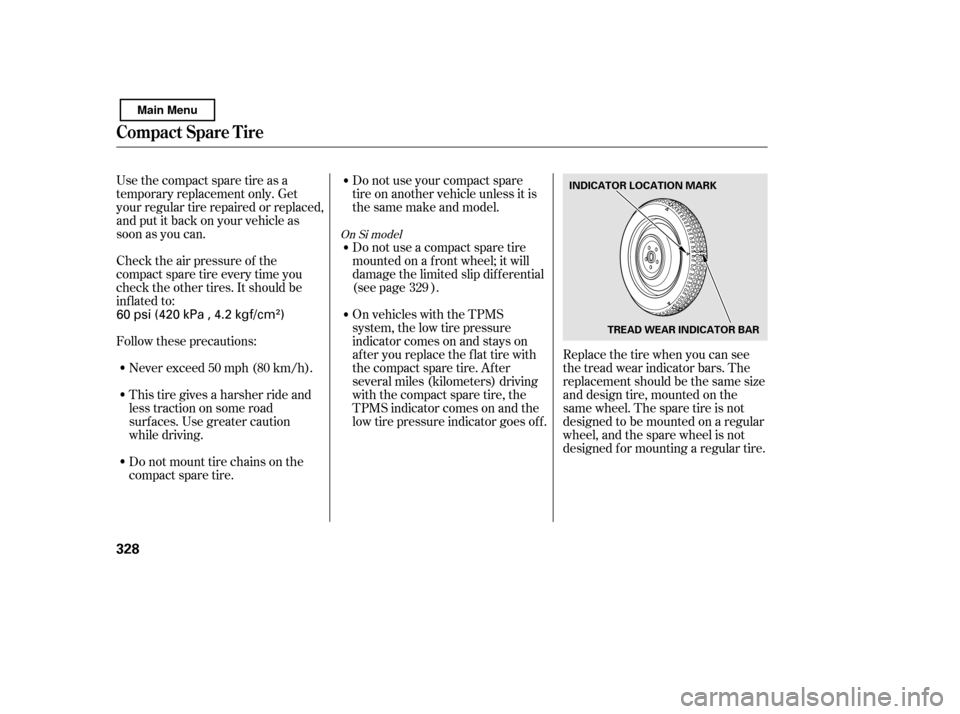
Replace the tire when you can see
the tread wear indicator bars. The
replacement should be the same size
and design tire, mounted on the
same wheel. The spare tire is not
designed to be mounted on a regular
wheel, and the spare wheel is not
designed f or mounting a regular tire.
Follow these precautions:
This tire gives a harsher ride and
less traction on some road
surf aces. Use greater caution
while driving.
Never exceed 50 mph (80 km/h).
Do not mount tire chains on the
compact spare tire. Do not use your compact spare
tire on another vehicle unless it is
thesamemakeandmodel.
On vehicles with the TPMS
system, the low tire pressure
indicator comes on and stays on
after you replace the flat tire with
the compact spare tire. Af ter
several miles (kilometers) driving
with the compact spare tire, the
TPMS indicator comes on and the
low tire pressure indicator goes of f .
Do not use a compact spare tire
mounted on a f ront wheel; it will
damage the limited slip dif f erential
(see page ).
329
On Si model
Compact Spare Tire
328
INDICATOR LOCATION MARK
TREAD WEAR INDICATOR BAR
60 psi (420 kPa , 4.2 kgf/cm)
Main Menu
Page 353 of 388

�µ�µ
If your vehicle needs to be towed,
call a prof essional towing service or
organization. Never tow your vehicle
with just a rope or chain. It is very
dangerous.
The operator
loads your vehicle on the back of a
truck.
Therearetwowaystotowyour
vehicle: If , due to damage, your vehicle must
be towed with the f ront wheels on
the ground, do this:
Release the parking brake.
Shif t the transmission to neutral.
Leave the ignition switch in the
ACCESSORY (I) position so the
steering wheel does not lock.
The tow
truck uses two pivoting arms that go
under the f ront tires and lif t them of f
the ground. The rear tires remain on
the ground. With the f ront wheels on the ground,
do not tow the vehicle more than 50
miles (80 km), and keep the speed
below35mph(55km/h).
Start the engine.
Release the parking brake.
Shif t to the D position and hold f or
5 seconds, then to N.
Turn of f the engine.
Leave the ignition switch in the
ACCESSORY (I) position so the
steering wheel does not lock.
Manual transmission:
Automatic transmission:
CONT INUED
Flat -bed EquipmentWheel-lif t Equipment
T his is the best way to
transport your vehicle.
This is an acceptable
way to tow your vehicle.
Emergency T owing
T aking Care of t he Unexpect ed
349
Improper towing preparation will
damage the transmission. Follow the
above procedure exactly. If you cannot
shif t the transmission or start the
engine (automatic transmission), your
vehicle must be transported with the
f ront wheels of f the ground.
Main Menu
Page 355 of 388

�µ
Thediagramsinthissectiongive
you the dimensions and capacities of
your vehicle and the locations of the
identif ication numbers. It also
includes inf ormation you should
know about your vehicle’s tires and
emissions control systems.
................
Identif ication Numbers . 352
................................
Specif ications . 354
DOT Tire Quality Grading
......................
(U.S. Vehicles) . 357
.................................
Treadwear . 357
......................................
Traction . 357
.............................
Temperature . 358
.................................
Tire Labeling . 359
Tire Pressure Monitoring
System (TPMS) Required
.............
Federal Explanation . 361 .......................
Emissions Controls . 363
.....................
The Clean Air Act . 363
Crankcase Emissions Control
....................................
System . 363
Evaporative Emissions Control ....................................
System . 363
Onboard Ref ueling Vapor
................................
Recovery . 363
...
Exhaust Emissions Controls . 364
....................
PGM-FI System . 364
Ignition Timing Control
................................
System . 364
Exhaust Gas Recirculation
...................
(EGR) System . 364
Three Way Catalytic ...........................
Converter . 364
....................
Replacement Parts . 364
..
Three Way Catalytic Converter . 365
........................
Emissions Testing . 366
T echnical Inf ormat ion
T echnical Inf ormation
351
Main Menu
Page 360 of 388

�µ
�µ �µ�µ�µ�µ�µ
�Î�Î�Î�Î�Î�Î�Î�Î�Î
�Î
�Î�Î �Î�Î
�Î
�Î �Î
�Î�Î
�Î
�Î�Î
�Î�Î �Î
Specif ications
356
Fuses
Alignment
Battery
Tires
P195/65R15 89H
Interior
Under-hood
Toe-in
Camber
Caster 7°24’0°45’
0°
0.08 in (2.0 mm)
0.00 in (0.0 mm)
Capacity 12 V
12 V
12 V36 AH/5 HR
38 AH/5 HR
45 AH/20 HR
47 AH/20 HR
12 V
12 V 38 AH/5 HR
47 AH/20 HR
12 V T135/80R16 101MT125/70D15 95M
215/45ZR17 91W P215/45R17 87V
P205/55R16 89H P195/65R15 89S
Size
Pressure
60 psi (420 kPa , 4.2 kgf/cm
)
33 psi (230 kPa , 2.3 kgf/cm)
32 psi (220 kPa , 2.2 kgf/cm)
30 psi (210 kPa , 2.1 kgf/cm)
T135/80D16 101M
See page 348 or the fuse label
attached to the inside of the fuse
box door under the steering
column.
See page 347 or the fuse box
cover.
FrontRear
FrontRear
Front Front/Rear
Spare
Front/Rear
Spare
Si (all season tires)
Canadian DX-G with manual transmission
DX, Canadian DX-G with automatic transmission
Except EX-L, Si
1: 2:3:4:5:6:7:8:9:
Optional for U.S. Si (summer tires)Si
U.S. EX-L
Si, Canadian EX-L
U.S. Vehicles
Canada Vehicles
EX-L, U.S. LX, LX-S, EX, Canadian SE
3
1 2 45
7
7 6
4, 6
3
1, 2
8, 9 8
Main Menu
Page 361 of 388

Quality grades can be f ound where
applicable on the tire sidewall
between tread shoulder and
maximum section width. For
example:
All passenger car tires must conf orm
to Federal Saf ety Requirements in
addition to these grades.The treadwear grade is a compara-
tive rating based on the wear rate of
the tire when tested under controlled
conditions on a specif ied government
test course. For example, a tire
graded 150 would wear one and one-
half (1 1/2) times as well on the
government course as a tire graded
100. The relative perf ormance of
tires depends upon the actual condi-
tions of their use, however, and may
depart signif icantly f rom the norm
due to variations in driving habits,
service practices and dif f erences in
road characteristics and climate.
The traction grades, f rom highest to
lowest, are AA, A, B, and C. Those
grades represent the tire’s ability to
stop on wet pavement as measured
under controlled conditions on
specif ied government test surf aces
of asphalt and concrete. A tire
marked C may have poor traction
perf ormance.
Warning: The traction grade
assignedtothistireisbasedon
straight-ahead braking traction tests,
and does not include acceleration,
cornering, hydroplaning, or peak
traction characteristics.
The tires on your vehicle meet all
U.S. Federal Saf ety Requirements.
All tires are also graded f or
treadwear, traction, and temperature
perf ormance according to
Department of Transportation
(DOT) standards. The f ollowing
explains these gradings.
Unif orm T ire Quality Grading
T readwear 200
Traction AA
Temperature A T readwear T raction
DOT T ire Quality Grading (U.S. Vehicles)
T echnical Inf ormation
357
Main Menu
Page 362 of 388

Warning: The temperature grade f or
this tire is established f or a tire that
is properly inf lated and not
overloaded. Excessive speed,
underinf lation, or excessive loading,
either separately or in combination,
can cause heat buildup and possible
tire f ailure.
The temperature grades are A (the
highest), B, and C, representing the
tire’s resistance to the generation of
heat and its ability to dissipate heat
when tested under controlled
conditions on a specif ied indoor
laboratory test wheel. Sustained high
temperature can cause the material
of the tire to degenerate and reduce
tire life, and excessive temperature
can lead to sudden tire f ailure. The
grade C corresponds to a level of
perf ormance which all passenger car
tires must meet under the Federal
Motor Vehicle Saf ety Standard No.
109. Grades B and A represent
higher levels of perf ormance on the
laboratory test wheel than the
minimum required by law.
Temperature
DOT T ire Quality Grading (U.S. Vehicles)
358
Main Menu