Page 330 of 400

A tire this worn gives very little
traction on wet roads. You should
replace the tire if you can see three
or more tread wear indicators.
Your tires have wear indicators
molded into the tread. When the
tread wears down, you will see a 1/2
inch (12.7 mm) wide band across the
tread. This shows there is less than
1/16 inch (1.6 mm) of tread lef t on
the tire.
Every time you check inf lation, you
should also examine the tires f or
damage, f oreign objects, and wear.
Youshouldlookfor:
Bumps or bulges in the tread or
side of the tire. Replace the tire if
youfindeitherof theseconditions.
Cuts, splits, or cracks in the side
of the tire. Replace the tire if you
can see f abric or cord.
Excessive tread wear.
When you return to normal speed
driving, be sure to readjust the tire
pressure f or normal driving. You
should wait until the tires are cold
bef ore adjusting the tire pressure.
Tire pressure f or high speed driving
is the same as f or normal driving.
Except Si model
Tires
Tire Inspection
326
INDICATOR LOCATION MARKS
TREAD WEAR INDICATOR
Main Menu
Page 331 of 400

In addition to proper inf lation,
correct wheel alignment helps to
decrease tire wear. If you f ind a tire
is worn unevenly, have your dealer
check the wheel alignment.
Have your dealer check the tires if
you f eel a consistent vibration while
driving. A tire should always be
rebalanced if it is removed f rom the
wheel. When you have new tires
installed, make sure they are
balanced. This increases riding
comf ort and tire lif e. For best results,
have the installer perform a dynamic
balance.
The last f our digits of the TIN (tire
identif ication number) are f ound on
the sidewall of the tire and indicate
the date of manufacture (See
on page ).
The service lif e of your tires is
dependent on many f actors,
including, but not limited to, driving
habits, road conditions, vehicle
loading, inf lation pressure,
maintenance history, speed, and
environmental conditions (even
when the tires are not in use).
In addition to your regular
inspections and inf lation pressure
maintenance, it is recommended that
you have annual inspections
perf ormed once the tires reach f ive
years old. It is also recommended
that all tires, including the spare, be
removed f rom service af ter 10 years
from the date of manufacture,
regardless of their condition or state
of wear. 369
On models with aluminum wheels
Tires
T ire Maintenance
Tire
Labeling
Tire Service Lif e
Maint enance
327
Improper wheel weights can damage
your vehicle’s aluminum wheels. Use
only Honda wheel weights f or
balancing.
Main Menu
Page 332 of 400

To help increase tire lif e and
distribute wear more evenly, rotate
the tires according to the
maintenance messages displayed on
the information display.
Move the tires to the positions
shown in the illustration each time
they are rotated. If you purchase
directional tires, rotate only f ront-to-
back.Themileageyoucanexpectfrom
yourvehicletiresisthesameas
comparable mid-and rear-engine
sports cars, and it will vary greatly
with your driving habits.
If you drive moderately, the f ront
tires could last more than 10,000
miles (16,000 km). However, the
mileage will be substantially less if
you tend to drive your vehicle at the
upper limits of its capabilities.
You should caref ully inspect your
vehicle’s tires f or wear, damage, and
proper inf lation every 7,500 miles
(12,000 km).
As a trade-of f , they will wear more
rapidly than tires used on ordinary
passenger vehicles. Because of the
vehicle’s weight distribution, and the
fact that the front wheels are the
driving wheels, you can expect them
to wear more rapidly than the rear
tires.
The tires that came on your vehicle
were designed and constructed to
provide superior grip during
acceleration, braking, and cornering.
When the tires are rotated, make
sure the air pressures are checked.
Si model only
Tires
Tire Rotation
Tire Wear
328
FrontFront
(For Directional
Tires and Wheels)
(For Non-directional
Tires and Wheels)
Main Menu
Page 333 of 400

Replace your tires with radial tires of
the same size, load range, speed
rating, and maximum cold tire
pressure rating (as shown on the
tire’s sidewall).
Mixing radial and bias-ply tires on
your vehicle can reduce braking
ability, traction, and steering
accuracy. Using tires of a dif f erent
size or construction can cause the
ABS and vehicle stability assist
system (VSA) to work inconsistently.
The ABS and VSA system (if
equipped) work by comparing the
speed of each wheel. When replacing
tires, use the same size originally
supplied with the vehicle. Tire size
and construction can affect wheel
speed and may cause the system to
activate.It is best to replace all f our tires at
thesametime.If thatisnotpossible
or necessary, replace the two f ront
tires or two rear tires as a pair.
Replacing just one tire can seriously
af f ect your vehicle’s handling.
If you ever replace a wheel, make
sure that the wheel’s specif ications
match those of the original wheels.
Also be sure you use only TPMS
specif ic wheels. If you do not, the
tire pressure monitoring system will
not work.
Replacement wheels are available at
your dealer.
On vehicles with TPMS
Tires
Replacing T ires and Wheels
Maint enance
329
Installing improper tires on your
vehicle can affect handling and
stability. This can cause a crash
in which you can be seriously
hurt or killed.
Always use the size and type of
tires recommended in this
owner’s manual.
Main Menu
Page 341 of 400

This section covers the more
common problems that motorists
experience with their vehicles. It
gives you inf ormation about how to
safely evaluate the problem and what
to do to correct it. If the problem has
stranded you on the side of the road,
you may be able to get going again.
If not, you will also f ind instructions
on getting your vehicle towed.......................
Compact Spare Tire . 338
....................
Changing a Flat Tire . 339
.............
If the Engine Won’t Start . 343
................................
Jump Starting . 345
..............
If the Engine Overheats . 347
.........
Low Oil Pressure Indicator . 349
..........
Charging System Indicator . 349
.......
Malf unction Indicator Lamp . 350
...............
Brake System Indicator . 351
..............................................
Fuses . 352
..............................
Fuse Locations . 356
......................
Emergency Towing . 358
Taking Care of the Unexpected
T aking Care of t he Unexpect ed
337
Main Menu
Page 342 of 400
Use the compact spare tire as a
temporary replacement only. Get
your regular tire repaired or replaced,
and put it back on your vehicle as
soon as you can.
Check the air pressure of the
compact spare tire every time you
check the other tires. It should be
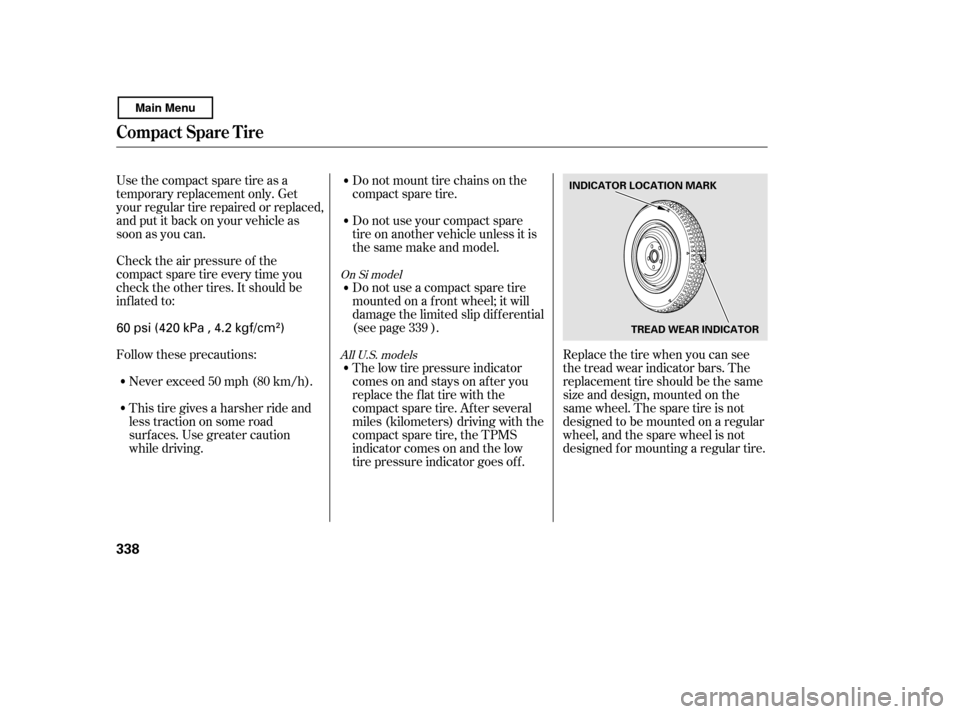
inf lated to:Replace the tire when you can see
the tread wear indicator bars. The
replacement tire should be the same
sizeanddesign,mountedonthe
same wheel. The spare tire is not
designed to be mounted on a regular
wheel, and the spare wheel is not
designed f or mounting a regular tire.
Do not use your compact spare
tire on another vehicle unless it is
thesamemakeandmodel.
Do not mount tire chains on the
compact spare tire.
Do not use a compact spare tire
mounted on a f ront wheel; it will
damage the limited slip dif f erential
(see page ).
This tire gives a harsher ride and
less traction on some road
surf aces. Use greater caution
while driving.
Never exceed 50 mph (80 km/h).
Follow these precautions:
The low tire pressure indicator
comes on and stays on af ter you
replace the flat tire with the
compact spare tire. Af ter several
miles (kilometers) driving with the
compact spare tire, the TPMS
indicator comes on and the low
tire pressure indicator goes of f .339
All U.S. models
On Si model
Compact Spare Tire
338
INDICATOR LOCATION MARK
TREAD WEAR INDICATOR
60 psi (420 kPa , 4.2 kgf/cm)
Main Menu
Page 347 of 400
Diagnosing why the engine won’t
start f alls into two areas, depending
on what you hear when you turn the
ignition switch to the START (III)
position:You hear nothing, or almost
nothing. The engine’s starter
motor does not operate at all, or
operates very slowly.
You can hear the starter motor
operating normally, or the starter
motor sounds like it is spinning
f aster than normal, but the engine
does not start up and run.
Store the wheel cover or center
cap in the trunk. Make sure it does
not get scratched or damaged.
Lower the trunk f loor, then close
the trunk lid.
Your vehicle’s original tire has a
tire pressure monitoring system
sensor. To replace a tire, ref er to
(see
page ).
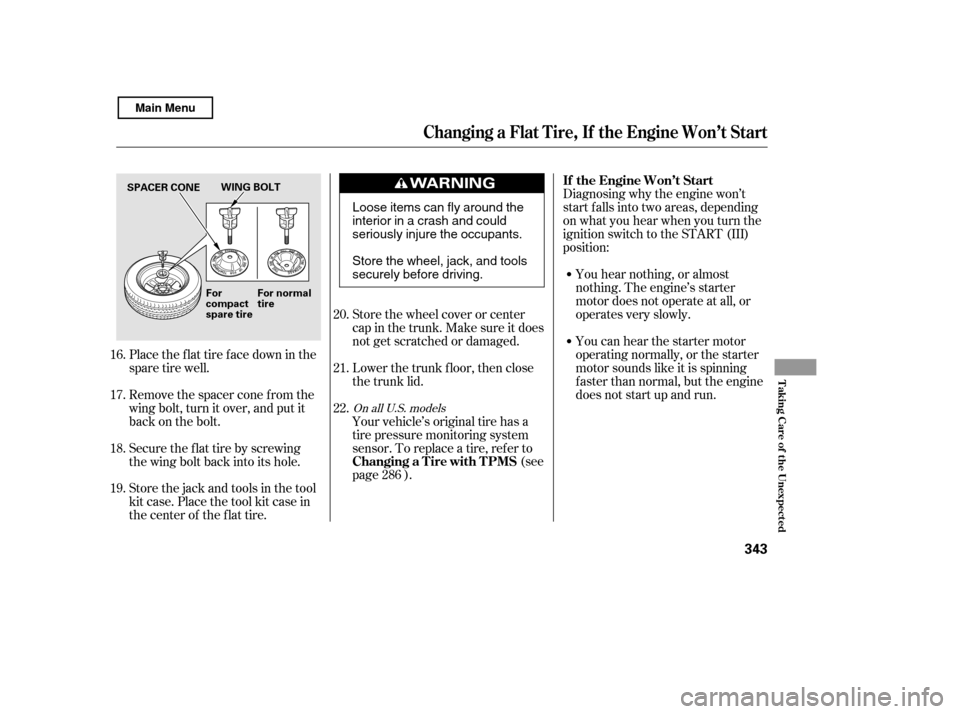
Place the flat tire face down in the
spare tire well.
Remove the spacer cone f rom the
wing bolt, turn it over, and put it
back on the bolt.
Securetheflattirebyscrewing
the wing bolt back into its hole.
Store the jack and tools in the tool
kit case. Place the tool kit case in
the center of the flat tire. 20. 21. 22.
16.17. 18. 19.
286
On all U.S. models
Changing a Flat T ire, If the Engine Won’t Start
If the Engine Won’t Start
Changing a T ire with T PMS
T aking Care of t he Unexpect ed
343
For normal tire
WING BOLT
For
compact
spare tire
SPACER CONE
Loose items can fly around the
interiorinacrashandcould
seriously injure the occupants.
Store the wheel, jack, and tools
securely before driving.
Main Menu
Page 365 of 400

�µ
Thediagramsinthissectiongive
you the dimensions and capacities of
your vehicle and the locations of the
identif ication numbers. It also
includes inf ormation you should
know about your vehicle’s tires and
emissions control systems.
................
Identif ication Numbers . 362
................................
Specif ications . 364
DOT Tire Quality Grading
......................
(U.S. Vehicles) . 367
Unif orm Tire Quality
..................................
Grading . 367
.................................
Treadwear . 367
......................................
Traction . 367
.............................
Temperature . 368
.................................
Tire Labeling . 369
Tire Pressure Monitoring System
(TPMS) Required Federal ............................
Explanation . 371 .......................
Emissions Controls . 373
.....................
The Clean Air Act . 373
Crankcase Emissions Control
....................................
System . 373
Evaporative Emissions Control ....................................
System . 373
Onboard Ref ueling Vapor ................................
Recovery . 373
...
Exhaust Emissions Controls . 374
....................
PGM-FI System . 374
Ignition Timing Control
................................
System . 374
Exhaust Gas Recirculation ...................
(EGR) System . 374
Three Way Catalytic ...........................
Converter . 374
....................
Replacement Parts . 374
..
Three Way Catalytic Converter . 375
........................
Emissions Testing . 376
T echnical Inf ormat ion
T echnical Inf ormation
361
Main Menu