2011 GMC SIERRA tires
[x] Cancel search: tiresPage 351 of 594

Black plate (57,1)GMC Sierra Owner Manual - 2011
Driving and Operating 9-57
When Using the Manual
Transfer Case
.Shifts into or out of Four-Wheel
Drive Low or N (Neutral) should
be made using quick motions to
avoid excessive gear grinding.
Shifting slowly may make it more
difficult to shift.
.You may notice that it is harder
to shift when the vehicle is cold.
After the vehicle warms up the
shifting will return to normal.
.While in Four-Wheel High or
Four-Wheel Drive Low you
may experience reduced fuel
economy.
.Avoid driving in Four-Wheel
Drive on clean, dry pavement.
It may cause your tires to wear
faster, make the transfer case
harder to shift, and run noisier.
.If the transfer case shifter is in
the N (Neutral) position and
you have difficulty reaching the
selected transfer case mode,
with the engine running, shift
the transmission momentarily
to D (Drive) and then back to
N (Neutral). This will realign the
gear teeth in the transfer case
and allow you to complete the
shift.
Shifting from Two-Wheel Drive
High to Four-Wheel Drive High
.Shifts between Two-Wheel Drive
High and Four-Wheel Drive High
can be made at any vehicle
speed.
.Shift the transfer case lever in
one continuous motion into
either the Four-Wheel Drive
High or Two-Wheel Drive
High position.
.Shifting from Two-Wheel Drive
High to Four-Wheel Drive High
while the vehicle is in motion
may require that moderate force
be applied to the shift lever for a
few seconds before Four-Wheel
Drive High can be engaged,
especially in cold weather.
.In extremely cold weather, it may
be necessary to slow or stop the
vehicle to shift into Four-Wheel
Drive High.
.While in Four-Wheel Drive High,
the vehicle can be driven at any
posted legal speed limit.
Page 385 of 594

Black plate (91,1)GMC Sierra Owner Manual - 2011
Driving and Operating 9-91
For information on towing a disabled
vehicle, seeTowing the Vehicle on
page 10‑103. For information on
towing the vehicle behind another
vehicle such as a motor home, see
Recreational Vehicle Towing on
page 10‑103.
Driving Characteristics
and Towing Tips
Pulling a Trailer
Important points for pulling a trailer:
.There are many different laws,
including speed limit restrictions,
having to do with trailering.
Make sure the rig will be legal,
not only where you live but
also where you will be driving.
A good source for this
information can be state
or provincial police.
.Consider using a sway control.
See “Hitches” underTowing
Equipment on page 9‑112.
.Do not tow a trailer at all during
the first 800 km (500 miles)
the new vehicle is driven.
The engine, axle, or other
parts could be damaged.
.During the first 800 km
(500 miles) that a trailer is
towed, do not drive over
80 km/h (50 mph) and do
not make starts at full throttle.
This helps the engine and other
parts of the vehicle wear in at
the heavier loads.
.Vehicles can tow in D (Drive).
Shift the transmission to a lower
gear if the transmission shifts
too often under heavy loads
and/or hilly conditions.
Important considerations that have
to do with weight:
.Weight of the trailer
.Weight of the trailer tongue
.Weight on the vehicle's tires
.Weight of the trailering
combination
Page 386 of 594

Black plate (92,1)GMC Sierra Owner Manual - 2011
9-92 Driving and Operating
Driving with a Trailer
{WARNING
When towing a trailer, exhaust
gases may collect at the rear
of the vehicle and enter if the
liftgate, trunk/hatch, or rear-most
window is open.
Engine exhaust contains Carbon
Monoxide (CO) which cannot be
seen or smelled. It can cause
unconsciousness and even death.
To maximize safety when towing
a trailer:
.Have the exhaust system
inspected for leaks and make
necessary repairs before
starting a trip.
.Never drive with the liftgate,
trunk/hatch, or rear-most
window open.(Continued)
WARNING (Continued)
.Fully open the air outlets
on or under the instrument
panel.
.Adjust the Climate Control
system to a setting that
brings in only outside air
and set the fan speed to the
highest setting. See Climate
Control System in the Index.
For more information about
Carbon Monoxide, see Engine
Exhaust on page 9‑44.
Towing a trailer requires a
certain amount of experience.
The combination you are driving is
longer and not as responsive as the
vehicle itself. Get acquainted with
the handling and braking of the rig
before setting out for the open road. Before starting, check all trailer
hitch parts and attachments, safety
chains, electrical connectors,
lamps, tires, and mirrors. If the
trailer has electric brakes, start the
combination moving and then apply
the trailer brake controller by hand
to be sure the brakes work.
During the trip, check occasionally
to be sure that the load is secure
and the lamps and any trailer
brakes still work.
Following Distance
Stay at least twice as far behind the
vehicle ahead as you would when
driving the vehicle without a trailer.
This can help to avoid heavy
braking and sudden turns.
Page 405 of 594
Black plate (111,1)GMC Sierra Owner Manual - 2011
Driving and Operating 9-111
Vehicle Series Hitch TypeMaximum Tongue
Weight
1500 Weight Carrying 272 kg (600 lbs)
2500HD/3500 Weight Carrying 453 kg (1,000 lbs)
1500 Weight Distributing 499 kg (1,100 lbs)
2500HD/3500 Weight Distributing 680 kg (1,500 lbs)
1500 Fifth-Wheel Gooseneck 680 kg (1,500 lbs)
2500HD Fifth-Wheel Gooseneck 1 134 kg (2,500 lbs)
3500 Single Rear
Wheels Fifth-Wheel Gooseneck 1 360 kg (3,000 lbs)
3500 Dual Rear
Wheels Fifth-Wheel Gooseneck 1 587 kg (3,500 lbs)
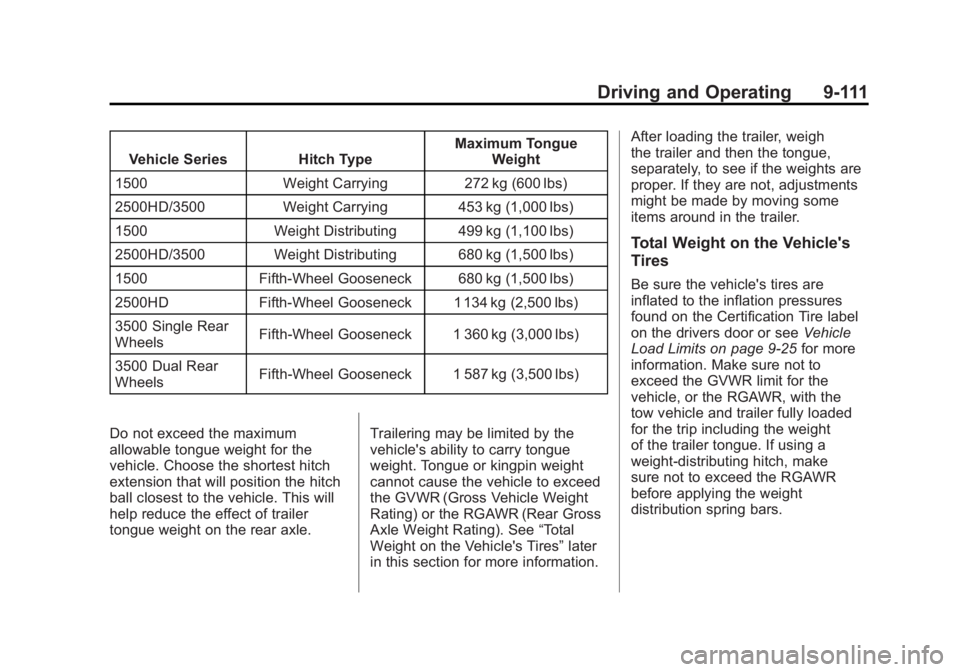
Do not exceed the maximum
allowable tongue weight for the
vehicle. Choose the shortest hitch
extension that will position the hitch
ball closest to the vehicle. This will
help reduce the effect of trailer
tongue weight on the rear axle. Trailering may be limited by the
vehicle's ability to carry tongue
weight. Tongue or kingpin weight
cannot cause the vehicle to exceed
the GVWR (Gross Vehicle Weight
Rating) or the RGAWR (Rear Gross
Axle Weight Rating). See
“Total
Weight on the Vehicle's Tires” later
in this section for more information. After loading the trailer, weigh
the trailer and then the tongue,
separately, to see if the weights are
proper. If they are not, adjustments
might be made by moving some
items around in the trailer.
Total Weight on the Vehicle's
Tires
Be sure the vehicle's tires are
inflated to the inflation pressures
found on the Certification Tire label
on the drivers door or see
Vehicle
Load Limits on page 9‑25 for more
information. Make sure not to
exceed the GVWR limit for the
vehicle, or the RGAWR, with the
tow vehicle and trailer fully loaded
for the trip including the weight
of the trailer tongue. If using a
weight-distributing hitch, make
sure not to exceed the RGAWR
before applying the weight
distribution spring bars.
Page 426 of 594

Black plate (2,1)GMC Sierra Owner Manual - 2011
10-2 Vehicle Care
Wheels and Tires
Tires . . . . . . . . . . . . . . . . . . . . . . . . 10-57
Tire Sidewall Labeling . . . . . . 10-58
Tire Designations . . . . . . . . . . . 10-61
Tire Terminology andDefinitions . . . . . . . . . . . . . . . . 10-62
Tire Pressure . . . . . . . . . . . . . . . 10-66
Tire Pressure for High-Speed Operation . . . . . . . . . . . . . . . . . 10-67
Tire Pressure Monitor System . . . . . . . . . . . . . . . . . . . 10-68
Tire Pressure Monitor Operation . . . . . . . . . . . . . . . . . 10-69
Tire Inspection . . . . . . . . . . . . . . 10-73
Tire Rotation . . . . . . . . . . . . . . . 10-73
Dual Tire Rotation . . . . . . . . . . 10-75
When It Is Time for New Tires . . . . . . . . . . . . . . . . . . . . . . 10-76
Buying New Tires . . . . . . . . . . . 10-77
Different Size Tires and Wheels . . . . . . . . . . . . . . . . . . . 10-79 Uniform Tire Quality
Grading . . . . . . . . . . . . . . . . . . . 10-80
Wheel Alignment and Tire Balance . . . . . . . . . . . . . . . . . . . 10-81
Wheel Replacement . . . . . . . . 10-82
Tire Chains . . . . . . . . . . . . . . . . . 10-83
If a Tire Goes Flat . . . . . . . . . . 10-84
Tire Changing . . . . . . . . . . . . . . 10-86
Full-Size Spare Tire . . . . . . . . 10-97
Jump Starting
Jump Starting . . . . . . . . . . . . . . 10-98
Towing
Towing the Vehicle . . . . . . . . 10-103
Recreational Vehicle
Towing . . . . . . . . . . . . . . . . . . . 10-103
Appearance Care
Exterior Care . . . . . . . . . . . . . . 10-108
Interior Care . . . . . . . . . . . . . . . 10-112
Floor Mats . . . . . . . . . . . . . . . . . 10-116
General Information
For service and parts needs,
visit your dealer. You will receive
genuine GM parts and GM-trained
and supported service people.
Genuine GM parts have one of
these marks:
Page 455 of 594

Black plate (31,1)GMC Sierra Owner Manual - 2011
Vehicle Care 10-31
Some driving conditions or climates
can cause a brake squeal when
the brakes are first applied or
lightly applied. This does not mean
something is wrong with the brakes.
Properly torqued wheel nuts are
necessary to help prevent brake
pulsation. When tires are rotated,
inspect brake pads for wear and
evenly tighten wheel nuts in
the proper sequence to torque
specifications inCapacities and
Specifications on page 12‑2.
If the vehicle has rear drum brakes,
they do not have wear indicators,
but if a rear brake rubbing noise is
heard, have the rear brake linings
inspected immediately. Rear brake
drums should be removed and
inspected each time the tires are
removed for rotation or changing. Drum brakes have an inspection
hole to inspect lining wear during
scheduled maintenance. When
the front brake pads are replaced,
have the rear brakes inspected, too.
Brake linings should always be
replaced as complete axle sets.
Brake Pedal Travel
See your dealer if the brake pedal
does not return to normal height,
or if there is a rapid increase in
pedal travel. This could be a
sign that brake service might
be required.
Brake Adjustment
Every time the brakes are applied,
with or without the vehicle moving,
the brakes adjust for wear.
Replacing Brake System Parts
The braking system on a vehicle is
complex. Its many parts have to be
of top quality and work well together
if the vehicle is to have really good
braking. The vehicle was designed
and tested with top-quality brake
parts. When parts of the braking
system are replaced, be sure to get
new, approved replacement parts.
If this is not done, the brakes might
not work properly. For example,
installing disc brake pads that
are wrong for the vehicle, can
change the balance between the
front and rear brakes
—for the
worse. The braking performance
expected can change in many
other ways if the wrong replacement
brake parts are installed.
Page 466 of 594

Black plate (42,1)GMC Sierra Owner Manual - 2011
10-42 Vehicle Care
Headlamp Aiming
The vehicle has a visual optical
headlamp aiming system. The aim
of the headlamps has been preset
at the factory and should need no
further adjustment.
However, if the vehicle is damaged
in a crash, the aim of the headlamps
may be affected and adjustment
may be necessary.
If oncoming vehicles flash their high
beams at you, this may mean the
vertical aim of the headlamps needs
to be adjusted.
It is recommended that the vehicle
be taken to the dealer for service if
the headlamps need to be adjusted.
It is possible, however, to re-aim the
headlamps as described.The vehicle should:.Be placed so the headlamps
are 7.6 m (25 ft) from a
light‐colored wall.
.Have all four tires on a level
surface which is level all the
way to the wall.
.Be placed so it is perpendicular
to the wall.
.Not have any snow, ice, or mud
on it.
.Be fully assembled and all other
work stopped while headlamp
aiming is being performed.
.Be loaded with a full tank of
fuel and one person or 75 kg
(160 lbs) sitting on the
driver seat.
.Have the tires properly inflated.
.Have the spare tire in its proper
location in the vehicle.Headlamp aiming is done with the
vehicle's low-beam headlamps.
The high-beam headlamps will be
correctly aimed if the low-beam
headlamps are aimed properly.
To adjust the vertical aim:
1. Open the hood. See
Hood on
page 10‑5.2. Locate the aim dot on the lens of the low‐beam headlamp.
3. Record the distance from the ground to the aim dot on the
low‐beam headlamp.
Page 481 of 594

Black plate (57,1)GMC Sierra Owner Manual - 2011
Vehicle Care 10-57
Wheels and Tires
Tires
Your new vehicle comes with
high-quality tires made by
a leading tire manufacturer.
If you ever have questions about
your tire warranty and where to
obtain service, see your vehicle
Warranty booklet for details.
For additional information refer
to the tire manufacturer.
{WARNING
.Poorly maintained and
improperly used tires are
dangerous.
.Overloading the tires can
cause overheating as a result
of too much flexing. There
could be a blowout and a
serious crash. SeeVehicle
Load Limits on page 9‑25.
(Continued)
WARNING (Continued)
.Underinflated tires pose the
same danger as overloaded
tires. The resulting crash
could cause serious injury.
Check all tires frequently to
maintain the recommended
pressure. Tire pressure
should be checked when
the tires are cold.
.Overinflated tires are more
likely to be cut, punctured,
or broken by a sudden
impact—such as when
hitting a pothole. Keep tires at
the recommended pressure.
.Worn or old tires can cause
a crash. If the tread is badly
worn, replace them.
.Replace any tires that have
been damaged by impacts
with potholes, curbs, etc.
(Continued)
WARNING (Continued)
.Improperly repaired tires
can cause a crash. Only the
dealer or an authorized tire
service center should repair,
replace, dismount, and mount
the tires.
.Do not spin the tires in
excess of 55 km/h (35 mph)
on slippery surfaces such
as snow, mud, ice, etc.
Excessive spinning may
cause the tires to explode.
See Tire Pressure for High-Speed
Operation on page 10‑67 for
inflation pressure adjustment for
high speed driving.