Page 274 of 406
Avoid excessive speed because vehicle momentum can work against you
and cause the vehicle to become stuck to the point that assistance may
be required from another vehicle. Remember, you may be able to back
out the way you came if you proceed with caution.
Mud and water
If you must drive through high water, drive slowly. Traction or brake
capability may be limited.
When driving through water, determine the depth; avoid water higher
than the bottom of the wheel rims (if possible) and proceed slowly. If the
ignition system gets wet, the vehicle may stall.
Once through water, always try the brakes. Wet brakes do not stop the
vehicle as effectively as dry brakes. Drying can be improved by moving
your vehicle slowly while applying light pressure on the brake pedal.
Be cautious of sudden changes in vehicle speed or direction when you
are driving in mud. Even AWD vehicles can lose traction in slick mud. As
when you are driving over sand, apply the accelerator slowly and avoid
spinning your wheels. If the vehicle does slide, steer in the direction of
the slide until you regain control of the vehicle.
If the engine, transmission, AWD system components or axles are
submerged in water, their fluids should be checked and changed, if
necessary.
Driving through deep water may damage the engine or
transmission.
If the front or rear axle is submerged in water, the axle lubricant and
PTU (Power Transfer Unit) lubricant should be checked and changed if
necessary.
After driving through mud, clean off residue stuck to rotating driveshafts
and tires. Excess mud stuck on tires and rotating driveshafts causes an
imbalance that could damage drive components.
“Tread Lightly” is an educational
program designed to increase public
awareness of land-use regulations
and responsibilities in our nations
wilderness areas. Ford Motor
Company joins the U.S. Forest Service and the Bureau of Land
Management in encouraging you to help preserve our national forest and
other public and private lands by “treading lightly.”
Driving on hilly or sloping terrain
Although natural obstacles may make it necessary to travel diagonally up
or down a hill or steep incline, you should always try to drive straight up
Driving
274
2011 Taurus(500)
Owners Guide, 1st Printing
USA(fus)
Page 275 of 406
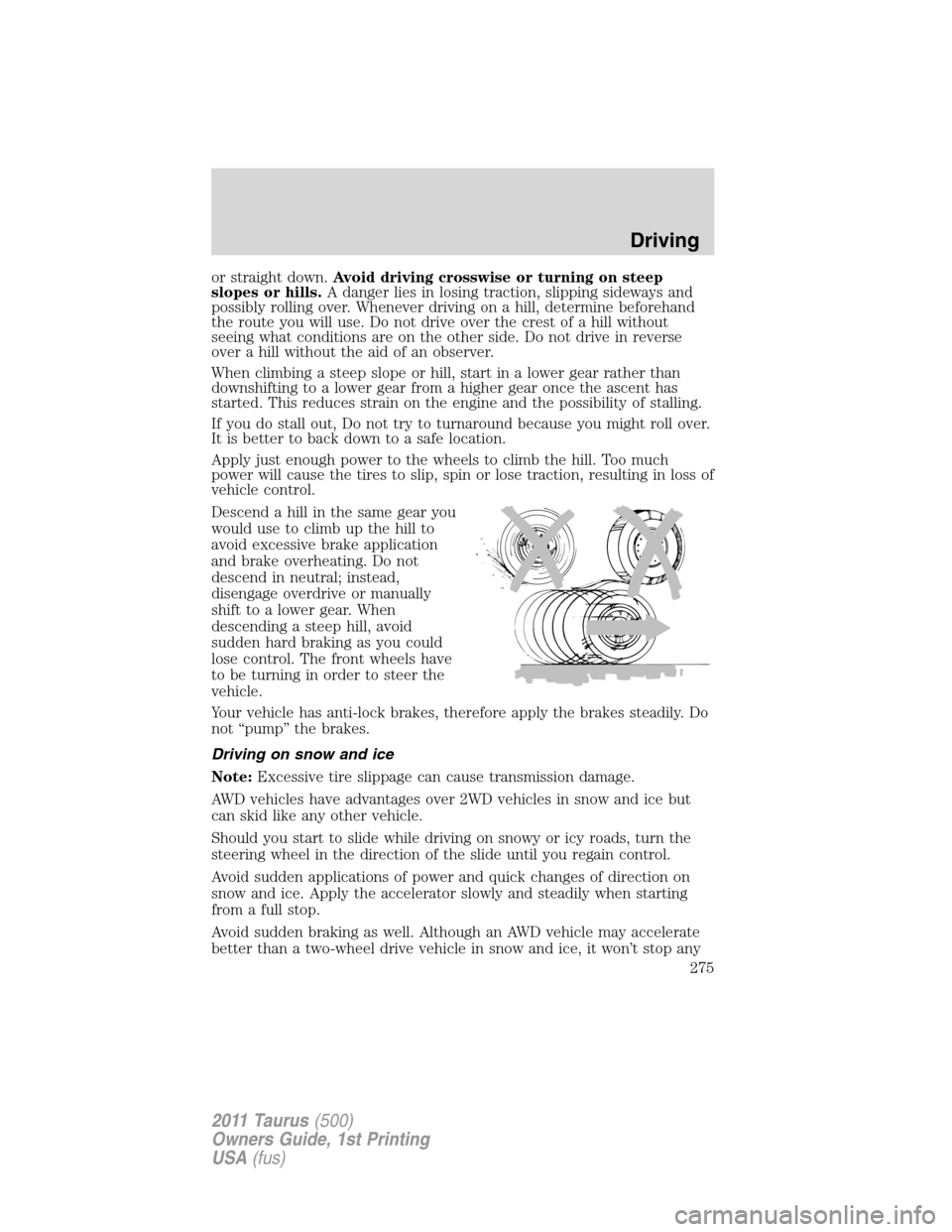
or straight down.Avoid driving crosswise or turning on steep
slopes or hills.A danger lies in losing traction, slipping sideways and
possibly rolling over. Whenever driving on a hill, determine beforehand
the route you will use. Do not drive over the crest of a hill without
seeing what conditions are on the other side. Do not drive in reverse
over a hill without the aid of an observer.
When climbing a steep slope or hill, start in a lower gear rather than
downshifting to a lower gear from a higher gear once the ascent has
started. This reduces strain on the engine and the possibility of stalling.
If you do stall out, Do not try to turnaround because you might roll over.
It is better to back down to a safe location.
Apply just enough power to the wheels to climb the hill. Too much
power will cause the tires to slip, spin or lose traction, resulting in loss of
vehicle control.
Descend a hill in the same gear you
would use to climb up the hill to
avoid excessive brake application
and brake overheating. Do not
descend in neutral; instead,
disengage overdrive or manually
shift to a lower gear. When
descending a steep hill, avoid
sudden hard braking as you could
lose control. The front wheels have
to be turning in order to steer the
vehicle.
Your vehicle has anti-lock brakes, therefore apply the brakes steadily. Do
not “pump” the brakes.
Driving on snow and ice
Note:Excessive tire slippage can cause transmission damage.
AWD vehicles have advantages over 2WD vehicles in snow and ice but
can skid like any other vehicle.
Should you start to slide while driving on snowy or icy roads, turn the
steering wheel in the direction of the slide until you regain control.
Avoid sudden applications of power and quick changes of direction on
snow and ice. Apply the accelerator slowly and steadily when starting
from a full stop.
Avoid sudden braking as well. Although an AWD vehicle may accelerate
better than a two-wheel drive vehicle in snow and ice, it won’t stop any
Driving
275
2011 Taurus(500)
Owners Guide, 1st Printing
USA(fus)
Page 276 of 406
faster, because as in other vehicles, braking occurs at all four wheels. Do
not become overconfident as to road conditions.
Make sure you allow sufficient distance between you and other vehicles
for stopping. Drive slower than usual and consider using one of the lower
gears. In emergency stopping situations, apply the brake steadily. Since
your vehicle is equipped with a four wheel anti-lock brake system (ABS),
do not “pump” the brakes. Refer to theBrakessection of this chapter
for additional information on the operation of the anti-lock brake system.
WARNING:If you are driving in slippery conditions that require
tire chains or cables, then it is critical that you drive cautiously.
Keep speeds down, allow for longer stopping distances and avoid
aggressive steering to reduce the chances of a loss of vehicle control
which can lead to serious injury or death. If the rear end of the vehicle
slides while cornering, steer in the direction of the slide until you
regain control of the vehicle.
Maintenance and modifications
The suspension and steering systems on your vehicle have been designed
and tested to provide predictable performance whether loaded or empty
and durable load carrying capability. For this reason, Ford Motor
Company strongly recommends that you do not make modifications such
as adding or removing parts (such as lift kits or stabilizer bars) or by
using replacement parts not equivalent to the original factory equipment.
Any modifications to a vehicle that raise the center of gravity can make
it more likely the vehicle will rollover as a result of a loss of control.
Ford Motor Company recommends that caution be used with any vehicle
equipped with a high load or device (such as ladder or luggage racks).
Failure to maintain your vehicle properly may void the warranty, increase
your repair cost, reduce vehicle performance and operational capabilities
and adversely affect driver and passenger safety. Frequent inspection of
vehicle chassis components is recommended if the vehicle is subjected to
heavy off-highway usage.
Driving
276
2011 Taurus(500)
Owners Guide, 1st Printing
USA(fus)
Page 277 of 406
DRIVING THROUGH WATER
If driving through deep or standing
water is unavoidable, proceed very
slowly especially when the depth is
not known. Never drive through
water that is higher than the bottom
of the wheel rims (for cars) or the
bottom of the hubs (for trucks).
When driving through water, traction or brake capability may be limited.
Also, water may enter your engine’s air intake and severely damage your
engine or your vehicle may stall.Driving through deep water where
the transmission vent tube is submerged may allow water into the
transmission and cause internal transmission damage.
Once through the water, always dry the brakes by moving your
vehicle slowly while applying light pressure on the brake pedal.
Wet brakes do not stop the vehicle as quickly as dry brakes.
Driving
277
2011 Taurus(500)
Owners Guide, 1st Printing
USA(fus)
Page 282 of 406

The fuses are coded as follows.
Fuse/Relay
LocationFuse Amp
RatingProtected Circuits
1 30A Left front power window, Smart
window motor
2 15A Brake on/off switch
3 15A Driver power seat
4 30A Right front power window, Smart
window motor
5 10A Transmission shifter solenoid, Keyless
keypad
6 20A Turn signals, Hazard flashers
7 10A Low beam headlamps (left)
8 10A Low beam headlamps (right)
9 15A Interior lights, Cargo lamps
10 15A Switch illumination, Puddle lamps
11 10A All wheel drive (AWD) module
12 7.5A Intelligent access (IA) module
13 5A Memory seats, Mirrors, Keypad, IA
receiver, Driver’s door module
14 10A Navigation display, Memory seat,
SYNC�, Center information display,
GPS, Driver seat
15 10A Climate control
16 15A Electronic finish panel, Ambient
lighting
17 20A Trunk release, Moon roof, Smart
windows, Lock/unlock
18 20A Rear heated seats
19 25A Audio amplifier
20 15A Diagnostic connector (OBDII),
Adjustable pedal motor
21 15A Daytime running lamps (DRL) control
Roadside Emergencies
282
2011 Taurus(500)
Owners Guide, 1st Printing
USA(fus)
Page 283 of 406

Fuse/Relay
LocationFuse Amp
RatingProtected Circuits
22 15A Park lamps, License plate lamps,
Auxiliary lamps
23 15A High beam headlamps
24 20A Horn
25 10A Demand lighting (battery saver)
26 10A Instrument panel cluster, Heads-up
display
27 20A Ignition switch, IA, Front wipers,
One-touch integrated start (OTIS)
28 5A Start relay/Audio mute
29 5A Instrument panel cluster, Heads-up
display
30 5A Not used (spare)
31 10A Not used (spare)
32 10A Airbag module
33 10A Not used (spare)
34 5A Anti-lock brake system (ABS),
Electronic power steering
35 10A Rear heated seats, AWD, Rear park
assist, Steering angle sensor, Blind
spot information system,
Multi-contour seats
36 5A Passive anti-theft system (PATS)
37 10A Not used (spare)
38 20A Subwoofer, Speaker amplifier
39 20A Radio/navigation
40 20A Not used (spare)
41 15A Delayed accessory feeds
42 10A Not used (spare)
43 10A Rear window defroster, Front wipers,
Automatic high beam controller,
Rainsensor
Roadside Emergencies
283
2011 Taurus(500)
Owners Guide, 1st Printing
USA(fus)
Page 285 of 406
The high-current fuses are coded as follows:
Fuse/Relay
LocationFuse Amp
RatingPower Circuits
1 80A** Passenger compartment fuse panel
power
2 80A** Passenger compartment fuse panel
power
3 — Not used
4 30A** Front wiper
5 30A** Passenger seat
6 20A** Cigar lighter
7 60A** Engine cooling fan (non-SHO engine)
8 30A** Moon roof
9 40A** Anti-lock brake system (ABS) pump
10 30A** Starter relay
11 30A** Powertrain Control Module (PCM)
relay
12 20A** ABS valve
13 15A* Adaptive cruise control
14 — Not used
Roadside Emergencies
285
2011 Taurus(500)
Owners Guide, 1st Printing
USA(fus)
Page 287 of 406
Fuse/Relay
LocationFuse Amp
RatingPower Circuits
43 G8VA relay Backup lamps
44 — Not used
45 — Not used
46 15A* Vehicle power 2 (PCM), Vehicle power
3 (PCM)
47 20A* Vehicle power 1 (PCM)
48 20A* Vehicle power 4 (ignition coils)
49 15A* Heated mirrors
50 Half ISO relay Blower motor relay
51 Half ISO relay High-mount brake lamp w/ ACCM
relay
52 Half ISO relay Starter relay
53 Half ISO relay PCM power relay
54 — Not used
55 Half ISO relay Front wiper relay
56 Half ISO relay Rear window defroster relay
57 — Not used
58 — Not used
59 Half ISO relay Left halogen headlamp relay
60 Half ISO relay Right halogen headlamp relay
61 — Not used
62 — Not used
63 Half ISO relay Daytime running lamps (DRL) 1 relay
64 Half ISO relay DRL 2 high beam control relay
65 G8VA relay Run/start relay (IA)
66 — Not used
*Mini fuse **Cartridge fuse
Roadside Emergencies
287
2011 Taurus(500)
Owners Guide, 1st Printing
USA(fus)