Page 265 of 406

The BLIS�and CTA has a yellow
indicator (also referred to as the
alert) located in the left and right
exterior mirrors. When the vehicle is
started, the BLIS�automatically
illuminates both indicators for
several seconds indicating the
system is operating. The first time
you place the transmission in D (Drive) after starting the engine and
drive forward at a speed greater than 3 mph (5 km/h) the BLIS�system
becomes active. Afterwards, the BLIS�remains active for all speeds
including zero mph. BLIS�is also active if the transmission is placed in N
(Neutral). If the transmission is shifted out of D (Drive) or N (Neutral)
the system will enter the CTA mode (see CTA operation below). Once
shifted back in to D (Drive) the BLIS�mode will activate once driven
above 3 mph (5 km/h).
The BLIS�will trigger the alert for vehicles that enter your blind zone
from the rear or merge in to the blind zone from the side. Vehicles that
you pass, or a vehicle that enters the blind zone from the front, will
trigger the alert only after the vehicle is present in the blind zone for
three seconds.Note:For vehicles that pass through the blind zone
quickly, typically less than two seconds, the BLIS�will not illuminate the
alert.
The BLIS�consists of two radar
sensors each located rearward of
the rear wheels hidden behind the
bumper fascia. Do not place any
type of bumper sticker in this area.
Note:The BLIS�typically will not
detect parked vehicles, humans,
animals, or infrastructure (fences,
guard rails, trees, etc.). The BLIS�
does not function when the transmission is in R (Reverse) or P (Park).
The BLIS�does not provide any additional warning when your turn
signal is activated.
BLIS�detection limitations:Due to the nature of radar technology,
there may be certain instances where vehicles entering and exiting the
blind spot zones may not be detected. Below is a list of circumstances
that may cause non-detection:
•Debris build-up on the rear quarter panel fascias
•Certain maneuvering of vehicles entering and exiting the blind zone
Driving
265
2011 Taurus(500)
Owners Guide, 1st Printing
USA(fus)
Page 271 of 406
All components of the AWD system are sealed for life and require no
maintenance.
Note:When an AWD system fault is present, the warningCHECK AWD
will display in the message center. The AWD system is not functioning
correctly and defaulted to front wheel drive. When this warning is
displayed, have your vehicle serviced at an authorized dealer
If your vehicle is equipped with AWD, a spare tire of a different size
other than the tire provided should never be used. If the spare tire is
installed, the AWD system may disable automatically and enter front
wheel drive only mode to protect driveline components. This condition
may be indicated by anAWD OFFmessage in the message center (see
Message centerin theInstrument Clusterchapter for more
information). If there is anAWD OFFmessage in the message center
from using the spare tire, this indicator should turn off after reinstalling
the repaired or replaced normal road tire and driving a short distance. It
is recommended to reinstall the repaired or replaced road tire as soon as
possible. Major dissimilar tire sizes between the front and rear axles
could cause the AWD system to stop functioning and default to front
wheel drive or cause damage to the AWD system.
Note:TheAWD OFFmessage may also be displayed in the message
center if the AWD system has overheated and defaulted to front wheel
drive. This condition may occur if the vehicle was operated in extreme
conditions with excessive wheel slip, such as deep sand. To resume
normal AWD function as soon as possible, stop the vehicle in a safe
location and allow it to idle. TheAWD OFFmessage will turn off when
the system cools and normal AWD function returns.
Note:Your AWD vehicle is not intended for off-road use. The AWD
feature gives your vehicle some limited off-road capabilities in which
driving surfaces are relatively level, obstruction-free and otherwise
similar to normal on-road driving conditions. Operating your vehicle
under other than those conditions could subject the vehicle to excessive
stress which might result in damage which is not covered under your
warranty.
Driving on slippery surfaces with AWD vehicles
AWD vehicles are specially equipped for driving on sand, snow, mud and
rough roads and have operating characteristics that are somewhat
different from conventional vehicles, both on and off the highway.
When driving at slow speeds off-highway under high outside
temperatures, use a low gear when possible. Lower gear operation will
maximize the engine and transmission cooling capability.
Driving
271
2011 Taurus(500)
Owners Guide, 1st Printing
USA(fus)
Page 306 of 406
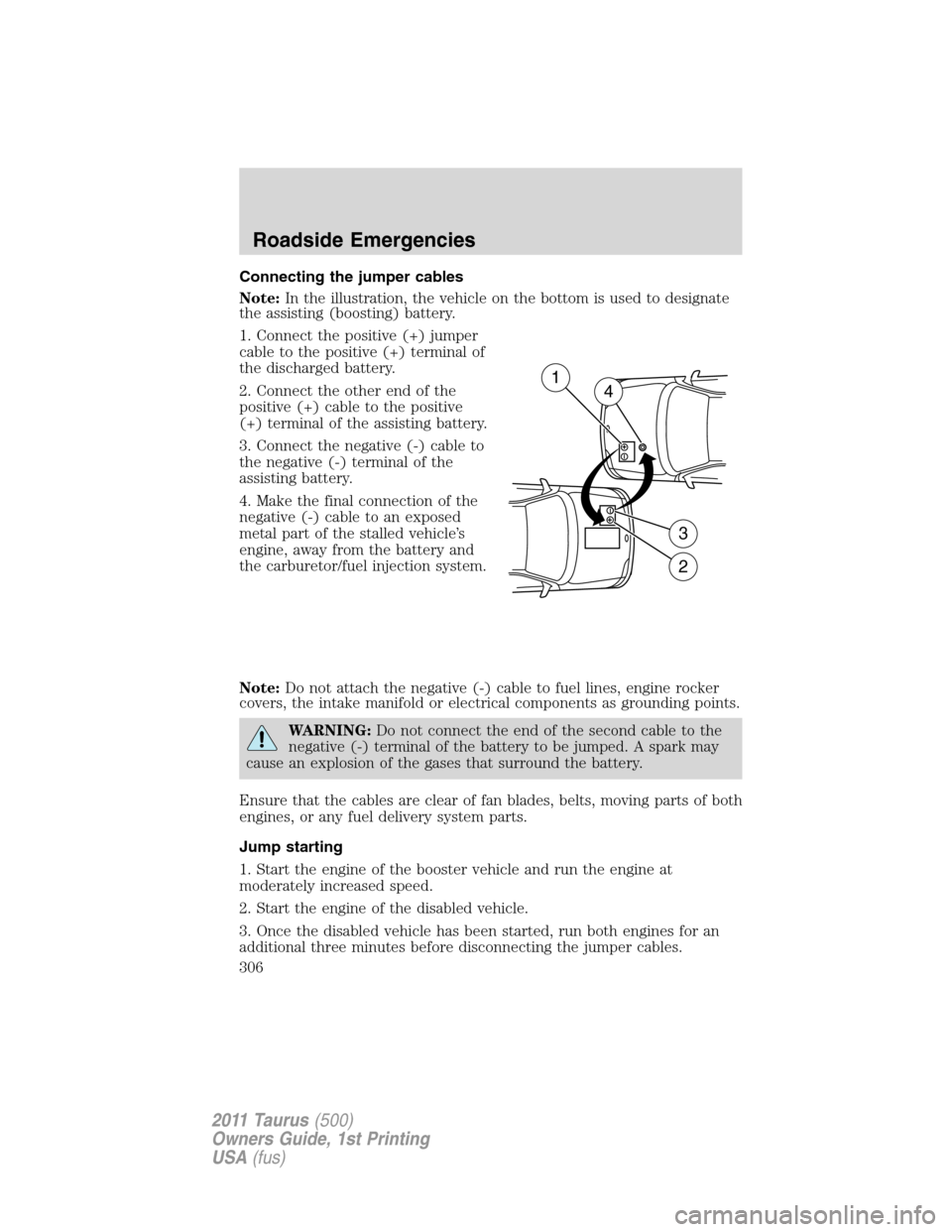
Connecting the jumper cables
Note:In the illustration, the vehicle on the bottom is used to designate
the assisting (boosting) battery.
1. Connect the positive (+) jumper
cable to the positive (+) terminal of
the discharged battery.
2. Connect the other end of the
positive (+) cable to the positive
(+) terminal of the assisting battery.
3. Connect the negative (-) cable to
the negative (-) terminal of the
assisting battery.
4. Make the final connection of the
negative (-) cable to an exposed
metal part of the stalled vehicle’s
engine, away from the battery and
the carburetor/fuel injection system.
Note:Do not attach the negative (-) cable to fuel lines, engine rocker
covers, the intake manifold or electrical components as grounding points.
WARNING:Do not connect the end of the second cable to the
negative (-) terminal of the battery to be jumped. A spark may
cause an explosion of the gases that surround the battery.
Ensure that the cables are clear of fan blades, belts, moving parts of both
engines, or any fuel delivery system parts.
Jump starting
1. Start the engine of the booster vehicle and run the engine at
moderately increased speed.
2. Start the engine of the disabled vehicle.
3. Once the disabled vehicle has been started, run both engines for an
additional three minutes before disconnecting the jumper cables.
+–
+–
2
3
14
Roadside Emergencies
306
2011 Taurus(500)
Owners Guide, 1st Printing
USA(fus)
Page 351 of 406
4. Subtract your initial odometer reading from the current odometer
reading.
5. Follow one of the simple calculations in order to determine fuel
economy:
Calculation 1:Divide total miles traveled by total gallons used.
Calculation 2:Multiply liters used by 100, then divide by total
kilometers traveled.
Keep a record for at least one month and record the type of driving (city
or highway). This will provide an accurate estimate of the vehicle’s fuel
economy under current driving conditions. Additionally, keeping records
during summer and winter will show how temperature impacts fuel
economy. In general, lower temperatures give lower fuel economy.
Driving style — good driving and fuel economy habits
Give consideration to the lists that follow and you may be able to change
a number of variables and improve your fuel economy.
Habits
•Smooth, moderate operation can yield up to 10% savings in fuel.
•Steady speeds without stopping will usually give the best fuel
economy.
•Idling for long periods of time (greater than one minute) may waste
fuel.
•Anticipate stopping; slowing down may eliminate the need to stop.
•Sudden or hard accelerations may reduce fuel economy.
•Slow down gradually.
•Driving at reasonable speeds (traveling at 55 mph [88 km/h] uses 15%
less fuel than traveling at 65 mph [105 km/h]).
•Revving the engine before turning it off may reduce fuel economy.
•Using the air conditioner or defroster may reduce fuel economy.
•You may want to turn off the speed control in hilly terrain if
unnecessary shifting between the top gears occurs. Unnecessary
shifting of this type could result in reduced fuel economy.
•Warming up a vehicle on cold mornings is not required and may
reduce fuel economy.
•Resting your foot on the brake pedal while driving may reduce fuel
economy.
Maintenance and Specifications
351
2011 Taurus(500)
Owners Guide, 1st Printing
USA(fus)