Page 359 of 406
WARNING:Do not run engine with the air filter disconnected.
Start the engine and continue with Step 6.
6. Install the dipstick making sure it is fully seated in the filler tube by
turning it to the locked position.
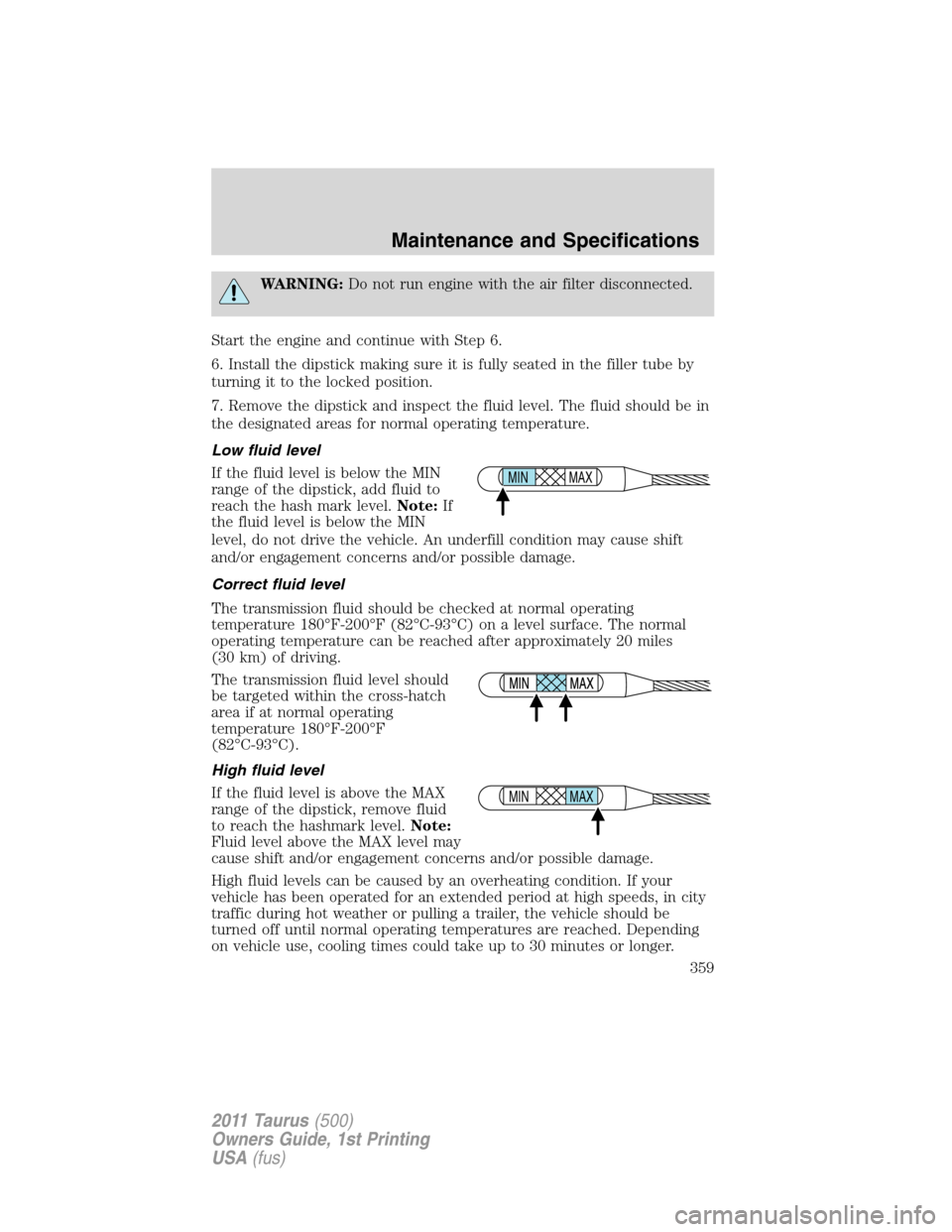
7. Remove the dipstick and inspect the fluid level. The fluid should be in
the designated areas for normal operating temperature.
Low fluid level
If the fluid level is below the MIN
range of the dipstick, add fluid to
reach the hash mark level.Note:If
the fluid level is below the MIN
level, do not drive the vehicle. An underfill condition may cause shift
and/or engagement concerns and/or possible damage.
Correct fluid level
The transmission fluid should be checked at normal operating
temperature 180°F-200°F (82°C-93°C) on a level surface. The normal
operating temperature can be reached after approximately 20 miles
(30 km) of driving.
The transmission fluid level should
be targeted within the cross-hatch
area if at normal operating
temperature 180°F-200°F
(82°C-93°C).
High fluid level
If the fluid level is above the MAX
range of the dipstick, remove fluid
to reach the hashmark level.Note:
Fluid level above the MAX level may
cause shift and/or engagement concerns and/or possible damage.
High fluid levels can be caused by an overheating condition. If your
vehicle has been operated for an extended period at high speeds, in city
traffic during hot weather or pulling a trailer, the vehicle should be
turned off until normal operating temperatures are reached. Depending
on vehicle use, cooling times could take up to 30 minutes or longer.
MAX MIN
MAX MIN
Maintenance and Specifications
359
2011 Taurus(500)
Owners Guide, 1st Printing
USA(fus)
Page 392 of 406
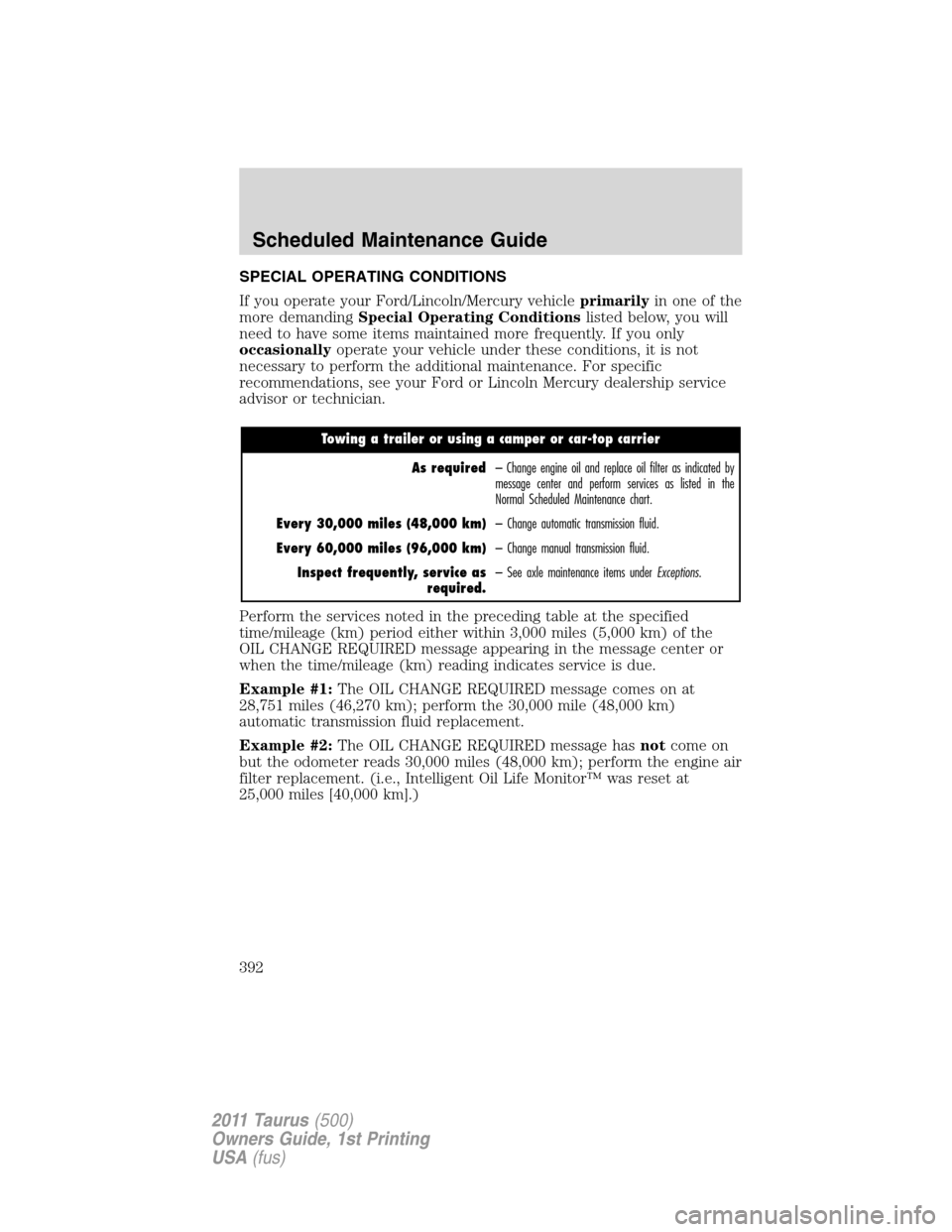
SPECIAL OPERATING CONDITIONS
If you operate your Ford/Lincoln/Mercury vehicleprimarilyin one of the
more demandingSpecial Operating Conditionslisted below, you will
need to have some items maintained more frequently. If you only
occasionallyoperate your vehicle under these conditions, it is not
necessary to perform the additional maintenance. For specific
recommendations, see your Ford or Lincoln Mercury dealership service
advisor or technician.
Towing a trailer or using a camper or car-top carrier
As required– Change engine oil and replace oil filter as indicated by
message center and perform services as listed in the
Normal Scheduled Maintenance chart.
Every 30,000 miles (48,000 km)– Change automatic transmission fluid.
Every 60,000 miles (96,000 km)– Change manual transmission fluid.
Inspect frequently, service as
required.– See axle maintenance items under
Exceptions.
Perform the services noted in the preceding table at the specified
time/mileage (km) period either within 3,000 miles (5,000 km) of the
OIL CHANGE REQUIRED message appearing in the message center or
when the time/mileage (km) reading indicates service is due.
Example #1:The OIL CHANGE REQUIRED message comes on at
28,751 miles (46,270 km); perform the 30,000 mile (48,000 km)
automatic transmission fluid replacement.
Example #2:The OIL CHANGE REQUIRED message hasnotcome on
but the odometer reads 30,000 miles (48,000 km); perform the engine air
filter replacement. (i.e., Intelligent Oil Life Monitor™ was reset at
25,000 miles [40,000 km].)
Scheduled Maintenance Guide
392
2011 Taurus(500)
Owners Guide, 1st Printing
USA(fus)
Page 397 of 406

EXCEPTIONS
In addition, there are several exceptions to the Normal Schedule. They
are listed below:
Normal vehicle axle maintenance
❑Rear axles and power take-off (PTO) units containing synthetic lubricant and light duty trucks equipped with Ford-design
axles are lubricated for life. These lubricants are not to be checked or changed unless a leak is suspected, service is re-
quired or the axle assembly has been submerged in water. The axle and PTO lubricant should be changed anytime the axle
and PTO have been submerged in water. During extended trailer tow operation above 70°F (21°C) ambient and wide open
throttle for extended periods above 45 mph (72 km/h), non-synthetic rear axle lubricants should be replaced every
3,000 miles (4,800 km) or three months, whichever occurs first. The 3,000 mile (4,800 km) lubricant change interval
may be waived if the axle was filled with 75W140 synthetic gear lubricant meeting Ford specification WSL-M2C192-A, part
number F1TZ-19580-B or equivalent. Add friction modifier XL-3 (EST-M2C118-A) or equivalent for complete refill of Traction-
Lok rear axles (refer to
Maintenance product and specificationsin theMaintenance and Specificationschapter for details).
The axle lubricant should be changed anytime an axle has been submerged in water.
Police/Taxi/Livery vehicle axle maintenance
❑Replace rear axle lubricant every 100,000 miles (160,000 km). Rear axle lubricant change may be waived if the axle
was filled with 75W140 synthetic gear lubricant meeting Ford specification WSL-M2C192-A, part number FITZ-19580-B or
equivalent. Add four ounces (118 mL) of friction modifier XL-3 (EST-M2C118-A) or equivalent for complete refill of Traction-
Lok rear axles. The axle lubricant should be changed anytime the axle has been submerged in water.
California fuel filter replacement
❑If vehicle is registered in California, the California Air Resources Board has determined that the failure to perform this main-
tenance item will not nullify the emission warranty or limit recall liability prior to the completion of the vehicle’s useful life.
Ford Motor Company, however, urges you to have all recommended maintenance services performed at the specified inter-
vals and to record all vehicle service.
Hot climate oil change intervals
❑If operating conditions are normal and you drive your Ford, Lincoln or Mercury vehicle under typical, everyday conditions
andyou are using an API performance category oil of SL or later (for example SM, etc.) then you can follow the
7,500 mile (12,000 km) normal service oil change intervals schedule. Vehicles operating in the Middle East, North Africa,
Sub-Saharan Africa or locations with similar climates must follow the oil change interval of 3,000 mile (5,000 km) if the
owner is using oils defined by the American Petroleum Institute (API) performance category of API SK or earlier (for ex-
ample SJ, etc.).
Engine air filter & cabin air filter replacement
❑Engine air filter and cabin air filter life is dependent on exposure to dusty and dirty conditions. Vehicles operated in these
conditions will require frequent inspection and replacement of the engine air filter and cabin air filter.
Scheduled Maintenance Guide
397
2011 Taurus(500)
Owners Guide, 1st Printing
USA(fus)
Page 406 of 406
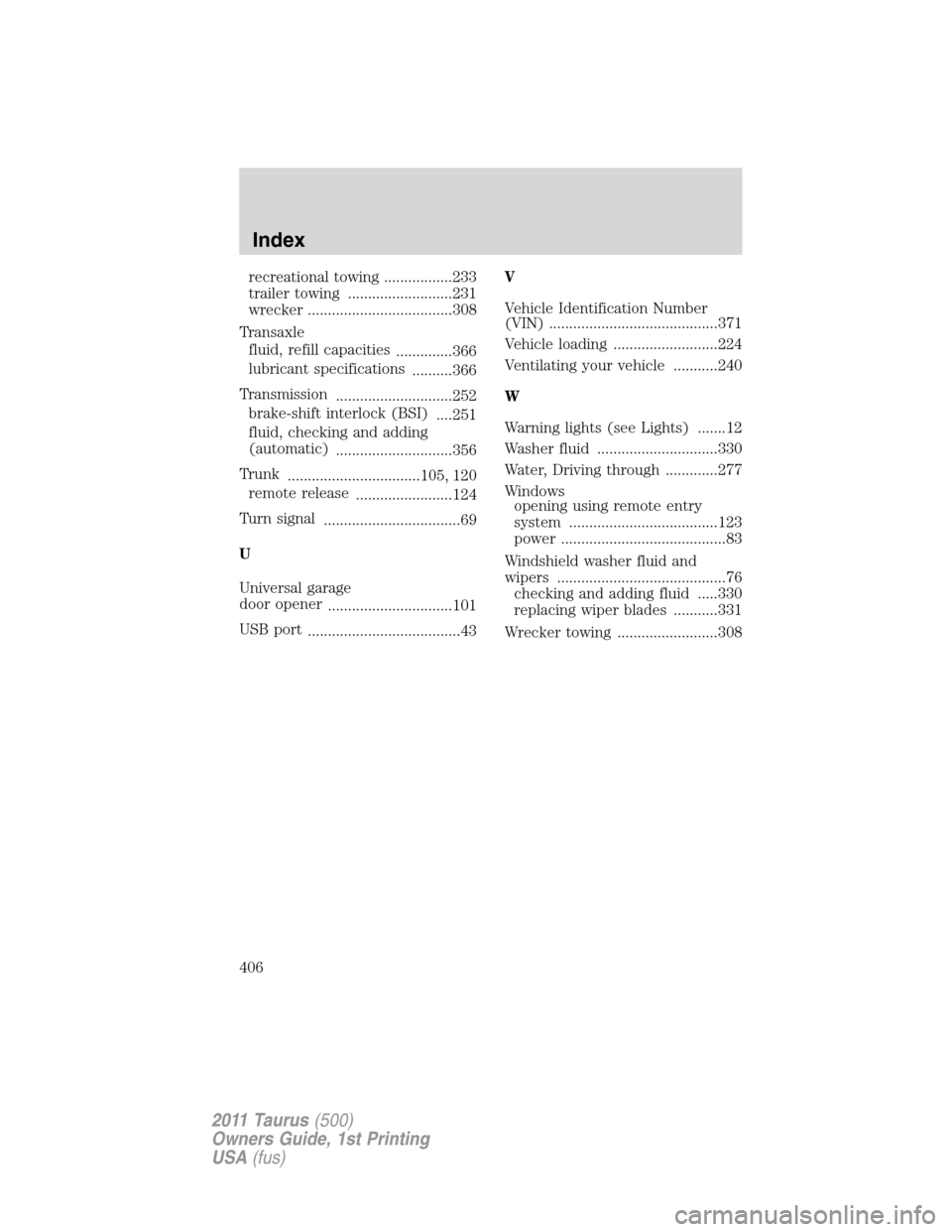
recreational towing .................233
trailer towing ..........................231
wrecker ....................................308
Transaxle
fluid, refill capacities
..............366
lubricant specifications
..........366
Transmission
.............................252
brake-shift interlock (BSI)
....251
fluid, checking and adding
(automatic)
.............................356
Trunk
.................................105, 120
remote release
........................124
Turn signal
..................................69
U
Universal garage
door opener
...............................101
USB port
......................................43V
Vehicle Identification Number
(VIN) ..........................................371
Vehicle loading ..........................224
Ventilating your vehicle ...........240
W
Warning lights (see Lights) .......12
Washer fluid ..............................330
Water, Driving through .............277
Windows
opening using remote entry
system .....................................123
power .........................................83
Windshield washer fluid and
wipers ..........................................76
checking and adding fluid .....330
replacing wiper blades ...........331
Wrecker towing .........................308
Index
406
2011 Taurus(500)
Owners Guide, 1st Printing
USA(fus)