2011 FORD TAURUS flat tire
[x] Cancel search: flat tirePage 296 of 406
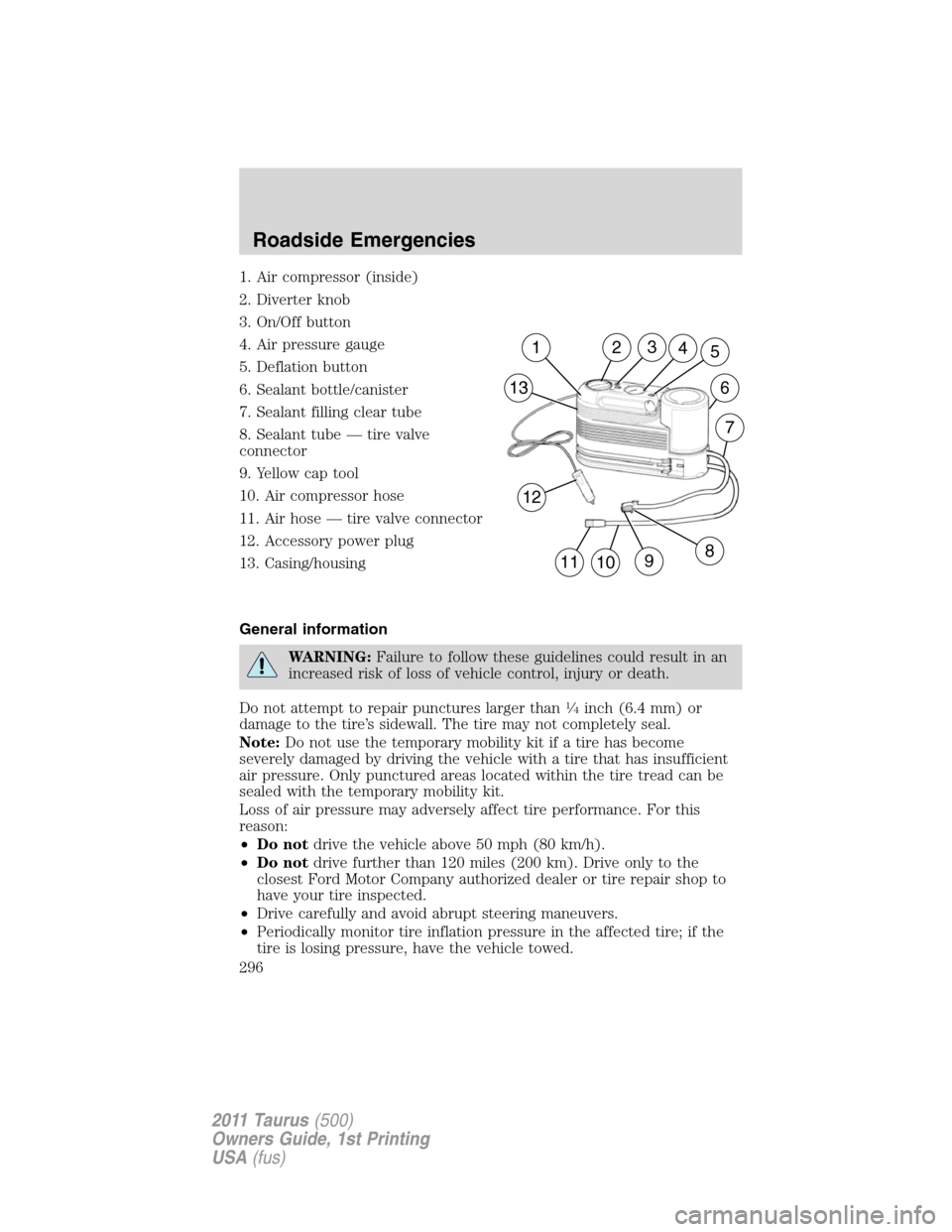
1. Air compressor (inside)
2. Diverter knob
3. On/Off button
4. Air pressure gauge
5. Deflation button
6. Sealant bottle/canister
7. Sealant filling clear tube
8. Sealant tube — tire valve
connector
9. Yellow cap tool
10. Air compressor hose
11. Air hose — tire valve connector
12. Accessory power plug
13. Casing/housing
General information
WARNING:Failure to follow these guidelines could result in an
increased risk of loss of vehicle control, injury or death.
Do not attempt to repair punctures larger than
14inch (6.4 mm) or
damage to the tire’s sidewall. The tire may not completely seal.
Note:Do not use the temporary mobility kit if a tire has become
severely damaged by driving the vehicle with a tire that has insufficient
air pressure. Only punctured areas located within the tire tread can be
sealed with the temporary mobility kit.
Loss of air pressure may adversely affect tire performance. For this
reason:
•Do notdrive the vehicle above 50 mph (80 km/h).
•Do notdrive further than 120 miles (200 km). Drive only to the
closest Ford Motor Company authorized dealer or tire repair shop to
have your tire inspected.
•Drive carefully and avoid abrupt steering maneuvers.
•Periodically monitor tire inflation pressure in the affected tire; if the
tire is losing pressure, have the vehicle towed.
1245
6
7
12
11108
3
9
13
Roadside Emergencies
296
2011 Taurus(500)
Owners Guide, 1st Printing
USA(fus)
Page 297 of 406

•Read the information in theTips for use of the temporary mobility
kitsection to ensure safe operation of the temporary mobility kit and
your vehicle.
Tips for use of the temporary mobility kit
Read the following list of tips to ensure safe operation of the temporary
mobility kit:
•Before operating the temporary mobility kit, make sure your vehicle is
safely off the road and away from moving traffic. Turn on the hazard
lights.
•Always set the parking brake to ensure the vehicle doesn’t move
unexpectedly.
•Do not remove any foreign objects, such as nails or screws, from the
tire.
•When using the temporary mobility kit, leave the engine running
(only if the vehicle is outdoors or in a well-ventilated area)so
the compressor doesn’t drain the vehicle’s battery.
•Do not allow the compressor to operate continuously for more than
15 minutes; this will help prevent the compressor from overheating.
•Never leave the temporary mobility kit unattended when it is
operating.
•Sealant compound contains latex. Make sure that you use the
non-latex gloves provided to avoid an allergic reaction.
•Keep the temporary mobility kit away from children.
•Only use the temporary mobility kit when the ambient temperature is
between -40°F (-40°C) and 158°F (70°C).
•Only use the sealing compound before the use by date. The use by
date is on the lower right hand corner of the label located on the
sealant canister (bottle).Check the use by date regularly and
replace the canister after four years.
•Do not store the temporary mobility kit unsecured inside the
passenger compartment of the vehicle as it may cause injury during a
sudden stop or collision. Always store the kit in its original location.
•After sealant use, the TPMS sensor and valve stem on the wheel must
be replaced by an authorized Ford dealer.
•When inflating a tire or other objects, use the black air hose only. Do
not use the transparent hose which is designed for sealant application
only.
Roadside Emergencies
297
2011 Taurus(500)
Owners Guide, 1st Printing
USA(fus)
Page 298 of 406
•Operating the temporary mobility kit could cause an electrical
disturbance in radio and DVD player operation.
What to do when a tire is punctured
A tire puncture within the tire’s tread area can be repaired in two stages
with the temporary mobility kit:
•In the first stage, the tire will be reinflated with a sealing compound
and air. After the tire has been reinflated, you will need to drive the
vehicle a short distance (approximately 4 miles [6 km]) to distribute
the sealant in the tire.
•In the second stage, you will need to check the tire pressure and
adjust, if necessary, to the vehicle’s tire inflation pressure.
First stage: Reinflating the tire with sealing compound and air
Preparation
Park the vehicle in a safe, level and secure area, away from moving
traffic. Turn the hazard lights on. Apply the parking brake and turn the
engine off. Inspect the flat tire for visible damage.
Sealant compound contains latex. To avoid any allergic reactions, use the
non-latex gloves located in the accessory box on the underside of the
temporary mobility kit housing.
Do not remove any foreign object that has pierced the tire. If a puncture
is located in the tire sidewall, stop and call roadside assistance.
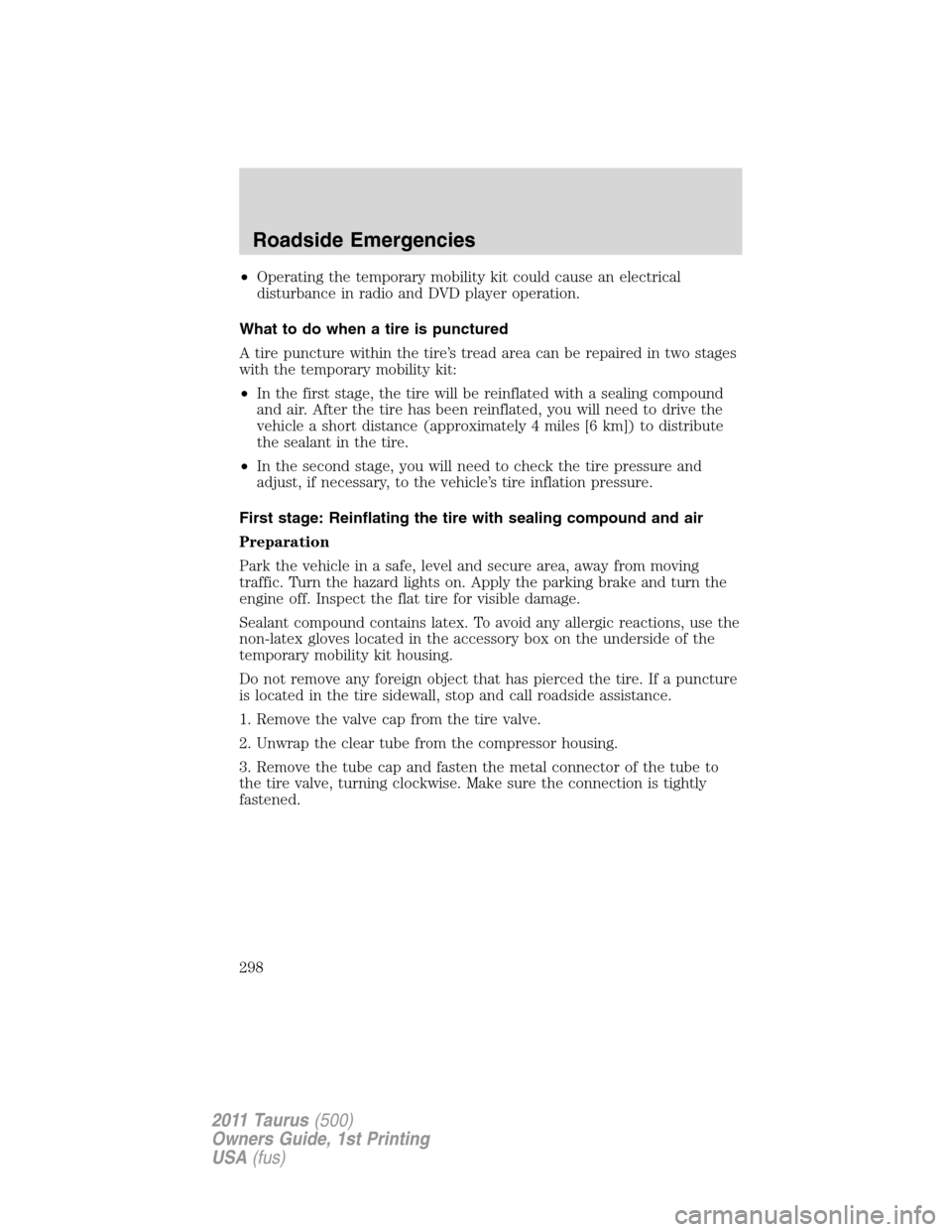
1. Remove the valve cap from the tire valve.
2. Unwrap the clear tube from the compressor housing.
3. Remove the tube cap and fasten the metal connector of the tube to
the tire valve, turning clockwise. Make sure the connection is tightly
fastened.
Roadside Emergencies
298
2011 Taurus(500)
Owners Guide, 1st Printing
USA(fus)
Page 299 of 406
4. Plug the power cable into the 12V
power point in the vehicle.
5. Remove the warning sticker found on the canister and place it on the
top of the instrument panel or the center of the dash.
6. Start the engine(only if the vehicle is outdoors or in a
well-ventilated area).
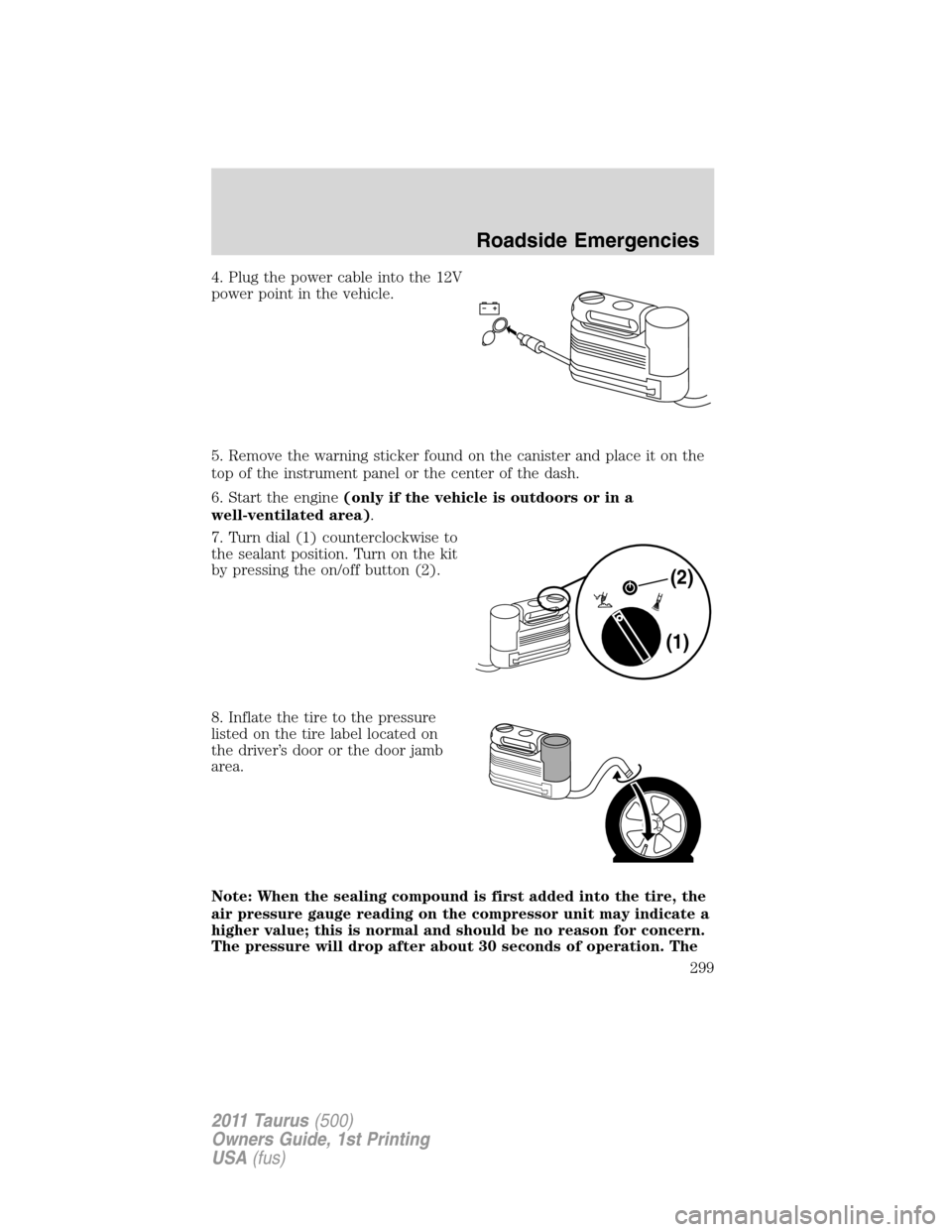
7. Turn dial (1) counterclockwise to
the sealant position. Turn on the kit
by pressing the on/off button (2).
8. Inflate the tire to the pressure
listed on the tire label located on
the driver’s door or the door jamb
area.
Note: When the sealing compound is first added into the tire, the
air pressure gauge reading on the compressor unit may indicate a
higher value; this is normal and should be no reason for concern.
The pressure will drop after about 30 seconds of operation. The
(2)
(1)
Roadside Emergencies
299
2011 Taurus(500)
Owners Guide, 1st Printing
USA(fus)
Page 300 of 406
tire pressure has to be checked with the compressor in the OFF
position to get the correct tire pressure reading.
WARNING:Do not stand directly over the temporary mobility
kit while inflating the tire. If you notice any unusual bulges or
deformations in the tire’s sidewall during inflation, stop and call
roadside assistance.
WARNING:If the tire doesn’t inflate to the recommended tire
pressure within 15 minutes, stop and call roadside assistance.
9. When the recommended tire pressure is reached, turn off the kit by
pressing the on/off button; disconnect the kit from the tire valve and the
power point. Re-install the valve cap on the tire valve, place the tube cap
on the metal connector, and return the kit to the stowage area.
10.Immediately and cautiously, drive the vehicle 4 miles (6 km)
to distribute the sealant evenly inside the tire. Do not exceed
50 mph (80 km/h).
Note:If you experience any unusual vibration, ride disturbance or
noise while driving, reduce your speed until you can safely pull off to
the side of the road to call for roadside assistance.Do not proceed
to the second stage of this operation.
11. After 4 miles (6 km), stop and check the tire pressure. SeeSecond
stage: Checking tire pressure.
Second stage: Checking tire pressure
Check the air pressure of your tires as follows:
1. Remove the valve cap from the tire valve.
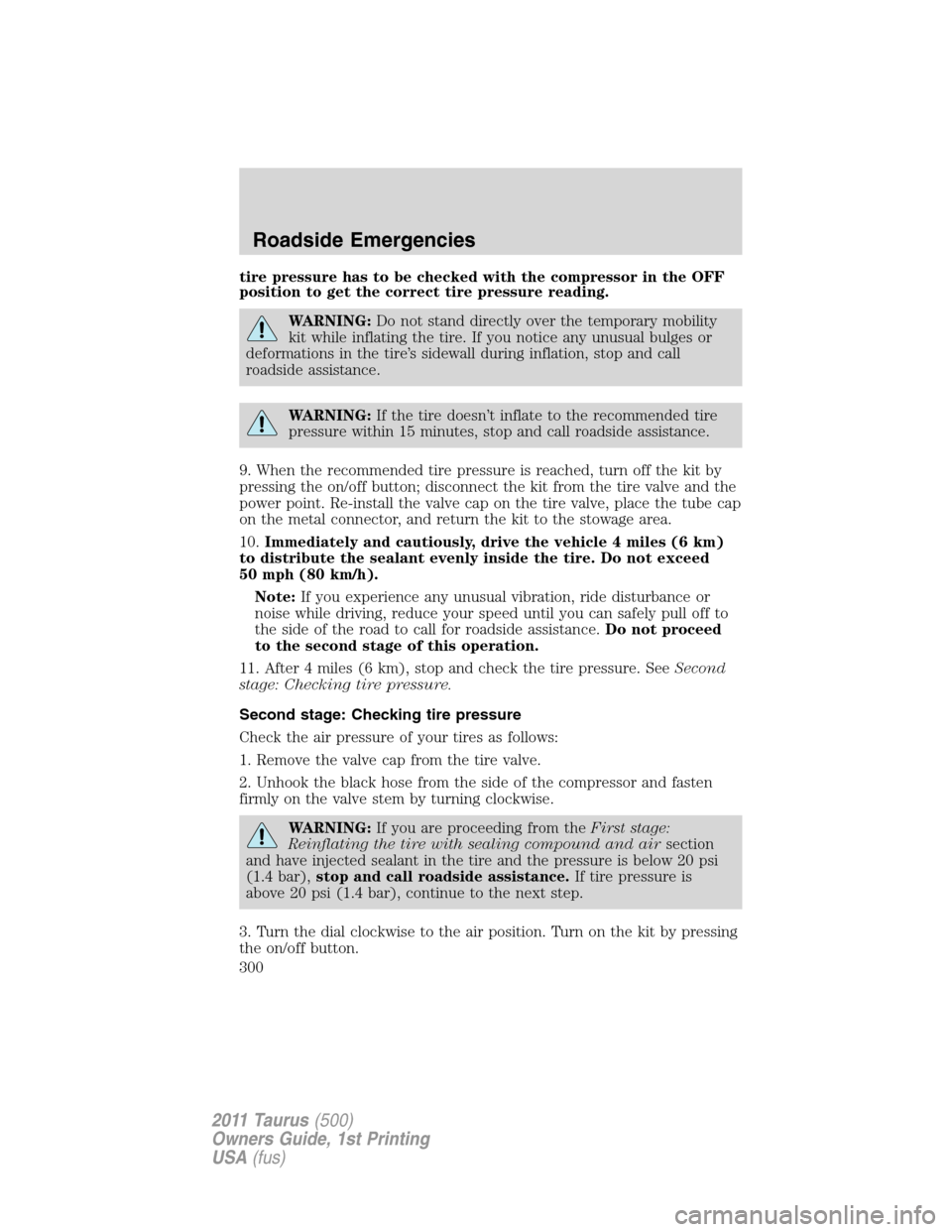
2. Unhook the black hose from the side of the compressor and fasten
firmly on the valve stem by turning clockwise.
WARNING:If you are proceeding from theFirst stage:
Reinflating the tire with sealing compound and airsection
and have injected sealant in the tire and the pressure is below 20 psi
(1.4 bar),stop and call roadside assistance.If tire pressure is
above 20 psi (1.4 bar), continue to the next step.
3. Turn the dial clockwise to the air position. Turn on the kit by pressing
the on/off button.
Roadside Emergencies
300
2011 Taurus(500)
Owners Guide, 1st Printing
USA(fus)
Page 301 of 406

4. Adjust the tire to the
recommended inflation pressure
from the tire label located on the
driver’s door or door jamb area.
Pressing the deflation button near
the sealant canister removes air
from the tire.
Note:The tire pressure has to be
checked with the compressor in the
OFF position to get the correct tire
pressure reading.
5. Turn the compressor off by pressing the on/off button.
6. Unplug the hoses, re-install the valve cap on the tire and return the
kit to the stowage area.
WARNING:The power plug may get hot after use and should
be handled carefully while unplugging.
What to do after the tire has been sealed
After using the temporary mobility kit to seal your tire, you will need to
replace the sealant canister and clear tube (hose). Sealing compound
and spare parts can be obtained and replaced at an authorized Ford
Motor Company dealership or tire dealer. Empty sealant bottles may be
disposed of at home; however, liquid residue from the sealing compound
should be disposed by your local Ford Motor Company dealership or tire
dealer, or in accordance with local waste disposal regulations.
Note:After the sealing compound has been used, the maximum vehicle
speed is 50 mph (80 km/h) and the maximum driving distance is
120 miles (200 km). The sealed tire should be inspected immediately.
Note:After sealant use, the TPMS sensor and valve stem on the wheel
must be replaced by an authorized Ford dealer.
You can check the tire pressure any time within the 120 miles (200 km)
by performing the procedure fromSecond stage: Checking tire
pressurelisted previously.
Roadside Emergencies
301
2011 Taurus(500)
Owners Guide, 1st Printing
USA(fus)
Page 303 of 406
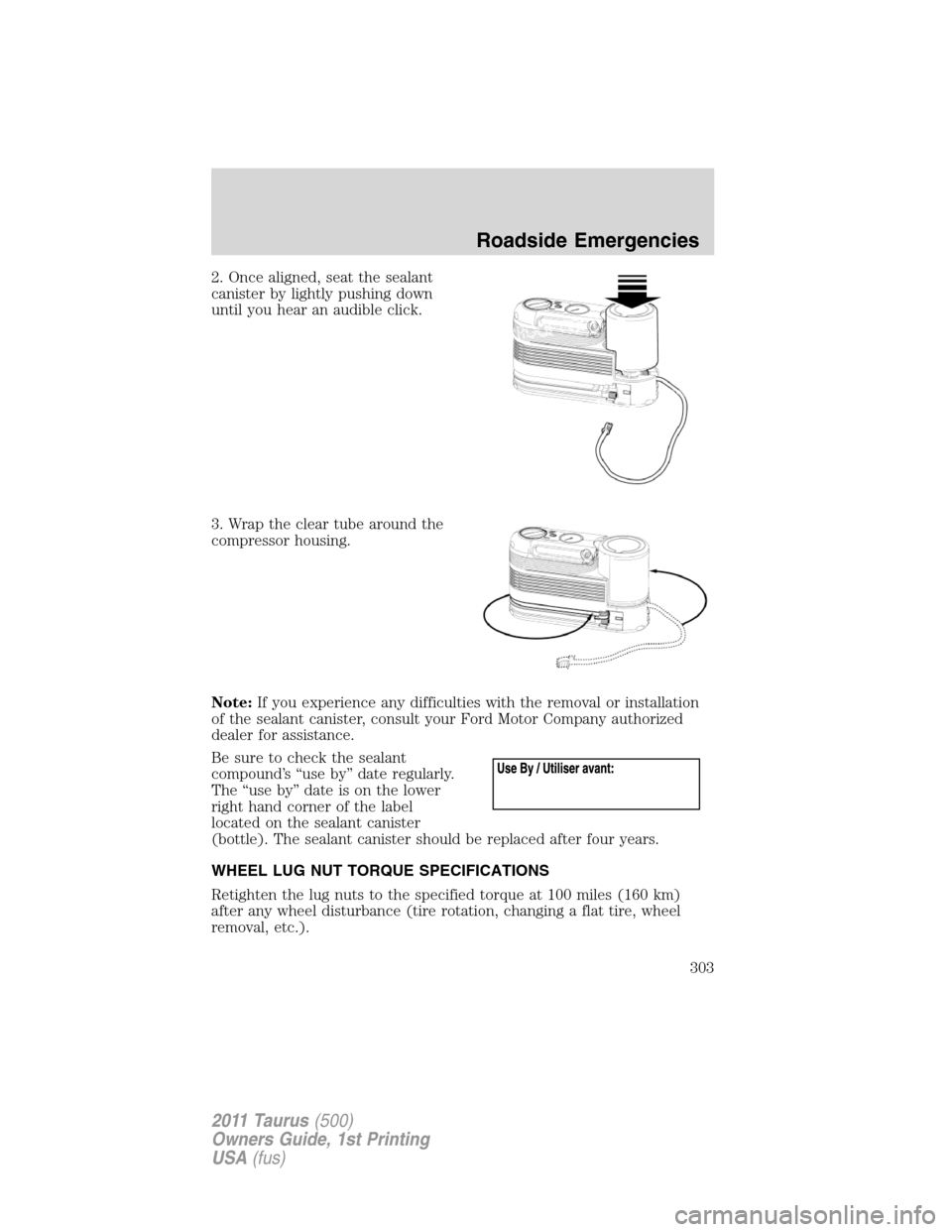
2. Once aligned, seat the sealant
canister by lightly pushing down
until you hear an audible click.
3. Wrap the clear tube around the
compressor housing.
Note:If you experience any difficulties with the removal or installation
of the sealant canister, consult your Ford Motor Company authorized
dealer for assistance.
Be sure to check the sealant
compound’s “use by” date regularly.
The “use by” date is on the lower
right hand corner of the label
located on the sealant canister
(bottle). The sealant canister should be replaced after four years.
WHEEL LUG NUT TORQUE SPECIFICATIONS
Retighten the lug nuts to the specified torque at 100 miles (160 km)
after any wheel disturbance (tire rotation, changing a flat tire, wheel
removal, etc.).
Roadside Emergencies
303
2011 Taurus(500)
Owners Guide, 1st Printing
USA(fus)
Page 352 of 406
•Combine errands and minimize stop-and-go driving.
Maintenance
•Keep tires properly inflated and use only recommended size.
•Operating a vehicle with the wheels out of alignment will reduce fuel
economy.
•Use recommended engine oil. Refer toMaintenance product
specifications and capacitiesin this chapter.
•Perform all regularly scheduled maintenance items. Follow the
recommended maintenance schedule and owner maintenance checks
found inscheduled maintenance information.
Conditions
•Heavily loading a vehicle or towing a trailer may reduce fuel economy
at any speed.
•Carrying unnecessary weight may reduce fuel economy (approximately
1 mpg [0.4 km/L] is lost for every 400 lb [180 kg] of weight carried).
•Adding certain accessories to your vehicle (for example bug
deflectors, rollbars/light bars, running boards, ski racks) may reduce
fuel economy.
•Using fuel blended with alcohol may lower fuel economy.
•Fuel economy may decrease with lower temperatures during the first
8–10 miles (12–16 km) of driving.
•Driving on flat terrain offers improved fuel economy as compared to
driving on hilly terrain.
•Transmissions give their best fuel economy when operated in the top
cruise gear and with steady pressure on the gas pedal.
•Close windows for high speed driving.
EMISSION CONTROL SYSTEM
Your vehicle is equipped with various emission control components and a
catalytic converter which will enable your vehicle to comply with
applicable exhaust emission standards. To make sure that the catalytic
converter and other emission control components continue to work
properly:
•Use only the specified fuel listed.
•Avoid running out of fuel.
•Do not turn off the ignition while your vehicle is moving, especially at
high speeds.
Maintenance and Specifications
352
2011 Taurus(500)
Owners Guide, 1st Printing
USA(fus)