2011 FORD SUPER DUTY airbag off
[x] Cancel search: airbag offPage 189 of 441
3.Medical condition.A passenger has a medical condition which,
according to his or her physician:
•causes the passenger airbag to pose a special risk for the passenger;
and
•
makes the potential harm from the passenger airbag in a crash greater
than the potential harm from turning OFF the airbag and allowing the
passenger, even if belted, to hit the dashboard or windshield in a crash.
WARNING:This vehicle has special energy management safety
belts for the driver and right front passenger. These particular
belts are specifically designed to work with airbags to help reduce the
risk of injury in a collision. The energy management safety belt is
designed to give or release additional belt webbing in some accidents
to reduce concentration of force on an occupant’s chest and reduce the
risk of certain bone fractures and injuries to underlying organs. In a
crash, if the airbag is turned OFF, this energy management safety belt
might permit the person wearing the belt to move forward enough to
incur a serious or fatal injury. The more severe the crash, and the
heavier the occupant, the greater the risk is. Be sure the airbag is
turned ON for any person who does not qualify under the NHTSA
deactivation criteria.
Transport Canada deactivation criteria (Canada Only)
1.Infant:An infant (less than 1 year old) must ride in the front seat
because:
•my vehicle has no rear seat;
•the rear seat in my vehicle cannot accommodate a rear-facing infant
seat; or
•the infant has a medical condition which, according to the infant’s
physician, makes it necessary for the infant to ride in the front seat so
that the driver can monitor the infant’s condition.
2.Child age 12 or under:A child age 12 or under must ride in the
front seat because:
•my vehicle has no rear seat;
•although children age 12 and under ride in the rear seat whenever
possible, children age 12 and under have no option but to sometimes
ride in the front seat because rear seat space is insufficient; or
•the child has a medical condition that, according to the child’s
physician, makes it necessary for the child to ride in the front seat so
that the driver can monitor the child’s condition.
Seating and Safety Restraints
189
2011 F-250/350/450/550(f23)
Owners Guide, 1st Printing
USA(fus)
Page 190 of 441
3.Medical condition:A passenger has a medical condition that,
according to his or her physician:
•poses a special risk for the passenger if the airbag deploys; and
•makes the potential harm from the passenger airbag deployment
greater than the potential harm from turning OFF the airbag and
experiencing a crash without the protection offered by the airbag
WARNING:This vehicle has special energy management safety
belts for the driver and right front passenger. These particular
belts are specifically designed to work with airbags to help reduce the
risk of injury in a collision. The energy management safety belt is
designed to give or release additional belt webbing in some accidents
to reduce concentration of force on an occupant’s chest and reduce the
risk of certain bone fractures and injuries to underlying organs. In a
crash, if the airbag is turned OFF, this energy management safety belt
might permit the person wearing the belt to move forward enough to
incur a serious or fatal injury. The more severe the crash, and the
heavier the occupant, the greater the risk is. Be sure the airbag is
turned ON for any person who does not qualify under the NHTSA
deactivation criteria.
Disposal of airbags and airbag equipped vehicles
See authorized dealer. Airbags MUST BE disposed of by qualified
personnel.
SAFETY RESTRAINTS FOR CHILDREN
See the following sections for directions on how to properly use safety
restraints for children. Also seeAirbag supplemental restraint system
(SRS)in this chapter for special instructions about using airbags.
Important child restraint precautions
WARNING:Always make sure your child is secured properly in
a device that is appropriate for their height, age and weight.
Child safety restraints must be purchased separately from the vehicle.
Failure to follow these instructions and guidelines may result in an
increased risk of serious injury or death to your child.
Seating and Safety Restraints
190
2011 F-250/350/450/550(f23)
Owners Guide, 1st Printing
USA(fus)
Page 196 of 441
•Keep the buckle release button pointing up and away from the safety
seat, with the tongue between the child seat and the release button,
to prevent accidental unbuckling.
•Place vehicle seat back in upright position.
•This vehicle does not require the use of a locking clip.
WARNING:Depending on where you secure a child restraint,
and depending on the child restraint design, you may block
access to certain safety belt buckle assemblies and/or LATCH lower
anchors, rendering those features potentially unusable. To avoid risk of
injury, occupants should only use seating positions where they are able
to be properly restrained.
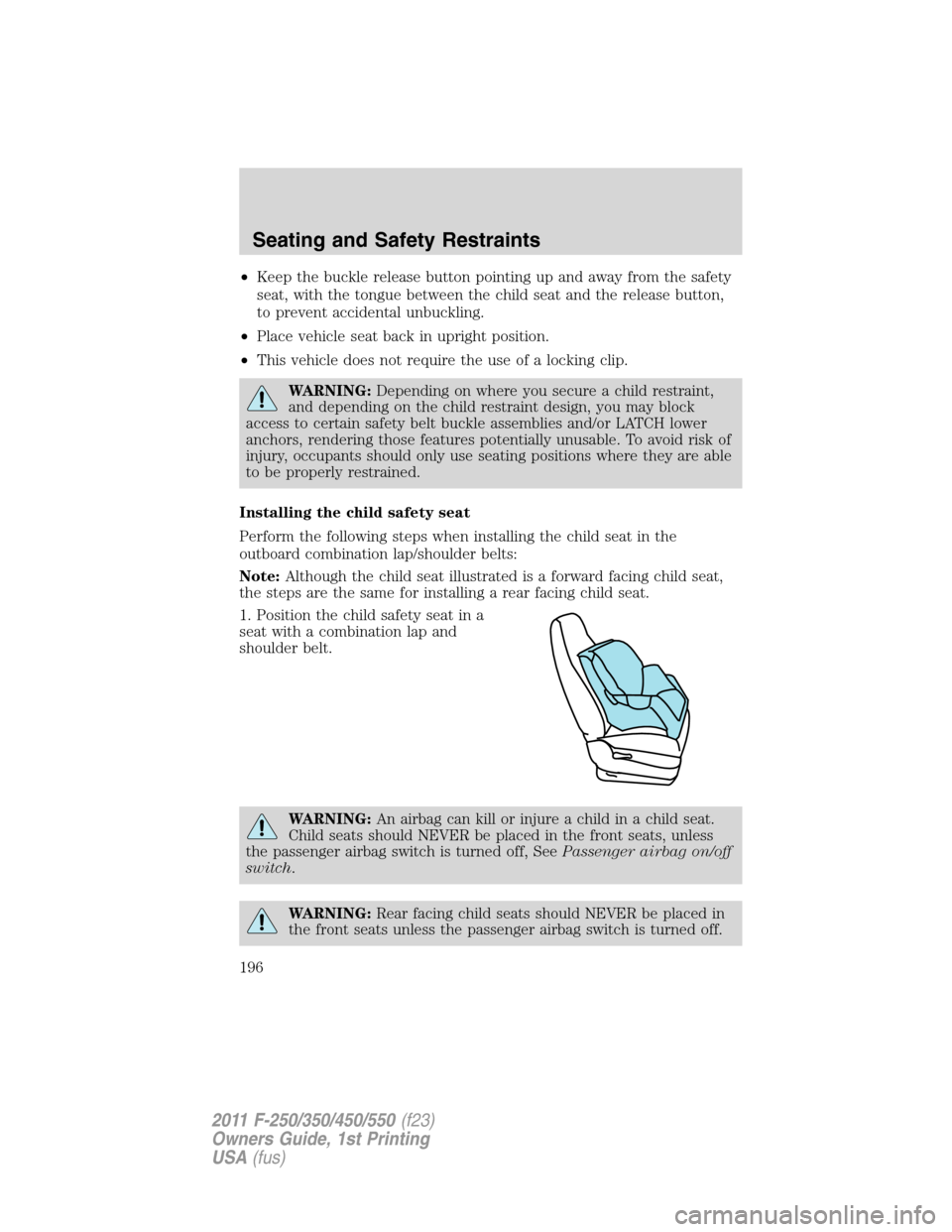
Installing the child safety seat
Perform the following steps when installing the child seat in the
outboard combination lap/shoulder belts:
Note:Although the child seat illustrated is a forward facing child seat,
the steps are the same for installing a rear facing child seat.
1. Position the child safety seat in a
seat with a combination lap and
shoulder belt.
WARNING:An airbag can kill or injure a child in a child seat.
Child seats should NEVER be placed in the front seats, unless
the passenger airbag switch is turned off, SeePassenger airbag on/off
switch.
WARNING:Rear facing child seats should NEVER be placed in
the front seats unless the passenger airbag switch is turned off.
Seating and Safety Restraints
196
2011 F-250/350/450/550(f23)
Owners Guide, 1st Printing
USA(fus)
Page 309 of 441
Snowplowing with your airbag-equipped vehicle
Your vehicle is equipped with a driver and passenger airbag
Supplemental Restraint System (SRS) The SRS is designed to activate in
certain frontal and offset frontal collisions when the vehicle sustains
sufficient longitudinal deceleration.
Careless or high speed driving while plowing snow which results in
sufficient vehicle decelerations can deploy the airbag. Such driving also
increases the risk of accidents.
WARNING:All occupants of the vehicle, including the driver,
should always properly wear their safety belts, even when an air
bag supplemental restraint system (SRS) is provided.
Never remove or defeat the “tripping mechanisms” designed into the
snow removal equipment by its manufacturer. Doing so may cause
damage to the vehicle and the snow removal equipment as well as
possible airbag deployment.
WARNING:Do not attempt to service, repair, or modify the air
bag supplemental restraint system (SRS) or its fuses. See your
Ford or Lincoln Mercury dealer.
WARNING:Additional equipment such as snowplow equipment
may effect the performance of the airbag sensors increasing the
risk of injury. Please refer to theBody Builders Layout Bookfor
instructions about the appropriate installation of additional equipment.
Transmission operation while plowing
Operate the vehicle with the automatic transmission gearshift lever in
the D (Overdrive) position and tow/haul off.
•Shift transfer case to 4L (4x4 Low) when plowing in small areas at
speeds below 5 mph (8 km/h).
•Shift transfer case to 4H (4x4 High) when plowing larger areas or light
snow at higher speeds. Do not exceed 15 mph (24 km/h).
•Do not shift the transmission from a forward gear to R (Reverse) until
the engine is at idle and the wheels are stopped.
•If the vehicle is stuck, shift the transmission in a steady motion
between forward and reverse gears. Do not rock the vehicle for more
than a few minutes. The transmission and tires may be damaged or
the engine can overheat.
Driving
309
2011 F-250/350/450/550(f23)
Owners Guide, 1st Printing
USA(fus)
Page 356 of 441
helps to remove the hot wax deposited on the wiper blade and
windshield from automated car wash facilities. Be sure to replace
wiper blades when they appear worn or do not function properly.
•Do not use abrasives, as they may cause scratches.
•Do not use fuel, kerosene, or paint thinner to clean any parts.
INSTRUMENT PANEL/INTERIOR TRIM AND CLUSTER LENS
(EXCEPT HARLEY-DAVIDSON)
Clean the instrument panel, interior trim areas and cluster lens with a
clean and damp, white cotton cloth, then with a clean and dry, white
cotton cloth.
•Avoid cleaners or polishes that increase the gloss of the upper portion
of the instrument panel. The dull finish in this area helps protect the
driver from undesirable windshield reflection.
•
Be certain to wash or wipe your hands clean if you have been in contact
with certain products such as insect repellent and suntan lotion in order
to avoid possible damage to the interior painted surfaces.
•Do not use household or glass cleaners as these may damage the
finish of the instrument panel, interior trim and cluster lens.
WARNING:Do not use chemical solvents or strong detergents
when cleaning the steering wheel or instrument panel to avoid
contamination of the airbag system.
If a staining liquid like coffee/juice has been spilled on the instrument
panel or on interior trim surfaces, clean as follows:
1. Wipe up spilled liquid using a clean white cotton cloth.
2. Wipe the surface with a damp, clean, white cotton cloth. For more
thorough cleaning, use a mild soap and water solution. If the spot cannot
be completely cleaned by this method, the area may be cleaned using a
commercially available cleaning product designed for automotive interiors.
3. If necessary, apply more soap and water solution or cleaning product
to a clean, white, cotton cloth and press the cloth onto the soiled
area–allow this to set at room temperature for 30 minutes.
4. Remove the soaked cloth, and if it is not soiled badly, use this cloth to
clean the area by using a rubbing motion for 60 seconds.
5. Following this, wipe area dry with a clean, white, cotton cloth.
Cleaning
356
2011 F-250/350/450/550(f23)
Owners Guide, 1st Printing
USA(fus)