Page 392 of 441
2. Park the vehicle on a level surface and engage the parking brake.
3. With the parking brake engaged and your foot on the brake pedal,
start the engine and move the gearshift lever through all of the gear
ranges. Allow sufficient time for each gear to engage.
4. Latch the gearshift lever in P (Park) and leave the engine running.
5. Remove the dipstick, wiping it clean with a clean, dry lint free rag. If
necessary, refer toIdentifying components in the engine compartment
in this chapter for the location of the dipstick.
6. Install the dipstick making sure it is fully seated in the filler tube.
7. Remove the dipstick and inspect the fluid level. The fluid should be in
the designated area for normal operating temperature or ambient
temperature.
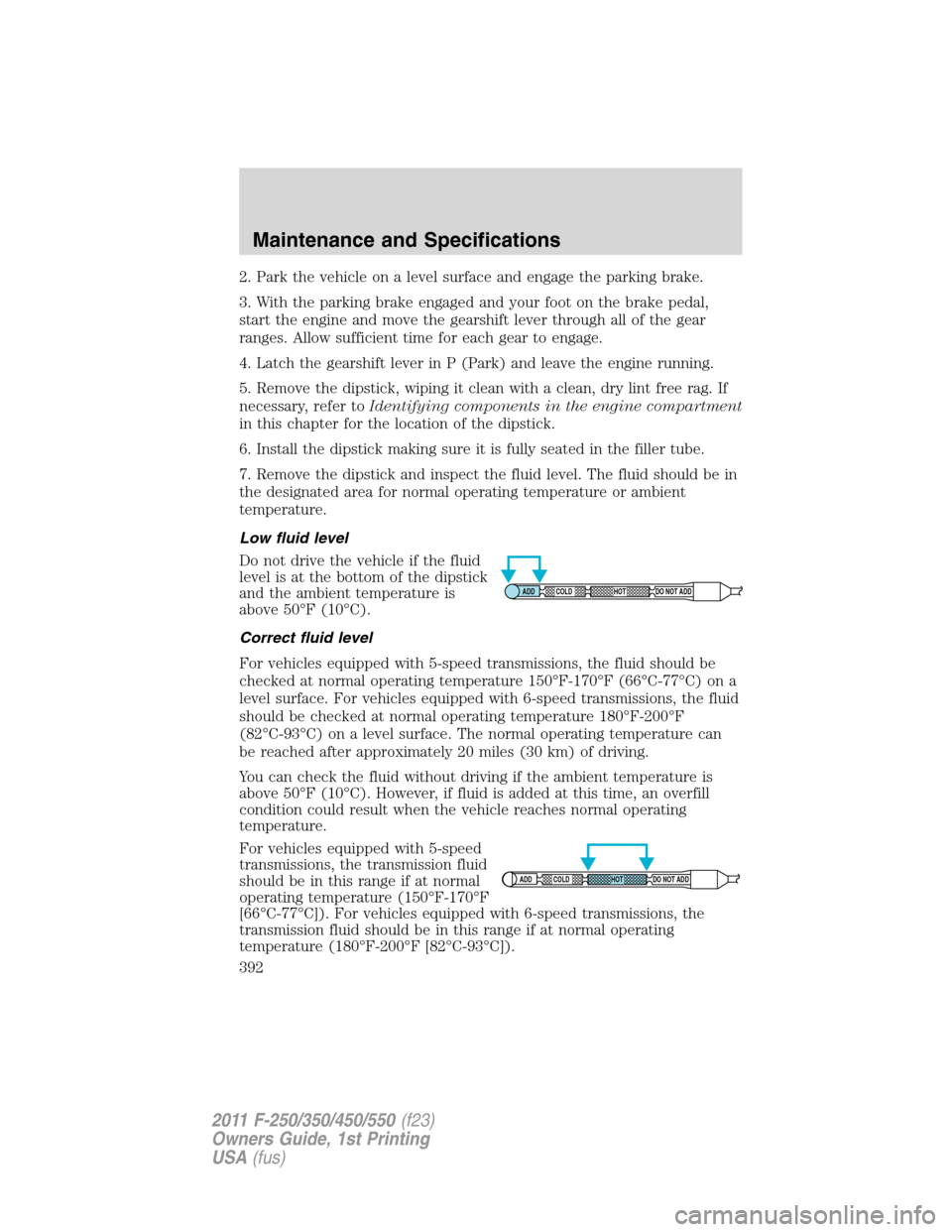
Low fluid level
Do not drive the vehicle if the fluid
level is at the bottom of the dipstick
and the ambient temperature is
above 50°F (10°C).
Correct fluid level
For vehicles equipped with 5-speed transmissions, the fluid should be
checked at normal operating temperature 150°F-170°F (66°C-77°C) on a
level surface. For vehicles equipped with 6-speed transmissions, the fluid
should be checked at normal operating temperature 180°F-200°F
(82°C-93°C) on a level surface. The normal operating temperature can
be reached after approximately 20 miles (30 km) of driving.
You can check the fluid without driving if the ambient temperature is
above 50°F (10°C). However, if fluid is added at this time, an overfill
condition could result when the vehicle reaches normal operating
temperature.
For vehicles equipped with 5-speed
transmissions, the transmission fluid
should be in this range if at normal
operating temperature (150°F-170°F
[66°C-77°C]). For vehicles equipped with 6-speed transmissions, the
transmission fluid should be in this range if at normal operating
temperature (180°F-200°F [82°C-93°C]).
ADD COLD HOT DO NOT ADD
ADD COLD HOT DO NOT ADD
Maintenance and Specifications
392
2011 F-250/350/450/550(f23)
Owners Guide, 1st Printing
USA(fus)
Page 395 of 441
The following procedure is for vehicles equipped with a gasoline engine.
If your vehicle is equipped with a diesel engine, refer to the diesel
supplement.
Note:Do not start your engine with the air cleaner removed and do not
remove it while the engine is running.
Changing the air filter element
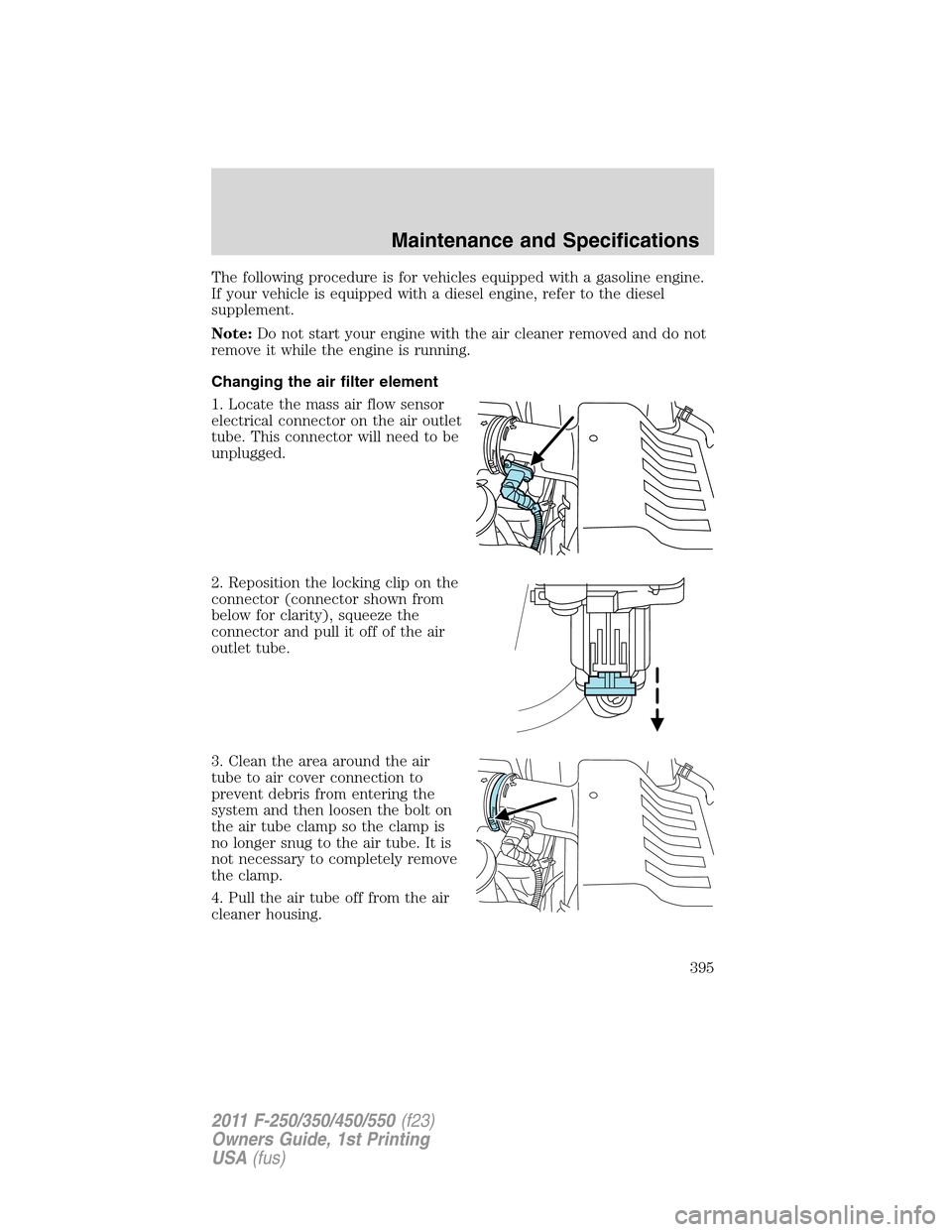
1. Locate the mass air flow sensor
electrical connector on the air outlet
tube. This connector will need to be
unplugged.
2. Reposition the locking clip on the
connector (connector shown from
below for clarity), squeeze the
connector and pull it off of the air
outlet tube.
3. Clean the area around the air
tube to air cover connection to
prevent debris from entering the
system and then loosen the bolt on
the air tube clamp so the clamp is
no longer snug to the air tube. It is
not necessary to completely remove
the clamp.
4. Pull the air tube off from the air
cleaner housing.
Maintenance and Specifications
395
2011 F-250/350/450/550(f23)
Owners Guide, 1st Printing
USA(fus)
Page 397 of 441
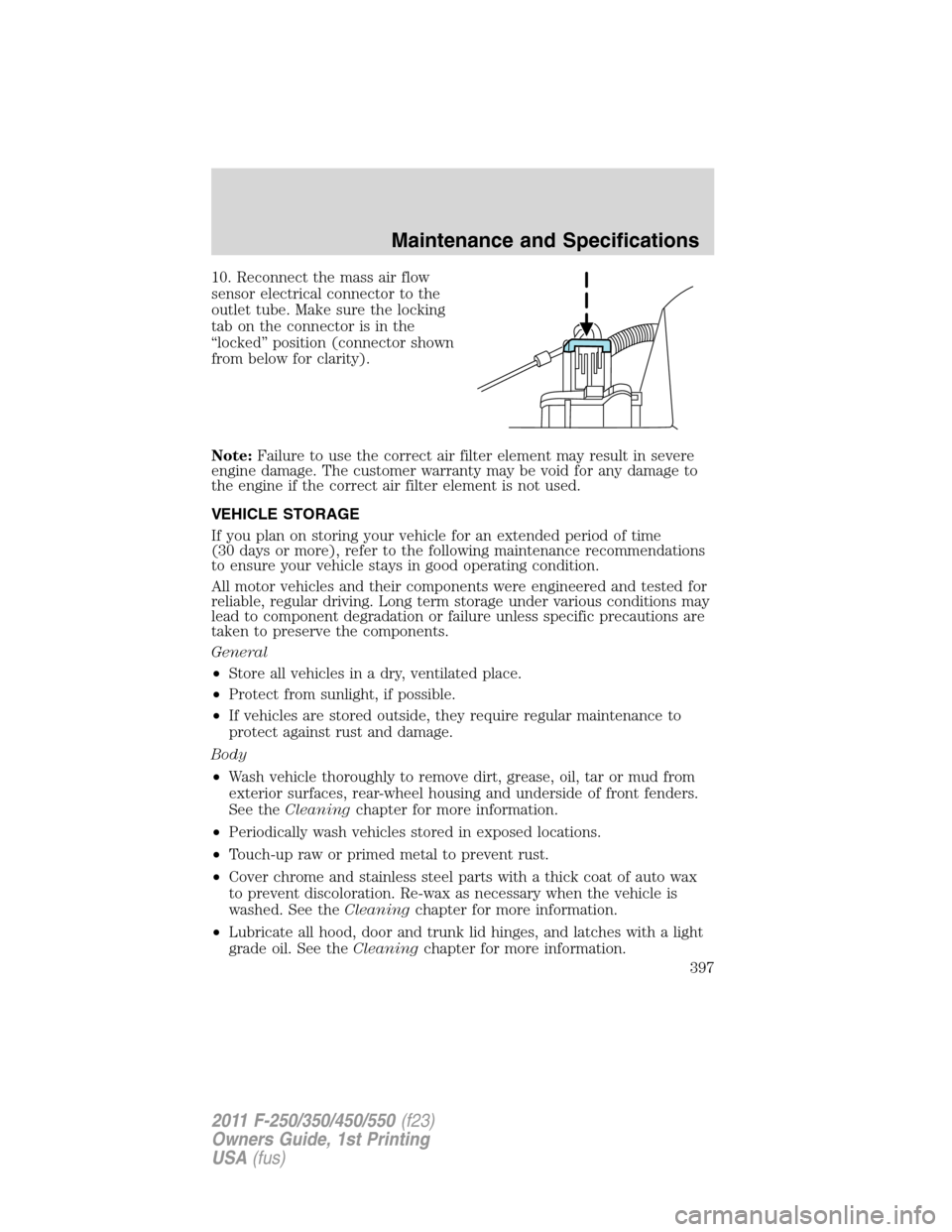
10. Reconnect the mass air flow
sensor electrical connector to the
outlet tube. Make sure the locking
tab on the connector is in the
“locked” position (connector shown
from below for clarity).
Note:Failure to use the correct air filter element may result in severe
engine damage. The customer warranty may be void for any damage to
the engine if the correct air filter element is not used.
VEHICLE STORAGE
If you plan on storing your vehicle for an extended period of time
(30 days or more), refer to the following maintenance recommendations
to ensure your vehicle stays in good operating condition.
All motor vehicles and their components were engineered and tested for
reliable, regular driving. Long term storage under various conditions may
lead to component degradation or failure unless specific precautions are
taken to preserve the components.
General
•Store all vehicles in a dry, ventilated place.
•Protect from sunlight, if possible.
•If vehicles are stored outside, they require regular maintenance to
protect against rust and damage.
Body
•Wash vehicle thoroughly to remove dirt, grease, oil, tar or mud from
exterior surfaces, rear-wheel housing and underside of front fenders.
See theCleaningchapter for more information.
•Periodically wash vehicles stored in exposed locations.
•Touch-up raw or primed metal to prevent rust.
•Cover chrome and stainless steel parts with a thick coat of auto wax
to prevent discoloration. Re-wax as necessary when the vehicle is
washed. See theCleaningchapter for more information.
•Lubricate all hood, door and trunk lid hinges, and latches with a light
grade oil. See theCleaningchapter for more information.
Maintenance and Specifications
397
2011 F-250/350/450/550(f23)
Owners Guide, 1st Printing
USA(fus)
Page 398 of 441
•Cover interior trim to prevent fading.
•Keep all rubber parts free from oil and solvents.
Engine
•The engine oil and filter should be changed prior to storage, as used
engine oil contain contaminates that may cause engine damage.
•Start the engine every 15 days. Run at fast idle until it reaches normal
operating temperature.
•With your foot on the brake, shift through all the gears while the
engine is running.
Fuel system
•Fill the fuel tank with high-quality fuel until the first automatic shutoff
of the fuel pump nozzle.
Note:During extended periods of vehicle storage (30 days or more),
fuel may deteriorate due to oxidation. This can damage rubber and other
polymers in the fuel system and may also clog small holes.
A quality fuel stabilizer should be added whenever actual or expected
storage periods exceed 30 days. Follow the instructions on the label. The
vehicle should then be operated at idle speed to circulate the additive
throughout the fuel system.
Cooling system
•Protect against freezing temperatures.
Battery
•Check and recharge as necessary. Keep connections clean and covered
with a light coat of grease.
•If storing your vehicle for more than 30 days without recharging the
battery, it may be advisable to disconnect the battery cables to ensure
battery charge is maintained for quick starting.
Note:If battery cables are disconnected, it will be necessary to reset
memory features.
Brakes
•Make sure brakes and parking brake are fully released.
Tires
•Maintain recommended air pressure.
Maintenance and Specifications
398
2011 F-250/350/450/550(f23)
Owners Guide, 1st Printing
USA(fus)
Page 399 of 441

Miscellaneous
•Make sure all linkages, cables, levers and pins under vehicle are
covered with grease to prevent rust.
•Move vehicles at least 25 feet (8 m) every 15 days to lubricate
working parts and prevent corrosion.
Removing vehicle from storage
When your vehicle is ready to come out of storage, do the following:
•Wash your vehicle to remove any dirt or grease film build-up on
window surfaces.
•Check windshield wipers for any deterioration.
•Check under the hood for any foreign material that may have collected
during storage (mice/squirrel nests).
•Check the exhaust for any foreign material that may have collected
during storage.
•Check tire pressures and set tire inflation per the Tire Label.
•Check brake pedal operation. Drive the vehicle 15 ft (4.5 meters) back
and forth to remove rust build up.
•If the battery was removed, clean the battery cable ends and inspect.
If you have any concerns or issues, contact your authorized dealer.
MOTORCRAFT PART NUMBERS
Component 6.2L V8 engine 6.8L V10 engine
Air filter element FA-1883 FA-1883
Oil filter FL-820-S FL-820-S
Battery (standard) BXT-65-650 BXT-65-650
Battery (optional) BXT-65-750 BXT-65-750
Spark plugs-platinum
1
1
For spark plug replacement, see your authorized dealer. Refer to the
scheduled maintenance informationfor the appropriate intervals for
changing the spark plugs.
Replace the spark plugs with ones that meet Ford material and
design specifications for your vehicle, such as Motorcraft�or
equivalent replacement parts. The customer warranty may be void
for any damage to the engine if such spark plugs are not used.
Maintenance and Specifications
399
2011 F-250/350/450/550(f23)
Owners Guide, 1st Printing
USA(fus)
Page 401 of 441
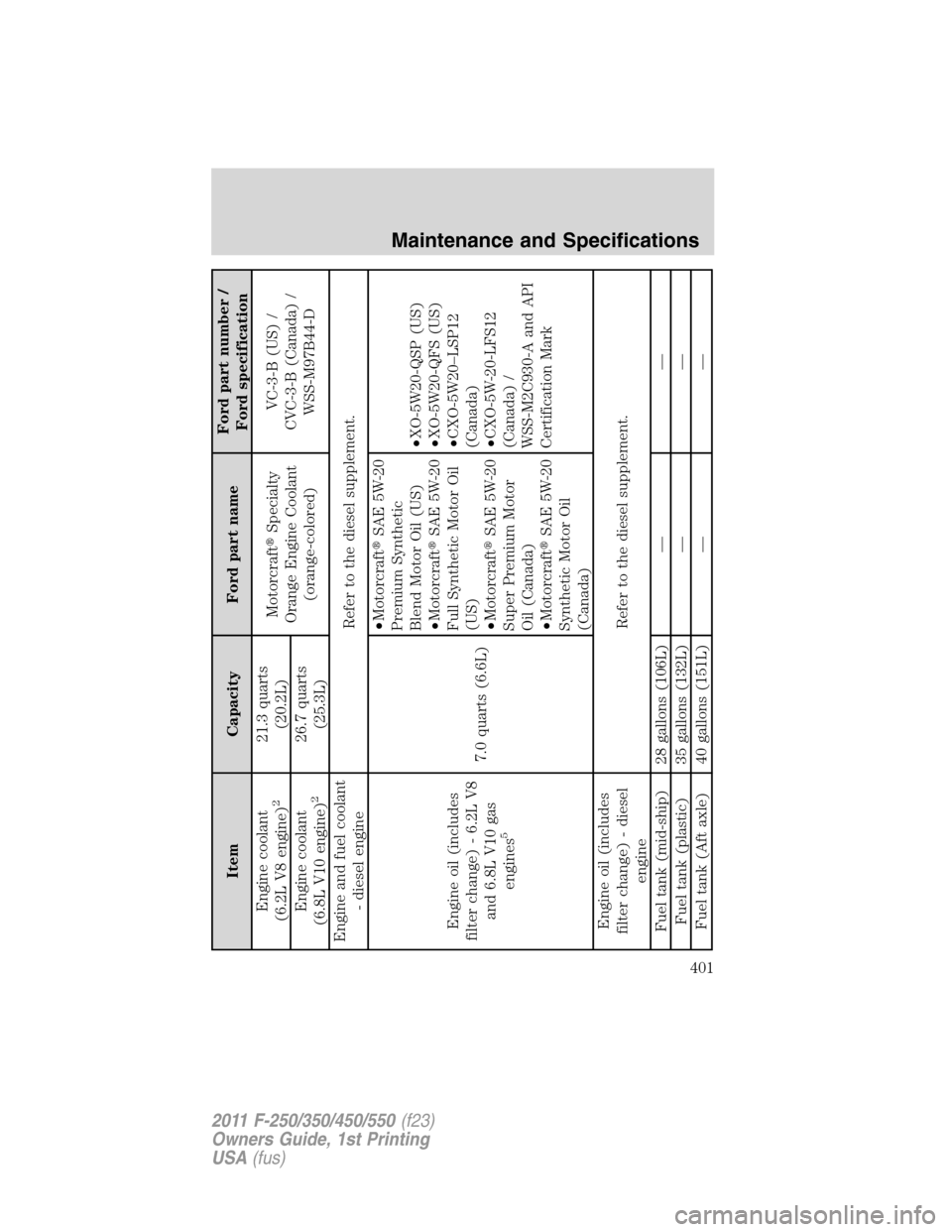
Item Capacity Ford part nameFord part number /
Ford specification
Engine coolant
(6.2L V8 engine)
2
21.3 quarts
(20.2L)Motorcraft�Specialty
Orange Engine Coolant
(orange-colored)VC-3-B (US) /
CVC-3-B (Canada) /
WSS-M97B44-D Engine coolant
(6.8L V10 engine)
2
26.7 quarts
(25.3L)
Engine and fuel coolant
- diesel engineRefer to the diesel supplement.
Engine oil (includes
filter change) - 6.2L V8
and 6.8L V10 gas
engines
5
7.0 quarts (6.6L)•Motorcraft�SAE 5W-20
Premium Synthetic
Blend Motor Oil (US)
•Motorcraft�SAE 5W-20
Full Synthetic Motor Oil
(US)
•Motorcraft�SAE 5W-20
Super Premium Motor
Oil (Canada)
•Motorcraft�SAE 5W-20
Synthetic Motor Oil
(Canada)•XO-5W20-QSP (US)
•XO-5W20-QFS (US)
•CXO-5W20–LSP12
(Canada)
•CXO-5W-20-LFS12
(Canada) /
WSS-M2C930-A and API
Certification Mark
Engine oil (includes
filter change) - diesel
engineRefer to the diesel supplement.
Fuel tank (mid-ship) 28 gallons (106L) — —
Fuel tank (plastic) 35 gallons (132L) — —
Fuel tank (Aft axle) 40 gallons (151L) — —
Maintenance and Specifications
401
2011 F-250/350/450/550(f23)
Owners Guide, 1st Printing
USA(fus)
Page 403 of 441
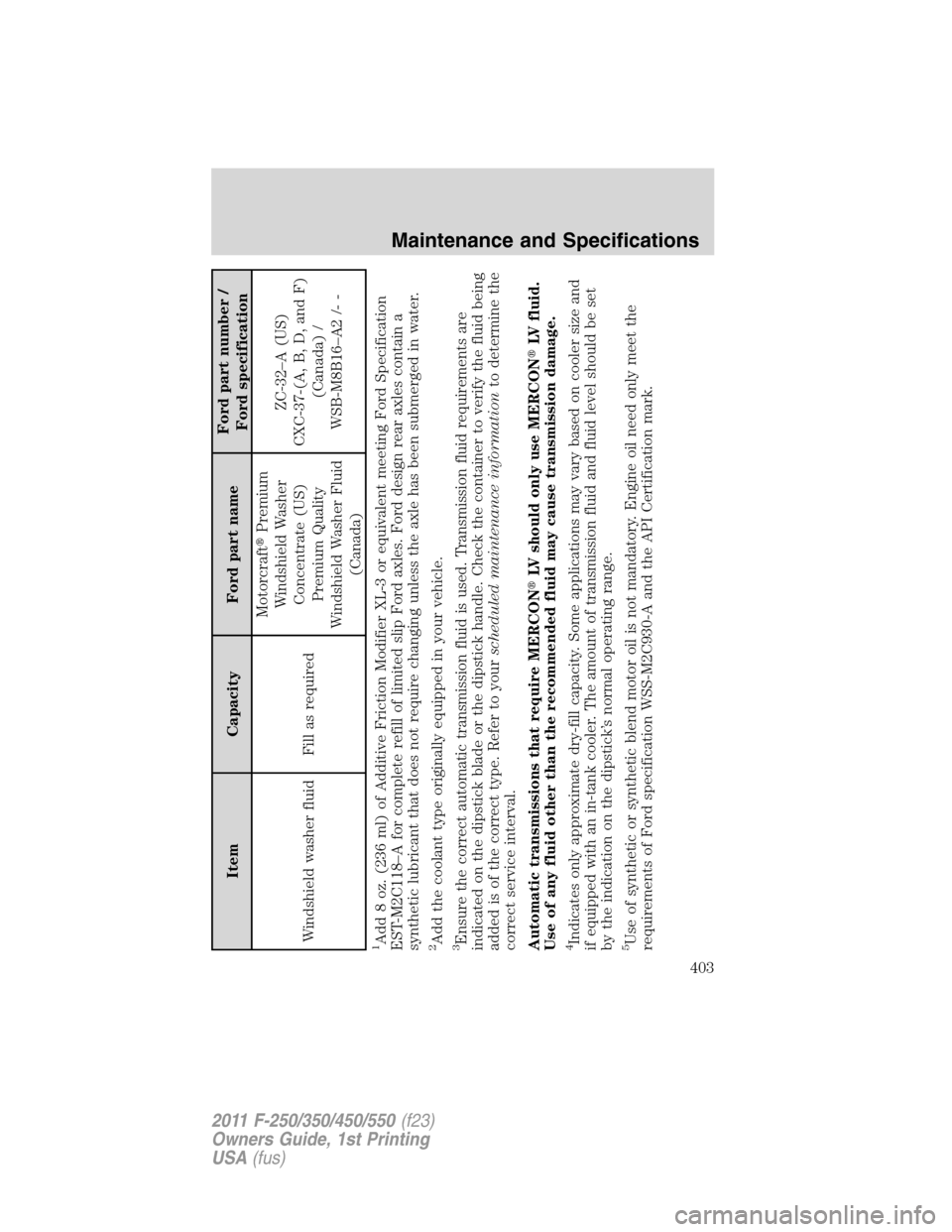
Item Capacity Ford part nameFord part number /
Ford specification
Windshield washer fluid Fill as requiredMotorcraft�Premium
Windshield Washer
Concentrate (US)
Premium Quality
Windshield Washer Fluid
(Canada)ZC-32–A (US)
CXC-37-(A, B, D, and F)
(Canada) /
WSB-M8B16–A2 /- -
1Add 8 oz. (236 ml) of Additive Friction Modifier XL-3 or equivalent meeting Ford Specification
EST-M2C118–A for complete refill of limited slip Ford axles. Ford design rear axles contain a
synthetic lubricant that does not require changing unless the axle has been submerged in water.2Add the coolant type originally equipped in your vehicle.3Ensure the correct automatic transmission fluid is used. Transmission fluid requirements are
indicated on the dipstick blade or the dipstick handle. Check the container to verify the fluid being
added is of the correct type. Refer to yourscheduled maintenance informationto determine the
correct service interval.
Automatic transmissions that require MERCON�LV should only use MERCON�LV fluid.
Use of any fluid other than the recommended fluid may cause transmission damage.4Indicates only approximate dry-fill capacity. Some applications may vary based on cooler size and
if equipped with an in-tank cooler. The amount of transmission fluid and fluid level should be set
by the indication on the dipstick’s normal operating range.5Use of synthetic or synthetic blend motor oil is not mandatory. Engine oil need only meet the
requirements of Ford specification WSS-M2C930-A and the API Certification mark.
Maintenance and Specifications
403
2011 F-250/350/450/550(f23)
Owners Guide, 1st Printing
USA(fus)
Page 404 of 441
ENGINE DATA
Engine 6.2L V8 engine 6.8L V10 engine
Cubic inches 378 413
Required fuel 87 octane 87 octane
Firing order 1-3-7-2-6-5-4-8 1-6-5-10-2-7-3-8-4-9
Spark plug gap0.039–0.043 inch
(1.0–1.1mm)0.039–0.043 inch
(1.0–1.1mm)
Ignition system Coil on plug Coil on plug
Compression ratio 9.8:1 9.2:1
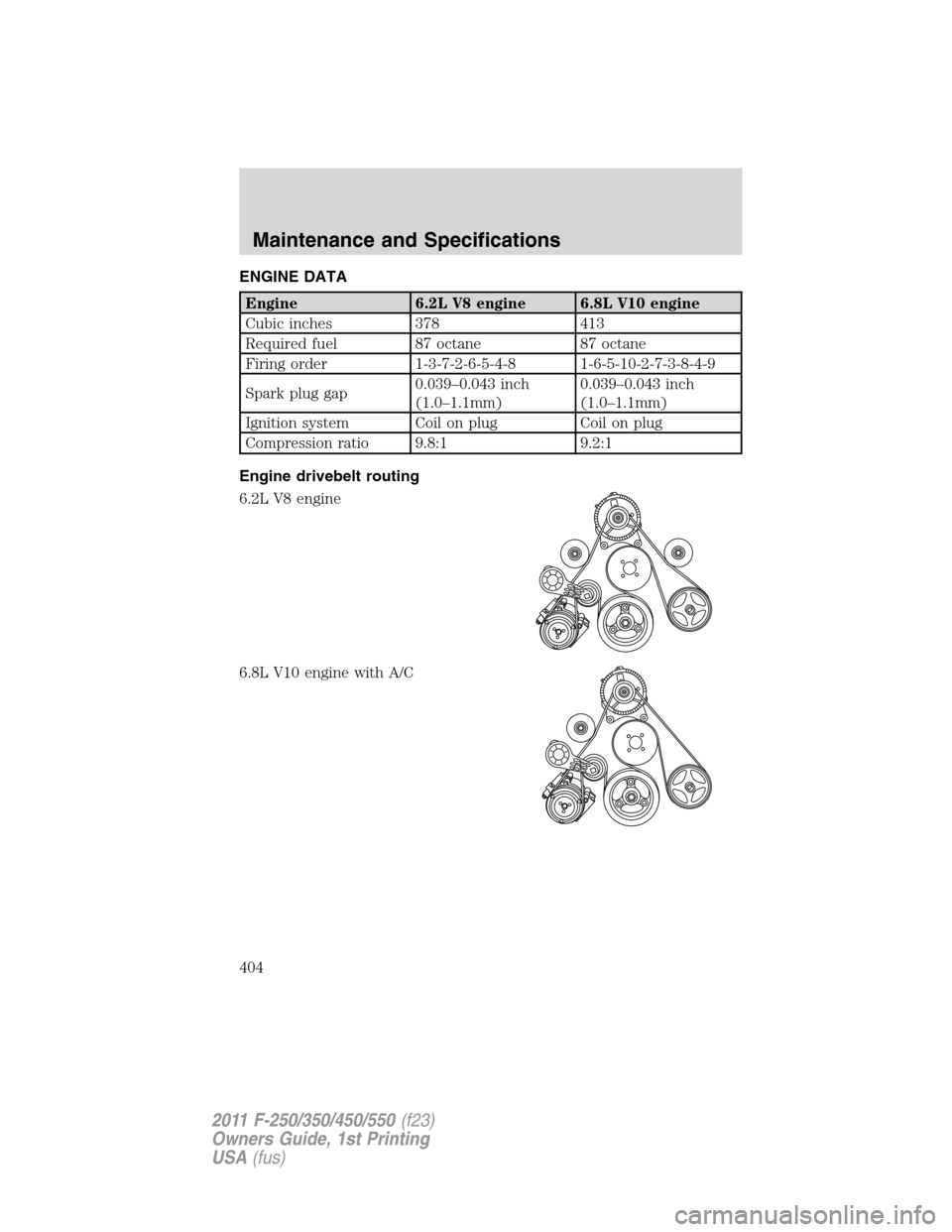
Engine drivebelt routing
6.2L V8 engine
6.8L V10 engine with A/C
Maintenance and Specifications
404
2011 F-250/350/450/550(f23)
Owners Guide, 1st Printing
USA(fus)