POWER STROKE DIESEL ENGINE
Your new diesel engine will feel, drive and function somewhat differently
than a gasoline engine. Therefore it is very important that you read and
thoroughly familiarize yourself and others operating the vehicle with this
guide.A special procedure for turning off the diesel engine is in the
Drivingchapter. It is important to read and understand this
material in order to maintain the best service life for your engine.
This guide will acquaint you with the Power Stroke diesel engine. It
provides recommendations on engine care and operating procedures. For
complete vehicle information, also refer to theOwner’s Guideincluded
with the vehicle. It also describes equipment and gives specifications for
equipment that was in effect when this guide was approved for printing,
and should be considered a permanent part of the vehicle.
Some aftermarket products may cause severe engine/transmission
and/or exhaust system damage;refer to theWarranty Guidefor more
information.Your vehicle’s powertrain control systems can detect
and store information about vehicle modifications that increase
horsepower and torque output such as whether or not
performance-enhancing powertrain components commonly referred
to as “performance chips” have been used. This information cannot
be erased and will stay in the system’s memory even if the
modification is removed. The information can be retrieved by Ford
Motor Company, Ford of Canada, and service and repair facilities
when servicing your vehicle. This information may be used to
determine if repairs will be covered by warranty.
Ford may discontinue models or change specifications without any notice
and without incurring obligations.
Important notice
Ford vehicles are suitable for producing ambulances only if equipped
with the Ford ambulance preparation package. In addition, Ford urges
ambulance manufacturers to follow the recommendation of theFord
Incomplete Vehicle Manual, Ford Truck Body Builder’s Layout Book
(and pertinent supplements) and theQualified Vehicle Modifiers
Guidelines.Using a Ford vehicle without the Ford ambulance
preparation package to produce an ambulance voids the Ford warranty
and could result in elevated underbody temperatures, fuel
overpressurization and the risk of fuel expulsion and fires. To determine
whether the vehicle is equipped with the Ford ambulance preparation
package, inspect the information plate on the driver’s side door pillar.
Contact the manufacturer of your vehicle to determine whether the
ambulance manufacturer’s followed Ford’s recommendations.
Introduction
2
2011 Econoline(eco)
Supplement, 1st Printing
USA(fus)
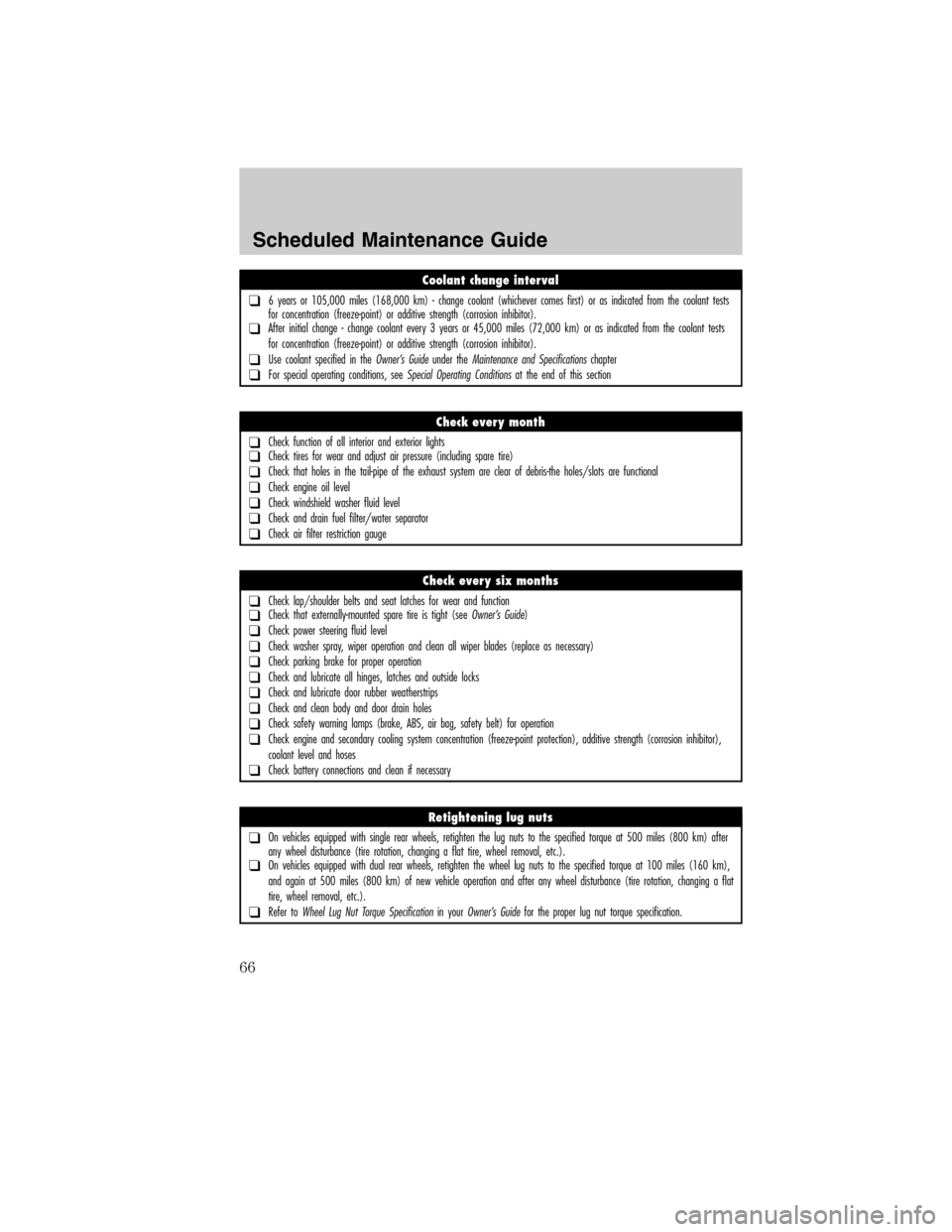
Coolant change interval
❑6 years or 105,000 miles (168,000 km) - change coolant (whichever comes first) or as indicated from the coolant tests
for concentration (freeze-point) or additive strength (corrosion inhibitor).
❑After initial change - change coolant every 3 years or 45,000 miles (72,000 km) or as indicated from the coolant tests
for concentration (freeze-point) or additive strength (corrosion inhibitor).
❑Use coolant specified in theOwner’s Guideunder theMaintenance and Specificationschapter
❑For special operating conditions, seeSpecial Operating Conditionsat the end of this section
Check every month
❑Check function of all interior and exterior lights❑Check tires for wear and adjust air pressure (including spare tire)
❑Check that holes in the tail-pipe of the exhaust system are clear of debris-the holes/slots are functional
❑Check engine oil level
❑Check windshield washer fluid level
❑Check and drain fuel filter/water separator
❑Check air filter restriction gauge
Check every six months
❑Check lap/shoulder belts and seat latches for wear and function❑Check that externally-mounted spare tire is tight (seeOwner’s Guide)
❑Check power steering fluid level
❑Check washer spray, wiper operation and clean all wiper blades (replace as necessary)
❑Check parking brake for proper operation
❑Check and lubricate all hinges, latches and outside locks
❑Check and lubricate door rubber weatherstrips
❑Check and clean body and door drain holes
❑Check safety warning lamps (brake, ABS, air bag, safety belt) for operation
❑Check engine and secondary cooling system concentration (freeze-point protection), additive strength (corrosion inhibitor),
coolant level and hoses
❑Check battery connections and clean if necessary
Retightening lug nuts
❑On vehicles equipped with single rear wheels, retighten the lug nuts to the specified torque at 500 miles (800 km) after
any wheel disturbance (tire rotation, changing a flat tire, wheel removal, etc.).
❑On vehicles equipped with dual rear wheels, retighten the wheel lug nuts to the specified torque at 100 miles (160 km),
and again at 500 miles (800 km) of new vehicle operation and after any wheel disturbance (tire rotation, changing a flat
tire, wheel removal, etc.).
❑Refer toWheel Lug Nut Torque Specificationin yourOwner’s Guidefor the proper lug nut torque specification.
Scheduled Maintenance Guide
66
2011 Econoline(eco)
Supplement, 1st Printing
USA(fus)