2011 FORD SUPER DUTY radiator
[x] Cancel search: radiatorPage 46 of 90
•Do not mix with recycled coolant unless from a Ford-approved
recycling process (seeUse of recycled engine coolantsection).
WARNING:To reduce the risk of personal injury, make sure the
engine is cool before unscrewing the coolant pressure relief cap.
The cooling system(s) are under pressure; steam and hot liquid can
come out forcefully when the cap is loosened slightly.
Add the proper mixture of coolant and distilled water to the cooling
system(s) by following these steps:
1. Before you remove the cap, turn the engine off and let it cool.
2. When the engine is cool, wrap a thick cloth around the cap. Slowly
turn cap counterclockwise until pressure begins to release.
3. Step back while the pressure releases.
4. When you are sure that all the pressure has been released, use the
cloth to turn it counterclockwise and remove the cap.
Engine and secondary cooling system refill procedure
The following procedure should be used when refilling the engine or
secondary cooling systems after it has been drained or become extremely
low.
1. Remove the pressure relief cap from the engine or secondary coolant
reservoir as previously outlined.
2. Slowly add a 50/50 mixture of coolant and distilled water to the
coolant reservoir until the coolant level is within the COLD FILL RANGE
as listed on the reservoir.
3. Reinstall the pressure relief cap.
4. Start and run the engine at 2,000 rpm for 2 minutes.
5. Shut engine off, and remove the pressure relief cap as previously
outlined.
6. If required, add a 50/50 mixture of coolant and distilled water to the
coolant reservoir until the coolant level is within the COLD FILL RANGE
as listed on the reservoir.
7. Engine cooling system: Repeat Step 3 until the coolant level has
stabilized (is no longer dropping after each step) AND the upper radiator
hose at the radiator is warm to the touch (indicating that the engine
thermostat is open and coolant is flowing through the radiator).
Secondary cooling system: Repeat Step 3 until the coolant level has
stabilized (is no longer dropping after each step) AND the lower
Maintenance and Specifications
46
2011 Econoline(eco)
Supplement, 1st Printing
USA(fus)
Page 47 of 90

passenger side of the secondary radiator is warm to the touch
(indicating secondary thermostat is open and coolant is flowing
through the entire system).
8. Reinstall the pressure relief cap. Shut the engine off and let it cool.
9. Check the coolant level in the reservoir before you drive your vehicle
the next few times (with the engine cool).
10. If necessary, add a 50/50 mixture of coolant and distilled water to the
coolant reservoir until the coolant level is within the COLD FILL RANGE
as listed on the reservoir. After any coolant has been added, check the
coolant concentration. SeeEngine and secondary cooling system
coolantearlier. If the concentration is not 50/50 (protection to
–34°F/–36°C), drain some coolant and adjust the concentration. It may
take several drains and additions to obtain a 50/50 coolant concentration.
Whenever coolant has been added, the coolant level in the coolant
reservoir should be checked the next few times you drive the vehicle. If
necessary, add enough 50/50 concentration of coolant and distilled water
to bring the liquid level to the proper level.
Coolant refill capacity
To find out how much fluid your vehicle’s cooling system can hold, refer
toMaintenance product specifications and capacitiesin this chapter.
Coolant additives
At specific mileage intervals of 15,000 miles (24,000 km), as listed in the
scheduled maintenance informationchapter, the coolant additive
should be checked. The optional message center, if equipped, will also
display the messageCHECK COOLANT ADDITIVEat this time. The
purpose of checking is to verify the correct concentration (freeze point
protection) and additive strength (corrosion inhibitor) levels of the
coolant for maximum engine performance and protection. Three
products are available for ensuring the life and health of the coolant: two
test kits and a coolant inhibitor additive:
•Rotunda 328-00007 (Matthew’s Water CoolCheck) – Evaluates water
quality (hardness, chloride, and pH) for 50/50 mixture of coolant and
distilled water. Use distilled water. If distilled water is unavailable,
water meeting the requirements of Rotunda 328-00007, is sufficient
for vehicle use. Using water that fails to meet the requirements can
lead to coolant passage scaling and degrade the engine’s durability and
performance.
Maintenance and Specifications
47
2011 Econoline(eco)
Supplement, 1st Printing
USA(fus)
Page 58 of 90
•Try operating the starter switch several times. Should the switch be
corroded, this operation may clean the contacts or make the switch
temporarily operable until you can reach the dealer.
•If all electrical connections are tight and you need assistance to start,
refer toJump startingin theRoadside Emergencieschapter of your
Owner’s Guide.
If engine cranks but won’t start
Prolonged starter cranking (in excess of 10 seconds) could cause
damage to the starter motor.
•Check the fuel gauge. You may be out of fuel. If the gauge shows that
there is fuel in the tank, the trouble may be in the electrical system or
the fuel system. If equipped with an auxiliary tank, be sure that the
tank control switch is set for the tank with fuel and not on an empty
tank.
•Leaving the ignition key turned to on for over two minutes without
starting may make starting difficult because the glow plugs will cease
activation. Reset the system by turning the ignition key to off and
then back to on again.
If the engine runs hot
The following could cause the engine to overheat:
•Lack of coolant.
•Dirty cooling system.
•Plugged radiator fins, A/C condenser and/or oil cooler.
•Malfunctioning fan drive.
•Driving with frozen coolant.
•Sticking thermostat.
•Overloading or pulling heavy trailers during hot weather.
•Grill or radiator air blockage.
•Slipping or missing drive belt.
•Plugged or very dirty air filter.
Maintenance and Specifications
58
2011 Econoline(eco)
Supplement, 1st Printing
USA(fus)
Page 67 of 90
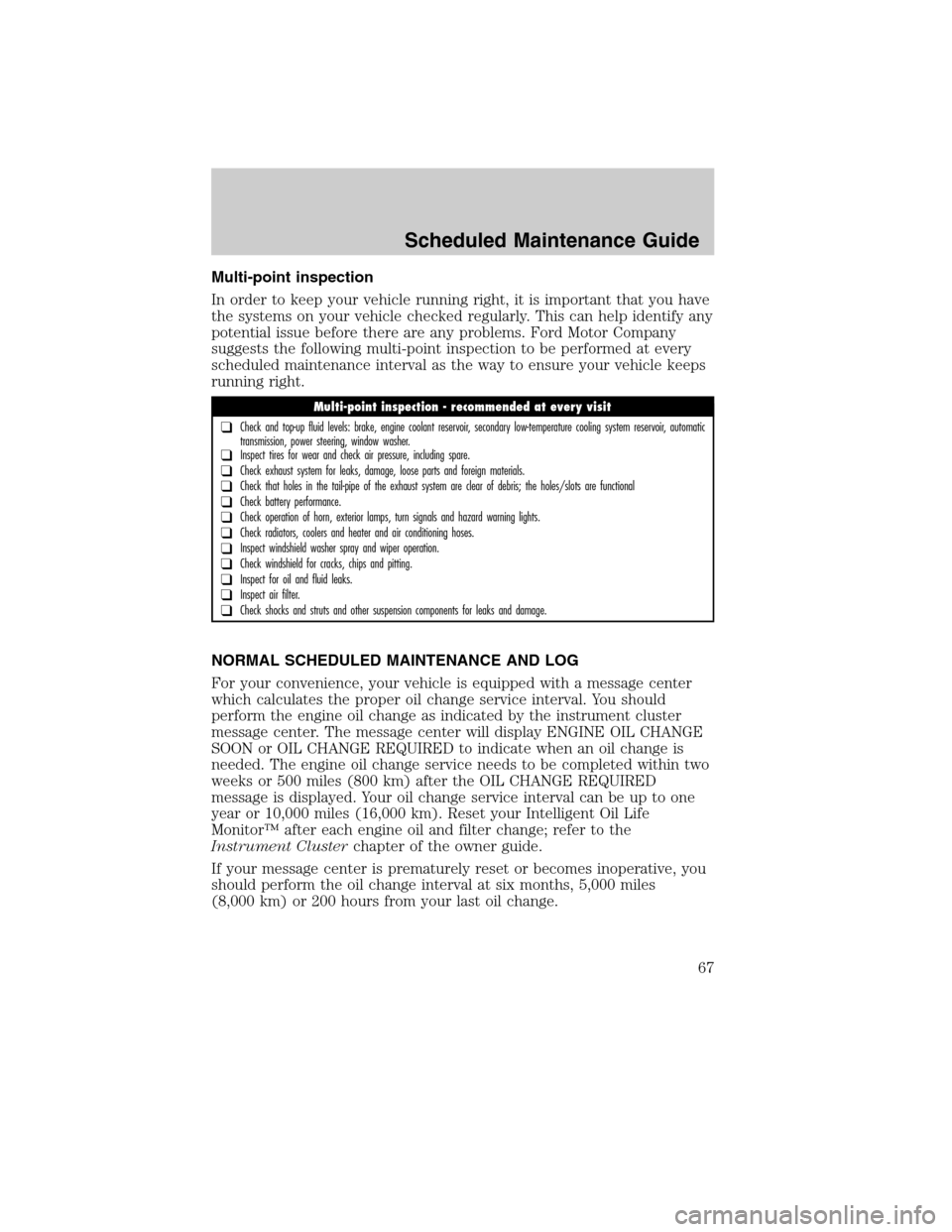
Multi-point inspection
In order to keep your vehicle running right, it is important that you have
the systems on your vehicle checked regularly. This can help identify any
potential issue before there are any problems. Ford Motor Company
suggests the following multi-point inspection to be performed at every
scheduled maintenance interval as the way to ensure your vehicle keeps
running right.
NORMAL SCHEDULED MAINTENANCE AND LOG
For your convenience, your vehicle is equipped with a message center
which calculates the proper oil change service interval. You should
perform the engine oil change as indicated by the instrument cluster
message center. The message center will display ENGINE OIL CHANGE
SOON or OIL CHANGE REQUIRED to indicate when an oil change is
needed. The engine oil change service needs to be completed within two
weeks or 500 miles (800 km) after the OIL CHANGE REQUIRED
message is displayed. Your oil change service interval can be up to one
year or 10,000 miles (16,000 km). Reset your Intelligent Oil Life
Monitor™ after each engine oil and filter change; refer to the
Instrument Clusterchapter of the owner guide.
If your message center is prematurely reset or becomes inoperative, you
should perform the oil change interval at six months, 5,000 miles
(8,000 km) or 200 hours from your last oil change.
Multi-point inspection - recommended at every visit
❑Check and top-up fluid levels: brake, engine coolant reservoir, secondary low-temperature cooling system reservoir, automatic
transmission, power steering, window washer.
❑Inspect tires for wear and check air pressure, including spare.
❑Check exhaust system for leaks, damage, loose parts and foreign materials.
❑Check that holes in the tail-pipe of the exhaust system are clear of debris; the holes/slots are functional
❑Check battery performance.
❑Check operation of horn, exterior lamps, turn signals and hazard warning lights.
❑Check radiators, coolers and heater and air conditioning hoses.
❑Inspect windshield washer spray and wiper operation.
❑Check windshield for cracks, chips and pitting.
❑Inspect for oil and fluid leaks.
❑Inspect air filter.
❑Check shocks and struts and other suspension components for leaks and damage.
Scheduled Maintenance Guide
67
2011 Econoline(eco)
Supplement, 1st Printing
USA(fus)