2011 FORD RANGER tires
[x] Cancel search: tiresPage 191 of 302

Fuse/Relay
LocationFuse Amp
RatingProtected Circuits
43 20A* A/C relay coil, IAC, Mass air flow
sensor, Heated exhaust gas oxygen
sensor, Catalyst module sensor, Vapor
management valve solenoid, EGR
solenoid, Heated PCV
44 15A* Ignition coil, Capacitor
45A — Not used
45B — Not used
46A — A/C clutch solenoid
46B — Not used
47 — PCM relay
48A — Fuel pump relay, Fuel injectors relay
48B — Fog lamp relay
51 — Not used
52 — Not used
53 — Not used
54 — Not used
55 — Blower relay
56 — Starter relay
* Mini Fuses ** Maxi Fuses
CHANGING THE TIRES
If you get a flat tire while driving, do not apply the brake heavily.
Instead, gradually decrease your speed. Hold the steering wheel firmly
and slowly move to a safe place on the side of the road.
Note:The tire pressure monitoring system (TPMS) indicator light will
illuminate when the spare tire is in use. To restore the full functionality
of the monitoring system, all road wheels equipped with tire pressure
monitoring sensors must be mounted on the vehicle.
Have a flat serviced by an authorized dealer in order to prevent damage
to the TPMS sensors, refer toTire pressure monitoring system
(TPMS)in theTires, Wheels and Loadingchapter. Replace the spare
tire with a road tire as soon as possible. During repairing or replacing of
the flat tire, have the authorized dealer inspect the TPMS sensor for
damage.
Roadside Emergencies
191
2011 Ranger(ran)
Owners Guide, 1st Printing
USA(fus)
Page 192 of 302

WARNING:The use of tire sealants may damage your tire
pressure monitoring system (TPMS) and should not be used.
However, if you must use a sealant, the TPMS sensor and valve stem
on the wheel must be replaced by an authorized Ford dealer.
WARNING:Refer toTire pressure monitoring system (TPMS)
in theTires, Wheels and Loadingchapter for important
information. If the tire pressure monitor sensor becomes damaged, it
will no longer function.
Dissimilar spare tire/wheel information
WARNING:Failure to follow these guidelines could result in an
increased risk of loss of vehicle control, injury or death.
If you have a dissimilar spare tire/wheel, then it is intended for
temporary use only. This means that if you need to use it, you should
replace it as soon as possible with a road tire/wheel that is the same size
and type as the road tires and wheels that were originally provided by
Ford. If the dissimilar spare tire or wheel is damaged, it should be
replaced rather than repaired.
A dissimilar spare tire/wheel is defined as a spare tire and/or wheel that
is different in brand, size or appearance from the road tires and wheels
and can be one of three types:
1.T-type mini-spare:This spare tire begins with the letter “T” for tire
size and may have “Temporary Use Only” molded in the sidewall
2.Full-size dissimilar spare with label on wheel:This spare tire has
a label on the wheel that states: “THIS TIRE AND WHEEL FOR
TEMPORARY USE ONLY”
When driving with one of the dissimilar spare tires listed above,do not:
•Exceed 50 mph (80 km/h)
•Load the vehicle beyond maximum vehicle load rating listed on the
Safety Compliance Label
•Tow a trailer
•Use snow chains on the end of the vehicle with the dissimilar spare
tire
•Use more than one dissimilar spare tire at a time
Roadside Emergencies
192
2011 Ranger(ran)
Owners Guide, 1st Printing
USA(fus)
Page 193 of 302

•Use commercial car washing equipment
•Try to repair the dissimilar spare tire
Use of one of the dissimilar spare tires listed above at any one wheel
location can lead to impairment of the following:
•Handling, stability and braking performance
•Comfort and noise
•Ground clearance and parking at curbs
•Winter weather driving capability
•Wet weather driving capability
3.Full-size dissimilar spare without label on wheel
When driving with the full-size dissimilar spare tire/wheel,do not:
•Exceed 70 mph (113 km/h)
•Use more than one dissimilar spare tire/wheel at a time
•Use commercial car washing equipment
•Use snow chains on the end of the vehicle with the dissimilar spare
tire/wheel
The usage of a full-size dissimilar spare tire/wheel can lead to
impairment of the following:
•Handling, stability and braking performance
•Comfort and noise
•Ground clearance and parking at curbs
•Winter weather driving capability
•Wet weather driving capability
•All-wheel driving capability (if applicable)
•Load leveling adjustment (if applicable)
When driving with the full-size dissimilar spare tire/wheel additional
caution should be given to:
•Towing a trailer
•Driving vehicles equipped with a camper body
•Driving vehicles with a load on the cargo rack
Drive cautiously when using a full-size dissimilar spare tire/wheel and
seek service as soon as possible.
Roadside Emergencies
193
2011 Ranger(ran)
Owners Guide, 1st Printing
USA(fus)
Page 246 of 302

Habits
•Smooth, moderate operation can yield up to 10% savings in fuel.
•Steady speeds without stopping will usually give the best fuel
economy.
•Idling for long periods of time (greater than one minute) may waste
fuel.
•Anticipate stopping; slowing down may eliminate the need to stop.
•Sudden or hard accelerations may reduce fuel economy.
•Slow down gradually.
•Driving at reasonable speeds (traveling at 55 mph [88 km/h] uses 15%
less fuel than traveling at 65 mph [105 km/h]).
•Revving the engine before turning it off may reduce fuel economy.
•Using the air conditioner or defroster may reduce fuel economy.
•You may want to turn off the speed control in hilly terrain if
unnecessary shifting between the top gears occurs. Unnecessary
shifting of this type could result in reduced fuel economy.
•Warming up a vehicle on cold mornings is not required and may
reduce fuel economy.
•Resting your foot on the brake pedal while driving may reduce fuel
economy.
•Combine errands and minimize stop-and-go driving.
Maintenance
•Keep tires properly inflated and use only recommended size.
•Operating a vehicle with the wheels out of alignment will reduce fuel
economy.
•Use recommended engine oil. Refer toMaintenance product
specifications and capacitiesin this chapter.
•Perform all regularly scheduled maintenance items. Follow the
recommended maintenance schedule and owner maintenance checks
found inscheduled maintenance information.
Conditions
•Heavily loading a vehicle or towing a trailer may reduce fuel economy
at any speed.
•Carrying unnecessary weight may reduce fuel economy (approximately
1 mpg [0.4 km/L] is lost for every 400 lb [180 kg] of weight carried).
Maintenance and Specifications
246
2011 Ranger(ran)
Owners Guide, 1st Printing
USA(fus)
Page 258 of 302

Brakes
•Make sure brakes and parking brake are fully released.
Tires
•Maintain recommended air pressure.
Miscellaneous
•Make sure all linkages, cables, levers and pins under vehicle are
covered with grease to prevent rust.
•Move vehicles at least 25 feet (8 m) every 15 days to lubricate
working parts and prevent corrosion.
Removing vehicle from storage
When your vehicle is ready to come out of storage, do the following:
•Wash your vehicle to remove any dirt or grease film build-up on
window surfaces.
•Check windshield wipers for any deterioration.
•Check under the hood for any foreign material that may have collected
during storage (mice/squirrel nests).
•Check the exhaust for any foreign material that may have collected
during storage.
•Check tire pressures and set tire inflation per the Tire Label.
•Check brake pedal operation. Drive the vehicle 15 ft (4.5 meters) back
and forth to remove rust build up.
•Check fluid levels (including coolant, oil and gas) to make sure there
are no leaks, and fluids are at recommended levels.
•If the battery was removed, clean the battery cable ends and inspect.
If you have any concerns or issues, contact your authorized dealer.
Maintenance and Specifications
258
2011 Ranger(ran)
Owners Guide, 1st Printing
USA(fus)
Page 278 of 302

Multi-point inspection
In order to keep your vehicle running right, it is important to have the
systems on your vehicle checked regularly. This can help identify
potential issues and prevent major problems. Ford Motor Company
recommends the following multi-point inspection be performed at every
scheduled maintenance interval to help ensure your vehicle keeps
running great.
Check every month
❑Check function of all interior and exterior lights❑Check tires for wear and correct air pressure, including spare tire
❑Check windshield washer fluid level
❑Check engine oil level
Check every six months
❑Check lap/shoulder belts and seat latches for wear and function❑Check parking brake for proper operation
❑Check safety warning lamps (brake, ABS, airbag, safety belt) for operation
❑Check cooling system fluid level and coolant strength
❑Check battery connections and clean if necessary
❑Check washer spray, wiper operation and clean all wiper blades (replace as necessary)
❑Check and lubricate all hinges, latches and outside locks. Inspect for correct operation
❑Check and lubricate door rubber weatherstrips. Inspect for excessive wear
❑Check and clean body and door drain holes. Inspect for clogs and obstructions
Scheduled Maintenance Guide
278
2011 Ranger(ran)
Owners Guide, 1st Printing
USA(fus)
Page 279 of 302

Be sure to ask your Ford or Lincoln Mercury dealership service advisor
or technician about the multi-point vehicle inspection. It’s a
comprehensive way to perform a thorough inspection of your vehicle. It’s
your checklist that gives you immediate feedback on the overall
condition of your vehicle. You’ll know what’s been checked, what’s okay,
as well as those things that may require future or immediate attention.
The multi-point vehicle inspection is one more way to keep your vehicle
running great!
Multi-point inspection - Recommended at every visit
❑Check and top-up fluid levels: brake, coolant recovery reservoir, manual and automatic transmission (if equipped with an
underhood dipstick), power steering (if equipped) and window washer
❑Inspect tires for wear and check air pressure, including spare.
❑Check exhaust system for leaks, damage, loose parts and foreign material.
❑Check battery performance.
❑Check operation of horn, exterior lamps, turn signals and hazard warning lights.
❑Check radiator, coolers, heater and air conditioning hoses.
❑Inspect windshield washer spray and wiper operation.
❑Check windshield for cracks, chips and pitting.
❑Inspect for oil and fluid leaks.
❑Inspect engine air filter.
❑Inspect half shaft dust boots, if equipped.
❑Check shocks and struts and other suspension components for leaks and damage.
❑Inspect steering and linkage.
❑Inspect accessory drive belt(s).
❑Inspect clutch operation, if equipped.
Scheduled Maintenance Guide
279
2011 Ranger(ran)
Owners Guide, 1st Printing
USA(fus)
Page 282 of 302
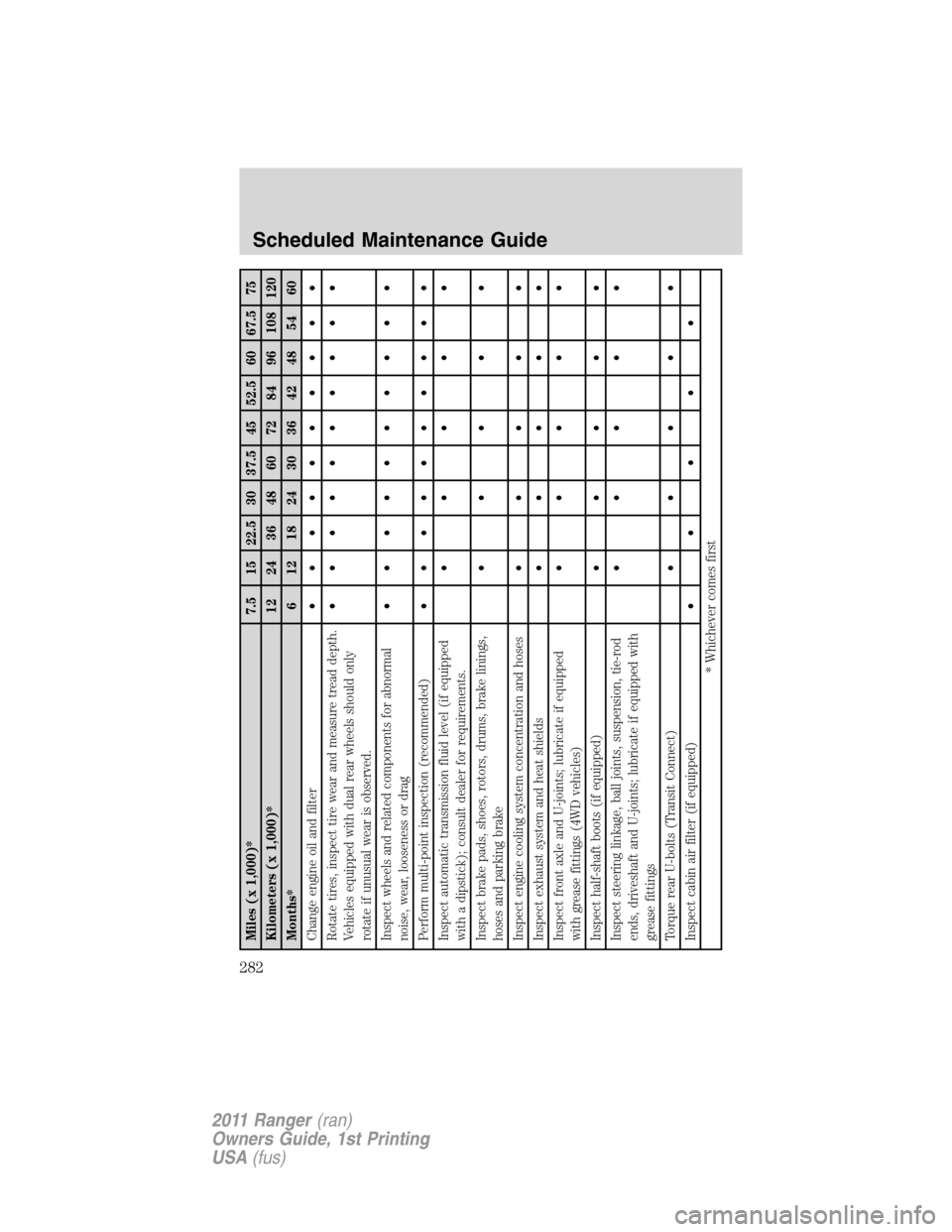
Miles (x 1,000)* 7.5 15 22.5 30 37.5 45 52.5 60 67.5 75
Kilometers (x 1,000)* 12 24 36 48 60 72 84 96 108 120
Months* 6 12 18 24 30 36 42 48 54 60
Change engine oil and filter• •••••••••
Rotate tires, inspect tire wear and measure tread depth.
Vehicles equipped with dual rear wheels should only
rotate if unusual wear is observed.• •••••••••
Inspect wheels and related components for abnormal
noise, wear, looseness or drag• •••••••••
Perform multi-point inspection (recommended)• •••••••••
Inspect automatic transmission fluid level (if equipped
with a dipstick); consult dealer for requirements.•••••
Inspect brake pads, shoes, rotors, drums, brake linings,
hoses and parking brake•••••
Inspect engine cooling system concentration and hoses•••••
Inspect exhaust system and heat shields•••••
Inspect front axle and U-joints; lubricate if equipped
with grease fittings (4WD vehicles)•••••
Inspect half-shaft boots (if equipped)•••••
Inspect steering linkage, ball joints, suspension, tie-rod
ends, driveshaft and U-joints; lubricate if equipped with
grease fittings•••••
Torque rear U-bolts (Transit Connect)•••••
Inspect cabin air filter (if equipped)•••••
* Whichever comes first
Scheduled Maintenance Guide
282
2011 Ranger(ran)
Owners Guide, 1st Printing
USA(fus)